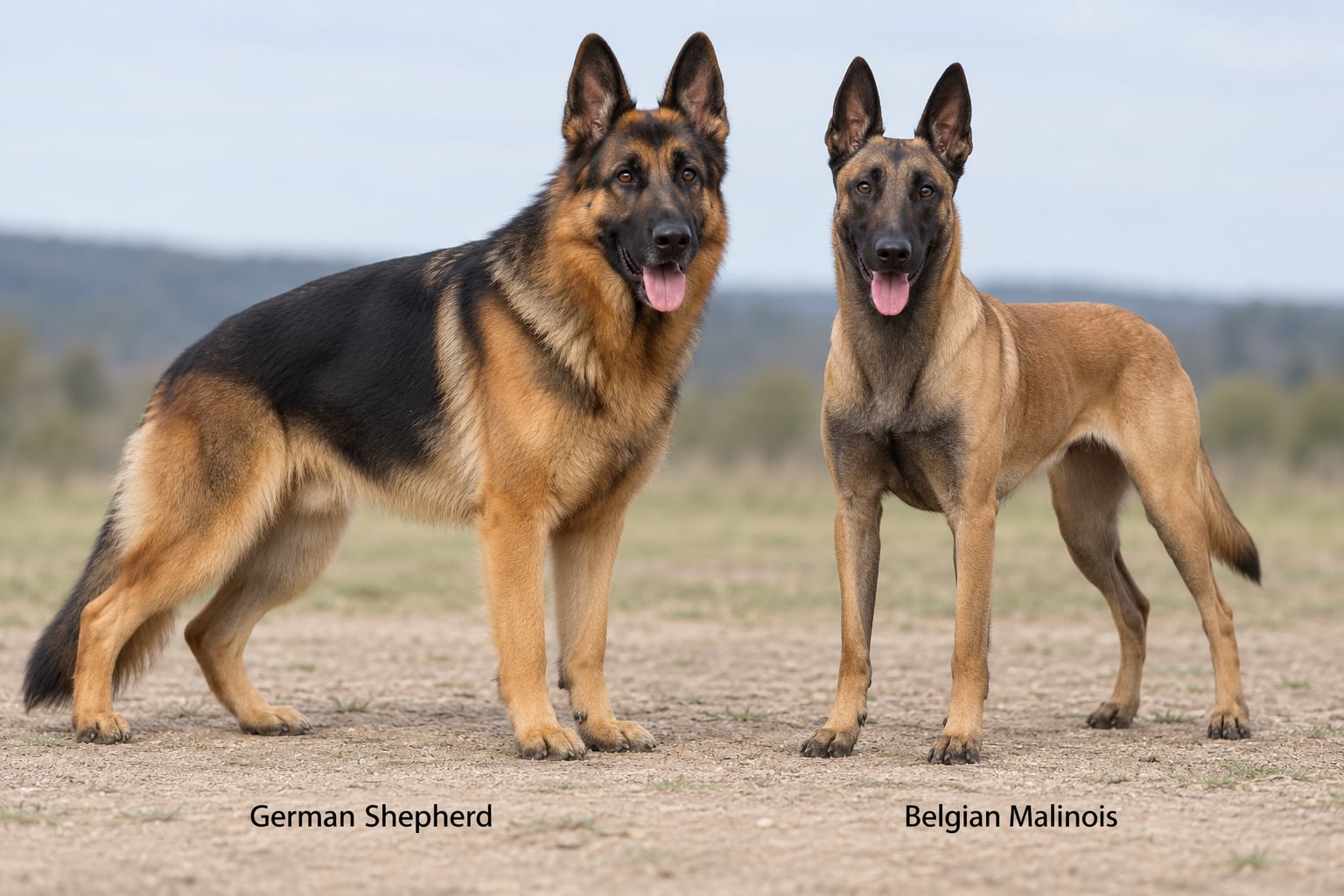
The German Shepherd is the bigger, heavier and calmer of the two; the Belgian Malinois is leaner, faster and much higher in drive. The german shepherd vs belgian malinois differences that actually change your daily life are size, exercise needs and temperament, not coat color or ear shape. Individual dogs vary more than breed averages suggest, so read this as a starting point rather than a guarantee.
Table of Contents
- German Shepherd vs Belgian Malinois Differences at a Glance
- How Do German Shepherds and Belgian Malinois Look Different?
- What Are the Differences in Temperament and Training Needs?
- German Shepherd vs Belgian Malinois Differences in Exercise and Work
- Which Breed Is Easier to Train?
- How the german shepherd vs belgian malinois differences show up during training
- How Do Grooming and Shedding Compare?
- What Health Problems Should Owners Know About?
- Are They Good With Children and Other Pets?
- Which Should You Choose?
- Frequently Asked Questions
- Is a Belgian Malinois more aggressive than a German Shepherd?
- Are German Shepherds better family dogs than Belgian Malinois?
- Can a German Shepherd and Belgian Malinois live together?
- How much exercise does a Belgian Malinois need compared with a German Shepherd?
- Which breed is better for first-time dog owners?
- Conclusion
German Shepherd vs Belgian Malinois Differences at a Glance
| Category | German Shepherd | Belgian Malinois |
|---|---|---|
| Height at withers | 22-26 inches | 24-26 inches |
| Weight (male) | About 65-90 lb | About 40-80 lb |
| Weight (female) | About 50-70 lb | About 40-60 lb |
| Build | Longer body, sloping topline | Square, level topline, narrow |
| Coat | Dense double coat, thick ruff | Short, close double coat |
| Typical colors | Black and tan, sable, all black, white markings | Solid or lightly marked fawn with a black mask |
| Energy and drive | High, with a lower ceiling | Very high, work-focused |
| Off switch at home | Often present | Less reliable, trainable |
| Training | Quick to learn, tolerant of handler error | Very quick to learn, less margin for error |
| Daily exercise | 45-75 min physical plus 20-45 min mental | 60-90 min physical plus 30-60 min mental |
| Protective instinct | Situational, more settled with family | Alert and handler-focused |
| Grooming | Heavy shedding, frequent brushing | Light shedding, quick weekly brushing |
| Typical lifespan | About 9-13 years | About 10-14 years |
| Health watch items | Hips, elbows, degenerative myelopathy, bloat, cancer risk | Hips, elbows, bloat, eye and dental issues |
| Best suited to | Families, first-time large-breed owners, multi-dog homes | Experienced handlers, sport and working homes |
One note on the numbers: breed standards set a range, and a healthy dog can sit at either end of it. A working-line German Shepherd from a serious breeder can weigh far more than a hobby-line one, and a Malinois raised for sport is usually lighter than one raised for companionship.
How Do German Shepherds and Belgian Malinois Look Different?
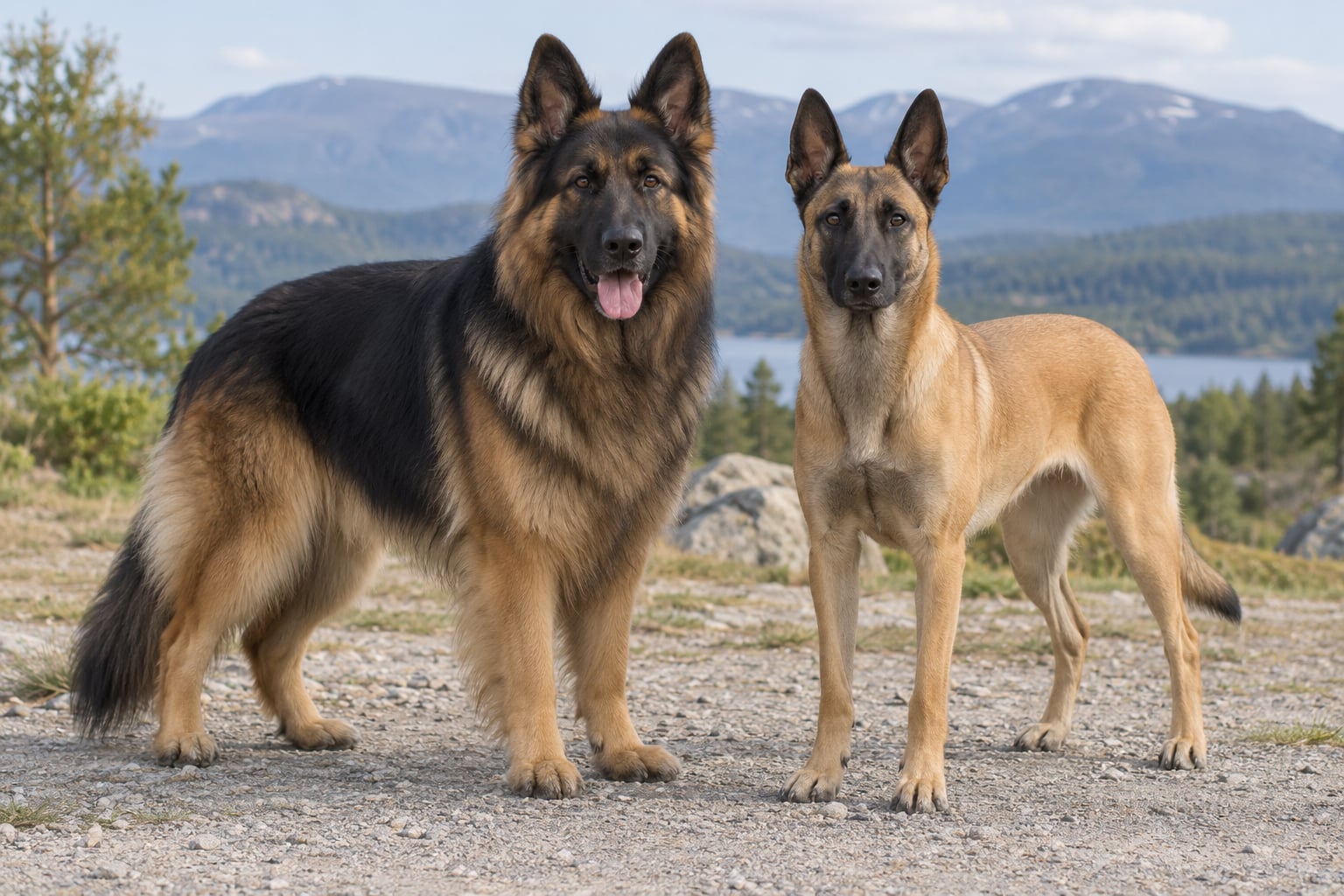
Both are erect-eared herding dogs, which is why shelters and the public mix them up so often. The fastest visual tell is the topline. German Shepherds are longer than they are tall, with a back that slopes gently downward toward the tail. Malinois are square, with a level back and a body that looks built for endurance rather than power.
Belgian Malinois are also narrower through the chest and lighter in the bone, which is why they look so lean beside a German Shepherd. Their short, close coat sits flat over the body and comes in fawn, cream to fawn with a strong black overlay, or fawn with a black mask. A long-haired Malinois also exists, and it is the exception that confuses people most.
German Shepherd colors are wider: black and tan, black with red or tan markings, sable, pure black, and black with white or silver. Working-line German Shepherds lean toward black and tan or sable. German Shepherd puppies are born with their eyes open and floppy ears, as Malinois pups are, and both breeds erect their ears between roughly eight and twelve weeks.
Head shape separates them too. The German Shepherd has a longer, wedge-shaped muzzle and a more pronounced stop, with medium-sized ears carried high. The Malinois tends to have a finer, more refined head with a black mask that frames the muzzle.
If you genuinely cannot tell what you have, do not guess from a photo. Pedigree papers, a DNA test or a scan of the microchip tell you in a week what a coat comparison cannot.
What Are the Differences in Temperament and Training Needs?
Temperament is the biggest practical difference. A typical German Shepherd is alert, loyal and comfortable settling into a household. A typical Malinois is alert, intense and much more likely to want a job every hour of the day. Owners describe the Malinois as “a German Shepherd on speed,” and that is about right.
Drive is the useful word here. Drive is the motivation to work, and it splits into two parts. Prey drive is the chase and shake response toward moving things, which Malinois tend to express more strongly. Reward drive is the motivation to please a handler, which both breeds show heavily. The Malinois pairs high prey drive with high reward drive, which is exactly why the breed excels at sport and detection work.
Neither breed is inherently aggressive. What varies is socialization, training consistency and how much work the dog gets. A Malinois that never meets unfamiliar people or other dogs may become distant or reactive, and the same is true of a German Shepherd. Early, positive exposure matters more for both breeds than the breed label does.
Sociability with family is another split point. German Shepherds are usually more relaxed in a busy house and more willing to lie on the sofa. Many Malinois bond hard to one handler and are less interested in being a everyone’s dog. That focus is a virtue in a working career and a nuisance in a household with lots of visitors.
Do Malinois turn on their owners? The honest answer is that any dog with high arousal, poor structure training or a shaky bond can bite the person it loves most, and Malinois owners do sometimes report that. Most of those cases trace back to skipped training, suppressed exercise or a household that treated the dog as a pet only.
German Shepherd vs Belgian Malinois Differences in Exercise and Work
The exercise gap is the single most reliable practical difference between these breeds. A German Shepherd usually manages well with 45-75 minutes of physical activity plus 20-45 minutes of mental work. A Malinois needs roughly 60-90 minutes of physical activity plus 30-60 minutes of mental work, and the mental part is what most owners underestimate.
For a German Shepherd, long walks, a daily sniff walk, fetch and basic obedience usually keep the house peaceful. For a Malinois, that is a warm-up. Structured sport, scent work, tracking, agility or protection work with a qualified trainer fills the gap. Without it, the difference shows up as chewed doors, digging, barking and a dog who cannot settle.
Both breeds end up in shelters for the same underlying reason: owners picked a working dog and then gave it a pet-dog life. If you want either breed and cannot commit to daily structure, pick a different breed honestly rather than hoping the puppy calms down. Owners on German Shepherd and Belgian Malinois forums say this constantly, and they are not exaggerating.
There is a nuance worth knowing. Working-line German Shepherds can range from a serious worker with a good off switch to a dog with the same crackhead energy as a Malinois. Ask the breeder what the parents actually do, and ask to meet them.
Climate matters less than most people expect, though there is a small difference. The German Shepherd carries more coat and handles cold better. The short-coated Malinois copes a bit better with heat, so shade, water and avoiding midday exercise in summer are non-negotiable for both.
Which Breed Is Easier to Train?
The Belgian Malinois learns faster than the German Shepherd. It picks up scent work, tracking, obedience and protection tasks in fewer repetitions, and it stays sharper for longer in a training session. The German Shepherd still learns quickly, and it is more forgiving when a handler makes a mistake.
How the german shepherd vs belgian malinois differences show up during training
In a training session, the Malinois offers more intensity and less margin for error. The breed will press hard on whatever you reward, so sloppy timing gets reinforced fast. German Shepherd owners often describe the dog as “working hard to please you,” while Malinois owners describe a dog that works even harder and needs a clearer plan.
Tasks each breed commonly excels at are worth separating. Malinois lean toward detection, tracking, bite work in sport contexts, and fast obedience. German Shepherds excel at broad work: search and rescue, scent detection, service roles, therapy work, tracking, and sports from Schutzhund and IPO to agility and nosework.
Both need reward-based training done daily from day one. Neither responds well to heavy-handed methods. A first-time owner with no large-breed experience is better served by the German Shepherd, because that breed tolerates learning curves that would overwhelm a Malinois.
How Do Grooming and Shedding Compare?
The Malinois is the easier dog to groom. Its short, close double coat needs a weekly brush-through, a bath every few months and regular nail trims. It sheds moderately all year and more heavily when the coat changes, but it never turns into a fur storm.
The German Shepherd sheds heavily. Plan on brushing two or three times a week year-round and daily during the seasonal coat blow, and expect fur on everything you own. Its dense ruff and heavier feathering behind the ears and legs trap mats if you skip sessions. Baths with a dog-safe shampoo keep the undercoat from matting behind the ears.
Both carry the breed’s double coat, which means shed hair is normal rather than a sign of illness. Flea treatment and a consistent brushing schedule cut most of what ends up on your couch.
What Health Problems Should Owners Know About?
Both breeds carry elevated joint risk, so hips and elbows are the first screening priority. Hip and elbow dysplasia appear in both, and a breeder who will not share hip and elbow results should be passed over. Degenerative myelopathy, a spinal cord condition that usually shows as hind-end weakness and scuffing, is a concern particularly common in German Shepherds.
Bloat, or gastric dilatation-volvulus, is a risk in both breeds and can be life-threatening. Know the warning signs: a swollen, hard abdomen, unproductive retching, drooling, restlessness and distress after eating. Emergency veterinary care is the only response, and your vet should talk you through feeding schedules and portion sizes.
German Shepherds also show higher rates of heart and blood-vessel disease, including hemangiosarcoma, and a higher cancer rate overall. Malinois owners should watch for eye and dental problems and check the hips carefully given how athletic the breed is. Any dog of either breed on joint supplements should start with a veterinary recommendation, not a neighbor’s advice.
A veterinarian should assess your individual dog’s risk, symptoms, nutrition and preventive care plan. Nothing in this section replaces a hands-on exam, and breed averages do not predict what will happen to your dog.
Are They Good With Children and Other Pets?
German Shepherds are generally the more forgiving option for a busy family. Many are gentle with children and tolerant of other dogs, though still watchful and vocal with strangers. Supervision with toddlers is still required, because a 70-pound dog can knock over a small child even while being gentle.
Malinois can be wonderful family dogs, but they take more management. Many are enthusiastic with children once properly socialized, and the breed is often described as a great dog for active families. The catch is the same one that shows up everywhere else: high prey drive makes introductions to cats, small dogs and livestock tricky, and dog-to-dog introductions sometimes end in a fight.
Cat and small-pet households should weigh the risk carefully. A household that has never run a drive dog should speak to a qualified trainer before bringing one home. The Swiss White Shepherd is a calmer relative, and plenty of families that love herding dogs choose one of those instead.
Which Should You Choose?
Choose the German Shepherd if you want a visibly substantial companion, if you are a first-time large-breed owner, or if your household needs a dog that is comfortable around visitors and other animals. Most families searching for a companion dog with a protective streak land here.
Choose the Belgian Malinois if you are an experienced handler who wants a dog with a very high ceiling for work. If you plan to enter a working sport, run tracking or scent detection, or train for personal protection with a professional, the Malinois gives you a dog that will suit that job. Bring commitment to 90-plus minutes of daily structured exercise and a secure yard.
Before either, write down the honest answer to three questions: how much exercise time do I have every day, who trains the dog, and who is the primary handler? Then check with your vet about local health and veterinary guidance, and decide between adoption and a reputable breeder. Breeders who test hips, elbows and eyes, and who let you meet the mother and see the litter, are the baseline.
Frequently Asked Questions
Is a Belgian Malinois more aggressive than a German Shepherd?
No breed is inherently aggressive, and the difference is smaller than reputation suggests. Aggression in either dog usually traces to lack of socialization, inconsistent training or a family that took on a working dog without the time to work it. Belgian Malinois carry more prey drive, so unsocialized dogs can react harder to unfamiliar animals.
Are German Shepherds better family dogs than Belgian Malinois?
Usually, yes for a typical household. German Shepherds are larger and calmer, often settle in with family and tolerate other dogs and visitors more easily. A Belgian Malinois can be an excellent family dog for active, experienced owners, but it needs more structure, more socialization and far more daily exercise to stay balanced around kids and guests.
Can a German Shepherd and Belgian Malinois live together?
It can work, but it is not an easy pairing. Both breeds have strong social drives and either can become dominant, reactive or stressed in a two-dog household. Introduce them slowly on neutral ground, keep separate feeding and resting areas, and get a qualified trainer involved before the first week ends. Same-sex pairs are usually the hardest.
How much exercise does a Belgian Malinois need compared with a German Shepherd?
Plan roughly 60-90 minutes of physical activity plus 30-60 minutes of mental work for a Malinois, against about 45-75 minutes plus 20-45 minutes for a German Shepherd. The mental portion matters as much as the miles: scent games, tracking, agility and puzzle work are what stop a high-drive dog from becoming destructive at home.
Which breed is better for first-time dog owners?
The German Shepherd is the more forgiving choice, largely because it is more tolerant of handler mistakes and settles more easily between walks. It is still a large, working breed that needs training from day one. The Belgian Malinois suits experienced handlers with time for sport training, structured exercise and consistent boundaries from the first week.
Conclusion
Start by comparing three numbers and one commitment: the exercise hours you can genuinely give every day, your training experience, the size your household can manage, and the time you will invest after the first year when the novelty is gone. The german shepherd vs belgian malinois differences that matter most come down to drive and handling, not appearance. If those numbers point to a calmer, heavier dog, choose the German Shepherd. If they point to serious handler experience and real structured work, the Belgian Malinois will give you more. Then get a healthy, well-socialized dog from a reputable breeder or rescue, and check joint, eye and spinal screening records before you pay a deposit.