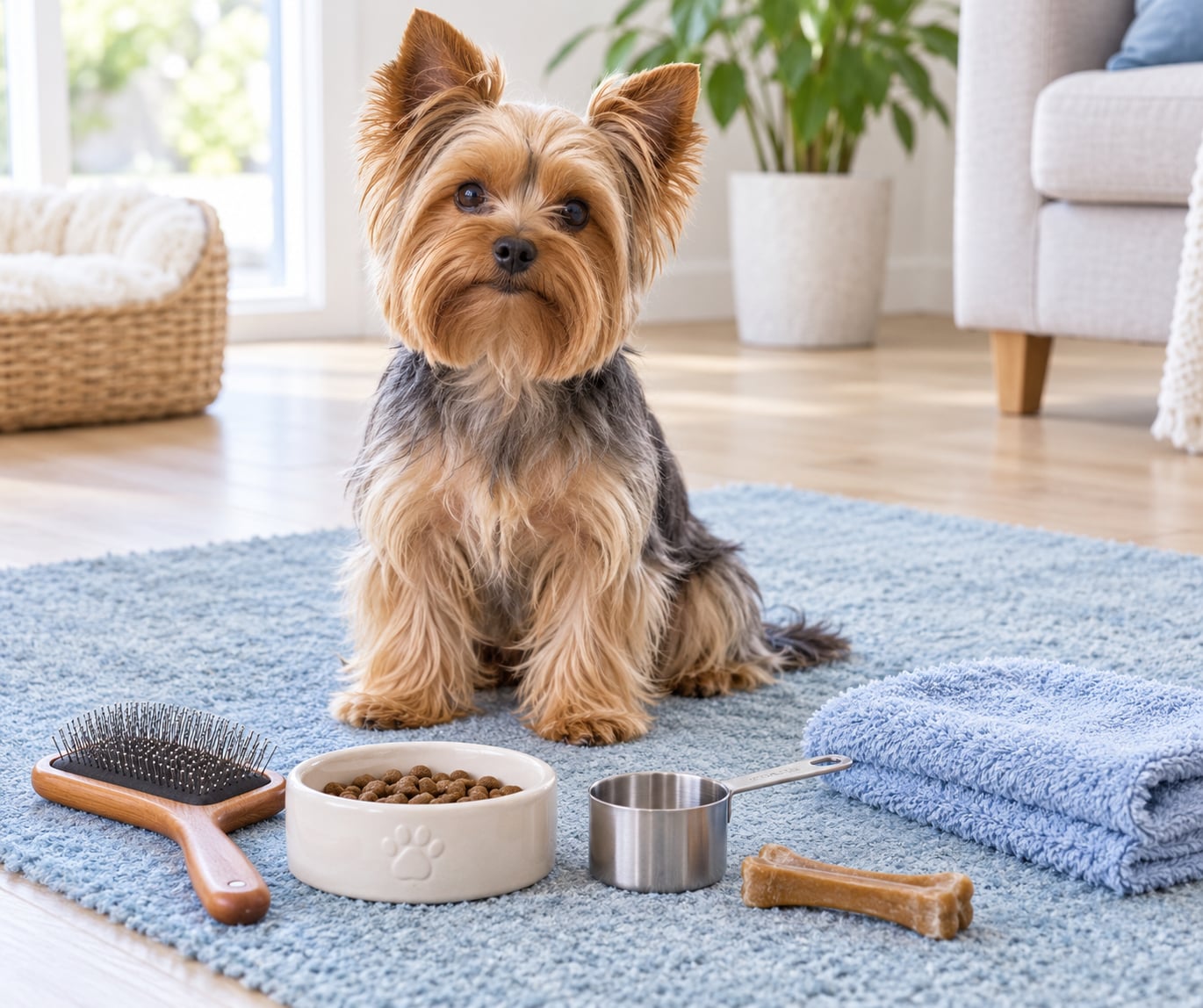
Yorkshire Terrier care and health basics come down to a handful of daily habits that are easy to keep and expensive to skip: measured meals, a brushed coat, brushed teeth, a short daily walk, and regular vet visits. Yorkies are small, but they are working terriers with a growing single coat, a crowded mouth and a narrow windpipe, so their needs are more specific than their size suggests. Most owners manage this comfortably in 30 to 45 minutes a day once the routine is established.
Are Yorkies difficult to take care of? Moderately high maintenance, mostly because of the coat and the teeth rather than exercise. Everything else on this page is straightforward once you know what to watch for.
Table of Contents
- What Yorkshire Terrier Care and Health Basics Include
- How to Feed a Yorkshire Terrier
- Foods to keep out of reach
- How to Groom a Yorkshire Terrier
- A home grooming routine that works
- Haircuts and finding a groomer
- Calming a Yorkie who panics at the brush
- Exercise, Play, and Mental Stimulation
- Keeping exercise safe
- Dental Care and Everyday Health Checks
- A two-minute home check, once a week
- Common Yorkshire Terrier Health Problems and Their Warning Signs
- When to Contact a Veterinarian
- A Simple Daily Care Routine
- What changes by life stage
- Frequently Asked Questions
- How often should a Yorkshire Terrier be brushed?
- What food is best for a Yorkshire Terrier?
- How much exercise does a Yorkshire Terrier need each day?
- What are common signs that my Yorkshire Terrier may be unwell?
- Can I give human medication to my Yorkshire Terrier?
- How often should a Yorkshire Terrier visit the veterinarian?
- Conclusion
What Yorkshire Terrier Care and Health Basics Include
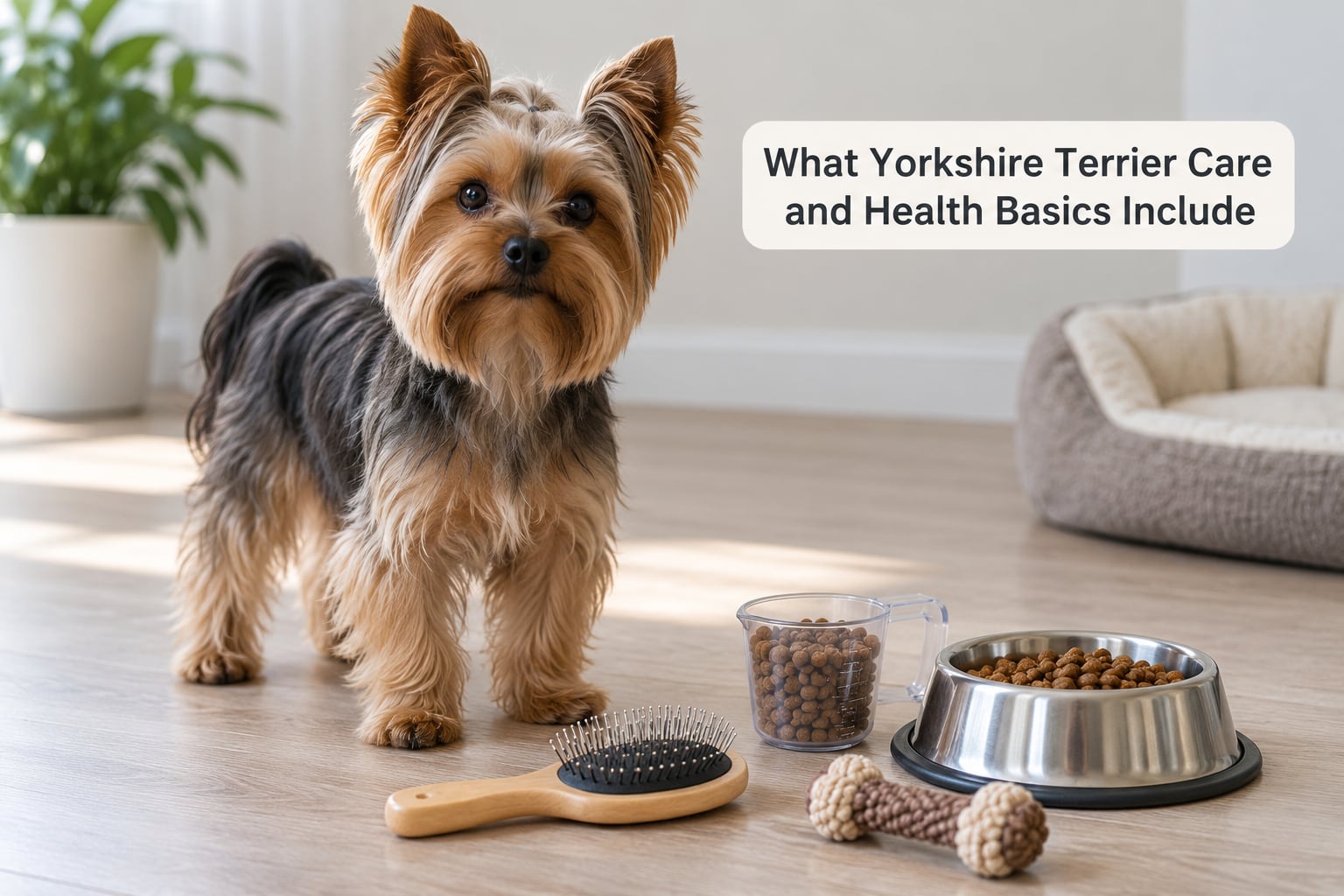
A Yorkie’s daily care splits into eight jobs. Feed measured meals twice a day, brush the coat daily, brush the teeth most days, walk and play, run a two-minute home health check, keep parasites under control with veterinary guidance, handle the dog safely given its low centre of gravity, and book preventive checkups.
The breed standard size is roughly 15 to 23 cm at the shoulder and 2 to 3.2 kg, and most Yorkies live around 13 to 16 years. Those numbers matter because everything else in this guide scales from them: a Yorkie’s entire daily food intake is a small fraction of an adult human meal, so treats add up fast.
| Yorkshire Terrier quick facts | Typical range |
|---|---|
| Height at shoulder | 15 to 23 cm |
| Weight | 2 to 3.2 kg |
| Lifespan | 13 to 16 years |
| Coat | Single coat of hair, blue and tan, grows continuously |
| Shedding | Low, because hair does not fall seasonally like fur |
| Daily walk | 20 to 30 minutes for an adult, split if you like |
| Brushing | Every day; more often during a coat change |
| Meals | Two measured meals a day for adults |
| Watch closely | Teeth, knees, windpipe, blood sugar in small puppies |
Two misconceptions cause trouble more often than anything else in the breed. The first is that a Yorkie is a fragile lap dog. They are scrappy, bold and energetic, and treat them as such. The second is that a small dog needs little exercise. Toy-sized dogs still need daily activity and mental work, mostly in short sessions.
How to Feed a Yorkshire Terrier
Feed a complete and balanced commercial dog food, ideally one made for small breeds, with the kibble sized for a toy dog. Read the label’s feeding guide, then adjust based on your dog’s body condition. Your vet can teach you to feel for ribs and waist, because a Yorkie can carry extra weight without looking obviously round.
For puppies, feed three to four small meals a day on a puppy formula until roughly six months, then move to two meals. Very small puppies have limited blood sugar reserves, so frequent meals help; a wobbly, weak or unusually sleepy puppy that skips a meal deserves a vet call the same day rather than a wait.
Measure portions with a proper measuring cup or a kitchen scale. Free-feeding from a bowl left on the floor is the fastest route to an overweight Yorkie, and excess weight puts extra load on patellas that are already prone to slipping.
Treats should stay under about 10 percent of daily calories. Use small pieces of training treats rather than table scraps, and count them alongside the meals.
Foods to keep out of reach
- Chocolate, coffee and anything with caffeine
- Xylitol, found in sugar-free gum, some peanut butters and baked goods
- Grapes, raisins and currants
- Onions, garlic and chives, in any form including powders and broths
- Fatty scraps, cooked bones and fatty human foods
- Raw dough containing yeast
- Alcohol and sugary drinks
If your dog eats something on that list, contact a veterinarian or an animal emergency service straight away and mention the substance and the approximate amount. Do not wait for symptoms, and do not induce vomiting unless a vet tells you to.
How to Groom a Yorkshire Terrier
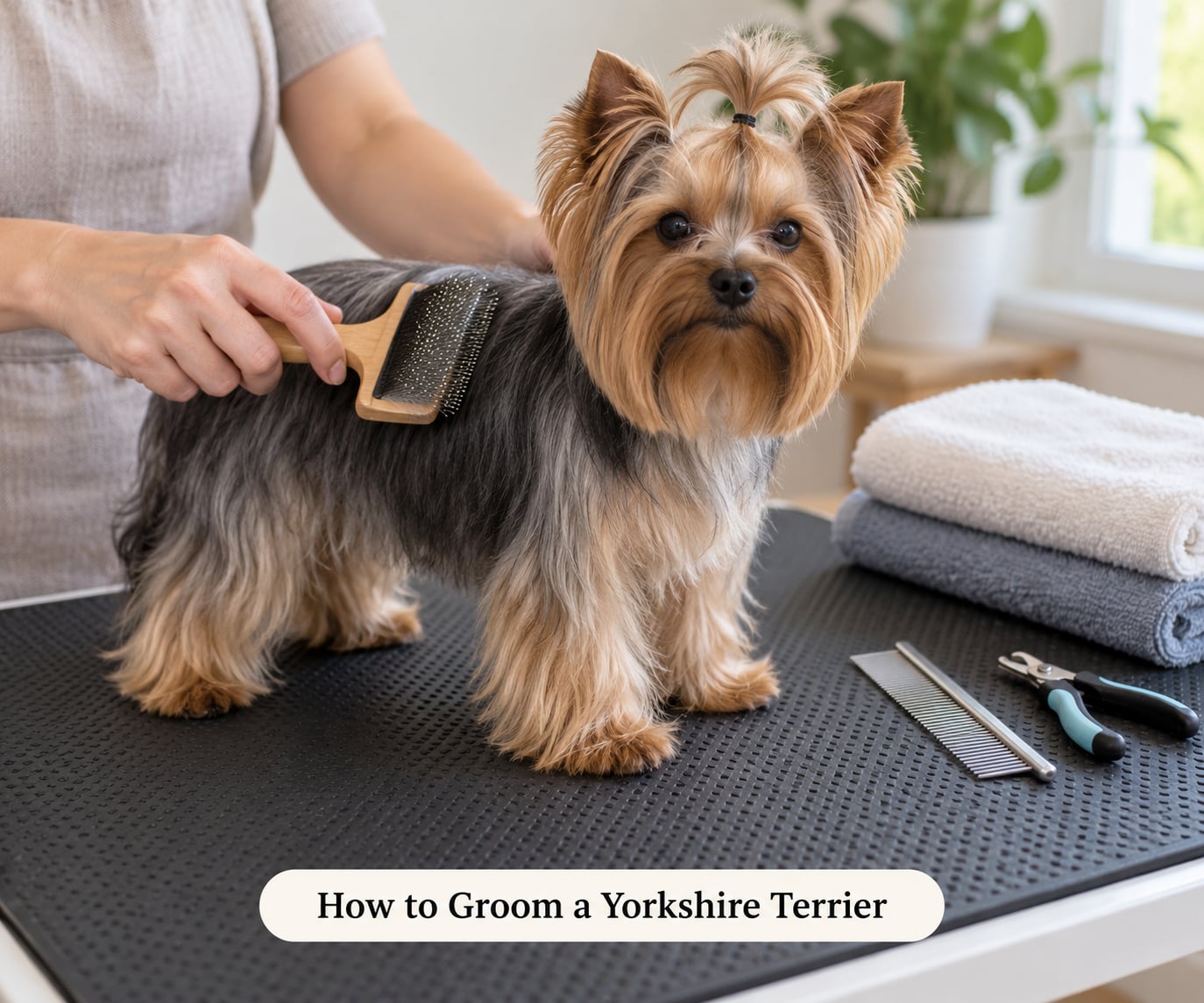
The coat is hair rather than fur, it never fully sheds, and it grows continuously. Skip a day or two and tangles start at the armpits, behind the ears and around the collar. Matted hair has to be cut out, and that hurts.
A home grooming routine that works
- Brush every day. A pin brush or slicker brush over the full coat, then a metal comb to check for tangles. Work in small sections from the skin outward, and treat the armpits and ear bases first.
- Bathe when dirty, not on a schedule. Use a dog shampoo, rinse thoroughly, and dry fully. A damp coat that is left to air dry mats at the ends.
- Trim nails every two to three weeks. Get a grip on the quick early, in good light. Ask your vet or groomer to show you where it sits so you can do it at home.
- Clean the ears gently. A damp cloth for the outside is usually enough; never push swabs or drops into the canal without veterinary direction.
- Wipe tear staining. A clean damp cloth or a plain tear-free wipe, a couple of times a week, keeps the hair under the eyes from staining yellow.
- Get a trim every 6 to 10 weeks. Consistent short trims are far easier to maintain than a long grown-out coat.
Haircuts and finding a groomer
The puppy cut, where the coat is scissored to about an inch so it looks like a puppy, is the lowest-maintenance option and the easiest to brush between visits. A shorter clip is faster still. Keep a photo of the length you want rather than describing it, since that advice comes up constantly from Yorkie owners who got a choppy result.
Before booking anyone, ask whether they routinely groom Yorkie coats, look at recent work on dogs of this coat type, and tell them you prefer texturing shears to thinning shears, which is what causes moth-eaten patches. A full groom on a small dog usually takes one to two hours; ask for the time in advance.
Calming a Yorkie who panics at the brush
Desensitise slowly and in small steps, in this order: touch and praise with no tools, then a brush touching the shoulder for one second, then a few strokes, then a short session with a high-value treat. Repeat before moving to clippers or a dryer. Start puppies with a bath and a comb rather than a full haircut, so grooming builds over weeks instead of turning into a fight.
Exercise, Play, and Mental Stimulation
An adult Yorkie needs roughly 20 to 30 minutes of walking per day, plus indoor play, and the amount changes with age. Puppies do better with several short outings than one long one. Senior dogs still want to go out, just more briefly and on flatter ground.
Indoor play counts: tossing a soft toy down a hallway, a snuffle mat with treats hidden in it, a slow-feeder puzzle, and short training sessions all tire a small dog more than a walk does. Two five-minute training blocks through the day are easy to fit into a normal schedule.
Use positive reinforcement. Yorkies learn quickly and are sensitive to tone, so a raised voice sets back training for days.
Keeping exercise safe
- Use a harness rather than a collar for walks and lifting, which reduces pressure on a narrow trachea.
- Avoid rough play with much larger dogs. One bad moment can mean a serious injury to a dog this light.
- Block access to high furniture and stairs, or add pet steps. Falls from couches are a common Yorkie injury.
- On hot pavement, test with the back of your hand for seven seconds before setting their paws down. Small dogs burn paw pads easily.
- Keep a coat or sweater in winter, and dry wet ears after outdoor walks in cold weather.
Dental Care and Everyday Health Checks
Dental disease is the most common and most preventable problem in small breeds. A Yorkie’s mouth is crowded, teeth sit close together, and plaque turns into gingivitis and then periodontal disease faster than in larger dogs. Bad breath, red or bleeding gums, and chewing on one side are signs worth acting on.
Brush the teeth with a dog-specific toothpaste and a small angled brush. Most dogs accept this after a week or two of short sessions, and a smear of paste on the finger works for the first attempts. Veterinary dentistry products and chews help between brushings, but they do not replace brushing or professional assessment.
A two-minute home check, once a week
- Eyes: clear, open, and even. Squinting, cloudiness, discharge or a suddenly different-sized eye is a same-day call.
- Ears: inside is pale and clean, smells neutral. Dark build-up, head shaking or a strong odour needs a vet.
- Mouth: pink gums, clean teeth, comfortable chewing.
- Nose and skin: no crusts, lumps, flaking or a new strong smell.
- Paws: check pads for cuts and grit, and nails for overgrowth.
- Movement: watch him walk and trot on a flat floor. A back-leg skip or a brief backward hop is worth mentioning at the next appointment, or sooner if it becomes frequent.
- Body condition: ribs easy to feel, a visible waist when viewed from above.
Your baseline matters here. Knowing what normal eyes, gums, stool and movement look like for your dog is what makes a change obvious later.
Common Yorkshire Terrier Health Problems and Their Warning Signs
Do Yorkshire Terriers have a lot of health issues? They are prone to a specific set of conditions rather than being unusually fragile. Most are manageable with early veterinary attention, and several are influenced by breeding choices, so ask about the health testing history of any breeder or rescue you work with.
| Condition | Often seen at | Warning signs | What to do |
|---|---|---|---|
| Periodontal disease | Any age, worsening with age | Bad breath, red or bleeding gums, broken or loose teeth, eating on one side | Start daily brushing, book a dental assessment |
| Patellar luxation | Puppies and young adults | Intermittent skip or backward hop in a back leg, crouching rear, yelping when the knee is touched | Note when it happens, have your vet examine the knee |
| Tracheal collapse | Middle age and older | A dry honking or goose-flesh cough that comes in fits, worse when excited or pulled by the collar | Switch to a harness, avoid neck pressure, book an appointment |
| Low blood sugar | Very small puppies and teacup-sized dogs | Wobbly, shaking, weak, unusually sleepy, glazed eyes, no interest in food | Offer food immediately and call a veterinarian promptly |
| Portosystemic liver shunt | Usually under 2 years old | Poor growth, vomiting after meals, very sleepy after eating, pale or yellow gums | Vet visit with blood tests; do not wait for more signs |
| Skin allergies and hair loss | Young to middle age | Itchy feet and face, bald patches along the back, recurring skin infections | Book an exam rather than trying food or creams yourself |
| Eye injury or ulcer | Any age | Sudden squinting, tearing, redness, rubbing at the face | Same-day veterinary call, and stop walks until then |
| Syringomyelia | Adults, more often with skull shape or family history | Pain when the neck or back is touched, yelping unexpectedly, odd posture or gait changes | Vet examination if the behaviour is new |
Senior Yorkies commonly show kidney changes, heart disease or cognitive change, and owners report these appearing somewhere in the 13-to-16-year range. Weight loss, more water drinking, a cough at rest, or confusion after dark deserve an appointment rather than an assumption that the dog is simply old.
What is the leading cause of death in Yorkshire Terriers? Across breed references, the answer that comes up most often is dental disease or complications related to it, which is also why the tooth section of this guide is longer than most guides make it.
When to Contact a Veterinarian
Some situations are emergencies. Call straight away, or go in, if you see:
- Difficulty breathing, blue or grey gums, or collapse
- A seizure, or sudden unresponsiveness
- A suspected toxin or foreign body swallowed, including chocolate, grapes, xylitol, or an object stuck in the throat
- Bleeding that does not stop, or blood in vomit or stool
- A swollen abdomen, retching without producing anything, or a visibly injured or protruding eye
- Repeated vomiting or diarrhoea, or refusal to eat or drink for a day
- Sudden weakness, an inability to stand, or an inability to move a limb
Book an appointment soon rather than urgently if you notice:
- Bad breath, red gums, or reluctance to eat hard food
- A cough that has appeared over weeks, especially if it happens when excited
- A back leg that skips or hops intermittently
- Persistent itching, bald patches or recurring skin odour
- Markedly increased thirst or weight loss
- A behaviour change, such as new anxiety or confusion
- Nails that have become curved and are catching on the floor
One rule covers a lot of ground: never give a Yorkshire Terrier human medication unless your veterinarian specifically directs it, with the exact product and dose. Common painkillers, anti-inflammatory drugs and cold and cough remedies are seriously dangerous to dogs, and tablets intended for a human adult are far too large for a 3 kg dog.
A Simple Daily Care Routine
This is the version I would put on the fridge:
- Morning: take him out to relieve himself, check eyes and ears, give the first measured meal, brush the coat, brush the teeth.
- Midday: two or three 5-minute training sessions, a short walk if the weather suits, fresh water topped up.
- Afternoon: puzzle feeder or snuffle mat, second measured meal, a few minutes of training.
- Evening: 20 to 30 minute walk in total for the day, quick coat check, second tooth brushing, paw check, fresh water, settle with a chew.
- Weekly: the two-minute head-to-tail health check, a nail look, and an ear wipe with a damp cloth.
What changes by life stage
| Stage | Feeding | Activity | Grooming | Veterinary care |
|---|---|---|---|---|
| Puppy (to 12 months) | 3 to 4 small meals, puppy formula | Short walks, frequent toilet breaks, socialisation classes | Brush daily, bath and comb only, no haircuts yet | Vaccination and puppy schedule as your vet sets it |
| Adult (1 to 7 years) | 2 measured meals, treat under 10 percent | 20 to 30 minutes walking plus indoor play and training | Daily brushing, trim every 6 to 10 weeks | Yearly checkups with dental assessment |
| Senior (7 years and older) | 2 meals, adjust with veterinary guidance | Shorter, flatter walks, more indoor play | Daily brushing, nails every 3 weeks or so | Checkups every 6 months, bloodwork as advised |
| Recovering from illness or surgery | Whatever your vet prescribes | As permitted, usually short lead toilet walks | Gentle, no bathing unless cleared | Follow the full discharge plan |
Frequently Asked Questions
How often should a Yorkshire Terrier be brushed?
Every day if you can manage it, because the coat is a single layer of hair that grows continuously and never fully sheds. Tangles form first behind the ears, in the armpits and under the collar, and those areas need a separate pass each time. If you miss a day, work through small sections with a metal comb rather than yanking at the coat. Consistent short trims between professional grooms make daily brushing far easier.
What food is best for a Yorkshire Terrier?
Any complete and balanced food, with small-breed kibble sized for a toy dog, measured into two meals a day for adults. Read the label’s feeding guide and then adjust using body condition, since the numbers on the back of the bag are only a starting point. Puppies usually need three to four small meals on a puppy formula. Keep treats under about 10 percent of daily calories, and ask your vet before starting any new food or supplement.
How much exercise does a Yorkshire Terrier need each day?
About 20 to 30 minutes of walking for a healthy adult, plus indoor play and short training sessions. Puppies do better with several short outings than a single long one, and senior dogs need shorter, flatter routes. Because the breed was bred for hunting rather than sitting, mental work matters as much as distance: puzzle feeders, snuffle mats and two five-minute training blocks count toward a good day. Heat and cold both matter, since a 3 kg dog warms and cools quickly.
What are common signs that my Yorkshire Terrier may be unwell?
Watch for changes from his normal baseline: bad breath, red or bleeding gums, a dry coughing fit, a back leg that skips or hops, a wobbly or weak moment, scratching at the face, sudden thirst, or any behaviour that is clearly off. Difficulty breathing, collapse, repeated vomiting, blood in vomit or stool, and suspected poisoning all need a veterinarian immediately rather than a call in the morning.
Can I give human medication to my Yorkshire Terrier?
No, unless your veterinarian specifically tells you to use a named product at a stated dose. Painkillers, anti-inflammatory drugs and cold and cough medicines intended for people are dangerous to dogs, and a single tablet can be a serious overdose for an animal weighing 3 kg. If your dog has swallowed something human, phone a veterinarian or an animal emergency service straight away and do not wait to see what happens.
How often should a Yorkshire Terrier visit the veterinarian?
At least once a year for a healthy adult, including a dental assessment, and every six months from around age seven. Puppies need the vaccination and parasite schedule your vet sets out, with visits spaced a few weeks apart. Any symptom on the red flag list changes that timetable. Booking routine visits is easier on your dog and usually cheaper than dealing with a problem that has been developing for months.
Conclusion
If you do three things well, your Yorkshire Terrier care routine works: keep the coat brushed and trimmed on schedule, keep teeth brushed and food measured, and go to the vet regularly even when nothing seems wrong. Add a daily walk, a few minutes of training, and a weekly two-minute check of eyes, ears, gums and movement, and you are covering most of what this breed needs.
The rest is noticing change early. Yorkshire Terrier health problems are usually far easier to manage in the first weeks, so contact a veterinarian whenever something in this guide sounds familiar, and never give human medication without specific instructions from one. Updated for 2026.