Australian Shepherd temperament is smart, energetic, loyal and unusually people-focused, with a strong herding instinct that shows up as chasing, circling and nipping at heels. The breed learns fast, wants a job, and responds best to reward-based training that redirects that instinct instead of punishing it. Most Aussies also gain an off switch somewhere between 18 and 24 months of age.
That last part is where most first-time owners get blindsided. They adopt a ten-week-old puppy who bounces off the walls, and then somewhere around the eight-month mark the bouncing turns into grabbing, chasing, and a dog who appears to have stopped listening entirely. Nothing is wrong with the dog. This is a herding breed doing exactly what it was built to do, with an adolescent brain attached.
This guide covers what the breed’s temperament actually looks like day to day, how much of it comes from genetics versus how you raise the dog, and the practical training habits that make the difference between an Aussie who herds your kids and one who settles on a mat while you make coffee.
Table of Contents
- Australian Shepherd Temperament: Common Traits and Personality
- The six traits owners notice first
- How Age, Genetics, and Environment Shape Australian Shepherd Behavior
- Lineage makes a measurable difference
- The socialization window is short and unforgiving
- Adolescence arrives around eight months
- Full maturity is later than most people expect
- Basic Training Principles for Australian Shepherd Owners
- Use a marker word or a clicker
- Keep sessions short and end on a win
- Teach one cue at a time in a low distraction
- Be consistent across the household
- Meet the need before you ask for the behavior
- Skip harsh correction
- Training Tips for Australian Shepherd Temperament and Daily Routines
- Name response comes before everything
- Attention on you is the interrupt you’ll use forever
- Wait at doors and on the sidewalk
- Loose-leash walking, with a pattern
- Recall as a verb, not a request
- Settle is the skill people skip
- Proof before you trust
- Common mistakes in australian shepherd training tips
- How to Manage Herding, Barking, and High Energy
- A 20-minute daily herding protocol
- Give the drive somewhere legal to go
- Manage barking by addressing the trigger
- Lower arousal without flooding
- Play sniffing, not chasing, at high arousal
- Socialization, Exercise, and Mental Stimulation
- Socialization during the 3-16 week window
- Exercise minutes by stage
- A 30-minute daily mental routine
- Social exposure should be controlled
- When to Adjust Training or Consult a Professional
- Frequently Asked Questions
- Is an Australian Shepherd easy to train?
- How much exercise does an Australian Shepherd need?
- Why does my Australian Shepherd bark so much?
- Can Australian Shepherds be trained not to herd people or other animals?
- When should puppy training and socialization begin?
- Are Australian Shepherds good with children and other pets?
Australian Shepherd Temperament: Common Traits and Personality
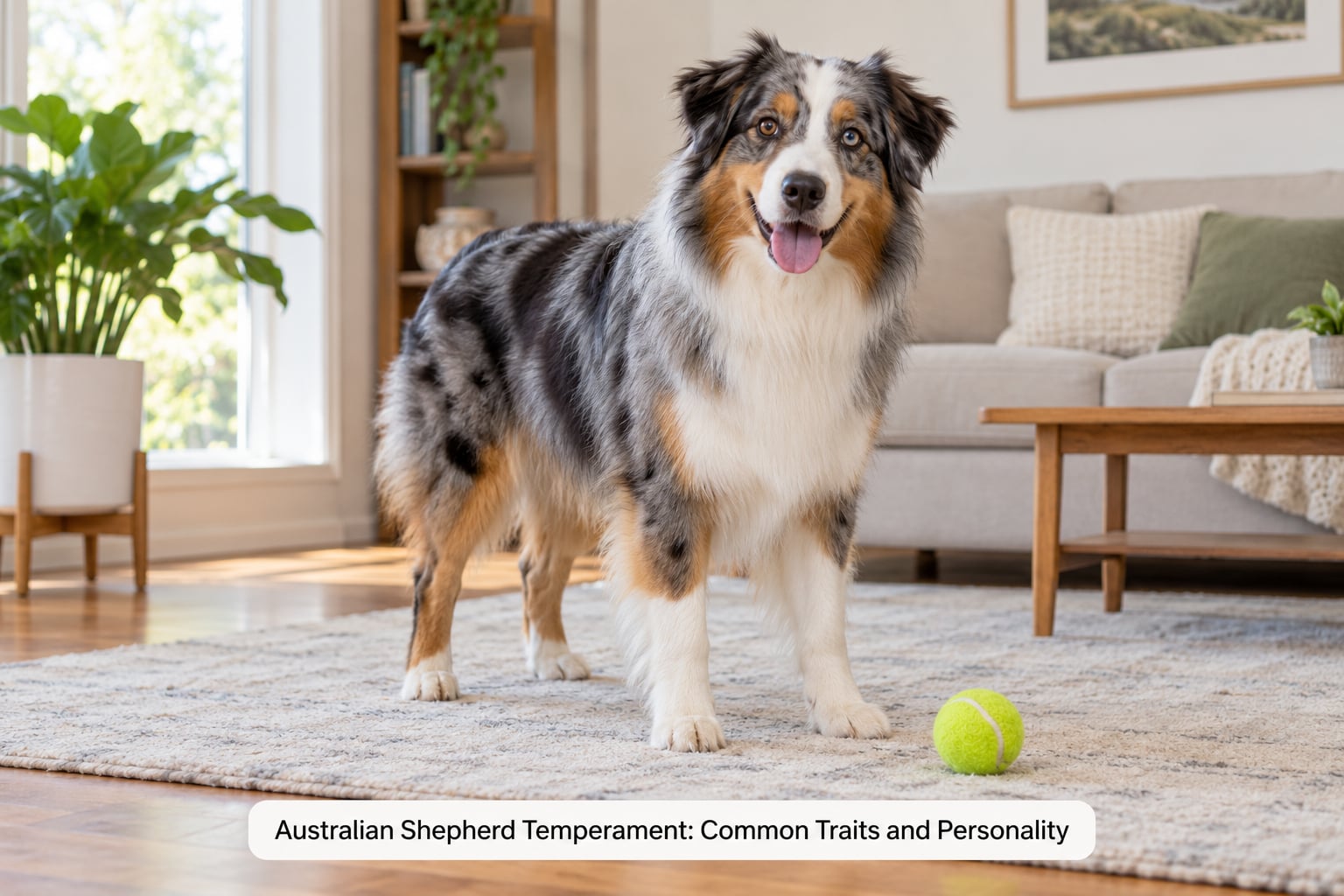
Australian Shepherd temperament combines near-genius problem solving with a working dog’s need for purpose and a companion dog’s need for company. These dogs are energetic to the point of intensity, deeply attached to their people, emotionally sensitive, and often reserved with strangers until they decide the person is worth warming up to.
Despite the name, the breed was developed in the United States, largely from working stock brought over from Europe. Australian shepherds work sheep, cattle and, increasingly, competitive sports. That history explains a lot of what you’ll see in your own dog.
The six traits owners notice first
- High intelligence. Aussies solve problems rather than obey rules, which makes training fast and problem-solving essential.
- Serious energy. Most need 60 to 90 minutes of physical work daily, plus mental work, or they invent their own entertainment.
- Loyalty and affection. This is a velcro breed. Many prefer to be near their person, including during bathroom trips.
- Emotional sensitivity. Aussies read your mood, take criticism hard, and can shut down or become anxious if handled harshly.
- Independent streak. Underneath the eagerness to please sits a strong-willed dog who decides for themselves whether a rule is worth following.
- Reserve with strangers. Some are friendly immediately; others watch quietly for a while. That watchfulness can tip into protectiveness.
On top of those sits the herding instinct, the motor underneath half the behavior people complain about. Chasing, stalking, leaning into a moving leg, pinning a smaller dog, and driving a car up a driveway are all the same circuit firing. It’s bred in, not learned, and it does not go away because you told the dog no.
Individual variation matters more here than in most breeds. Two littermates from the same parents can differ enormously: one bold and socially easy, one cautious and reactive. Treat the list above as a description of the breed average, not a personality test for your dog.
How Age, Genetics, and Environment Shape Australian Shepherd Behavior
Three things decide how your Aussie behaves day to day: what the parents were like, what happened to the dog between three and sixteen weeks old, and what your household taught it afterward. None of them are negotiable once the dog is in your home, but you can influence the third one entirely.
Lineage makes a measurable difference
Working-line Aussies are selected for drive, stamina and responsiveness to a handler, and they tend to be more intense, more vocal and harder to exhaust. Show-line dogs are bred for appearance and outward composure, and they are usually easier to live with but can carry heavier herding instinct with less biddability. A pet dog from a breeder who tests both temperament and structure is the safest bet.
If you do not know the line, watch the puppy at play with other dogs for ten minutes. A dog that lifts high, freezes, stalks or goes quiet and intense is showing drive. A dog that bounces, mouths and disengages is showing ordinary puppy arousal. The two look similar from across the room and need opposite responses.
The socialization window is short and unforgiving
Between roughly three and sixteen weeks, a puppy is learning what the world is safe to move through. That includes vacuum cleaners, slippery floors, beards, bicycles, children screaming, vet handling, doorbells and calm handling of feet and ears. A puppy who meets these things at eight weeks banks them for life; a puppy who meets them at eight months meets them as something suspicious.
Keep socialization calm. Standing on a bench while a truck passes counts. Being shoved into a stranger’s arms while barking does not, and it teaches the opposite lesson.
Adolescence arrives around eight months
Many owners report a clear regression at six to twelve months: recall that worked last month stops working, previously friendly dogs become rude, and the dog suddenly cannot settle. Your Aussie is not regressing, he’s maturing and getting harder to impress. Reward-based training that worked at ten weeks needs more structure and more reinforcement now.
Full maturity is later than most people expect
The common answer to when Aussies calm down is 18 to 24 months, sometimes later for high-drive individuals. Expect the first real drop in intensity in the second year and full settling closer to three, with the last stretch being calmness indoors rather than stamina.
Past experience shapes the rest. Rescue Aussies often arrive with a trained recall and an abandoned herding habit, or with stranger-reactivity that has nothing to do with genetics. Those histories are real and they respond to patience, but they take longer than a puppy’s.
Basic Training Principles for Australian Shepherd Owners
Aussies learn by association and problem-solving, not by deferring to authority. That single fact decides everything about how you train them: they will work for a reason that makes sense to them, and they will shut down when the reason stops making sense.
Use a marker word or a clicker
A clicker or a single word like “yes” marks the exact instant the behavior happens, so the dog learns to connect the reward to the moment rather than to your mood. Once the behavior is reliable, most trainers add a written cue word.
Keep sessions short and end on a win
Two to five minutes for a puppy, ten for an adolescent, fifteen for an adult. Stop while you’re still winning rather than pushing into the frustration phase, and never end a session on a correction.
Teach one cue at a time in a low distraction
Mark and reward something the dog already does, add the word, then add the distraction in stages: quiet room, hallway, yard, street. Training sit next to a skateboard is a beginner mistake every herding-breed owner has made at least once.
Be consistent across the household
If the dog gets a treat for sitting on the sofa for grandma and a growl for it from you, you have taught it that sofa rules depend on who is standing there. Agree on a cue set and stick to it.
Meet the need before you ask for the behavior
A dog who has had no walk, no sniff and no mental work will not hold a sit. Fifteen to twenty minutes of exercise and a food puzzle usually buys you more training focus than twenty minutes of drilling ever will.
Skip harsh correction
Yelling, leash corrections and dominance-based methods land badly on a sensitive breed. Owners report more shut-down behavior and more anxiety afterward, and herding breeds often get noisier when stressed. Reward-based work is not soft; it is faster with these dogs.
Training Tips for Australian Shepherd Temperament and Daily Routines
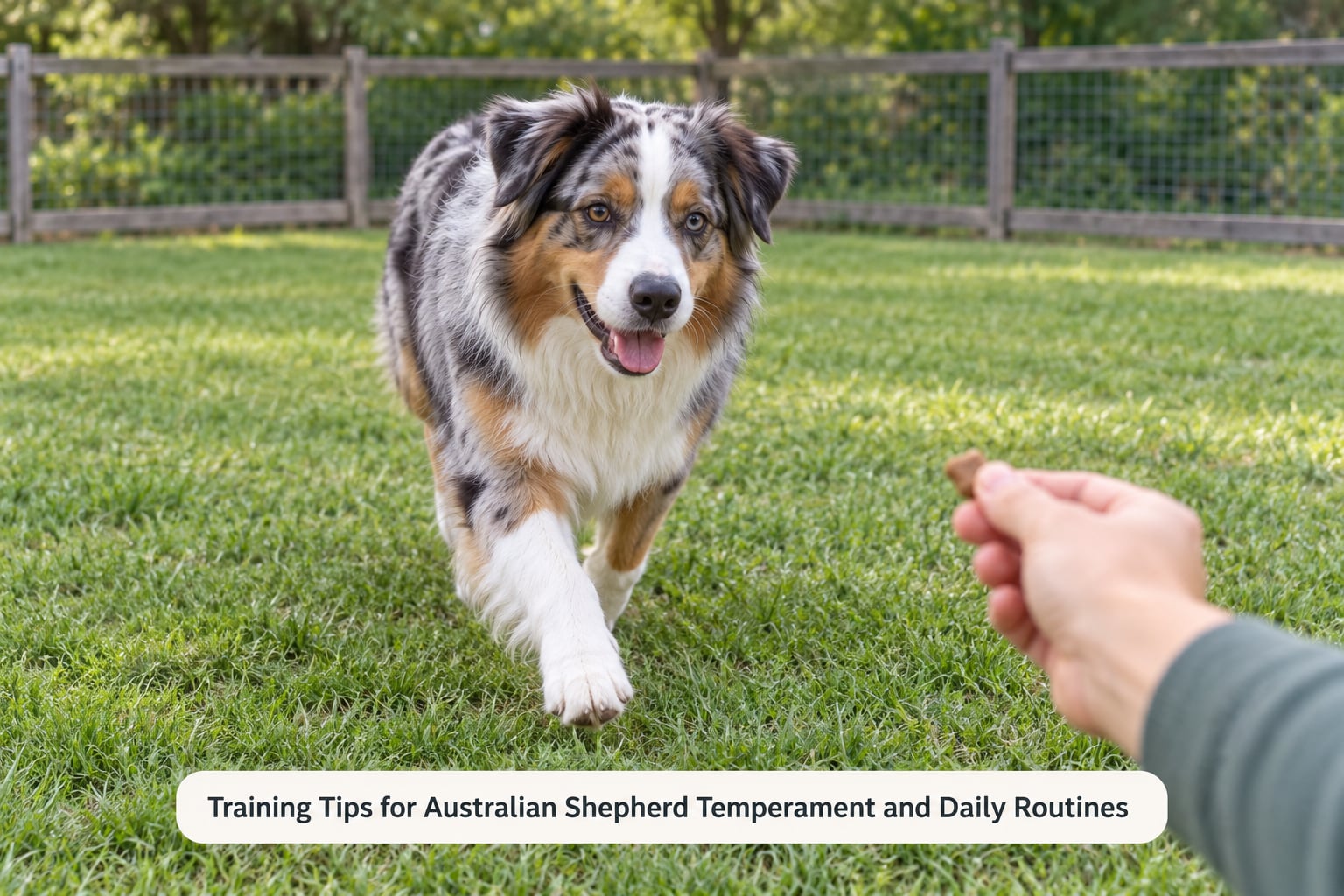
Here is the sequence that gets the most mileage per minute for most Aussies, roughly in the order they should learn it. Full proof of a relaxed recall in a securely fenced area is a good day’s work; a reliable recall off lead in the park takes months.
| Age | What to work on | Session length | What progress looks like |
|---|---|---|---|
| 8 weeks to 4 months | Name response, marker word, hand target, attention on you, sit, leave it | 2-3 minutes, 3-5 times a day | Ears turn toward your name from across the room |
| 4 to 6 months | Settle on a mat, wait at doors, loose-leash walking, recall indoors | 5-7 minutes | Waits at an open door until released |
| 6 to 12 months | Recall in a fenced area, duration cues, place training, calm greetings | 10 minutes | Comes from 20 feet on a single call, most days |
| 12 to 18 months | Recall with distractions, stay with distance, proofing off-switch around herding triggers | 10-15 minutes | Turns away from a moving target when asked |
| 18 months plus | Proofing in public, long-lead freedom, advanced cues, sport or work | 15 minutes | Off-switch holds near runners and bikes |
Name response comes before everything
Say the name once, and when the dog looks at you, mark it and hand over a treat. Ten seconds a day for two weeks gives you an attention cue you can interrupt with anything. Owners on r/puppy101 use the same idea in play: interrupt every five to ten seconds, pay the dog for stopping, put her back down. It turns a frantic game into a game with pauses.
Attention on you is the interrupt you’ll use forever
Reward any spontaneous glance. Add a cue like “look at me” later. This is the pause button for herding, barking and lunging, and it works far better than pulling the dog off a target.
Wait at doors and on the sidewalk
Ask for a sit, hold the lead closed, reward four seconds, release. Build to ten, then open the door a crack. The reason this matters for Aussies is that doors and sidewalks are where herding traffic appears.
Loose-leash walking, with a pattern
Keep a fixed spot on the floor for his nose, stop walking when the slack goes, and pay him to return to that spot. Mark the moment he hits it. Twenty-second sessions beat an hour of holding your arm out.
Recall as a verb, not a request
Use one word, in a high happy voice, and reward generously the second he arrives. Hold a long line in open areas for the first several months so a failed recall ends in a walk back rather than a chase. The recall cue is the single most useful interrupt you will own with this breed.
Settle is the skill people skip
Teach “go to mat” with a treat on the mat, build duration, then add distance and motion. An Aussie who can settle on command takes a lot of pressure off an evening, a dinner table and a visitor.
Proof before you trust
Do not call “come” and expect a free trip back every time you use it. That is how a solid recall becomes an unreliable one, and most herding problems start with a recall the dog learned was optional.
Common mistakes in australian shepherd training tips
Yelping or saying “ow” at nipping makes an adult herding dog’s mouth worse, not better, and it teaches the dog that hands and pant legs are the ones that react. Multiple rescue sources and experienced owners in r/AustralianShepherd recommend calmly removing the dog from the situation instead. The “no” command fails because it names what not to do without offering a replacement behavior, which leaves the dog solving its own problem. And alpha-roll dominance theory has no support in reward-based training practice; a dog you physically intimidate stops offering information, not offering opinions.
How to Manage Herding, Barking, and High Energy
Herding drive is not disobedience and it is not aggression, though the three can look similar in a two-second window. Figure out which one you are looking at before you train.
| What you see | Most likely cause | What works |
|---|---|---|
| Loose, bouncy nipping during play, stops when you move, no body stiffness | Play nipping and arousal | Interrupt every 5-10 seconds, mark and reward the pause, resume. Rehearse the trade so your hands stop being the best toy in the room. |
| Crouching, stalking, intense staring, cutting off runners, pinning small dogs | Herding instinct | Early interrupt cue with a long line, heavy reward for disengaging, plus a real outlet: treibball, agility, frisbee or scent work. |
| Stiff body, hard stare, lunging, growling, freeze response around a person or animal | Fear, guarding or reactive behavior | Increase distance first. Reward calm observation from far enough away. This is a behaviorist job, not a training job. |
A 20-minute daily herding protocol
Work in a fenced area with a long line attached. Let the dog go, and the moment you see the stalk begin, call your interrupt cue once. When the dog disengages, mark it and reward heavily on the ground. Return to a neutral game. Repeat, and stop for the day after three or four clean repetitions. Consistency across days is what extinguishes this, and it usually takes weeks rather than sessions.
Give the drive somewhere legal to go
A dog with a genuine outlet herds less. Flair work, treibball, agility, dock diving and scent games all absorb the same impulse in a form the dog can succeed at. Owners often find that a sport they do twice a week does more than doubling the walk.
Manage barking by addressing the trigger
Alert barking is communication, and in Aussies it usually means a doorbell, a car in the drive or another dog on a walk. Desensitization plus counter-conditioning is the reliable route: start at a distance the dog can notice without barking, mark, feed, and add a few steps each session. Interrupting with a command mid-bark teaches the dog that barking does not get him an answer.
Lower arousal without flooding
Take the dog off the line of sight of the trigger rather than pushing him to “get used to it.” Food puzzles, sniff walks and mat training bring arousal down faster than another round of high-energy play, which raises it.
Play sniffing, not chasing, at high arousal
Ball chasing is exciting. Searching for hidden treats or a thrown scent article calms the system. Aim for roughly one third physically exhausting play and two thirds sniffing on a normal day.
Socialization, Exercise, and Mental Stimulation
An under-stimulated Aussie is a dog who rehearses herding. Exercise alone rarely fixes it, because a tired body with an idle mind goes looking for something to do. Both halves need attention, every day, not just on weekends.
Socialization during the 3-16 week window
Prioritize surfaces (grate, gravel, tile, metal), household sounds, grooming and paw handling, people of different ages and appearances, and vaccinated dogs in a controlled class. Keep each new experience boring and reward calm, because an overexcited puppy in a new environment is not learning anything good.
Exercise minutes by stage
From 8 to 16 weeks, ten to fifteen minutes at a time on soft ground, several times a day. From four months to a year, 30 to 60 minutes with off-leash or structured play. Adult Aussies usually settle at 60 to 90 minutes daily, split into two or three walks for dogs that struggle to settle after one big one. Overexercising a young dog on hard surfaces is a joint risk, so keep puppies off concrete for long stretches.
A 30-minute daily mental routine
Ten minutes of scent work, whether that’s a hidden treat game or a towel roll with treats inside. Ten minutes with a puzzle feeder or a lick mat. Ten minutes of training games disguised as play: find it, wait, touch, go to spot, with the dog never guessing what you want. The dogs who settle best on an evening are usually the ones who spent it thinking rather than sprinting.
Social exposure should be controlled
Meeting dogs is useful only at low intensity. One calm adult dog on a long line while the puppy practices polite greeting teaches more than a dog park visit at full noise, where the puppy learns that other dogs are exciting chaos and greetings are optional.
When to Adjust Training or Consult a Professional
Reward-based training stalls sometimes, and sometimes the problem was never a training problem. A few signals tell you which one you are dealing with.
| What you see | Who to call | Why |
|---|---|---|
| Normal training going well but recall or manners plateau, or you want to accelerate progress | Certified trainer or a reward-based class | Coaching, timing and a plan tailored to your dog |
| Reactivity, fear, guarding, hard biting that has a body-stiffness component, or history you do not understand | Reward-based behaviorist or veterinary behaviorist | Behavior work needs assessment and an individualized counter-conditioning plan |
| Sudden behavior change, pain, flinching, any possible injury or illness | Veterinarian first | Pain changes behavior. Nothing medical gets solved with training. |
| Separation distress, vocalizing and destructive behavior when alone | Behaviorist, plus a vet check | Needs a plan built around the specific triggers, not a different dog |
Talk to your vet before giving any medication, including anything a human takes. Never give human medication to a dog, and don’t assume a behavior change is training when pain, thyroid problems or sensory decline can produce the same symptoms.
Stop and reassess yourself, too. If your dog is showing stress in training, lookups, ears back, lip licking or avoidance, you’ve gone past his threshold. Back up a few steps rather than repeating until he complies.
One more thing owners raise constantly: neutering does not fix nipping or herding. It changes hormone-driven behavior somewhat in young males, but the herding circuit itself is untouched. Owners who neutered hoping to end chasing generally found chasing carried on unchanged.
Frequently Asked Questions
Is an Australian Shepherd easy to train?
Yes, and faster than almost any breed, but not without conditions. Aussies learn by association and problem solving, so reward-based methods work quickly while harsh correction causes shut-down behavior. Short sessions, one cue at a time and low distractions early on produce a reliable dog within a few months.
How much exercise does an Australian Shepherd need?
Most adult Aussies need 60 to 90 minutes of physical activity a day, plus mental work, split into two or three walks. A single long walk rarely finishes them off. If your dog still herds, barks or grabs after a full walk, the missing piece is sniffing, puzzle feeding or a sport rather than more running.
Why does my Australian Shepherd bark so much?
Usually because of something specific: a doorbell, a car in the driveway, another dog, or a person approaching the yard. Alert barking is communication, not defiance. Start at a distance where your dog can notice the trigger without barking, mark the moment he goes quiet, and feed him, adding distance a few steps at a time.
Can Australian Shepherds be trained not to herd people or other animals?
You can dial it down a lot, but the instinct itself rarely goes away. Reward-based training with a reliable recall interrupt, plus a long line in open areas, cuts chasing dramatically in most dogs. A sport that uses the same drive, such as treibball or agility, usually gives a better result than suppression attempts.
When should puppy training and socialization begin?
Start at eight weeks, and treat three to sixteen weeks as the critical socialization window. Sessions should run two to three minutes, several times a day, in calm settings. Everything the puppy meets calmly in this period, from grooming to vacuum cleaners to calm dogs, counts as learning about safety.
Are Australian Shepherds good with children and other pets?
They can be excellent with both, and they can also push, chase and herd them. Aussies are often better with dogs they were raised with than with unfamiliar ones, and their herding drive shows up most with running children and small animals. Supervise early on and always give the dog a retreat the children cannot follow.
Do one thing this week: pick a single cue your dog already does, name it, and mark it ten seconds a day. Name response builds faster than any other foundation skill, and it gives you the interrupt you’ll need for everything else.