Both retrievers are excellent family dogs, and the honest difference between them is small. If your household is calm and people-focused, a Golden Retriever usually fits better. If your family is active, outdoorsy and willing to work with a stubborn, food-motivated dog, a Labrador Retriever is the better match. That is the short version of the golden retriever vs labrador retriever as a family dog debate, and the rest of this guide breaks it down by the parts of family life that actually decide it: temperament with kids, exercise, shedding, training and health.
Both breeds came from the same job. They are sporting dogs bred to find and carry back waterfowl, and ten generations of that work shaped the two personalities people argue about today. The Golden, developed in Scotland, is a softer, more attentive dog. The Lab, developed in Newfoundland from working dogs that hauled nets and fish in cold water, is tougher, gaudier and less interested in pleasing you for its own sake.
Neither is the low-maintenance option. Both are large, both shed, and both need an hour or more of movement most days for their whole lives. What changes is the texture of the daily grind, and that texture is what this guide is really about.
Table of Contents
- Golden Retriever vs Labrador Retriever as a Family Dog at a Glance
- Temperament and behavior with children
- Friendliness and patience compared
- Play style and supervision needs
- Why individual dogs beat breed averages
- Energy and exercise needs
- Daily routines by age
- Mental enrichment counts as exercise
- Yards, apartments and busy schedules
- Size, space, and home suitability
- Space requirements indoors
- Can either breed live in an apartment?
- Other pets in the home
- Grooming, shedding, and everyday care
- Shedding and brushing routine
- Bathing, nails and ears
- Food planning and weight control
- Training and first-time dog ownership
- What motivates each breed
- Where first-time owners struggle
- Puppy or adult dog?
- Health considerations to discuss with a veterinarian
- Questions to ask at your first visit
- Inherited risks to know about
- Preventive care that actually matters
- Which retriever should you choose for your family?
- If your family is highly active
- If you have young children
- If you are a first-time owner
- If you are in an apartment or a small home
- If someone in the house has allergies
- If you want a specific temperament
- Frequently Asked Questions
- Is a Golden Retriever or Labrador Retriever better for a family with children?
- Are Golden Retrievers or Labrador Retrievers more energetic?
- Which retriever is easier for first-time dog owners?
- Do Golden Retrievers or Labrador Retrievers shed a lot?
- Can either breed live in an apartment?
- How do I choose between a Golden Retriever and a Labrador Retriever?
- Conclusion
Golden Retriever vs Labrador Retriever as a Family Dog at a Glance
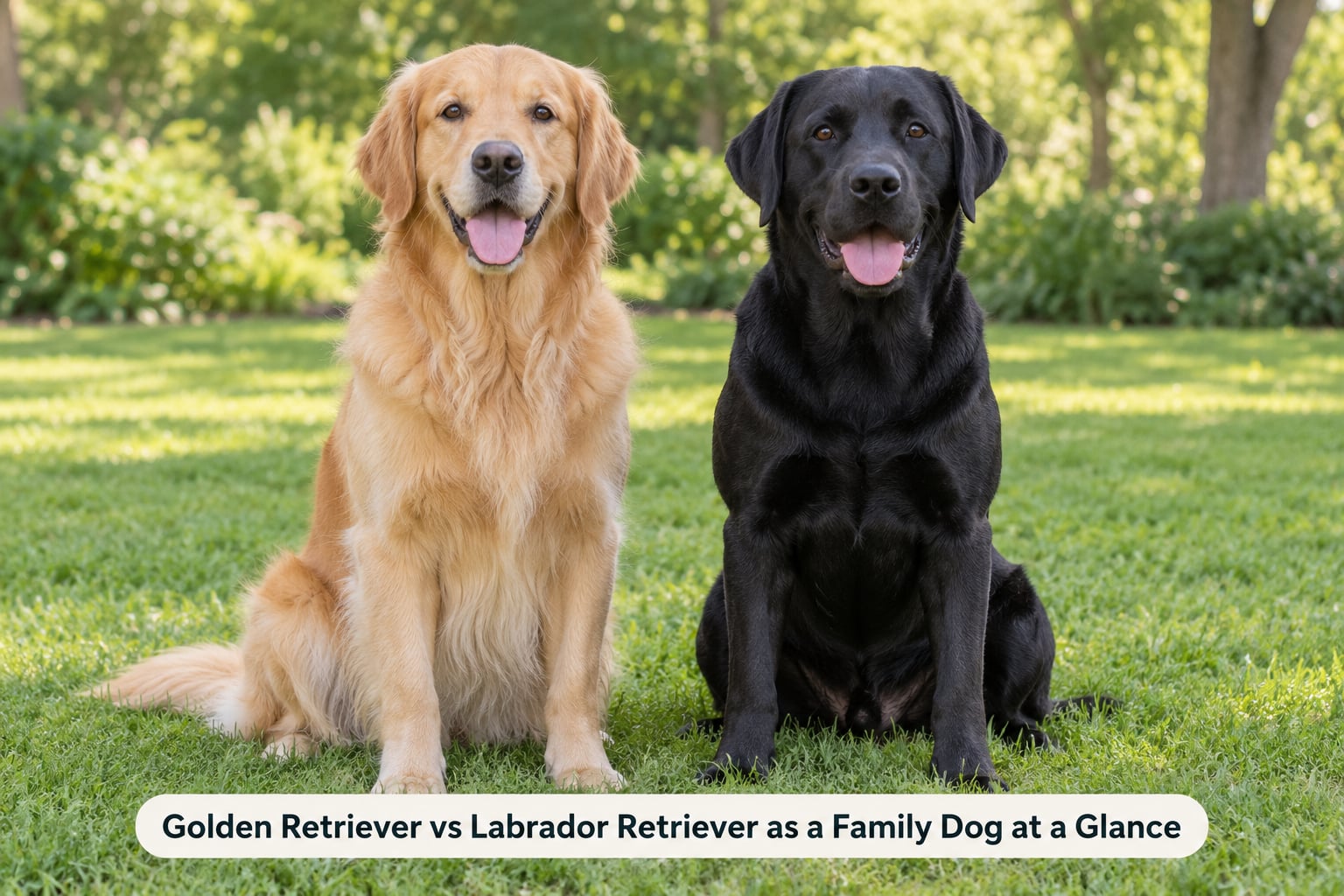
| Factor | Golden Retriever | Labrador Retriever |
|---|---|---|
| Typical temperament | Soft, sensitive, people-focused, eager to be near you | Outgoing, goofy, independent, less clingy |
| Energy level | High, but steadier and easier to settle | Very high, especially from 6 months to 2 years |
| Adult size | Males 65 to 75 lb, females 55 to 65 lb | Males 55 to 80 lb, females 45 to 70 lb |
| Height at shoulder | Males 23 to 25 in, females 21 to 23 in | Males 22 to 24 in, females 21 to 23 in |
| Coat | Long, dense double coat with feathering | Shorter, water-resistant double coat |
| Shedding | Heavy, year-round plus twice-yearly coat blow | Moderate but constant, year-round |
| With children | Patient and gentle, ideal for toddlers | Playful and boisterous, better with older kids |
| Training style | Responds to praise, sensitive to tone | Responds to food, stubborn when inconsistent |
| Typical lifespan | About 10 to 12 years | About 10 to 12 years |
If you read one row, read the children row. A Golden that has been raised with kids is the more patient of the two, and a Lab that has been raised with kids is the more physical of the two. Owners with both breeds often describe Goldens as shadows who follow a child from room to room, and Labs as partners who play hard and wrestle.
One more practical note before the details. When people search the golden retriever vs labrador retriever as a family dog question, they usually want permission to pick one. There is no wrong answer here. There is a dog whose quirks you will find easier to live with, and that is what the sections below help you work out.
Temperament and behavior with children
Golden Retrievers are usually the calmer, more nurturing option with young children, and that is the single most useful thing to know if you have a toddler or a preschooler. Goldens tend to notice when someone is upset and go over to them, and they are generally comfortable being handled, hugged and climbed on, which matters enormously when a three-year-old is involved.
Friendliness and patience compared
Both breeds rank among the most friendly dogs in existence. They greet strangers without suspicion and they get along with other dogs more often than not. The difference is in the flavor of it. A Golden wants to be physically close to the people it likes, and a Lab is perfectly happy to be friendly at a distance.
Owners on retriever forums consistently describe the Golden as the more emotionally attuned of the pair. The common thread in those conversations is that Goldens take corrections personally. Raise your voice in training and you may have a dog that sulks for half a day. That sensitivity is a real downside for some families, and it is worth weighing before you decide based only on the cuddling.
Play style and supervision needs
Labradors play harder. A Lab puppy is a rocket with a tail, and around small children that enthusiasm turns into accidental knockdowns. Most Lab owners describe the first two years as the hard part, with a dog that is genuinely too big for its coordination and mouth-softness when excited.
Supervision matters for both breeds. A Goldie’s patience is not a licence to leave a toddler alone with any dog, and a Lab’s playfulness is not aggression but does need management. Children should learn the same two rules with either breed: no hugging from above, and no food or sleep areas shared with the dog.
Why individual dogs beat breed averages
Breed predicts a range, not a personality. Two Goldens from different litters can behave like different dogs entirely. If you can meet the puppy’s mother, and especially if she is calm and people-oriented, that tells you more about your dog than any chart. Rescues and experienced breeders will usually arrange it.
Energy and exercise needs
Expect roughly an hour of real exercise daily for an adult of either breed, and considerably more while young. Labradors have the higher ceiling here. Forum descriptions of Lab puppies range from energetic to genuinely frantic, and the common thread is that it is an energy problem rather than a temperament problem. An under-exercised Lab does not calm down; it finds something to chew.
Daily routines by age
Puppies need three short outings rather than one long one, because their bladder is small and their joints are still forming. From about six months to two years, plan on hard exercise, ideally off furniture and stairs while the skeleton matures. Adult dogs settle into a rhythm of a morning walk, a midday outing or a game, and an evening walk that is longer than the morning one.
Golden Retrievers will happily match an active routine and are slightly quicker to settle indoors afterward. Labradors often need one more outlet than you planned for. A tired Lab is a wonderful house dog; a restless one is a liability.
Mental enrichment counts as exercise
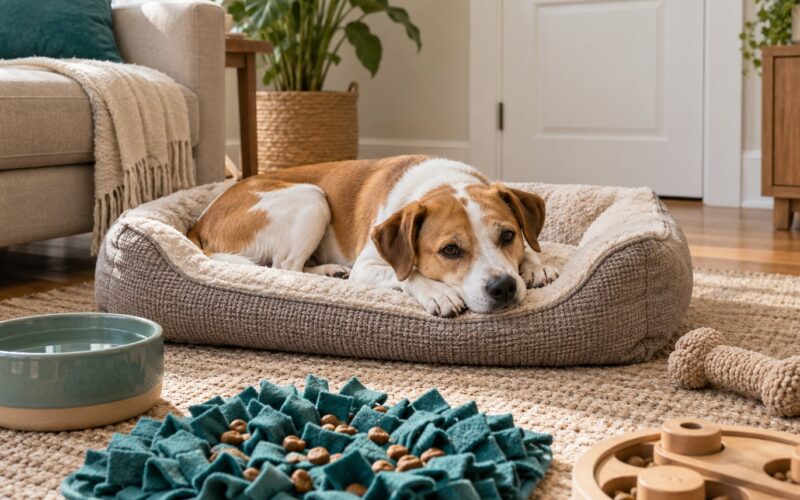
Retrievers are smart enough to get into things. A snuffle mat, a filled lick mat, a hidden-meal game or 10 minutes of scent work will burn more mental energy than another walk, and it matters most on days when the weather keeps you inside. Many owners report that a puzzle feeder is the single thing that makes rainy-day life workable.
Yards, apartments and busy schedules
A secure yard helps enormously with both breeds, but a yard is not a substitute for walks. Backyards get used for the same ten minutes every morning while the real training happens outside, where the world is. If your family is out every evening, be honest about that before you commit to either breed.
Both dogs love water. Swimming is genuinely good exercise for them, and many retrievers will walk into any lake, pond or cold sea you allow. That enthusiasm is a joy and also a safety issue, since a Lab will not self-limit in cold water.
Size, space, and home suitability
Both are medium-large dogs, and neither suits a household that wants a dog living in a corner of the flat. Goldens are the larger and heavier of the two at the top end, with males commonly 65 to 75 lb and females 55 to 65 lb. Labradors vary more widely, and males run roughly 55 to 80 lb, which is the heaviest dog in most American households.
Space requirements indoors
Think about a 6-by-8 foot sleeping area, a place for a 30-pound dog to lie down without being stepped on, and a secure spot at the door for a wet coat. Dog gates become part of the furniture faster than people expect. Crates, if you use them, should be sized generously because a Labrador will outgrow a small crate and then resent it.
Can either breed live in an apartment?
It can be done, and plenty of owners do it, but only with a realistic plan. Apartment retrievers need multiple outings a day and long weekend walks, and owners report that apartment Labs are the harder case because of the chewing and the pacing. If nobody in the household can commit to at least three outings daily, choose a smaller breed.
Other pets in the home
Both retrievers generally live happily with cats, but that depends far more on the individual dog than the breed. Introduce through a gate or a cracked door first, never face to face with a loose cat, and reward calm watching. The Golden’s softer, less prey-focused style often makes this easier, while the Lab’s higher drive takes longer to train out.
Bringing a second dog into a retriever household works well when the resident dog is also a retriever, since they share a play style. A two-dog home is easier on the humans in the long run, though the first year is more expensive than one.
Grooming, shedding, and everyday care
Golden Retrievers shed more, and there is no way around it. Owners on breeder forums describe tumbleweeds of long hair and permanent vacuum ownership. Goldens carry a dense undercoat beneath a longer, feathered topcoat, and they blow that undercoat twice a year, in spring and autumn, sometimes in the space of a week.
Shedding and brushing routine
Plan on brushing a Golden two to three times a week year-round, and daily during the blow. A slicker brush and an undercoat rake do most of the work. A Goldie’s coat mats behind the ears and at the collar, so those spots need checking every time.
Labradors shed constantly but in shorter lengths, so the fur is less visible while the volume on your clothes is still significant. Weekly brushing keeps a Lab’s coat healthy and cuts down on loose hair, and a rubber grooming glove works well for the coat and handles the sensitive skin underneath.
Bathing, nails and ears
Bath both breeds every six to eight weeks, or whenever they smell like the dog park. Dry a Golden fully after every swim or bath, because a damp undercoat is how you get hot spots on the skin. Trim their nails every two to three weeks, since fast-growing nails scratch more easily.
Floppy ears mean more ear trouble. Labs, with shorter coats and more exposed ear canals, are somewhat more prone to infections than Goldens. Check weekly, smell for anything yeasty, and ask your vet about a routine product instead of waiting for the head-shaking.
Food planning and weight control
Neither breed is naturally low-maintenance about food. Labs are famously food-obsessed, and counter surfing is standard behaviour rather than a training failure. Weigh portions, feed at set times, and put food bowls in a room where nobody stands. Retrievers gain weight easily, and a lean adult is far easier on the joints than a heavy one.
Goldens manage weight more easily, partly because they are more interested in praise than in food. That same praise motivation makes them easy to over-treat during training, so a large part of a Golden’s daily calories should be tiny training pieces.
Training and first-time dog ownership
Both breeds are ranked among the most trainable dogs in the world, largely because they were bred to work alongside people. The difference is what gets results. Labs respond to food; Goldens respond to your voice and your approval. Train each one the way it is wired.
What motivates each breed
Positive reinforcement is not optional here, and it is not a soft method. It is the fastest way to build a reliable recall in a breed that was literally bred to run off and bring things back without listening. Keep sessions short, three to five minutes, and end before the dog gets bored.
A Golden trained with a sharp tone will shut down or become anxious. A Lab trained with inconsistency will simply try a different behaviour until something works. Many experienced owners say Goldens are easier to teach and Labs are harder to keep accountable, which is a fair summary.
Where first-time owners struggle
The first eighteen months are harder than most people expect with either breed. Owners on retriever forums talk about puppy blues openly: the dog that chewed through shoes, the barking that started at six months, the adolescent phase at roughly eight months when a previously reliable dog stops listening.
What makes that phase survivable is planning. Book a puppy socialization class before the puppy comes home if you can, because classes fill. Set up a relationship with a vet during the first week. Join a breed-specific training group. All three are things owners say they wish they had done sooner.
Puppy or adult dog?
An adult retriever skips the destructive stage and arrives with a known temperament, which matters a great deal if you have toddlers. The trade-off is that you inherit whatever training another person did or did not do. Many rescues and breeders offer adolescent and young adult dogs, a sweet spot of roughly 8 months to 2 years.
Whichever route you take, avoid getting a puppy that will be enormous at the same time your child is a newborn. Eighteen months of two big needs in one house is the single most common reason families regret the timing.
Health considerations to discuss with a veterinarian
Both breeds are generally healthy, and both live roughly 10 to 12 years. But each has inherited conditions you should know the name of before you sign anything. Your veterinarian can tell you which tests to prioritize for your dog. This is general information, not a diagnosis, and any question about your own dog belongs in an appointment.
Questions to ask at your first visit
Ask about hip and elbow evaluation, eye testing, and heart evaluation for whichever dog you choose. Ask what the parents were screened for, and get the paperwork in writing. Ask how to feed a growing large-breed puppy, since the first year of nutrition affects joint development. Ask what your clinic’s reminder system looks like so you do not fall behind on vaccines.
Inherited risks to know about
Goldens carry a higher lifetime risk of several cancers, including hemangiosarcoma and osteosarcoma, along with heart valve disease, hypothyroidism, eye conditions and ichthyosis, a skin condition that shows up as crusty, scaly patches. Many owners have lost a Golden young, and the fear around cancer in this breed is real and well documented in owner communities.
Labradors carry higher rates of hip and elbow dysplasia, obesity, exercise-induced collapse, progressive retinal atrophy, retinal dysplasia and a hereditary muscle weakness. Bloat, and the tail and hip condition owners call cold tail or water tail after swims, are also more common in the breed.
Preventive care that actually matters
Keep both dogs lean, which protects joints for a decade. Walk on varied surfaces and limit repetitive high-impact jumping, particularly for Labs. Brush their teeth or use veterinary dental care, since retrievers get tartar fast. Keep nails short. Stay current on weight checks at every visit, because a retriever will talk you into believing the fifth treat was fine.
Pet insurance is worth a real look for either breed, given the cancer risk in Goldens and the joint and eye testing in Labs. Many owners buy it before the first vet bill rather than after. Start that conversation with your vet rather than with an advertisement.
Which retriever should you choose for your family?

If your family is highly active
Choose the Labrador. If there are people out on the trail on Saturday and a lake within reach, a Lab’s energy is the asset rather than the problem. You will get a dog who genuinely wants to come, and who is easy to train with rewards because rewards are what it understands.
If you have young children
Choose the Golden. The patience and the tendency to seek out people rather than space make the difference when the smallest person in the house is still learning to walk. Go in expecting to supervise, but you are starting from a steadier animal.
If you are a first-time owner
Choose the Golden only if you are comfortable with a sensitive dog who reacts to your tone. Choose the Lab only if you can be boringly consistent, because a Lab will test every boundary you set. Neither is easy. If you want the most forgiving first experience, an adult Golden from a rescue tends to be it.
If you are in an apartment or a small home
Choose the Golden, and only with a firm three-outings-a-day routine. Goldens settle more readily indoors after exercise. If you cannot commit to that, do not choose a retriever at all, and nobody in your family will be happier for it.
If someone in the house has allergies
Neither breed is a good answer. Both shed year-round, and neither is hypoallergenic. An adult dog from a breed that sheds less, combined with a strict air filtration routine, is a more honest choice than a retriever plus optimism.
If you want a specific temperament
Choose the Golden for warmth and attention, the Lab for goofiness and independence. If you are choosing a retriever for therapy, service or emotional support work, both are strong candidates, and both reward the reward-driven Lab with fast early progress and the Golden with steady long-term focus.
Frequently Asked Questions
Is a Golden Retriever or Labrador Retriever better for a family with children?
A Golden Retriever is usually the better choice for young children because it is more patient, gentler and more inclined to seek people out than a Labrador. Labradors play harder and can knock a toddler over by accident, which is a normal accident but still a rough one. With children over six or so, either breed works well once the dog is raised alongside them and supervised. No dog, breed aside, should ever be left unsupervised with a small child.
Are Golden Retrievers or Labrador Retrievers more energetic?
Labradors are generally the more energetic of the two, especially between six months and two years, when owners describe puppies as frantic and prone to destructive behaviour when under-exercised. Goldens have high energy too, but they tend to settle more easily indoors once they have had a proper walk. Plan on roughly an hour of daily exercise for an adult of either breed, and considerably more during the first two years.
Which retriever is easier for first-time dog owners?
Neither is objectively easier. A Golden is more sensitive, so it responds quickly to a patient owner but takes corrections hard, and a Lab is more independent, so it learns faster but needs firm, consistent rules and more food-based motivation. Many first-time owners do best with a young adult Golden from a rescue, since it skips the destructive puppy stage and the dog already knows the basics.
Do Golden Retrievers or Labrador Retrievers shed a lot?
Goldens shed more, and by a noticeable margin. Their long double coat carries a dense undercoat that comes out twice a year in a heavy seasonal blow, so expect brushing two or three times a week year-round and daily during those weeks. Labradors shed constantly too, but in short lengths, so the fur is less visible on the furniture. Neither breed is a good match for allergy-sensitive households.
Can either breed live in an apartment?
Both can, but only with three or more outings a day, longer weekend walks and a plan for mental enrichment such as puzzle feeders. Goldens tend to be the more manageable option indoors once exercised, since they settle more readily. Labs adapt too, but owners report more chewing and pacing when a Lab is under-stimulated. If nobody in the household can commit to that routine, a smaller breed is a better fit.
How do I choose between a Golden Retriever and a Labrador Retriever?
Write down three things first: how much exercise your household can realistically give, whether anyone has allergies, and how old your youngest child will be when the dog is fully grown. Then match the answer to the breed profile. Choose the Golden for softness, patience and indoor settling, or the Lab for energy, outdoorsy lifestyles and reward-driven training. Meet the mother of any puppy you are considering, and ask for hip, elbow, eye and heart health paperwork in writing.
Conclusion
The decision rule is simple: choose a Golden Retriever when your family wants a softer, more attentive dog that settles easily and has the patience for small children. Choose a Labrador Retriever when your household is active, spends real time outdoors, and can keep the rules firm and the treat jar full.
Start before you fall in love with a specific puppy. Write down your household’s actual activity level, your space, your experience and your child’s age, and match those against the two profiles above. That is the whole golden retriever vs labrador retriever as a family dog question in three lines. Then meet the mother of any litter you visit, ask for the health screening paperwork in writing, and let that dog choose you back.