
French bulldog health problems to know before adopting centre on a shortened skull and a compact body: narrowed airways, heat intolerance, skin fold and ear disease, eye injury risk, and spinal disc disease. Add chronic allergy skin, crowded teeth and difficult births, and you get a dog that can live a full, happy life with careful veterinary care.
That is the honest version. Plenty of French bulldogs are perfectly comfortable, and plenty are not. The difference usually comes down to what you find out before you sign, not after.
What follows is general background information for people weighing the breed, not veterinary advice and not a diagnosis of any individual dog. Breathing, skin, spine and eye problems can change fast, so anything described here as a warning sign belongs with a veterinarian, urgently when it involves breathing, the eyes or the spine.
Table of Contents
- French Bulldog Health Problems to Know Before Adopting: Quick Guide
- What breathing problems should prospective owners expect?
- How do you tell ordinary breathing from a real problem?
- Why are spinal problems and mobility issues important?
- What skin, ear and allergy issues can French bulldogs develop?
- What eye problems should adopters watch for?
- How can heart, heat and weight issues affect the breed?
- What dental, reproductive and routine health questions belong on an adoption checklist?
- What should you do before adopting a French bulldog?
- How to use French bulldog health problems to know before adopting in your decision
- Frequently Asked Questions
- Is noisy breathing in a French bulldog always a serious problem?
- How can I tell if my French bulldog is overheating?
- What medical records should I ask for before adopting?
- Can a perfectly healthy puppy still develop these problems later?
- Which signs need urgent veterinary care rather than a routine appointment?
- Conclusion
French Bulldog Health Problems to Know Before Adopting: Quick Guide
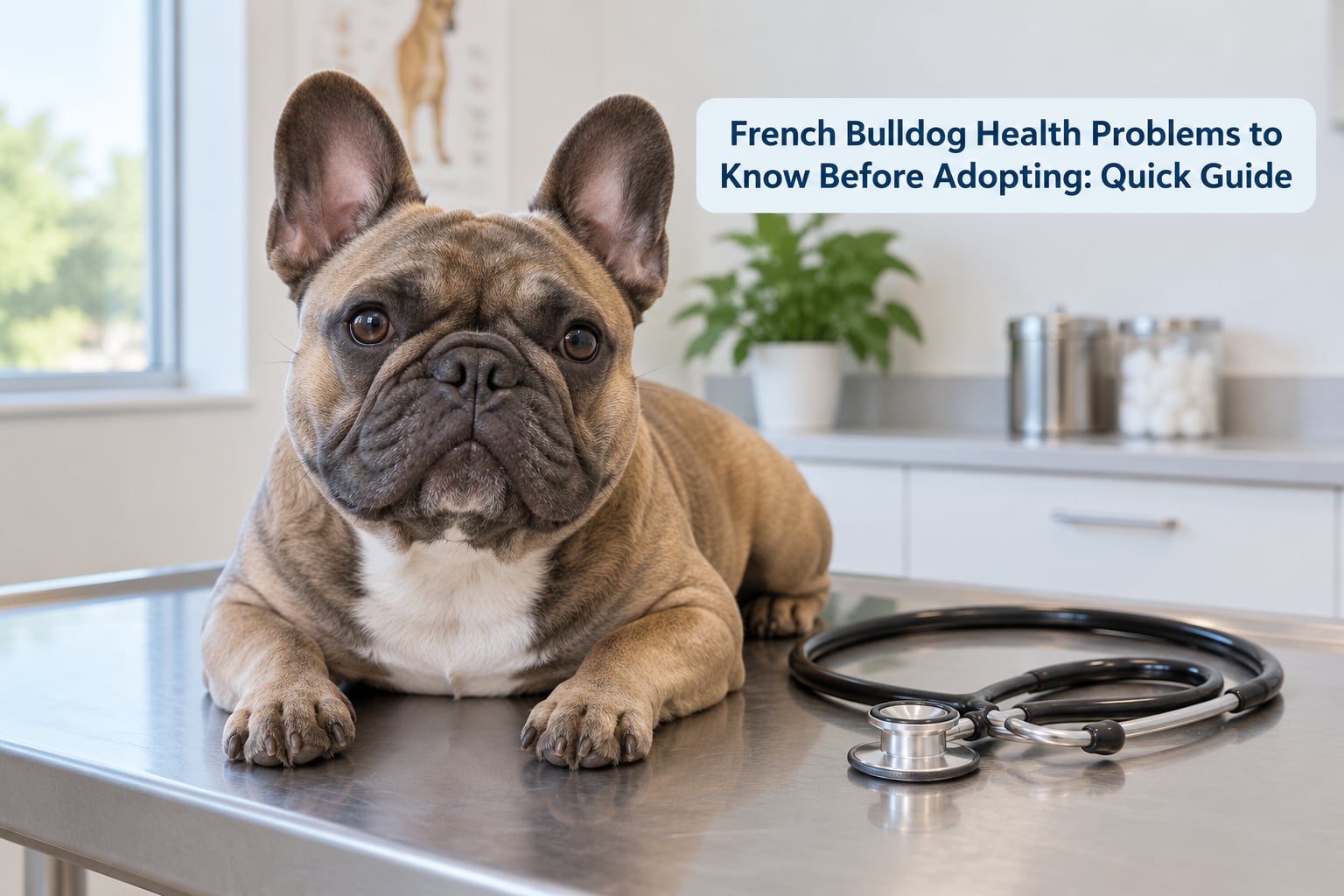
Most of these conditions trace back to the same handful of physical traits: a flat face, prominent eyes, narrow ear canals, deep skin folds, a short muzzle and a compressed spine. That head shape is not a defect in any individual dog. It is the reason a French bulldog looks like a French bulldog, and it is also why the breed carries a predictable disease load.
| Body system | What adopters should know | Typical age it shows |
|---|---|---|
| Breathing | Brachycephalic obstructive airway syndrome (BOAS), noisy breathing, exercise intolerance | Noticeable from puppyhood |
| Heat tolerance | Overheating risk in warm weather and during excitement | Any age, worse as a puppy |
| Skin and folds | Skin fold dermatitis (intertrigo), itching, hair loss, recurring odour | Often starts under a year |
| Ears | Otitis externa, yeast and bacterial infection, chronic pain | Recurring, often young adult |
| Eyes | Corneal ulceration, redness, discharge, squinting, cherry eye | Any time, often young |
| Spine and joints | Intervertebral disc disease (IVDD), hemivertebrae, patellar luxation, hip problems | IVDD typically 4 to 8 years |
| Heart | Screening history matters; heart disease is uncommon but real | Adulthood |
| Reproductive | Dystocia (difficult birth); French bulldogs commonly deliver by caesarean section | Only relevant if breeding |
| Dental | Crowded teeth and malocclusion; more tartar and gum disease | From young adulthood |
| Weight | Even mild excess weight worsens breathing and joint strain | Lifetime management |
Signs that mean contact a vet the same day: struggling to breathe, blue or very pale gums, collapse, a swollen face, repeated retching, an eye that is squinting or clouded, or sudden weakness in the back legs.
What breathing problems should prospective owners expect?
Brachycephalic obstructive airway syndrome, usually shortened to BOAS, is the condition every French bulldog owner should understand before adoption. The skull is shortened, so the airway has less room. The soft palate can be too long for the space, the nostrils can be narrowed, and the airway narrows further still when the dog is hot or excited.
Snoring and a low, grumbly breath at rest are common, and owners often laugh them off as personality. The quiet breathing an average dog makes while asleep is the benchmark worth learning, because the difference between that and constant noisy effort is where the concern starts.
How do you tell ordinary breathing from a real problem?
Effort is the clue. Gums that are pink rather than blue, pale or brick red. Breathing that pulls in at the ribs or the neck rather than moving the chest alone. Exhaustion after a short walk on a mild day. Retching or gagging that produces nothing, particularly after eating or drinking. Restless sleep with pauses and choking noises.
Owners posting on r/Frenchbulldogs describe normalising loud breathing for years before a vet pushed them to look at it properly. The complaint that comes up again and again is not that a Frenchie snores. It is that nobody told them there was a difference between snoring and effort.
Surgical airway work can widen the airway and improve airflow substantially. It cannot rebuild a normal skull, and recovery in flat-faced dogs carries its own risks because airway and anaesthesia management in brachycephalic breeds is more delicate. Cambridge research on BOAS and guidance from the Royal Veterinary College and ACVS are useful reading if you want the clinical background.
If breathing is difficult, effortful or accompanied by colour change in the gums, that is an emergency appointment, not a routine one.
Why are spinal problems and mobility issues important?
Intervertebral disc disease, or IVDD, is the condition that catches new owners out most often. It happens when a disc in the spine pushes out of position and compresses the spinal cord. In French bulldogs the shortened vertebral column makes disc disease more likely, and the breed is also associated with congenital vertebral malformations such as hemivertebrae, where a vertebra is compressed or wedge-shaped.
It tends to appear in adult dogs, most often between about four and eight years, which is exactly why an eight-month-old puppy can look perfectly normal and a six-year-old can collapse overnight.
Signs that deserve a neurological assessment: a hunched or unwilling-to-move posture, crying when jumped on or lifted, weakness in one or two back legs, a paw dragged on the ground, difficulty standing, loss of bladder control, or sudden paralysis of the hindquarters. The mildest presentation is a dog that is quieter, off food and reluctant to jump onto the sofa. It is easy to read as a mood.
Forum owners share the same shock every time: nobody warned them a spinal injury was possible, and then a diagnostic scan and surgery arrived together. Questions worth putting to a breeder, rescue or vet before you commit: has spine imaging been done, has the dog ever shown back pain, is there any history of neurological episodes in the family, and what is the plan if spinal disease appears?
If your dog is unable to walk or is leaking urine, that is an emergency.
What skin, ear and allergy issues can French bulldogs develop?
Skin fold dermatitis, also called intertrigo, is inflammation where skin touches skin. A French bulldog’s facial folds trap moisture and heat, and the same crowding narrows the ear canals. French bulldog skin allergies are extremely common, with atopy and food allergy both seen, and the two often overlap.
What adopters usually see: itching, redness between the toes or around the muzzle, hair loss in patches, a yeasty or sour smell, chewing at the feet, and ears that smell, shake their head or discharge. Chronic ear disease is the version that drains owners the most, because it keeps coming back after every course that clears it.
Rescue groups note a less obvious allergen worth knowing about: storage mites, which live in dry kibble and dried food. If a dog itches year round with no seasonal pattern, that is one thing a controlled dietary trial can rule in or out, under veterinary guidance.
Folds need routine observation and gentle cleaning in the way your vet recommends, with the skin dried properly afterwards. Do not apply human creams, creams from the bathroom cabinet, or ear drops that were not prescribed for this dog. Never use a human painkiller; it is not safe for dogs.
Get a vet to look at swelling, discharge, sores, severe itching, redness that spreads or any sign of discomfort. Skin problems are rarely emergencies, but they are much easier to fix early.
What eye problems should adopters watch for?
French bulldog eyes sit proud of the skull with a shallow eyelid coverage and a poor blink reflex. That anatomy leaves the cornea exposed to scratches, dried-out surfaces and impact from grass, dust and rough play.
Corneal ulceration is an open wound on the surface of the eye. It is painful, it can progress quickly, and in flat-faced dogs it can worsen within a day. Signs are squinting, holding an eye partly shut, redness, watery or thick discharge, rubbing at the face, and any change in how the eye looks. Cherry eye, where the gland prolapses and a red lump appears in the corner of the eye, is common in the breed and usually needs surgery rather than watching.
Cloudiness, a suddenly different-looking eye, trauma of any kind or a change in vision is a same-day appointment. Do not put eye drops in that were not prescribed, and do not try to flush an injury with tap water.
How can heart, heat and weight issues affect the breed?
Heat is where most French bulldog emergencies start. A dog cools itself mainly by panting, and a restricted airway means less effective cooling. On a warm afternoon a Frenchie can be in trouble long before you would expect.
Watch for heavy panting that will not settle, drooling, weakness, wobbling, bright red or very pale gums, disorientation, retching, or a dog who seems fine and then suddenly cannot stand. Get somewhere cool and to a vet straight away. Two other questions belong on your vet list before adoption: how the heart has been assessed, and how the dog is managed in warm weather.
Weight deserves its own line. French bulldogs are food-motivated and compact, and carrying a few extra pounds adds fat around the chest and abdomen, which makes breathing harder and puts more load on the spine and joints. A body condition score checked at each wellness visit, with a feeding plan you can actually measure, is one of the cheapest things you can do for a dog with this head shape.
Fainting, prolonged panting, weakness, marked thirst or a sharp drop in activity are all reasons to call a vet rather than wait for the next routine visit.
What dental, reproductive and routine health questions belong on an adoption checklist?
Dental crowding is the quiet one. French bulldog teeth are crowded, which creates more tartar and more gum disease, and crowding can make a tooth break or an abscess form where you cannot see it. Ask what dental care has been done and plan on brushing and professional checks rather than waiting for bad breath.
Reproductive questions matter mainly if you might breed. Dystocia, a difficult or obstructed birth, is common enough in the breed that caesarean delivery is routine in some countries. Hypospadias, an abnormal urethral opening, is also reported in French bulldogs. Neither affects a pet dog, and neither is the reason to look elsewhere. Be aware that the breed also needs artificial insemination in many cases, which is another reason breeding, and puppy shopping, is expensive.
Your practical checklist with a rescue, shelter or breeder:
- Full vaccination record and dates, plus current parasite prevention
- Veterinary records from previous owners, including any diagnosis and any treatment given
- Genetic or DNA panel results, and what the breeder actually screened for
- Whether spine imaging has been done, and any history of back pain
- Breathing assessment at rest and during gentle exercise
- Eye check, skin and fold check, ear examination
- Dental history and current weight, with a body condition score
- Whether the dog is spayed or neutered, and the arrangements if not
- Any behaviour or temperament history, and how the dog responds to handling
- An honest conversation about expected lifetime veterinary costs
A responsible source will tell you what they know, including what they do not know. Treat any test or disclosure as a snapshot, never a guarantee of a healthy future.
What should you do before adopting a French bulldog?
Request the records before you meet the dog, not after. Ask what breathing sounds like at rest, whether the dog has ever had a back problem, what the eyes and ears look like now, and what the weight is. Book a veterinary assessment within the first week, ideally with a practice that sees flat-faced breeds regularly, and treat that appointment as the real start of the adoption.
How to use French bulldog health problems to know before adopting in your decision
Use the list above as filters rather than as reasons to walk away. A dog with a managed allergy or a corrected cherry eye is a very different proposition from a dog in respiratory distress, and rescues regularly place dogs with known, well-documented conditions. What matters is that the condition is identified, it is being managed, and the people placing the dog are honest about it.
Then set up the practical side early: insurance arranged before you bring the dog home or on day one, an emergency fund, a named vet, and a heat plan for the first warm week.
Most people who regret adopting a French bulldog did not regret the health problems. They regret skipping the questions.
Frequently Asked Questions
Is noisy breathing in a French bulldog always a serious problem?
Not always, and it is not always harmless either. Loud breathing during sleep or after play is common in the breed. Breathing that takes visible effort at rest, comes with a stretched rib cage, or comes with gums that are not pink needs a veterinary assessment. The reason to ask early is that airway problems are easier to assess before a dog is overheated, exhausted or already in crisis.
How can I tell if my French bulldog is overheating?
Panting that will not settle, drooling, weakness, wobbling, bright red or pale gums, disorientation, repeated retching or a sudden inability to stand are the common signs. Flat-faced dogs cool themselves mainly by panting, so a restricted airway slows that process. Move to a cool space, keep the dog calm and contact a veterinarian or emergency service immediately rather than waiting to see whether the panting eases.
What medical records should I ask for before adopting?
Ask for the full vaccination history with dates, current parasite prevention, and every veterinary record a previous owner or rescue holds, including diagnoses and treatments. Request genetic or DNA panel results and know which conditions were actually screened. Also ask about spine imaging, breathing assessments, eye and ear checks, dental history and current weight. Complete records tell you far more than a cheerful description of a healthy puppy.
Can a perfectly healthy puppy still develop these problems later?
Yes. Breathing and heat intolerance are usually visible early, but spinal disc disease most often appears between about four and eight years of age, and chronic ear and skin disease often builds over months or years. A healthy examination at adoption tells you where the dog is today, not where it will be in five years. Ask about family history and screening, then plan for routine veterinary reviews rather than assuming the first visit settles everything.
Which signs need urgent veterinary care rather than a routine appointment?
Difficulty breathing, blue or very pale gums, collapse, repeated retching, a squinting or clouded eye, sudden weakness or paralysis in the back legs, and loss of bladder control all need same-day or emergency care. A swollen face or spreading redness on the skin should be seen the same day as well. If you are unsure whether breathing is normal for the breed, call a vet and describe what you are seeing rather than waiting to see how it develops.
Conclusion
French bulldog health problems to know before adopting are worth taking seriously, and none of them is a reason on its own to give up on the breed. Some are structural and lifelong, some are managed with routine care, and some arrive suddenly out of nowhere.
So request the records, ask the uncomfortable questions about breathing, spine, eyes, skin, heart and weight, and arrange a veterinary assessment before you sign anything. The first practical action is that health review, booked today.