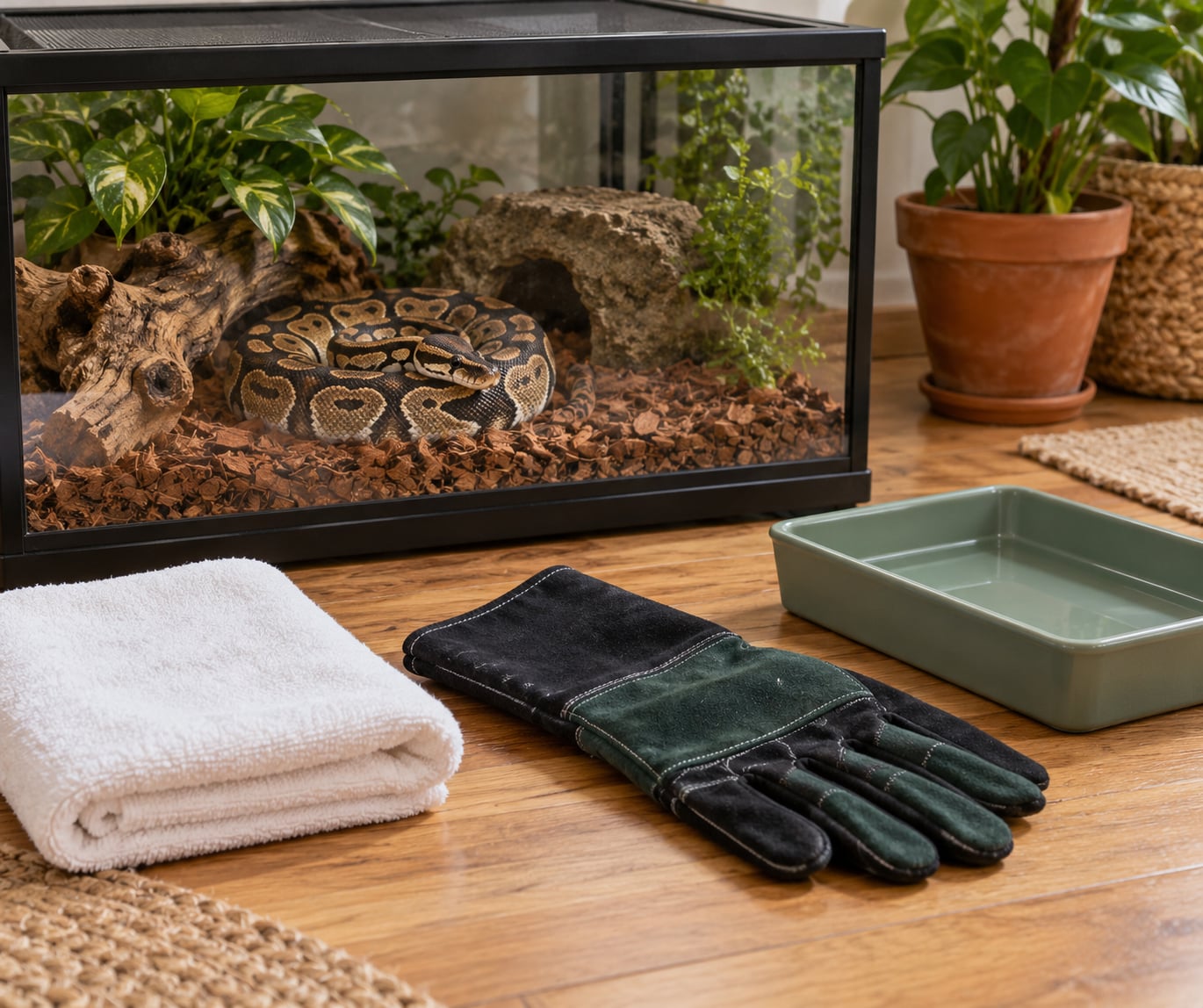
To handle a pet snake safely, wash your hands, let the snake notice you before you touch it, support its body at mid-section with one hand while the other hand supports the rest, keep the session short, and lower it back into a secure part of its enclosure. Ten calm minutes is plenty for a beginner session, and it takes about five minutes to prepare properly.
Most snake bites happen because someone reached in too fast, grabbed near the head, or picked the animal up within a day or two of feeding. Snakes do not bite because they dislike you. They bite because fast movement reads as a threat, and because your hands smell like the last meal you prepared.
This guide covers the common pet species beginners actually keep: corn snakes, ball pythons, king and milk snakes, and rat snakes. It assumes a non-venomous animal. If your snake is venomous, handling is a specialist job and this guide does not apply.
The steps below are the same ones experienced keepers describe on reptile forums, where new owners repeatedly ask the same three questions: where do my hands go, how long should I hold it, and how long after feeding is it safe. Answers to all three follow.
Table of Contents
What You Need
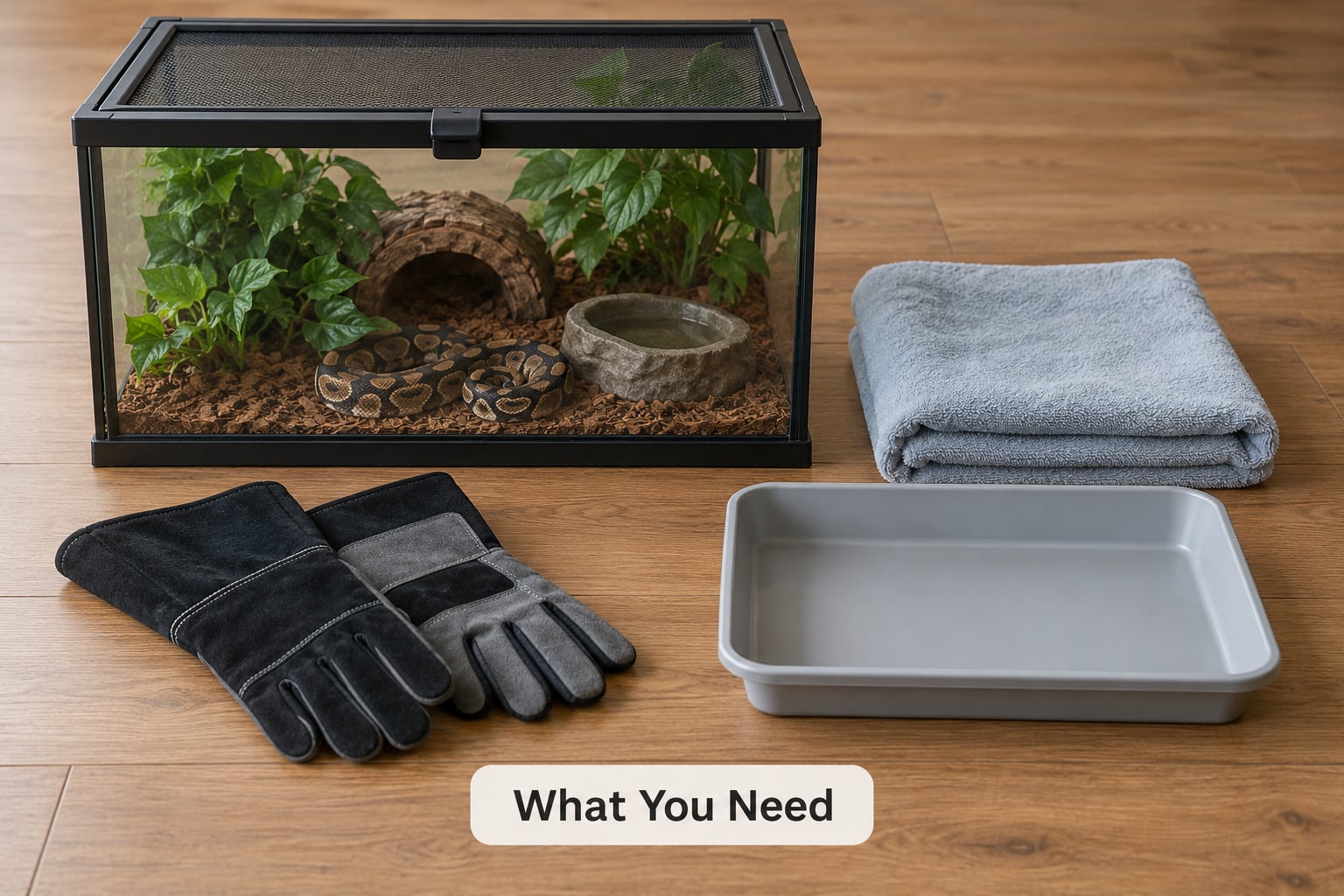
Preparation is the part beginners skip, and it is the part that prevents most bites. You need four things ready before the enclosure door opens: a closed room, a clean towel laid over a flat surface, a clear plan for where the snake goes during the session, and hands that smell like nothing at all.
A secure room. Close every door and window in the space you plan to use. A snake moving fast in an unfamiliar room will find the gap under a door, and finding it again is a genuine search job, not a five-minute one.
A clean towel over a flat surface. Snakes grip with texture, and a bare smooth floor means a snake that slides out of your hands. A towel gives them something to push against and gives you a non-slip landing spot if you have to lower them in a hurry.
Something to set the snake on. A shallow tray, a plastic tub lid, or the towel itself works. Most snakes will crawl off your hands within a few minutes, and having a designated spot makes that moment boring instead of chaotic.
Nothing on your hands. Lotion, hand sanitizer, perfume, cigarette smoke and food residue all carry scent. Washing with plain unscented soap and drying thoroughly is the whole preparation.
A snake hook is worth owning but not required on day one. Experienced handlers on r/snakes and r/ballpython often use one for the very first contact with a defensive animal, since it lets you lift and support without putting your hand in strike range.
How to Handle a Pet Snake Safely: Step-by-Step
Wash Your Hands and Prepare the Space
Wash with unscented soap and dry completely, then clear the area of clutter and other pets. Check that the enclosure door and any screen lid are closed behind you before you open the front.
This step is where the post-feeding rule gets tested too. If you fed your snake with tongs this morning, that is exactly the wrong moment. Most keepers wait 48 to 72 hours after a meal before handling, because handling too soon is a common cause of regurgitation, which is genuinely dangerous for the snake.
Gloves are useful for a nervous owner, though they are not required for a non-venomous species. If you wear them, choose smooth ones with no textured grip pads, since rough material gives the snake something to bite into.
Let the Snake Notice You
Hold your hand still near the front of the enclosure for a minute or two before reaching in. Snakes notice movement and smell before they notice shapes, so staying motionless lets your scent register without a sudden silhouette appearing overhead.
Approach from the side, not from above. An open hand descending straight down mimics a bird or a reaching predator, and most species read it that way. Keep your hand low, approach horizontally, and let the tip of your fingers enter first.
Move slowly. A snake that is relaxed will usually stay put or shift slightly. If you see tongue flicking, that is investigation, not a warning. If you see an S-shaped coil, a raised head, or the head angled toward your hand, stop and put it down for another day.
For a defensive snake, a snake hook makes the first contact instead. Slide the hook under the body around mid-section, lift just enough to take the weight, and let the snake crawl onto your free hand. Owners report this cuts defensive strikes far more than trying to out-muscle the animal.
Support the Body at Two Points
Place one hand under the snake at about the middle of its body and let the other hand take the rest of the weight as it shifts. Weight resting on a single hand or on a single coil puts pressure on the spine, which is not built like a mammal’s and does not forgive a bad grip.
The snake should feel supported along most of its length, not pinched. You are supporting, not restraining. If you cannot move your fingers without the body compressing noticeably, you are squeezing too hard.
Let the snake reposition itself as much as it wants. A snake that slides its head under your arm or across your forearm is doing what snakes do. Trying to keep it in one fixed shape creates the struggle you were trying to avoid.
Keep its face away from yours and away from anyone else’s. There is no reason for a beginner to hold a snake within biting range of their own face, and turning the head outward costs you nothing.
Lift Slowly and Keep the Snake Close
Raise it a few centimetres and pause. Then a few more. Snakes dislike abrupt starts, and most of the wobbling that shows up in first sessions comes from a handler lifting too fast rather than from the animal being nervous.
Hold the snake near your body or against a flat surface so it has a reference point. For a beginner-friendly species like a corn snake, letting it coil loosely around both hands and your forearm works well, though there is no need to replicate that shape with a heavy constrictor.
For a snake over about six feet, that changes completely. Get a second person, have one of you support the body while the other manages the front section, and never drape a large snake around your neck. A constrictor’s coiling is a natural reflex rather than a decision, and nobody wants to test that reflex near their carotid.
Support heavy bodies on a flat surface where you can. A tray, a table, or the floor next to your knees gives a large snake something to rest against instead of letting all of that weight pull against your hands.
Limit Handling Time and Watch the Signals
Keep the first sessions to about five minutes, twice a week, and stop early if the snake is actively trying to get away. Ten to fifteen minutes is fine for a settled adult that is moving calmly through your hands.
Signs that the session should end: repeated attempts to flee, a strike, sustained musking, or constant movement that never settles. Signs that the snake is comfortable: slow exploratory movement, resting its weight on you, curling loosely, and tongue flicking without recoiling.
Two periods to avoid entirely are the week around a shed, when the eyes turn cloudy blue and the snake can see very little, and the 48 to 72 hours after feeding. Handling during blue phase adds stress with no upside, since the snake barely knows where you are.
Snakes do not get “more used to you” through a single long session. Short, calm, repeated contact is what builds tolerance. Some individuals never appear to enjoy being held, and that is normal. Tolerating it calmly is a perfectly good outcome.
Return the Snake to Its Enclosure
Lower the snake into the section of the enclosure furthest from the door, onto a flat surface such as a hide or a piece of cork bark. Keep your hand underneath until you feel the body settle and stop sliding.
Release your support one section at a time rather than dropping the whole animal. Then close the door or slide the lid, and check that it is fully seated. A snake that has been held is usually calmer and slower on the way back than it was on the way out.
Wash your hands again with soap and water after the session. Snakes can carry Salmonella, and so can their enclosures and substrate. This is routine, it is true of every reptile, and it is the reason you would never handle a snake and then make a sandwich immediately afterwards.
Common Mistakes
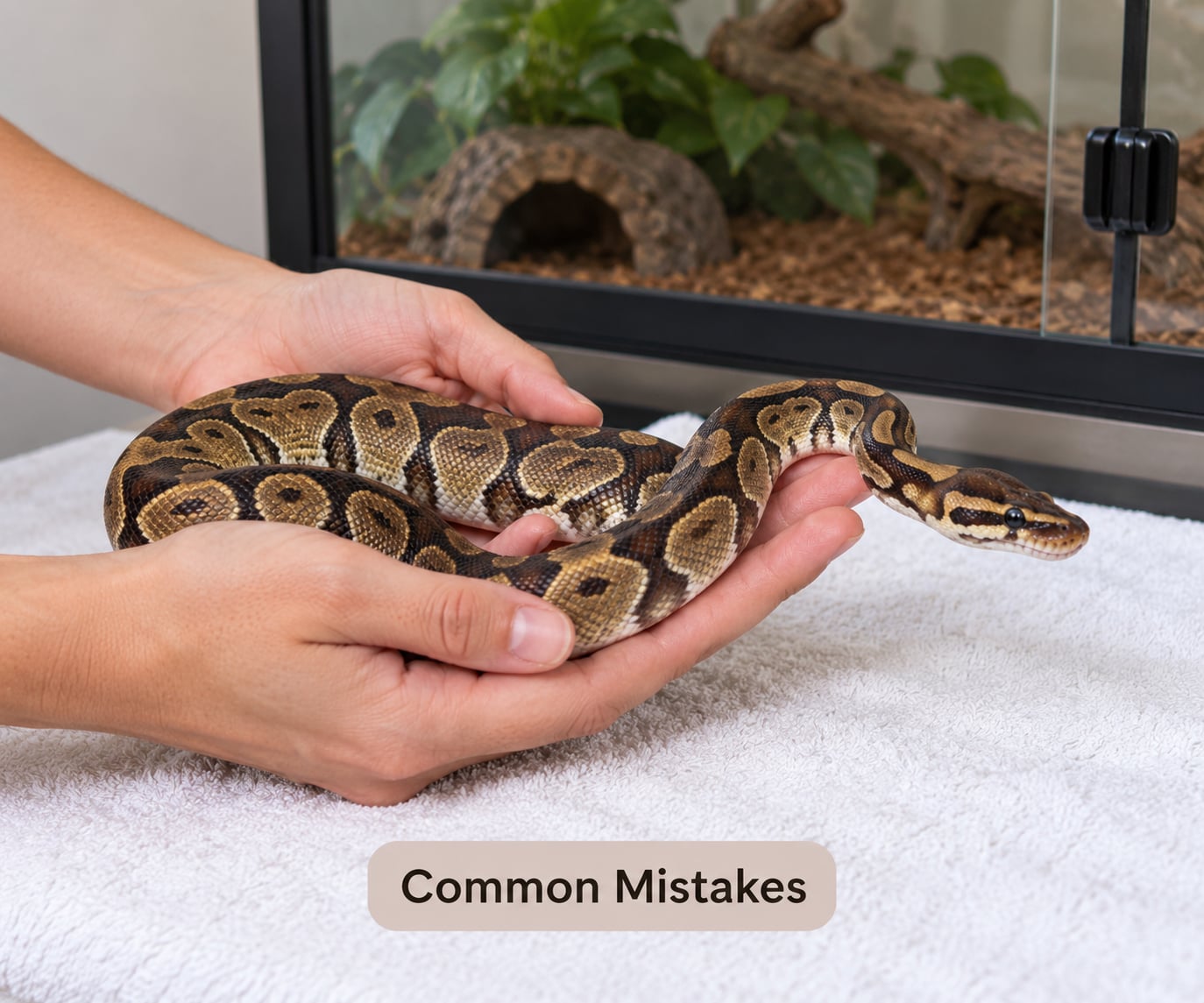
These are the errors that show up again and again in beginner threads, and each one has a simple fix.
1. Grabbing from above. The single most common cause of defensive strikes. Approach from the side with your hand low, and let the snake smell you before you touch it.
2. Grabbing the head or the tail. Never hold a snake by the head; you can injure the jaw and neck, and the snake will fight harder than if you had simply let go. Tails are fragile too, and a snake that breaks a tail from being grabbed has a permanent injury. Support the body at mid-section instead.
3. Squeezing when it moves. The instinct to hold tighter makes everything worse and risks spinal damage. Support, then let go. A snake that slips away and is found immediately beats a snake held too tightly.
4. Handling too soon after feeding. Wait 48 to 72 hours. A stressed snake may expel its meal, and a regurgitated meal carries a real risk of infection.
5. Handling during a shed. Cloudy blue eyes mean poor vision and higher stress. Wait until the shed is complete and the snake is moving normally again.
6. Ignoring the escape risk. Do not open the enclosure in a shared room, on a bed, or in a house with other pets. One handler, one closed room, one snake out at a time.
7. Treating defensive behaviour as aggression. An S-shaped neck, a raised head and a strike are a frightened animal, not a mean one. Give it distance and try again on a quieter day, or use a hook.
8. Using human medicine on a bite or on the snake. Never. If a bite breaks skin, clean it with soap and water and get medical advice if the wound is deep, swelling, or not healing. For the snake, a reptile-experienced veterinarian is the only call you make.
9. Handling a large constrictor alone. Past roughly six feet, use a second person. Nobody should hold a large snake alone, and neck draping is never acceptable.
10. Skipping the acclimation period. Owners commonly leave a new snake alone for three to seven days before the first session. Rushing day two tends to produce a snake that hides for a week afterwards.
Frequently Asked Questions
How often should I handle my pet snake?
For a settled adult, most keepers handle two or three short sessions a week, about five to fifteen minutes each. New snakes need three to seven quiet days before the first session, and sessions should stay short while trust builds. Avoid handling for 48 to 72 hours after feeding and throughout the shed cycle.
Does every snake species handle the same way?
The core method is identical for common pets: approach from the side, support mid-body with two hands, keep sessions brief. Temperament differs, though. Corn snakes and king snakes are usually active and tolerant, ball pythons are heavier and slower, and rat snakes are fast and jumpy. Species that rear up defensively need a hook and more patience, not firmer hands.
Can you hold a snake without it getting bitten?
You cannot remove the risk entirely, because a nervous snake may strike. You can reduce it a great deal: wash off food scent, approach slowly from the side, never reach over the head, wait 48 to 72 hours after feeding, and use a snake hook for the first contact with a defensive animal. Most beginner bites are small puncture marks that need soap, water and a check for infection over the following days.
What should I do if my snake bites me?
Do not pull away in the moment, because jerking can break teeth and worsen the wound. Wash the area with soap and water, apply a clean dressing, and check for signs of infection such as spreading redness, swelling or pus over the following days. Seek medical advice for any deep puncture, for bites near a joint or on the hands, or if you notice any unusual symptoms. Never give the snake human medication.
Can children handle a pet snake safely?
Children can handle a well-mated beginner species such as a corn snake, with an adult present for every session. An adult’s hands do the lifting, the child can touch the body while it is supported, and the session stays under a few minutes. Choose a species that is not venomous, not heavy, and not known to rear up defensively, and keep the enclosure closed whenever the child is not directly supervised.
When should I contact a reptile veterinarian?
Call a reptile-experienced vet if your snake refuses food for several weeks, regurgitates more than once, loses weight, holds its head oddly, has swelling or discharge, or seems unable to move normally. Handling never causes these signs on its own, but rough handling can stress an animal that is already unwell, which is another reason to keep sessions calm and short.
Conclusion
The safest first action takes five minutes, not five hours: wash your hands with unscented soap, clear and close the room, make sure the snake has been fed more than two days ago and is not shedding, then lift the body at mid-section with one hand supporting the rest. Keep the session short, put the snake back onto a flat surface inside the enclosure, close the door, and wash your hands again. Repeat that calmly twice a week and the whole job gets easier each time.