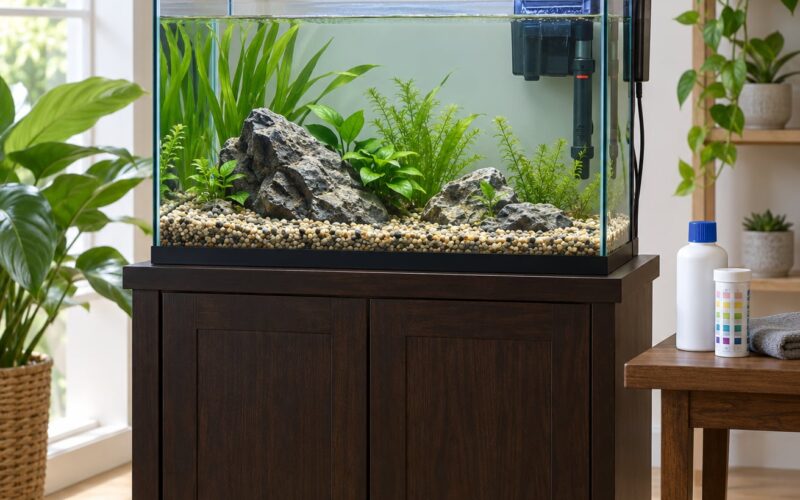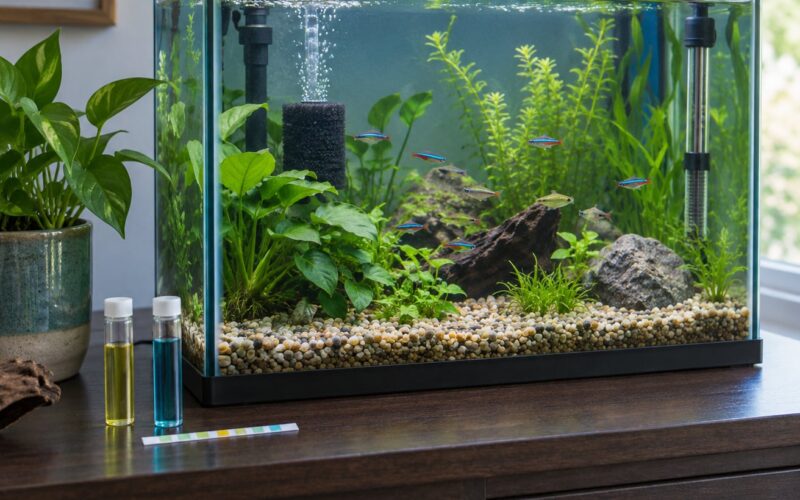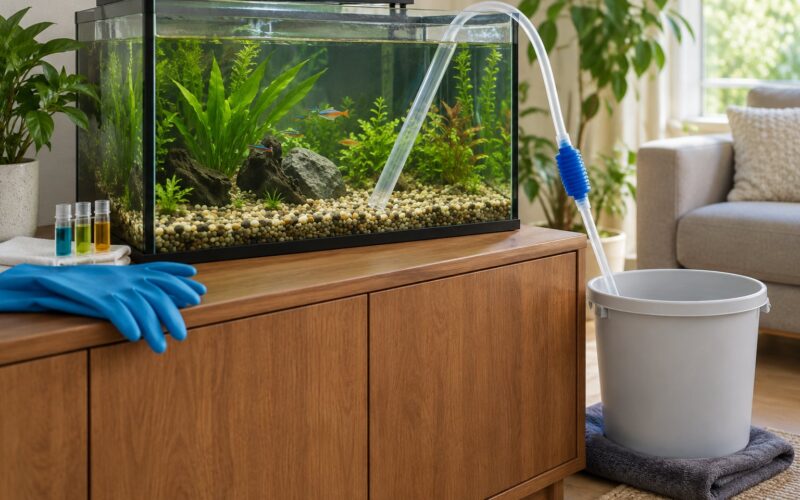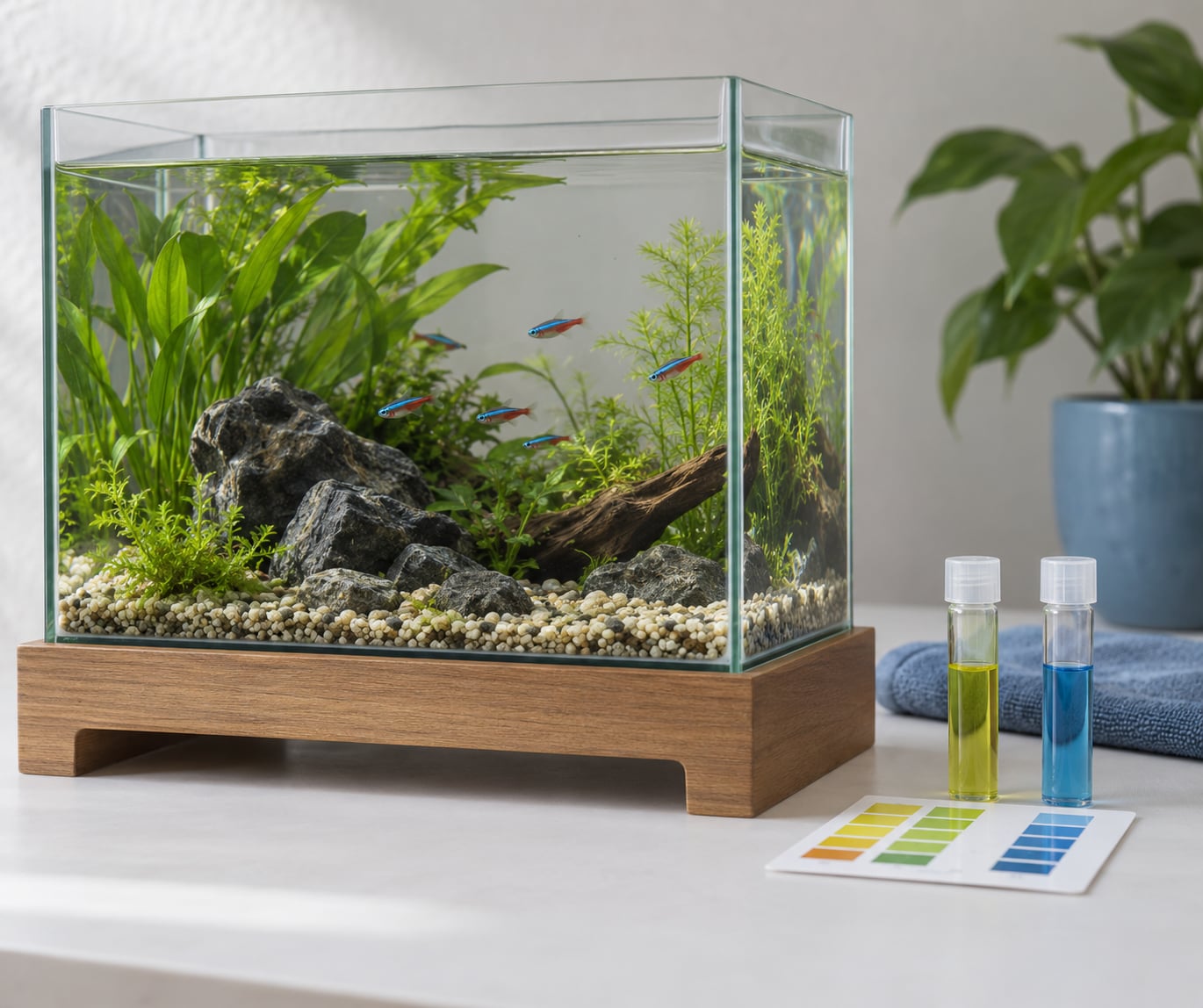
Testing aquarium water means measuring ammonia, nitrite, nitrate, pH and temperature with a liquid reagent kit, test strips or an electronic meter, then comparing each number against the safe range for your livestock. In a healthy freshwater aquarium, ammonia and nitrite both read 0 ppm, nitrate sits below roughly 40 ppm, and pH is stable. The whole routine takes 10 to 15 minutes.
That last part is the one people rush. A number on its own tells you very little, because a snapshot has no memory. What matters is whether ammonia and nitrite are at zero, whether nitrate is climbing, and whether pH holds steady from week to week.
Beginners reading their first test strip often assume the colour they matched is the colour that is there. Most of the time the number is right and the interpretation is off. This guide covers the technique, the targets, and what to do when a result is bad.
Table of Contents
- What You Need
- Step-by-Step: How to Test Aquarium Water and Read Results
- 1. Check the aquarium and test-kit instructions before you sample
- 2. Collect a representative water sample
- 3. Test pH, ammonia, nitrite and nitrate in order
- 4. Check temperature and, when relevant, salinity
- 5. Record the results and interpret them in context
- Common Mistakes That Give You False Results
- Improve Your Testing Routine
- Frequently Asked Questions
- How often should I test aquarium water?
- Are aquarium test strips accurate enough, or should I use a liquid test kit?
- What does zero ammonia mean in a new aquarium?
- Why did my aquarium pH change suddenly?
- How do I test salinity in a saltwater aquarium?
- Should I retest aquarium water if a result looks bad?
- Conclusion
What You Need
A complete testing setup costs less than most people expect and lasts years. You need five things, and two of them are free.
- A liquid reagent test kit for ammonia, nitrite, nitrate and pH. This is the accurate option and the one this guide assumes below.
- A clean sample container or the vial that came with the kit. Rinse it with tank water, never detergent and never tap water, and let it air dry.
- A thermometer, either a floating one in the tank or an infrared gun reading the surface.
- A printed reference card or colour chart, taped to the wall next to the tank where you can hold the tube up to it.
- A notebook or phone spreadsheet. Ten seconds to write four numbers now saves hours of guessing later.
Test strips are a fine addition rather than a replacement. Keep a strip on hand for the moments you need an answer in ten seconds, and use the liquid kit for anything that decides whether you act.
Step-by-Step: How to Test Aquarium Water and Read Results
1. Check the aquarium and test-kit instructions before you sample
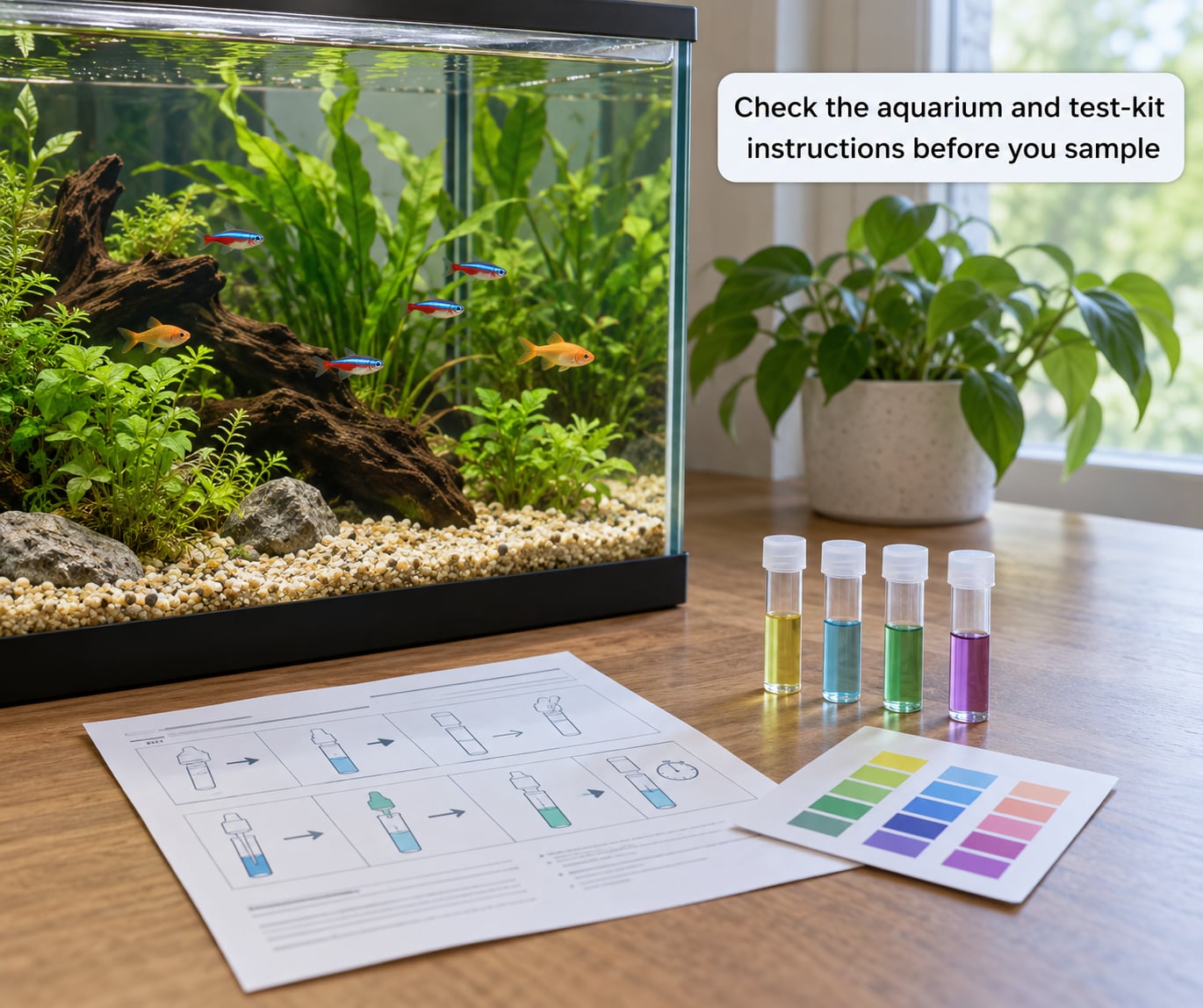
Before touching the water, work out what system you are running and what the kit expects. A freshwater kit measures ammonia, nitrite, nitrate, pH and usually KH and GH. A marine or reef kit adds salinity, calcium, alkalinity and magnesium, and its pH and alkalinity targets are different numbers entirely.
Read the instruction sheet rather than working from memory. Drop counts change between brands, and the order of addition matters. Two kits from different manufacturers with the same colour chart can use different drop counts, which is exactly how people end up reading a false zero.
Also check the expiration dates on the reagent bottles. Heat and humidity degrade them, and a kit that has sat open through a summer in a warm cupboard will read slightly high or slightly low with no warning.
2. Collect a representative water sample
Where you draw from changes the answer more than most people realise. Take the sample from inside the tank, but away from the substrate, the filter intake and any equipment that has just been running. Water straight off a bubbler carries a cloud of air that ruins a pH reading.
Rinse the vial with tank water first, then fill it to the marked line. Overfilling dilutes the sample and skews the result downward. Underfilling raises it. The line exists for a reason.
If you are chasing a problem, sample in the morning before feeding, and test within a few minutes. Ammonia levels rise through the day as fish produce waste, and nitrate climbs after you feed. A sample taken straight after a large water change tells you about your tap water more than your tank.
3. Test pH, ammonia, nitrite and nitrate in order
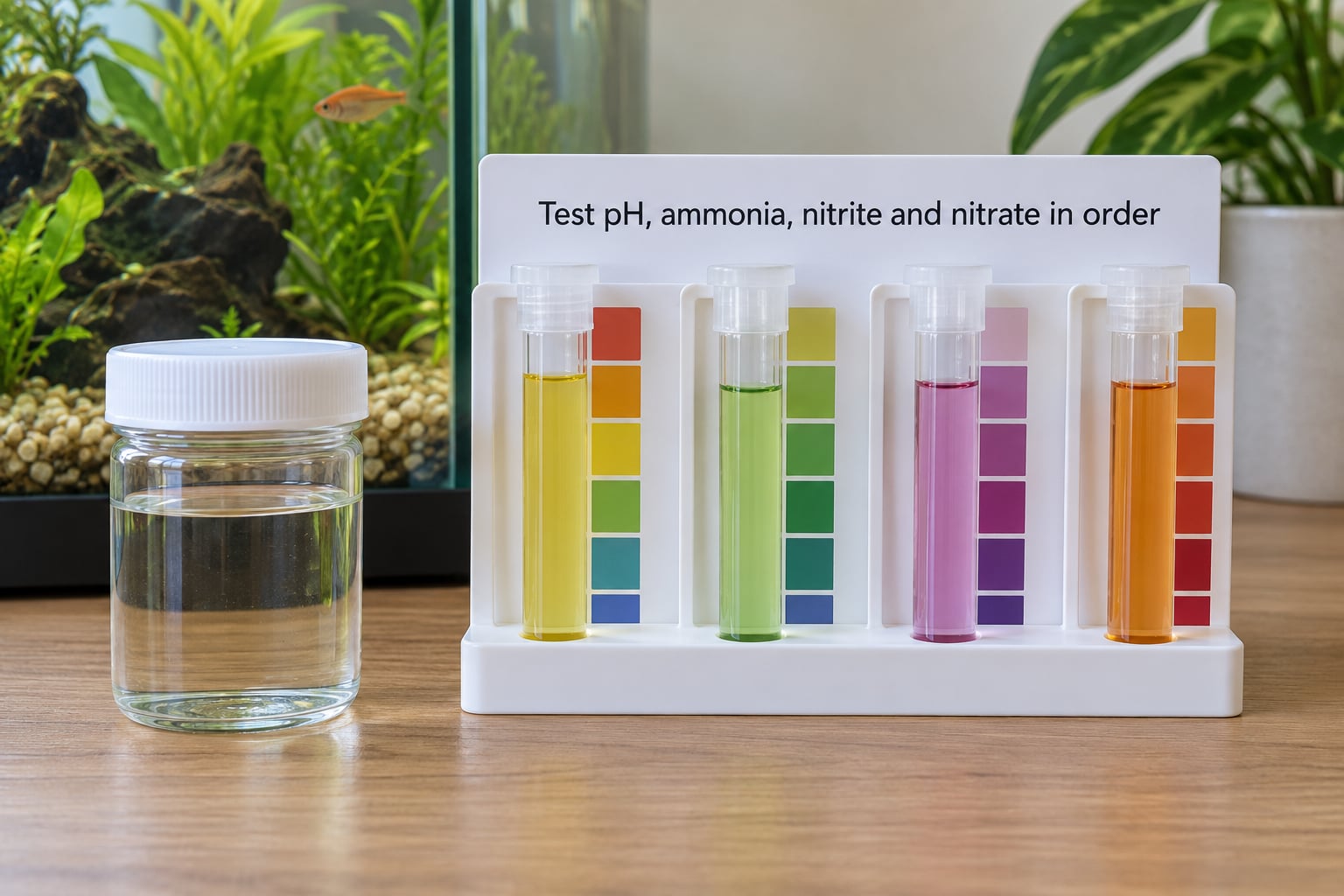
Run one test at a time, in the order the manual gives you. Most kits want the pH test first because pH affects how the other reagents colour.
Shake each reagent bottle hard for about ten seconds. Settled reagent gives you a weak, wrong result, and the nitrate bottle is the usual culprit because the powder settles fast.
Add the drops one at a time with the vial held at eye level. Swirl after every drop to coat the sides, cap it, and shake again. If a drop lands on the sidewall above the water line and you have counted it, you have counted a reagent that never mixed in.
Then read at the stated time. Not early, not late. The instruction sheet gives a window, usually somewhere between 30 seconds and 5 minutes, and colour keeps developing past it. A nitrite test read at ten minutes looks higher than the same test read at three minutes, which is why forums are full of people who get different answers from identical water.
Hold the vial against the colour chart in natural daylight or bright indirect light. A warm overhead bulb tints both the sample and your perception of it, and aquarium lights make everything look yellow. White background, daylight, no warm bulb.
Match the closest colour, not the one you want. If the sample sits between two swatches, take the higher number while you are troubleshooting. Under-reporting a problem is more expensive than chasing a number that turns out to be rounding.
4. Check temperature and, when relevant, salinity
Temperature is the easiest reading in the tank and the one people skip. Most freshwater community fish do well around 23 to 26 °C, and discus, some loaches and other species need warmer. What matters more than the number is stability, because a swing of a few degrees in a day stresses fish far more than a stable temperature slightly off the ideal.
Saltwater and brackish tanks need salinity. Use a refractometer for accurate work and a hydrometer only if you have nothing better. Hydrometers read low and drift with temperature, which is why reef keepers treat them as a rough instrument. Marine systems typically sit around 35 ppt, and reef systems often run slightly lower and hold alkalinity stable instead.
Never chase a number you found on a forum. Salinity, pH, alkalinity and temperature targets are species-specific, and the correct range for one tank can be wrong for the next one down the shelf.
5. Record the results and interpret them in context
Write all four numbers down, every time, with the date. Here is the reference frame for a freshwater community aquarium.
| Parameter | Target range | Warning threshold | What a bad reading means | What to do |
|---|---|---|---|---|
| Ammonia (NH3/NH4) | 0 ppm | Any detection | Waste is not being converted; burn risk | Stop feeding, water change, test daily |
| Nitrite (NO2-) | 0 ppm | 0.25 ppm or more | First stage of the cycle is stalled or incomplete | Water change, dose dechlorinator, test again tomorrow |
| Nitrate (NO3-) | Under 40 ppm | Over 40 ppm | Cycle is working; nitrogen is accumulating | Reduce feeding, schedule water changes |
| pH | 6.5 to 7.5 typical | Shift of 0.5 or more in a week | Something is changing in the water, not the fish | Check KH, check for a crashing buffer |
| Temperature | 23 to 26 °C | Swing over 2 °C in a day | Immune stress, slowed feeding | Heater check, unplug a struggling heater |
Two details in that table carry more weight than the numbers. First, ammonia and nitrite have no acceptable range: at 0.25 ppm you have a problem, not a target. Second, the direction and speed of change beat the absolute number. A pH of 7.2 that has sat there for a year is healthier than 7.5 that arrived overnight.
If you want a second reference point, read the nitrogen cycle in 30 seconds: ammonia is the raw waste, nitrite is what the first group of bacteria makes from it, and nitrate is what the second group makes from that. Two zeros and a low, stable number is the goal.
Common Mistakes That Give You False Results
Most bad readings come from technique, not from a broken tank. Colour matching on the nitrate scale is the single most complained-about skill in the hobby, and it is fixable.
| Mistake | Which way the reading skews | How to avoid it |
|---|---|---|
| Expired or heat-damaged reagents | Falsely high or low | Check the date on every bottle, store below 25 °C |
| Not shaking the reagent bottle | Falsely low | Shake each bottle 10 seconds before use |
| Too few drops counted | Falsely low | Hold the vial at eye level and count out loud |
| Reading past the stated time | Falsely high | Use a phone timer, read inside the window |
| Wet vial or water on the dropper tip | Falsely low | Use dry hands, keep caps on |
| Comparing under a warm aquarium light | Distorted, both ways | Use daylight or bright neutral light |
| Testing chlorinated tap water | False readings across the board | Test the tap separately, before treatment |
| Testing water from the substrate or filter intake | Falsely high | Sample mid-water, above the gravel |
One more trap deserves its own note. Certain dechlorinators interfere with reagent results, which is why experienced keepers test straight from the tap with no treatment added. Check your municipal water report, run an untreated tap sample once, and you will know whether your source water is interfering before you ever blame your biofilter.
If a reading is bad, here is the triage. Stop feeding for a day, do a 25 to 30 percent water change with dechlorinated water, retest the same parameters, and act again only if the second reading is still bad. Change one thing at a time so you know what worked.
Improve Your Testing Routine
Test at the same time of day, before feeding, so the numbers compare cleanly against each other. Keep the log going after the tank is stable, because the day you notice a slow nitrate climb is the day you have time to do something cheap about it.
Test daily while cycling, twice a week in a settled tank, and immediately after adding livestock, dosing medication, or moving filter media. And test against targets for your species, not generic internet ranges. If you are not sure what your fish needs, that is a conversation for a vet or a species reference, not a forum poll.
Frequently Asked Questions
How often should I test aquarium water?
Test daily while a new aquarium is cycling, twice a week once it is settled and stable, and right after anything disruptive: adding livestock, dosing medication, moving filter media, or a large water change. If fish show signs of illness, test every day until you have a clear trend. Frequency matters less than consistency, so pick a schedule you will actually keep and test at the same time of day, ideally before feeding.
Are aquarium test strips accurate enough, or should I use a liquid test kit?
Liquid reagent kits are more accurate and are the better choice for anything that decides whether you act, especially ammonia and nitrite. Strips are fine for a fast daily check, and they are quick enough for a beginner to use consistently. Their main limits are colour-matching difficulty, humidity sensitivity, and a limited range. Experienced keepers generally steer beginners toward the liquid kit because the drop count is fixed and the colour chart is easier to read.
What does zero ammonia mean in a new aquarium?
Zero ammonia in a new aquarium is good news, but it is not proof the cycle is finished. Ammonia disappears once the bacteria converting it are established, which can happen before the bacteria converting nitrite are settled. Check that nitrite is also zero and that nitrate is present at a low, stable level before you add fish. Treating your tank as cycled too early is one of the most common reasons a new aquarium later shows an ammonia spike.
Why did my aquarium pH change suddenly?
A sudden pH move is usually the water changing, not the fish. Common causes include a crash in carbonate hardness (dKH), a large water change with water of a different pH, a dying piece of driftwood or stone, exhausted or replaced filter media, or a heater failing and cycling on and off. Check your KH, retest after a small water change with treated water, and change water gradually rather than all at once. Never chase pH with chemical buffers blindly.
How do I test salinity in a saltwater aquarium?
Use a refractometer for accurate readings and calibrate it with the solution that came with it. A hydrometer is cheaper but reads low and drifts as temperature changes, so treat it as rough. Marine systems usually run around 35 ppt, while reef systems often sit a little lower and focus on holding alkalinity stable. Salinity and temperature both need to be stable day to day, because swings stress fish more than a slightly off target number.
Should I retest aquarium water if a result looks bad?
Yes. Retest before you act, because a surprising number is more often a technique error than a real emergency. Take a fresh sample from mid-water, check your reagent dates and drop count, read at the stated time in daylight, and run the test a second time. If the second reading matches the first and it is bad, stop feeding, do a 25 to 30 percent water change with dechlorinated water, and test again tomorrow before making any larger change.
Conclusion
Test the water, compare each result against the target for your specific species, and write the four numbers down with the date. That is the whole routine and it takes about fifteen minutes.
When something looks wrong, retest before you panic, then act gradually: stop feeding, do a 25 to 30 percent water change with dechlorinated water, and test again tomorrow. For any fish showing signs of illness, talk to a vet, since water chemistry is one piece of a larger picture and not a diagnosis.
Last reviewed October 2026.