To clean cat urine smell permanently you have to remove the wet source, treat every contaminated surface with an enzyme cleaner, give that cleaner real dwell time, and dry the area completely. The smell comes back in most homes because dried urine leaves uric acid crystals and ammonia byproducts soaked into fibers, foam, carpet padding and grout, and any humidity wakes them up again.
That last part is why a spot can look perfectly clean and still smell the next morning. The visible stain is only the top of the problem. What you actually need to clean is whatever the urine soaked into, which is usually somewhere you cannot see.
The active work takes 30 to 60 minutes for a single accident. Drying is what takes the rest of the time, and rushing it is the number one reason people think the method failed.
Table of Contents
- What You Need
- Step-by-Step: How to Clean Cat Urine Smell Permanently
- How to find and remove the urine source
- How to clean cat urine from hard floors
- How to clean cat urine smell from carpets and rugs
- How to treat urine on couches, beds, and curtains
- How to stop the odor from coming back
- Common Mistakes
- Frequently Asked Questions
- What is the best cleaner for cat urine smell?
- Does vinegar remove cat urine smell permanently?
- Why does my carpet still smell like cat urine after cleaning?
- Can baking soda get rid of a cat urine smell?
- When should I take my cat to the vet for urination changes?
- Conclusion
What You Need
A cat urine cleanup needs very little, and most of it you probably already own. The only product that genuinely matters is an enzyme cleaner, meaning one that digests the urea molecules rather than masking the odor with fragrance.
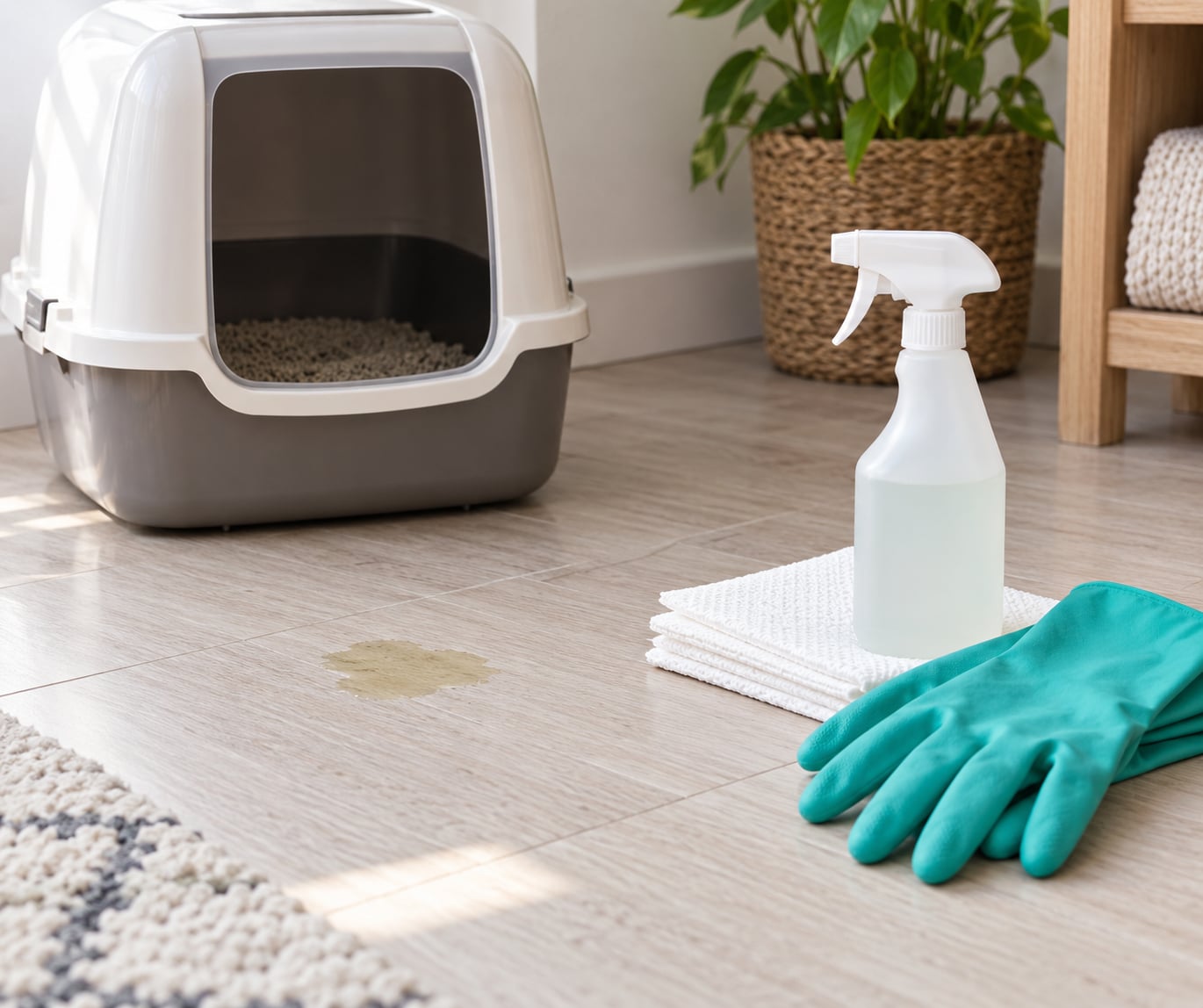
- Disposable towels or old cloths for blotting. Paper towels work well on hard floors because they absorb without leaving lint.
- Nitrile or rubber gloves, because you are touching an area your cat considers a toilet.
- An enzyme-based urine cleaner labelled for the surface you have: carpet, upholstery, wood, tile or concrete. Labels matter more than brands here.
- A soft brush, stiff bristle or toothbrush, for agitation on carpet fibers and seams.
- A handheld or shop vacuum if the accident landed on carpet or an upholstered cushion.
- A UV or blacklight flashlight if you have cleaned before and the smell keeps returning, since old spots are invisible.
- Baking soda for absorbing moisture on carpet before you treat it, not as a cleaner on its own.
Before you use anything on a surface, patch test an inconspicuous corner and wait the time printed on the label. Sealed hardwood, finished tile and most upholstery will not react, but natural stone, dyed wool and rubber-backed rugs can discolor or swell, and you will not find out until the whole area is damp.
Two safety rules apply to every method below. Never mix products, because bleach with vinegar or bleach with ammonia releases toxic gas. And keep the cat out of the room until every treated surface is fully dry to the touch, not just surface dry, because cats walk on damp carpet and then groom that paw.
Step-by-Step: How to Clean Cat Urine Smell Permanently
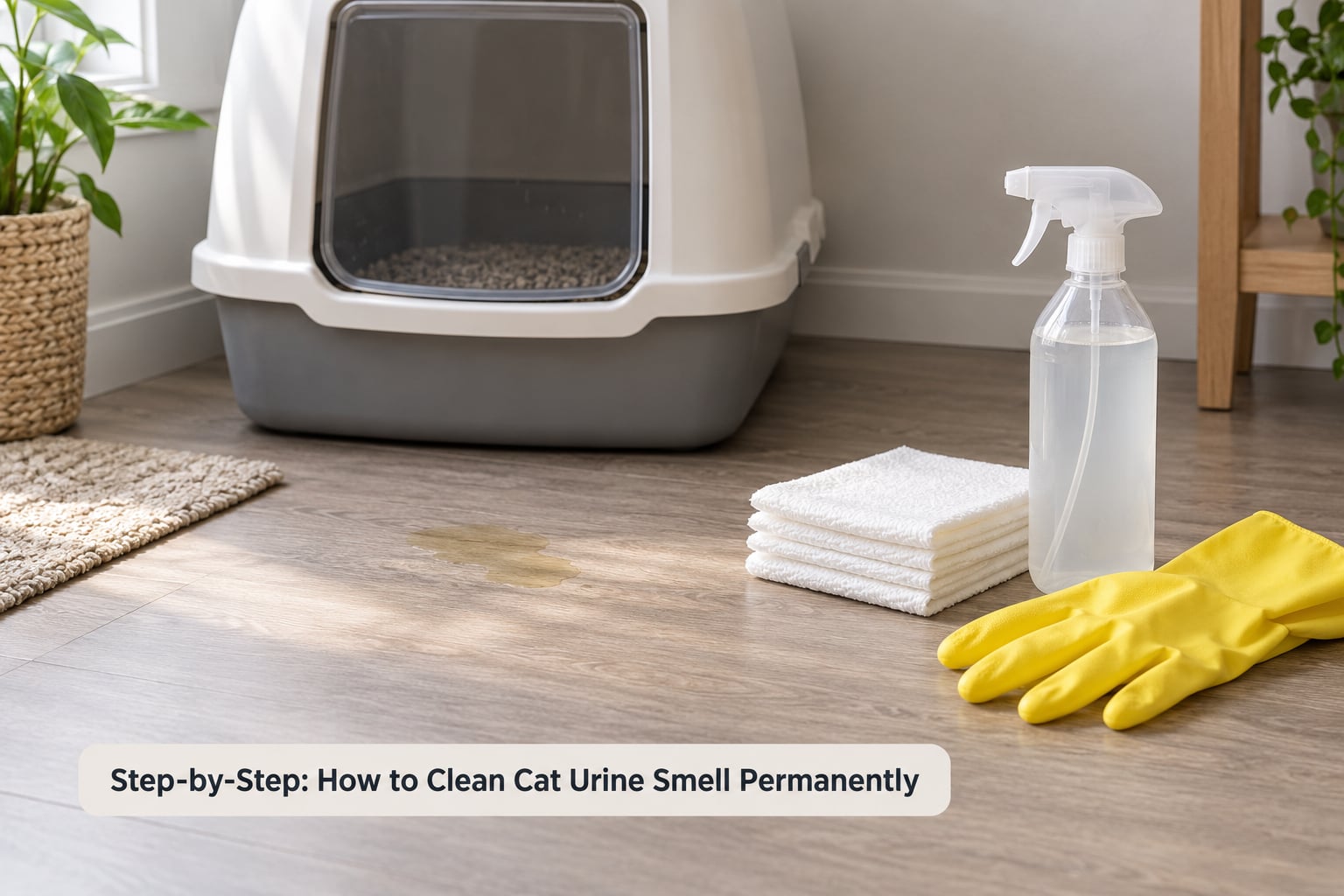
This process works because it attacks the urine in three separate places: the surface, the padding or foam below it, and the reason the cat chose that spot in the first place. Skipping any one of the three means the odor comes back, usually within days.
How to find and remove the urine source
Finding the source is the part that decides whether the job lasts, because as long as the source exists the smell will return. Start with the litter box itself, then the floor directly beside it, since a lot of cats miss the edge while standing.
Check the obvious places in this order: bedding, laundry baskets, shoes by the door, couch corners, the seam of a mattress, under a bed, doorways, and the wall or window edge nearest a window or another cat’s territory. Cats that are marking a vertical surface leave a smaller, higher-up patch than cats that are house-soiling.
Sit on the floor at your cat’s eye level and look for pale patches in the carpet, since dried residue often turns yellow or white and catches the light differently from undyed fibers. In a dark room, shine a UV flashlight along the floor after everyone has gone to bed, and watch for the bright patches and the glow in the grout lines.
Once you find the source, remove the wet material immediately. Pull up soaked bedding or padding, take out the washable covers, and blot hard floors with towels working from the outside inward. Blotting lifts the liquid; scrubbing presses it deeper into the fibers and seams, which is where it survives.
How to clean cat urine from hard floors
On tile, sealed wood, laminate or vinyl, cat urine is one of the easier problems because the surface does not absorb, so the mess sits on top unless it ran into a seam. Blot first with dry towels until the surface is damp rather than wet, then change to a clean towel for the next stage.
Apply the enzyme cleaner at full strength as the label directs, covering not only the stain but about 15 cm of floor around it, since urine travels along the wet edge. Leave the floor damp for the stated contact time, usually 15 to 30 minutes, and do not wipe it dry at the end. The cleaner needs to stay wet to keep working.
Rinse only when the product instructions ask for it. Over-wetting hardwood drives moisture under the floorboards and into the subfloor, which is a much bigger job. Airflow from a fan across the area finishes the drying faster than you would think.
Never use bleach, ammonia, or a vinegar-only treatment here. Bleach reacts dangerously with vinegar, and ammonia leaves a smell close enough to urine to invite your cat back to the same spot.
How to clean cat urine smell from carpets and rugs
Carpet is where most people give up, because the smell comes from the pad and backing, not the fibers you can see. For a fresh accident, absorb what you can, then vacuum the residue once the area is dry enough to walk on.
For an old dried spot, work a carpet-safe enzyme cleaner into the fibers with a soft brush, using roughly as much cleaner as there was urine that soaked in. That dosage rule of thumb comes from carpet cleaning professionals and it matters, because dilute product means the enzymes never reach a useful concentration.
Let it sit damp overnight if you can. A carpet can hold moisture in the pad for a day or two, and if you only give it twenty minutes the enzymes finish their work too early.
Dry the carpet with airflow and, if you own one, a dehumidifier. Then wait until it is completely dry and check whether the odor returns. If the smell is still there the next day, treat the same spot a second time, and a third if needed. Multiple threads on carpet cleaning forums describe two or three applications as normal for a soaked area.
If the pad itself is saturated, no surface product will fix it permanently. Pulling up an edge of the carpet to look at the pad tells you what you are dealing with, and a soaked pad usually means replacing that section of carpet or calling in a professional extractor.
How to treat urine on couches, beds, and curtains
Upholstery follows the same rule as carpet, with one extra difficulty: the foam inside a cushion or the core of a mattress keeps liquid far longer than the outer fabric does. Cleaning the visible upholstery without reaching the foam is why couch smells return for months.
Check the care label first and remove any covers you can, since covers are usually washable and treat them separately on their own cycle. Blot from the outside of the stain inward, changing towels often, and never rub a cushion because that drives urine into the seam.
For removable cushions, saturate the foam through the fabric with a fabric-safe enzyme cleaner and let the cushion sit in a well-ventilated spot for several hours before drying. To get into a couch seam you cannot open, inject a small amount of undiluted cleaner through the upholstery with a syringe and blot what comes out, repeating on the other side of the seam.
Repeat the treatment for deeply soaked materials, because foam needs more than one pass. And be honest about the exceptions: wool, velvet, leather and anything antique or expensive are better handled by a professional, since water and enzymes can shrink, stiffen or discolor these fabrics permanently.
How to stop the odor from coming back
The odor returns when the underlying reason for the accident is still there, so prevention targets the litter box and the cat’s stress level rather than the carpet. The most common causes are a dirty box, too few boxes, a box in a noisy or blocked location, and territorial tension in a multi-cat home.
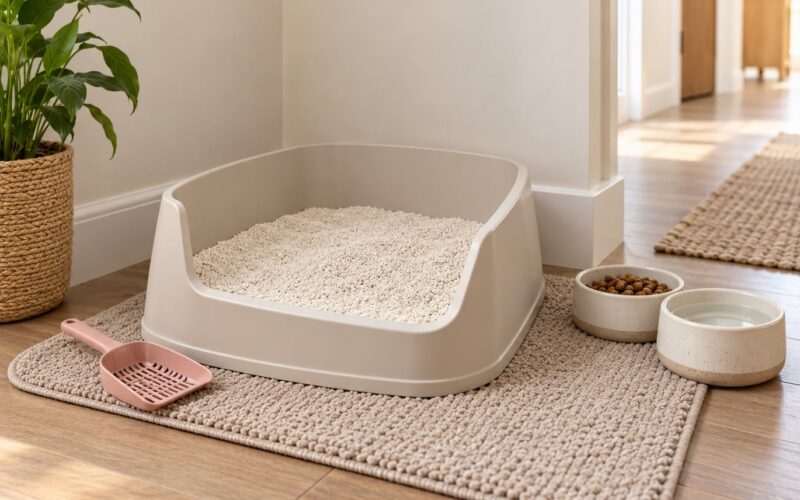
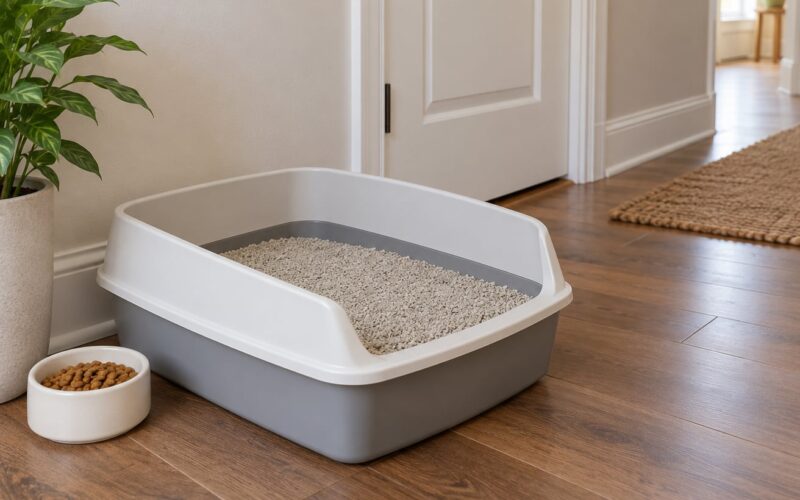
The rule of thumb most cat behaviorists use is one litter box per cat plus one. Scoop every day, wash the box with unscented soap on a schedule you can keep, and choose unscented clumping litter since many cats reject strongly perfumed litter and then eliminate outside the box. A stainless steel or ceramic box holds less odor than plastic and is easier to rinse, which matters when urine has soaked into the base.
Reduce stress where you can: keep the box away from noisy appliances and appliances that hiss, provide more than one exit route per room, and give each cat somewhere high to sit. If accidents started suddenly rather than gradually, that is a medical question rather than a behavioral one.
Take your cat to the veterinarian when accidents are frequent, sudden, or accompanied by blood, straining, crying, vomiting, or a change in litter box habits. Urinary crystals, a urinary infection, arthritis pain and kidney problems all present as house-soiling, and none of them get better with a better enzyme cleaner.
Common Mistakes
Almost every frustrating cleanup fails the same way, and the fix for each is cheap. Here are the mistakes I would correct first in someone else’s house.
- Masking the odor with fragrance. Air fresheners and scented sprays add a smell on top of a smell, and they do nothing about the source. Your nose adapts to them within days while the urine odor stays.
- Using ammonia. Ammonia is a breakdown product of urine, so a surface that smells like ammonia reads as a bathroom to a cat. Many cats come straight back to a spot cleaned with it.
- Using bleach. Bleach does not remove urine, it can set protein stains, and mixing it with vinegar or ammonia produces toxic gas.
- Cleaning only the visible spot. Urine spreads sideways under the surface far wider than the mark you can see. Always treat 15 to 30 cm beyond the stain.
- Scrubbing instead of blotting. Scrubbing drives liquid deeper into padding, foam and seam. Blot and let the product sit.
- Rushing the dwell time. Drying the surface after a few minutes cancels the enzyme action. Keep it damp for the label time and expect overnight on carpet.
- Using a cleaner unsafe for the surface. Enzyme products are not interchangeable across natural stone, dyed wool, sealed wood and rubber-backed rugs. Patch test first.
- Letting the cat back in before it is dry. Damp carpet is walked on and then groomed. Keep the room closed until it is dry to the touch all the way through the pad.
Two more worth naming. Vinegar on its own is a deodorizer that changes pH briefly, not a digester of the urea molecules, so it can leave the odor intact and tempt the cat back. And a diluted or expired enzyme product often does nothing at all, which is the honest reason some people say that enzyme cleaners stopped working for them.
If the smell is still strong after two full treatments spread over a few days, no scented product will save you at that point. The source is either deeper than your product reaches or the cat is urinating there again.
Frequently Asked Questions
What is the best cleaner for cat urine smell?
An enzyme cleaner labelled for urine is the best option, because it breaks down the urea molecules that create the odor instead of covering them. Apply it undiluted at full strength, cover the whole stained area plus the edges around it, keep it damp for the label contact time, and let the surface air dry. Look for a pet-safe, fragrance-free formula and patch test on upholstery or natural stone first. Expect two or three applications for a soaked area.
Does vinegar remove cat urine smell permanently?
Vinegar alone does not remove cat urine smell permanently. It changes the surface pH briefly, which freshens the area for a few hours, but it does not digest the uric acid crystals and urea residue soaked into padding, foam or grout, so the odor returns. A vinegar solution can also smell slightly acidic to a cat and invite repeat marking in the same spot. Use vinegar, if at all, only as a mild pre-treatment for hard surfaces, followed by a proper enzyme cleaner.
Why does my carpet still smell like cat urine after cleaning?
Usually because the urine went past the fibers into the carpet pad and backing, where surface spraying cannot reach. Urine travels along the wet front as it soaks in, so the contaminated area is much larger than the visible stain, and dried crystals reactivate whenever the carpet holds humidity. Other reasons include not keeping the cleaner damp for the full contact time, applying it too diluted to be effective, or the cat continuing to urinate in the same spot. A soaked pad usually requires professional extraction or replacement.
Can baking soda get rid of a cat urine smell?
Baking soda absorbs moisture and helps pull liquid out of carpet fibers, which makes it a useful first step on a fresh accident. On its own it does not remove cat urine smell, because it has no way to break down the urea and uric acid residue left behind. People on pet forums report decent results by covering a spot with baking soda for several hours, vacuuming it up, and then treating the area with an enzyme cleaner. Always clean your vacuum afterwards, since the powder is fine and abrasive.
When should I take my cat to the vet for urination changes?
Take your cat in when house-soiling starts suddenly, when accidents become more frequent, or when you notice straining, crying in the box, blood in the urine, vomiting, or a drop in appetite. Urinary crystals, urinary infection, kidney problems and arthritis pain all cause cats to stop using the litter box, and none of them resolve with cleaning products or more litter boxes. A quick check by a veterinarian rules out a medical cause before you spend money on deodorizing a spot the cat will simply re-mark tomorrow.
Conclusion
Start by finding the source, not by buying another spray. Locate every affected spot, remove and dispose of soaked material, then apply an enzyme cleaner at full strength to the whole area, keep it damp for the full contact time, and let the surface dry completely before the cat goes back in.
If the odor survives two honest treatments, the urine reached the pad or the foam, and that is a job for a professional extractor. If the accidents keep happening, that is a conversation with your veterinarian, not a cleaning problem. Getting the litter box right, one box per cat plus one, scooped daily, prevents most repeat accidents before they start.