To trim cat claws without a fight, clip only the clear white tips, work on two or three nails per sitting, and give a treat straight after every single nail. Most cats need a week or two of reward-based handling practice before a real trim, so the calm part happens long before the clippers come out.
That is the honest version. Cats do not dislike nail trims because of the snip, they dislike losing control of their feet. Pinch a paw and the cat learns that paws mean restraint, and the next session starts from a worse place than the last one. Training the association first is slower on paper and much faster in practice.
Table of Contents
- What You Need
- Step-by-Step
- Choose the Right Moment and Place
- Let Your Cat Get Used to the Clippers
- Touch One Paw at a Time
- Introduce the Sound and Closing Motion
- Trim One Small Section at a Time
- Finish Gradually and Check the Claws
- Common Mistakes
- Frequently Asked Questions
- Where should I cut a cat’s claw?
- What should I do if I accidentally cut a cat’s quick?
- How do I trim a cat’s dewclaw safely?
- How long should a claw-trimming session be?
- What can I do if my cat will not let me touch its paws?
- Conclusion
What You Need
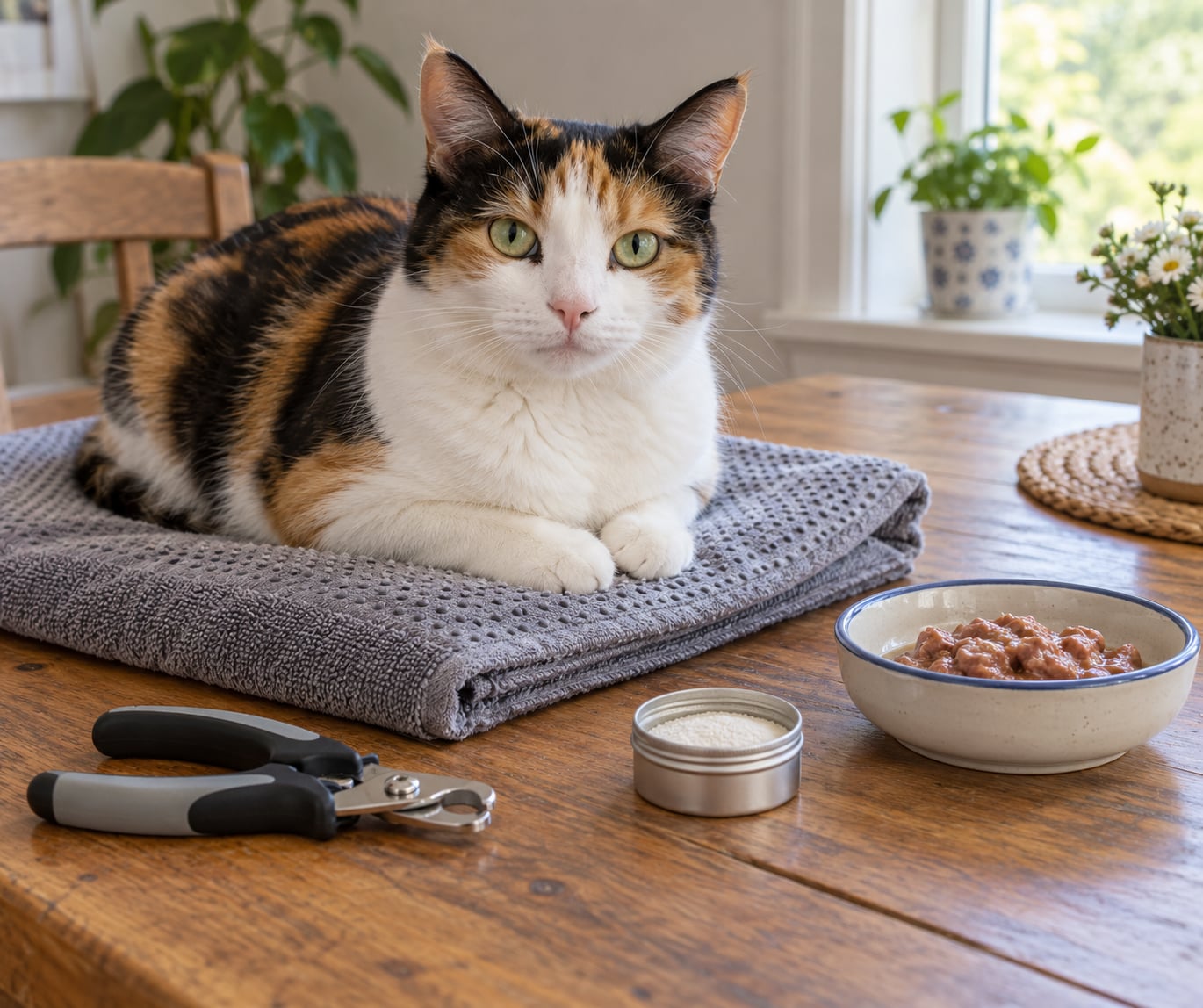
You need fewer things than most cat owners expect: sharp clippers, styptic powder within reach, a small towel, high-value treats, and a calm, nonslip surface to work on.
Sharp clippers matter more than the brand. A dull blade crushes and splits the claw instead of cutting it, which hurts and makes the cat wary for weeks. Cat-specific clippers are built with a wider, flatter jaw for a cat’s curved claw, and that is why they are worth having over human nail clippers, whose narrow straight jaws can split a claw down the side.
Sharp human clippers will do in a pinch if you are careful, and plenty of vets use them. What does not work is a pair with a hinge that wobbles or a blade that has been used on card.
Styptic powder is the single most useful thing to have nearby. Cornstarch works in a pinch, and so does pressing a clean dry bar of soap or a damp cloth firmly against the tip. Styptic powder is better because it works on contact and stops the bleeding fastest.
For treats, use something your cat normally turns down. Wet food, a lickable treat, or a tiny bit of raw fish beats a dry kibble every time. Licking takes a few seconds, which gives you time to release the paw before the cat pulls it away.
Before you start, close the doors and windows in the room, lay the towel down so the surface grips, and have good light. In a multi-cat household, shut the other cats out. Owners on r/CatAdvice and r/CatTraining mention the interruption from a second cat as one of the most common ways a session derails.
If you have no clippers at all, a nail file or a cat nail grinder works. Both are slower and both make noise or vibration, so they suit a cat already comfortable with paw handling rather than a cat you are still training.
Step-by-Step
Here is how to trim cat claws without a fight in practice: work through these six steps slowly across several sessions rather than in one sitting. Stop while your cat is still relaxed, not after it has objected. Two or three nails a day finished calmly beats all eighteen finished in a wrestling match.
Choose the Right Moment and Place
Start after a meal, after a play session, or during a quiet cuddle, when your cat is already drowsy and full. Sleepy cats are the easiest to start with, which is why trainers often suggest practising paw touches while yours is dozing on your lap.
Set up on a stable surface that your cat already likes, such as a towel on the sofa or a table top they know. Keep the whole thing short, about a minute or two, if your cat is alert or distracted. A cat that is still watching the clippers is not ready, however much you would like to get on with it.
Let Your Cat Get Used to the Clippers
Put the clippers on the floor or the towel, visible but not picked up, and go about your business. Most cats will sniff them. When your cat investigates without walking off, mark the moment with a treat.
Next session, hold the clippers near your cat and treat. After a few days, bring them close enough that your cat can smell the metal. Do not touch a paw with them yet. The point of this step is that the sight of the tool alone stops predicting something bad.
Touch One Paw at a Time
Gently massage a paw for one or two seconds, then release and treat. That is the whole exercise. Repeat three or four times, then end the session while your cat is still relaxed.
If your cat pulls away, freezes, flattens its ears, swats, or vocalises, you have gone past the edge. Go back one step, or back to the treat only, and try again tomorrow. Owners who switched from holding the cat down to a treat-after-every-paw routine report that the swatting and biting usually stopped within a couple of weeks.
Introduce the Sound and Closing Motion
Once paws are fine, open and close the clippers in the air near your cat and treat. The click is the scary part for many cats, not the cut. Let the sound happen, deliver the treat, and repeat.
After a few sessions, rest the open blades against a treat so your cat has to put its mouth near the tool to collect the reward. Progress only when your cat stays relaxed between repetitions. If the click makes your cat leave the room, drop back a step rather than pushing through.
Trim One Small Section at a Time
Hold the paw gently in one hand, press lightly on the top of the toe just behind the claw to extend it, and take the claw in your other hand.
Look for the translucent white tip. The quick is the pink wedge further back, containing blood vessels and nerves, and on a dark claw you will not see it at all, so cut less. Make several small cuts across the white tip rather than one deep squeeze, and release the paw before you treat it.
A dewclaw is the small claw on the inner side of the front paw that never touches the ground. It needs trimming more often than the others because nothing wears it down, and it can grow long enough to curl back into the pad.
Finish Gradually and Check the Claws
Switch to another paw, reward, and then stop. A session of two nails across two or three days is a successful session, not a failure.
Plan the next one for the day after tomorrow, and finish your cat’s claws over the following week or so. Before you stop, run a finger over the tips: they should feel rounded and blunt, with no hook. If a sharp hook remains, one more small cut, next session.
Trim every two to four weeks once your cat accepts the routine. Signs that claws have gone too long include hooks catching on blankets or carpet, tips visible while the cat is resting, a claw that struggles to retract, and a tapping sound when the cat walks across a hard floor. Many cats, particularly outdoor and feral ones, wear their own claws down through scratching and need very little help.
Common Mistakes
Most bad trims trace back to rushing, and knowing how to trim cat claws without a fight means learning to stop early. A cat who is still willing to come back tomorrow is being trained. A cat who hides under the bed for an afternoon is not.
Using dull human clippers crushes and splits the claw. Replace the tool or have the blade sharpened instead of pushing harder on a claw that will not cut cleanly.
Cutting into the quick hurts, and a cat who feels pain once will remember it for months. Take small nips from the white tip only, and remember that on dark claws the quick sits further back than you can see.
Trying to finish all four paws in one sitting guarantees you lose. Trim two nails, reward, and stop. Pushing on past the point of swatting and biting is the exact moment you teach the cat that the whole routine ends badly.
Scruffing, pinning, or wrapping the cat tightly into a towel hold does get nails cut, and trainers on r/CatTraining are blunt about the cost. A cat held down learns that paws mean being trapped, and the next trim begins with a fight already half won by the cat. If you do use a towel wrap, make it a slow, familiar wrap your cat settles into rather than a sudden restraint, and pair it with treats rather than speed.
Chasing a cat that bolts mid-session is worth skipping. Owners across the cat forums warn that catching a fleeing cat to finish the job reinforces the escape response. Close the door, let the cat go, and try again in a couple of days.
Do not sedate your cat yourself. Sedation for nail trims is a veterinary decision because of the risks to breathing, blood pressure, and recovery, and it needs a vet to assess whether your cat is a good candidate. Never give a cat any human medication.
Declawing is not an alternative to trimming. It amputates the last bone of each toe and causes lasting pain, litter-box problems, and defensive behaviour. Many animal welfare organisations and cities ban it outright. Claw caps and soft covers are also worth approaching carefully: some shelters and vets advise against them because they stop a cat retracting and grooming its claws and add stress, and others use them in specific situations under guidance. Ask your vet before fitting them rather than buying a pack online.
Call a vet rather than continuing at home if your cat limps, cries when you touch a paw, has visibly overgrown or split claws, bleeds more than a few drops or will not stop, seems genuinely painful, or cannot be handled safely by anyone in the house. A vet nurse or a groomer offering a nail-trim service is a perfectly good outcome too, and it beats a scene in your living room.
Frequently Asked Questions
Where should I cut a cat’s claw?
Cut only the translucent white tip, several small snips rather than one deep squeeze. The pink wedge further back is the quick, which carries blood vessels and nerves. On dark claws you cannot see the quick, so take less than you think you need and stop while the tip is still straight, before it turns into a hook.
What should I do if I accidentally cut a cat’s quick?
Stay calm and hold firm pressure on the tip with a clean dry cloth for a minute or two. Styptic powder or cornstarch pressed onto the tip stops it faster. Do not squeeze the whole paw, since that pushes more blood toward the claw. A single nail that bleeds briefly is usually fine, but call your vet if bleeding continues, the paw swells, or your cat seems distressed.
How do I trim a cat’s dewclaw safely?
The dewclaw is the small claw on the inner side of each front paw that never touches the ground. Because nothing wears it down, it grows long and can curl into the pad, so check it every few weeks. Treat it like any other claw: extend it gently, take small snips from the white tip, and stop well before the pink quick.
How long should a claw-trimming session be?
Keep each session to one or two minutes, and finish while your cat is still calm and willing. Two or three nails in a sitting is a good result. Spread the full set of claws over a week or so rather than trying to finish them at once. Cats that get stopped early usually come back for the next session; cats pushed too far often hide for a day.
What can I do if my cat will not let me touch its paws?
Go back to the easiest step you can manage, even if that is only a treat near your cat for a few days. Then touch one paw for a second, treat, and repeat, adding a few seconds each time. Do not chase, scruff, or towel-wrap your way to a full trim. If paw handling stays impossible despite weeks of practice, ask your vet about a fear-free appointment or a nail-trim service.
Conclusion
Start with one short session this week: three treats near the clippers on the floor, then a one-second paw touch and a treat. Repeat that until it is boring, then add the next step.
Moving to trimming cat claws without a fight is a training project measured in weeks, not minutes, and two tidy nails beats eighteen won in a wrestling match. If your cat stays fearful despite patient work, or shows pain, limping, bleeding that will not stop, or claws growing into the pads, book a vet visit and let a professional or a fear-free clinic handle it.