Most cats knead because the behavior is wired into them from birth. Kittens use the same paw motion on their mother’s belly to stimulate milk, and adult cats repeat it for the comfort it brings. So why does my cat knead with her paws? Because she is borrowing a kitten feeling of safety, and usually on something soft and familiar.
That is the short version. The rest of this guide covers the five common meanings, how to read the style of kneading, why she picks your lap instead of the blanket, when a change in the habit is worth a phone call to the vet, and what to do when the claws hurt.
Table of Contents
- Why Does My Cat Knead With Her Paws?
- What Does Cat Kneading Usually Mean?
- Nursing instinct
- Comfort and self-soothing
- Affection and bonding
- Scent marking and territory
- Making a nest
- Why some cats knead more than others
- How to Tell the Difference Between Comfort and Concern
- Kneading vs. Humping: How to Tell Them Apart
- Why Does My Cat Knead and Then Bite Me?
- Why Do Kittens Knead More Than Adult Cats?
- Why Does My Cat Knead on Me or Another Animal?
- How Your Cat’s Kneading May Change With Age
- When Should I Be Concerned About Cat Kneading?
- Should You Stop Your Cat From Kneading?
- Frequently Asked Questions
- Is it normal for cats to knead with their front paws?
- Why does my cat knead and then bite me?
- Does kneading mean my cat is in pain?
- Why does my adult cat knead when it seems too young to remember nursing?
- Should I let my cat knead my clothes every day?
- Conclusion
Why Does My Cat Knead With Her Paws?
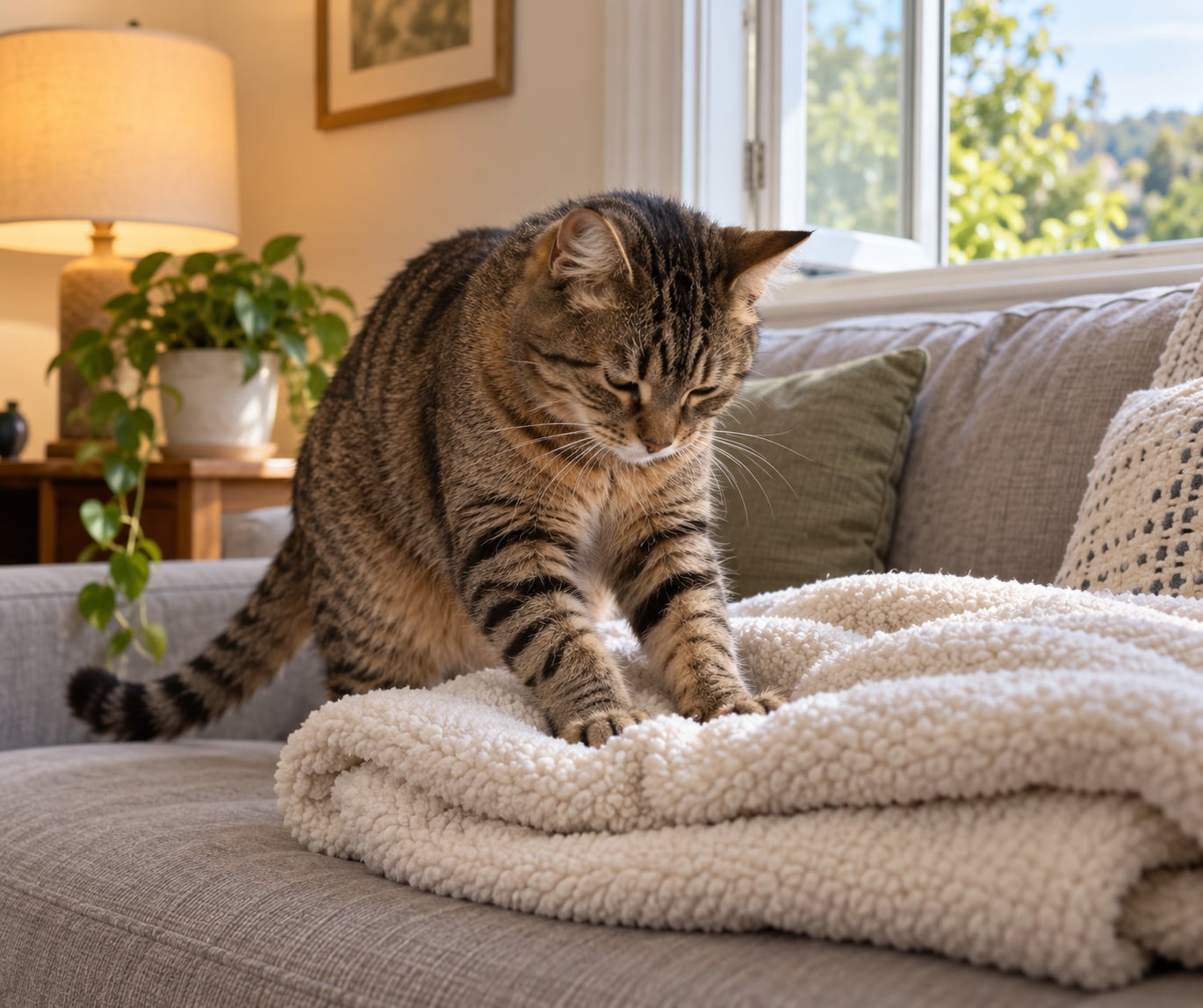
Kneading is a rhythmic, alternating push of the front paws against a soft surface, and owners call it making biscuits or working the dough for obvious reasons. It starts as a nursing reflex in kittens and survives into adulthood as a self-soothing habit, so a healthy cat kneading is normal behavior rather than a problem.
Cats spend a large share of the day asleep, and many of them run a short pre-sleep routine: circle the spot, knead it flat, then settle in. Kneading presses down a blanket’s loft and warms a sleeping surface, which is part of why it shows up so often at bedtime.
Owners sometimes see the paws open and close in the air during petting and wonder if something is wrong. It is the same reflex, just without a surface underneath it, and the same movement shows up when a cat stretches before getting up.
What Does Cat Kneading Usually Mean?
Five meanings cover nearly all of it. Read the one that matches the surrounding behavior rather than the movement alone.
Nursing instinct
Kittens knead the mother cat’s belly to stimulate milk production and flow. That motion gets paired with warmth, food and the calming scent of the litter, so cats that grow up keeping the habit carry the association with them for life.
Comfort and self-soothing
A relaxed cat often kneads with half-closed eyes and a loud purr, the way owners describe a cat that looks hypnotized or switched off. Repeated rhythmic movement releases dopamine, and the same action can calm a cat during stress, which is why the habit sometimes shows up more in anxious or newly adopted cats.
Affection and bonding
Kneading on a person is usually a trust signal. Cats are not group-nuzzlers the way dogs are, so they reserve contact behavior for individuals they have chosen, which is why a cat that kneads only one person in the house is showing preference, not rejection of anyone else.
Scent marking and territory
Cats have scent glands between their paw pads. Every knead leaves a trace of their own odor on the surface, which reads to other cats as a claim on that spot. That is one reason cats sometimes knead a spot that already smells like them, and why an unfamiliar cat is more likely to knead near the door.
Making a nest
Kneading flattens and shapes bedding into a shallow dish that holds warmth. Wild feline ancestors did the same thing to press down grass and leaves, and the pattern shows up even in kittens raised in a clean house who never had a bed to prepare.
Why some cats knead more than others
Kneading intensity is partly personality and partly history. Cats that were handled and held a lot in their first weeks tend to carry more of the kitten behavior into adulthood, and some cats never learned to stop because nobody taught them another way to settle.
Loud kneaders and silent ones both sit in the normal range. What differs more is context: kneading right before a nap, kneading on a favorite blanket, and kneading while a cat is agitated and trying to escape are three different messages.
How to Tell the Difference Between Comfort and Concern
Watch the whole cat, not just the paws.
- Body language: relaxed, loose body, slow blinking and ears to the side or forward point to comfort. A tense body, pinned ears, a lashing tail or a crouched posture do not.
- Rhythm: relaxed kneading is slow and even. Kneading that speeds up, becomes frantic or lasts much longer than usual is worth noting.
- Vocalization: a low steady purr is normal. Loud repeated meowing during or after kneading is a different signal.
- Where it happens: kneading on the sofa before a nap is ordinary. Kneading that starts suddenly and happens wherever the cat happens to be, including the floor, is worth watching.
- Everything else: appetite, litter box habits, play, hiding and general energy tell you more than the kneading alone.
One scratch pattern changes how owners read it. Cats that knead with claws tucked in are usually content. Claws fully extended on a soft surface often show excitement or overstimulation rather than contentment.
Kneading vs. Humping: How to Tell Them Apart
These two get confused constantly in cat communities, and the distinction is simple: kneading uses the front paws with a flat or level back, while humping uses all four with the back arched and the rear end raised. If your cat cycles through a second or two of humping and mounts, that is reproductive behavior, not affection, and spaying or neutering usually stops it.
Why Does My Cat Knead and Then Bite Me?
Three different things get labeled the same way. A gentle nibble right after a kneading session is a love bite, and it usually arrives when the cat is already overstimulated from petting. A bite with no warning, in the middle of kneading, points to overstimulation and a cat that has had enough handling. A bite alongside loud meowing, an arched back or a stiff body points to stress or fear rather than affection.
The practical fix is to stop touching your cat the moment the ears flatten, the tail starts flicking or the skin twitches under the hand. Give her a quiet place to settle and let the kneading finish on her own terms.
Why Do Kittens Knead More Than Adult Cats?
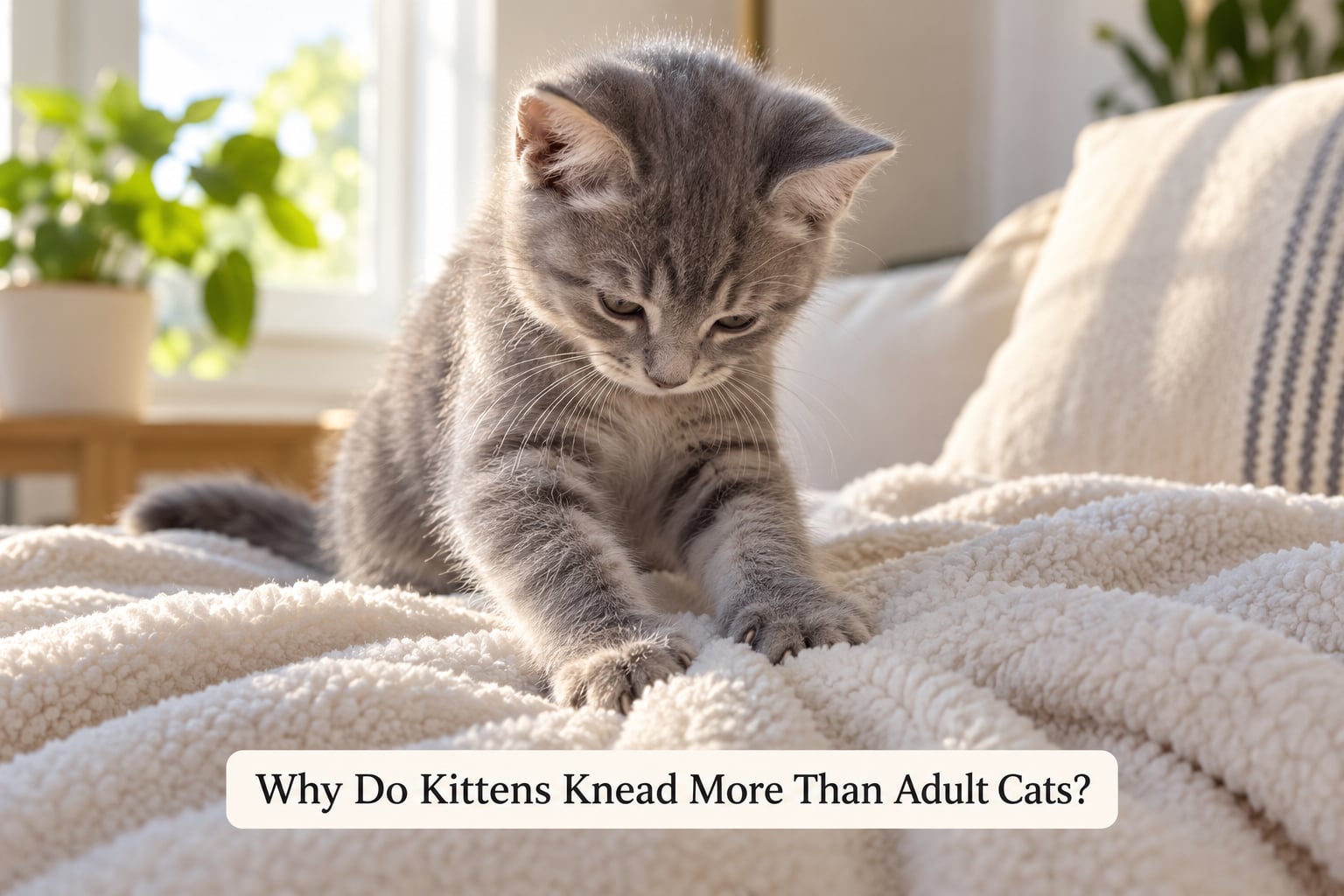
Because in kittens it is a working mechanism, not a comfort. Nursing does not happen automatically on demand; the motion of the kitten’s paws against the mammary glands helps stimulate milk production and delivery, so the behavior earns its place early and gets practiced hard.
Kittens that are weaned by hand sometimes never complete the cycle, and those are often the most enthusiastic adult kneaders. Their behavior was never switched off because it never fully switched on.
Plenty of adult cats knead despite having had no mother or littermates, which is normal. Instincts do not need a rehearsal schedule.
Why Does My Cat Knead on Me or Another Animal?

Surface choice matters more than you would think. Cats pick soft, warm, absorbent things, and they pick repeatedly: the same microfiber blanket, the same old sweater, the same spot on your chest. Repetition is a signal of preference, not habit.
Then there is scent. Kneading on you deposits scent from her paw pads onto your clothes and skin, and on your clothes it mixes your scent with hers. That shared-odor effect is part of why cats pick a favorite person rather than a favorite chair.
Kneading another animal usually means that animal has been accepted into the cat’s safe group. A dog that lies still and does not reach over the cat’s head is often treated as furniture, which is a compliment in cat terms. Cats also knead other cats they are bonded with, usually on a shared blanket or bed rather than directly on the body.
If she kneads you and not your partner, that is preference, not a judgment. Cats pick people by temperature, scent, schedule and how still they sit, and those things rarely match between two household members.
How Your Cat’s Kneading May Change With Age
Kittens knead often, briefly and with claws out, and it is mostly feeding mechanics. Young adults tend to knead at their clearest, often on a person during a quiet evening. Adult cats settle into a routine, and a cat that kneads daily is simply the cat she is.
Stress reshapes it. Owners on cat forums report that kneading gets more frequent after a renovation, a move, a period alone at home, or the arrival of a new baby or pet. It is the same self-soothing action redirected toward whatever makes the cat feel better.
Senior cats are where the pattern most often changes, and the direction matters. Kneading that slows down or stops is not usually alarming on its own. Kneading that starts out of nowhere in a cat that never did it before, especially with limping, stiffness or a different appetite, deserves a vet visit.
A change on its own is not a diagnosis. It is a reason to book an appointment.
When Should I Be Concerned About Cat Kneading?
Kneading is only a concern when it changes. Book a veterinary appointment if you notice any of these alongside a new or intensified habit.
- Kneading that comes with wincing, flinching, a limp or a reluctance to be touched anywhere on the body. Joint pain and arthritis often show up in how a cat lands from a jump, and in how it uses its paws.
- Swelling, heat or tenderness in a paw, or licking at the paw repeatedly.
- Appetite change, weight loss or a drop in drinking.
- Hiding, irritability or uncharacteristic aggression.
- Kneading that has become obsessive: very frequent, long sessions, hard to interrupt, and repeated even when the cat is trying to rest.
- Sudden onset in a mature or senior cat that never kneaded before.
- A kneading habit that stops completely, along with other signs that something is off.
Excessive kneading that repeats and resists interruption is sometimes treated as a compulsive behavior rather than a comfort habit, and that conversation belongs with a vet. Reducing triggers, keeping the environment predictable and, where appropriate, a behaviorist referral all come into that plan.
This article is general information, not a diagnosis for your cat. Anything on the list above is a reason to speak to a veterinarian rather than to read more online.
Should You Stop Your Cat From Kneading?
Usually no. Kneading is a healthy way a cat regulates itself, and suppressing it leaves the stress unspent with nowhere to go. Most of what owners want is not less kneading, less pain from it.
Things that help most, in the order I would try them:
- Put a folded blanket on your lap before she climbs on. It becomes the kneading target and it catches the claws, which solves both problems at once.
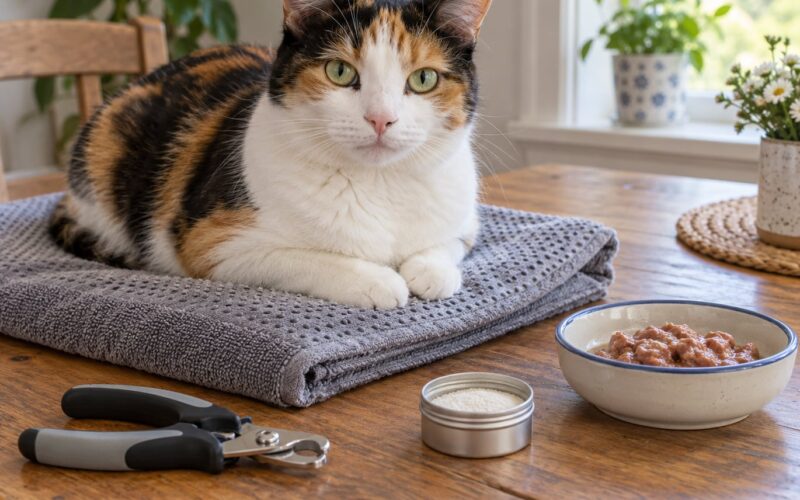
- Keep nails trimmed. Shorter claws dig less and snag less. Your cat should get used to the clippers over a few short sessions, with treats, not a wrestling match.
- Give her a designated spot. A folded blanket on the sofa or on your bed at the same spot each night turns the habit into a routine she already expects.
- Redirect, do not punish. If the claws hurt, gently slide a hand under and lift her away, then settle her onto the blanket. Water sprays, yelling and pushing work in the moment and damage the trust that made the kneading happen in the first place.
- Never declaw for this. Declawing removes the last joint of each toe and often makes biting worse. It is banned in a growing number of countries for good reason.
Owners often feel guilty for wanting to interrupt a behavior they know means love. You do not have to enjoy the scratches to be reasonable about them, and you are not breaking the bond by setting a soft blanket in front of her.
Frequently Asked Questions
Is it normal for cats to knead with their front paws?
Yes. Kneading with the front paws is a normal feline behavior, usually described as making biscuits. The same rhythmic paw motion kittens use to stimulate milk as they nurse survives into adulthood as a self-soothing action, so a cat that kneads a blanket, a sweater or your lap is showing a healthy, expected instinct. Soft claws, a loose body and a steady purr all point to a content cat.
Why does my cat knead and then bite me?
The timing usually matters more than the bite itself. A gentle nibble after a long kneading session is a love bite, and it tends to arrive once your cat is already overstimulated from petting. Stop petting as soon as her ears flatten or her tail starts flicking, put her on a blanket, and let the kneading finish. A bite with a stiff body and loud meowing is a stress signal, not affection.
Does kneading mean my cat is in pain?
Not on its own. Kneading with a relaxed body, slow blinking and a loud purr is normal behavior. Pain becomes a concern when the habit changes: kneading alongside wincing, a limp, a reluctance to be touched, repeated licking at a paw, or a new habit that starts suddenly in an adult or senior cat. Those combinations are worth a veterinary appointment rather than a guess.
Why does my adult cat knead when it seems too young to remember nursing?
Instincts do not need a memory attached to them. The kneading motion is part of a fixed kitten behavior pattern that expresses itself later in life on its own, which is why cats hand-reared from birth and cats raised by a mother both knead as adults. Your cat is not remembering nursing. She is running a behavior that feels safe, and the same rhythmic movement releases calming chemicals in her brain.
Should I let my cat knead my clothes every day?
Let her, but pick the surface. Daily kneading on an old sweater or a folded blanket on your lap is a healthy routine, and the scent her paw pads leave there is part of how she marks a place as safe. Keep an inexpensive blanket between her claws and a shirt you like, trim her nails regularly, and you will usually get the same affectionate behavior without the holes.
Conclusion
Kneading is a sign of security, not a fault. It starts as a nursing reflex, turns into a way cats settle themselves and mark their favorite places, and carries into old age as one of the clearest ways a cat says it feels safe. Most of the time you can simply enjoy it.
What to watch is change. A sudden new habit in an adult cat, kneading that comes with stiffness or licking at a paw, or a habit that becomes compulsive and hard to interrupt is the part worth a phone call to your vet.
And if the only real problem is that her claws find your chest at 2 a.m., put a folded blanket on the lap before she climbs up. That fix works more often than anything else.
Sources worth reading alongside this guide: PetMD and Blue Cross both explain the nursing-instinct origin, Preventive Vet breaks kneading into style variants, and International Cat Care covers the welfare side of self-soothing behavior in cats.