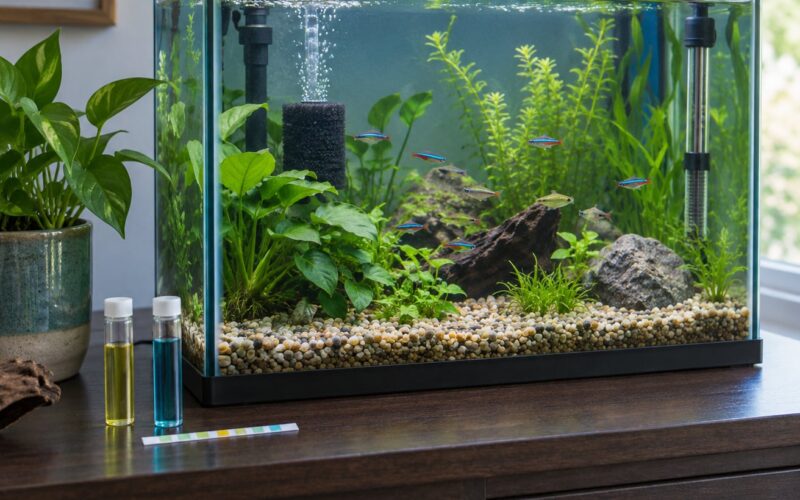
Learning how to set up a freshwater aquarium for beginners comes down to two jobs: installing the equipment correctly, then cycling the tank so nitrifying bacteria can handle the waste your fish will produce. The physical setup takes an afternoon. The cycle usually takes 4 to 6 weeks, and that waiting period is where most first tanks fail.
Skip the cycle and your fish are swimming in toxic ammonia within a day or two. Plan for a few weeks of patience and the rest is straightforward.
Updated for 2026. This guide covers the equipment list, the setup sequence, how to read your water tests, and how to introduce the first fish without the mistakes that show up in almost every beginner forum thread.
Table of Contents
- What You Need
- Tank, stand and lid
- Filter
- Heater and thermometer
- Light
- Substrate and hardscape
- Water conditioner, test kit and food
- Step-by-Step: How to Set Up a Freshwater Aquarium
- Choose the Right Tank, Equipment, and Fish
- Set Up the Tank Stand and Accessories
- Add and Condition the Water
- Filter and Cycle the Aquarium
- Introduce Fish Gradually
- Maintain the Freshwater Aquarium
- Common Mistakes
- Frequently Asked Questions
- How long does it take to cycle a freshwater aquarium?
- How many fish can I put in a new aquarium?
- Do I need a filter if my aquarium has an air pump?
- Can I use tap water in a freshwater aquarium?
- How often should I change the water in a beginner aquarium?
- Conclusion
What You Need
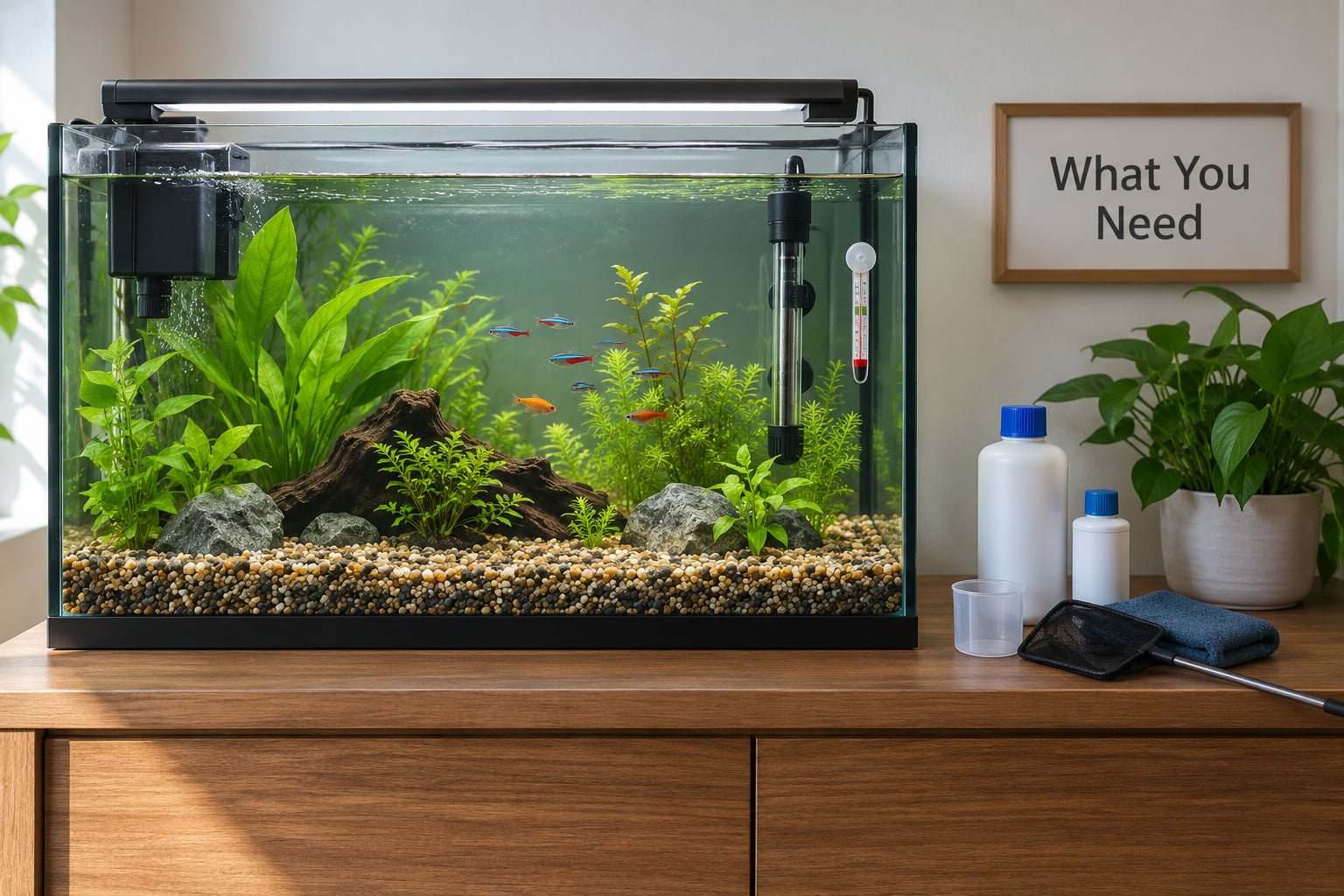
A 10 to 20 gallon tank is the sensible starting point for a first aquarium. More water dilutes mistakes and survives them better, so if your budget and your stand allow it, start at 20 gallons and buy the livestock later.
Tank, stand and lid
The stand is not an accessory. Water weighs about 8.3 pounds per gallon, so a 20 gallon tank puts roughly 165 pounds on a surface that a piece of furniture was never designed for. Set the stand on a level floor near an outlet, away from direct sun and from radiators.
Always use a lid. Bettas and killifish jump, and a lid is cheaper than finding your fish on the carpet.
Filter
Choose a filter rated to move 4 to 6 times your tank volume per hour, which means a 20 gallon tank wants roughly 100 to 120 gallons per hour of turnover. Hang-on-back filters suit beginners because they hang outside the tank and are easy to service. Sponge filters in a small box work for shrimp tanks and fry. Canister filters handle larger volumes but cost more and take up cabinet space.
Yes, you can run a filter rated for a 20 gallon tank on a 10 gallon tank. The flow will be higher than needed, so throttle it with a spray bar or an inline diffuser. An oversized filter is a much better problem than an undersized one.
Heater and thermometer
Tropical community fish need a heated tank, and 72 to 82F covers most of the species beginners keep. Buy an adjustable thermostatic heater with a built-in or separate thermometer, and check the temperature daily for the first month while you learn its rhythm.
Light
Most freshwater tanks run an LED light on a timer for 6 to 10 hours a day. That upper limit matters more than it sounds: light is what lets algae grow, and a tank lit 24 hours a day will turn green within a month.
Substrate and hardscape
Budget 1 to 1.5 pounds of substrate per gallon, rinsed in a bucket until the water runs mostly clear. Inert rock like lava rock or dragon stone adds surface area where bacteria can attach without shifting your water chemistry. Skip coral, marble and limestone-based stone unless you have measured the hardness, because they dissolve and change pH.
Water conditioner, test kit and food
Water conditioner is not optional. It neutralises chlorine and chloramine, and untreated tap water also kills the beneficial bacteria you are trying to grow, so a tank filled with raw tap water never cycles properly.
For testing, buy a kit that measures ammonia specifically. Many multi-test strips skip ammonia entirely, which leaves you blind to the one parameter that matters most during cycling. A liquid test kit is more accurate if you can read a colour chart.
Optional extras: an air pump with an air stone for extra surface agitation, a gravel vacuum, a bucket you never use for anything but aquarium water, and a bottle of bacteria in a bottle to speed up the cycle.
Step-by-Step: How to Set Up a Freshwater Aquarium
Choose the Right Tank, Equipment, and Fish
Tank size decides everything downstream. The common beginner mistake is buying the smallest tank in the store because it is cheapest, then finding that the water chemistry swings hard enough to stress fish twice a day. A 20 gallon tank gives you more thermal mass, more dilution and more room for the filter to do its job. Buy the tank and stand as a set when you can, and check that the stand’s footprint clears the tank’s base by an inch on each side.
Match the heater to the tank volume rather than to your target temperature alone. An undersized heater struggles in a cold room and fails to hold 75F through a winter night, and it runs constantly doing it. Filter, heater and light all need to reach an outlet, and the tank needs to sit where you can see into it without crouching.
On fish, research adult size and temperament before you buy, not the size of the fish in the bag. Adults get considerably larger, and two species that look peaceful at 2 inches can fight over territory at 5. Check whether the species you want are peaceful or schooling, because a group of six small tetras and a group of three corydoras are the two setups most beginners get right, while a single betta in a community tank is a frequent source of stress for everyone in the tank.
Set Up the Tank Stand and Accessories
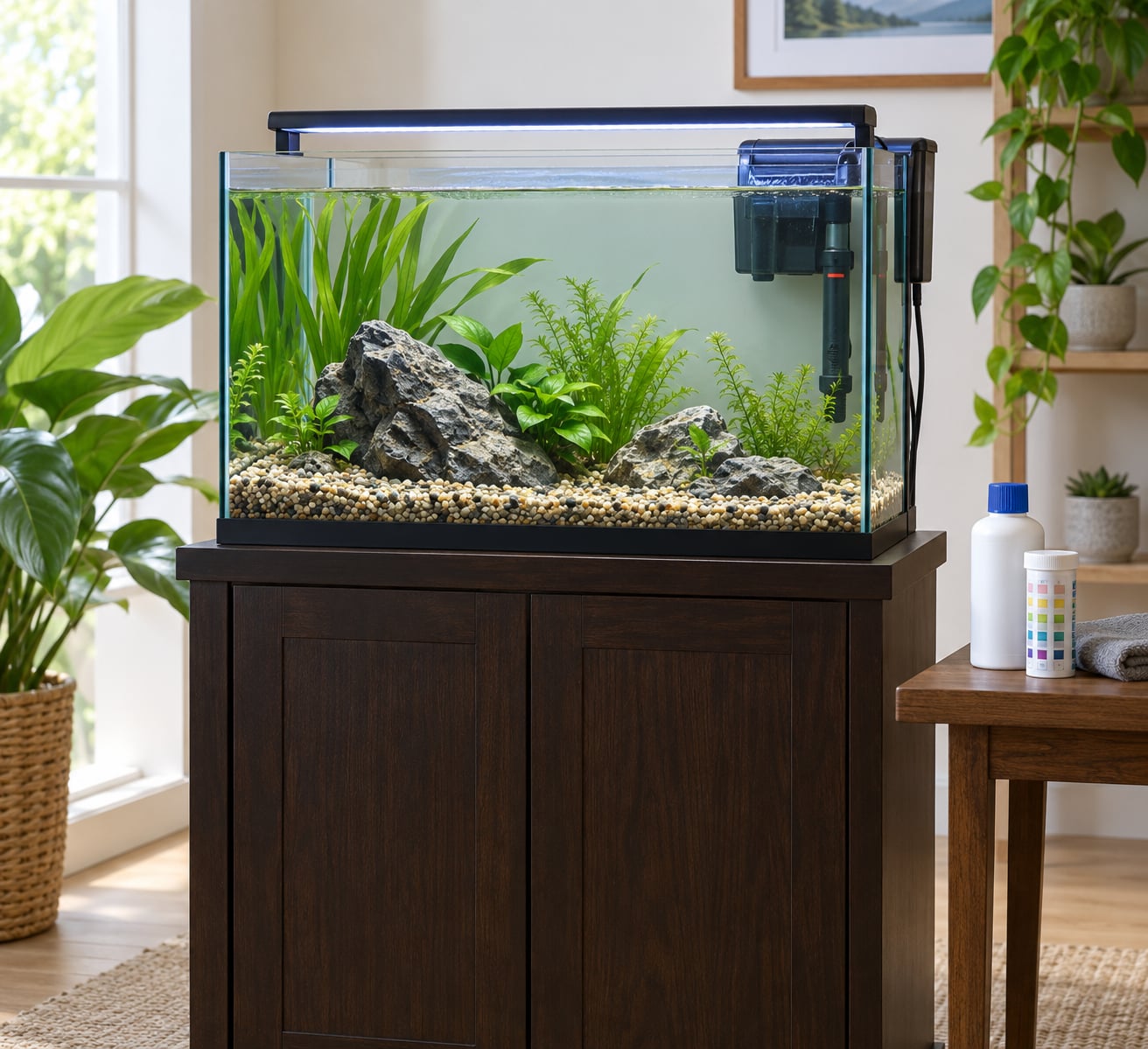
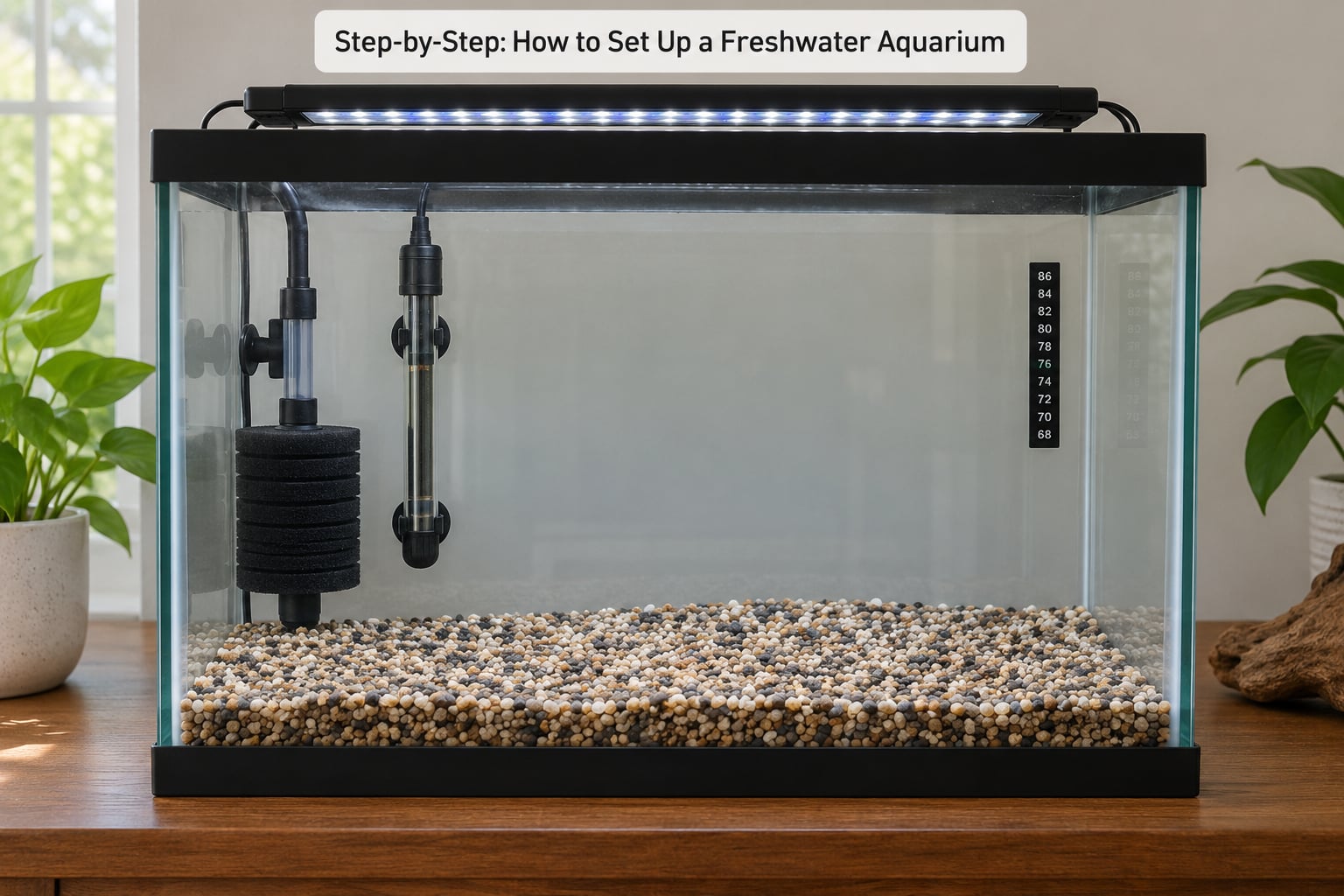
Level the stand first, then set the empty tank on top and check it again from a low angle. Rinse substrate in a bucket with tap water until the water clears, pour it in, and slope it gently toward the front glass so you can see debris.
Place the hardscape now, while the tank is empty and your hands are not full of water. Position the heater diagonally in the back corner with good flow around it, and run the filter outlet across the full length of the tank to create surface agitation, which is where your fish will collect oxygen.
Keep the intake strainer at least an inch or two above the substrate, because a filter that swallows gravel clogs in a week. Route every cable behind the stand so nothing is pinched, and make sure the drip loop on each cable stops water from running back down into the plug.
Fill the tank, run the filter and heater, and let everything work for 24 hours before you trust it. Watching for leaks while you are still rearranging decor is much easier than watching water spread across a floor afterwards.
Add and Condition the Water
You do not need to let tap water sit in an open bucket for days. That old advice came from an era when people had to wait for chlorine to evaporate, and it wastes water while doing nothing useful. Run a general water conditioner at the dose on the bottle for your volume, and the water is ready immediately.
Add a splash of tank water to the bucket first to temper the temperature, then fill slowly through your hand or a clean plate to avoid stirring up sediment. Match the final temperature to what your heater is set at before anything living goes in.
Filter and Cycle the Aquarium
The nitrogen cycle is the whole reason the tank works. Fish waste and uneaten food release ammonia, which is toxic at almost any concentration. Nitrifying bacteria living in your filter media and substrate oxidise that ammonia into nitrite, then into nitrate, which is far less harmful and gets removed through water changes.
Both of those bacterial colonies need ammonia to grow, which is why a brand new empty tank can test 0 ppm on ammonia, 0 ppm on nitrite and 0 ppm on nitrate and still kill every fish you put in it. The strips are not wrong; there has simply been no ammonia source yet to detect. This is the trap that catches most beginners, and it explains why a tank can look chemically perfect and still be lethal.
Your cycle is complete when ammonia reads 0 ppm, nitrite reads 0 ppm, and nitrate is present above 0 ppm but under 40 ppm. Nitrate is the receipt that tells you both colonies are working.
A fishless cycle is the safest option. Dose pure ammonia to about 2 to 3 ppm, feed the filter and test every day or two, and add more ammonia as it drops. Pure ammonia comes from a hardware store or a grocery cleaning aisle, not a pet store.
A planted cycle uses live plants as an ammonia source and usually finishes faster. A fish-in cycle seeds the bacteria with hardy fish immediately, but the fish pay for your impatience and some do not survive it. Most hobbyists land on 4 to 6 weeks, and anyone promising a fully cycled tank in three days with a bottled additive is describing a test that never happened.
A day-by-day calendar looks like this. Days 1 to 3: add ammonia, run the filter and heater, test daily. Days 4 to 10: ammonia falls, nitrite appears as the first colony establishes. Days 10 to 21: ammonia and nitrite both drop as the second colony grows, and nitrate climbs. Days 21 to 40: ammonia and nitrite stay at 0 ppm across several consecutive tests and nitrate stabilises. Only then do you add fish.
If you know someone with a mature tank, you can shortcut most of this. Run the mature filter beside the new one for a couple of weeks, or add a cup of established media or substrate. You are not skipping the biology, you are arriving with more of it already in place.
Introduce Fish Gradually
Floating the sealed bag for 15 minutes matches temperature but does almost nothing about chemistry, and it is the single most common cause of fish dying hours after purchase.
Open the bag, add small increments of tank water to it over about an hour until the bag water roughly doubles in volume, then net the fish across. For sensitive species such as shrimp, discus and many tetras, set up a drip line and drip for two hours instead.
Add only what the filter can handle. A common beginner pairing for a 20 gallon community tank is a school of six to eight small schooling fish, or a group of two or three short-bodied fish such as corydoras, with the stocking split across several weeks rather than all at once.
Watch the tank for at least two weeks after the first addition before adding anything else. New fish often take a few days to settle, and a school that has just been introduced needs stable conditions before it handles a second addition.
Maintain the Freshwater Aquarium
Daily, spend two minutes watching the fish. Gasping at the surface, clamped fins or fish hiding in a corner are early warnings that something is off.
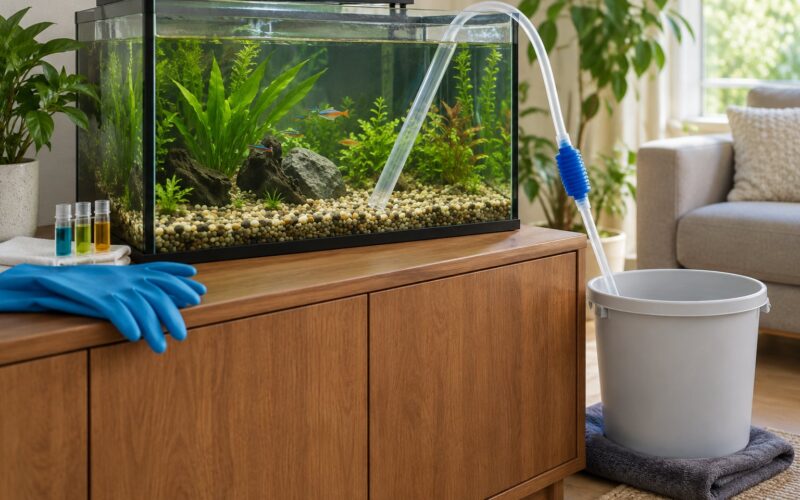
Weekly, test ammonia, nitrite and nitrate, change 20 to 25 percent of the water, siphon debris out of the substrate, wipe algae off the glass, and rinse your filter media in removed tank water. Never clean filter media under the tap, because the chlorine kills the colony you spent weeks building.
Monthly, trim and replant dying leaves, replace a burned-out bulb, and check the heater’s setting against your thermometer.
Overfeeding is the most common cause of trouble in a healthy-looking tank. Feed only what the fish eat in a couple of minutes and remove uneaten food rather than leaving it to break down.
Going away for two weeks is fine in a cycled, well-established tank. Feeder blocks release food slowly, an automatic feeder works if it is tested first, and a sitter who knows the water-change routine is better than both. Raise the photoperiod slightly for the first few days, skip the big clean, and ask someone to check on it daily.
Common Mistakes
Adding fish before the cycle is finished. This is the mistake behind most early deaths. Wait for ammonia and nitrite at 0 ppm with nitrate present, and no sales pitch should rush you past that.
Treating an empty tank as a finished tank. Clear test strips in a brand new aquarium mean nothing until there has been ammonia to detect.
Using untreated tap water. Chlorine harms fish gills and the nitrifying bacteria equally. Condition every drop you add.
Overcrowding too early. Extra fish mean extra waste, and your filter has a fixed capacity for handling it.
Cleaning the filter too well. Swapping in sterile media on a schedule resets the cycle each time. Rinse old media in dirty tank water and put it straight back.
Leaving the light on around the clock. Six to 10 hours on a timer keeps algae down and lets the plants rest.
Letting the temperature swing. Sudden drops stress fish and can trigger disease. Check the thermometer daily during the first month.
Trusting the first pet store employee you meet. Ask specifically for the aquatic department specialist and read the store’s own tanks as a health signal. Cloudy water or fish gasping at the surface tells you plenty.
If your water turns cloudy mid-cycle, leave it alone. A bacterial bloom is a sign that bacteria are multiplying, and it usually clears on its own. Do a 25 percent water change only if it stays cloudy after the ammonia and nitrite have both returned to 0 ppm.
Frequently Asked Questions
How long does it take to cycle a freshwater aquarium?
A tank without an ammonia source can take 4 to 6 weeks to cycle, and many hobbyists describe about a month as realistic. A fishless or planted cycle with pure ammonia runs faster, usually 3 to 5 weeks, and seeding a new filter with media from a mature tank can shorten it further. Your tank is cycled when ammonia reads 0 ppm, nitrite reads 0 ppm, and nitrate is present. Test daily rather than trusting a fixed date.
How many fish can I put in a new aquarium?
Only what the filter and the finished cycle can support, and less than you think. Many beginners follow the one inch of fish per gallon rule, but adult size, species temperament and filtration matter far more than length. Add a small group first, watch the water for two weeks, then add more in batches.
Do I need a filter if my aquarium has an air pump?
An air pump and a filter do different jobs. The pump adds oxygen to the water, while the filter removes waste and provides the surface where nitrifying bacteria colonise. A bubbler alone cannot handle fish waste, so a cycled tank still needs mechanical and biological filtration to stay safe.
Can I use tap water in a freshwater aquarium?
Yes, but never without a water conditioner. Tap water carries chlorine or chloramine, which damage fish gills and also kill the nitrifying bacteria you are trying to grow, so an unconditioned tank may never cycle. Dose a general dechlorinator for your full water volume, and never add untreated water directly from the tap.
How often should I change the water in a beginner aquarium?
Once a week, replacing 20 to 25 percent with conditioned tap water, is the routine most beginner tanks do well on. During the first month, or after a large addition of fish, test ammonia and nitrite more often and change water if either reads above 0 ppm. Never replace all the water at once, because the filter colony needs stable conditions.
Conclusion
Your first four actions set everything else up: pick a tank you can actually support, install and leak-test the equipment, condition the water, and let the tank cycle until ammonia and nitrite both read 0 ppm with nitrate present. Only then do you add fish, slowly and in small groups.
Over the first 30 days, that looks like testing daily during the cycle, watching your fish rather than the tank, and making small changes instead of large ones. Water quality comes before everything, and a patient beginner keeps more fish than an impatient one.