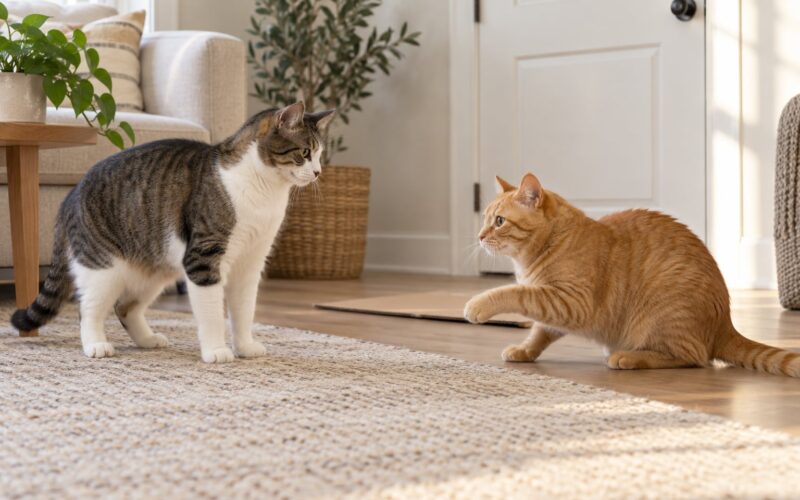
An indoor cat stays healthy on a mix of vertical territory, daily prey-style play, food it has to work for, scratching posts, hiding spots and a predictable routine. That mix is what indoor cat enrichment means, and most of it costs nothing or close to it.
Here is the honest version: cats sleep 14 to 16 hours a day, which leaves several waking hours every day with nothing to hunt, climb or solve. When those hours stay empty, the behaviour shows up as zoomies at 2 a.m., yowling at the door, overgrooming, or eating straight out of the bowl and then looking bored at you. Learning how to enrich an indoor cat’s environment is mostly about filling those hours on purpose.
Most of the fixes below take an afternoon and a cardboard box. If you only do four things, make them vertical space, two daily play sessions, one food puzzle, and a place to hide.
Table of Contents
- What You Need Before You Start
- Vertical space
- Interactive toys, not just self-play toys
- Scratching options
- Something to make food harder
- Hiding and resting places
- A safe play area
- A two-minute safety check
- Step-by-Step: Building a Richer Indoor Environment
- 1. Create More Vertical Space
- 2. Set Up Daily Interactive Play
- 3. Add Food-Based Enrichment
- 4. Provide Scratching and Hunting Outlets
- 5. Make Hiding and Exploring Easier
- 6. Rotate Toys and Change the Environment
- 7. Sensory Enrichment and Other Ways to Enrich an Indoor Cat’s Environment
- 8. Add Rhythm So the Bored Hours Have a Job
- Common Mistakes When Enriching an Indoor Cat’s Environment
- Outsourcing it to too many toys
- Unstable or blocked climbing furniture
- Leaving string, ribbon or wand toys unsupervised
- Using human medication on a cat
- Letting enrichment treats run the calorie budget
- Ignoring a sudden behaviour change
- Frequently Asked Questions
- Do cats get bored staying inside all day?
- What does an indoor cat need to be happy?
- How do I calm a bored cat quickly?
- How often should I play with my indoor cat?
- Does an indoor cat need toys, or is play with the owner enough?
- When should I take my cat to the vet instead of adding toys?
- Conclusion
What You Need Before You Start
Enrichment is about opportunity, not shopping. You can begin with whatever is already in the house, then add one or two things a month as you spot a gap.
Vertical space
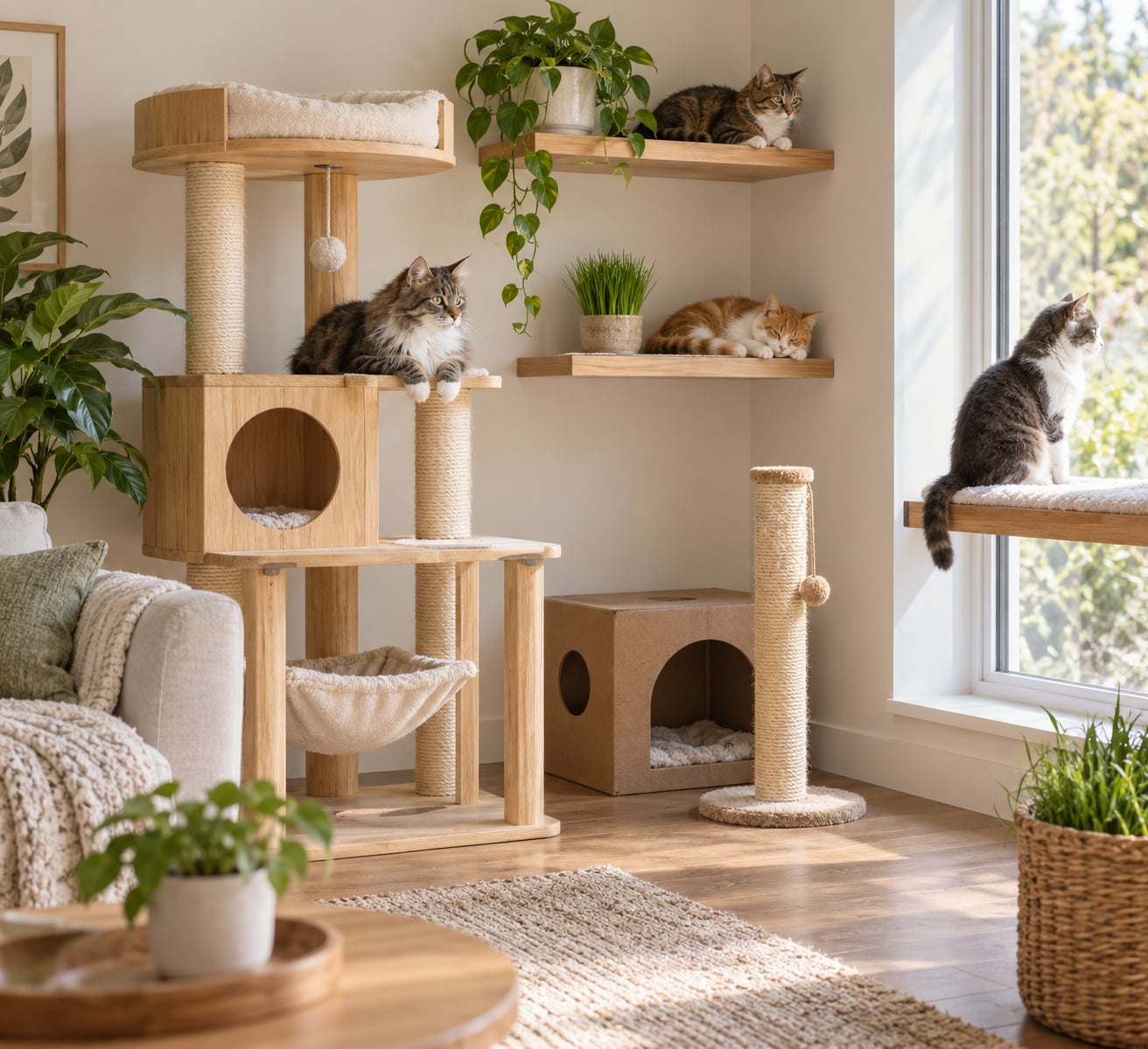
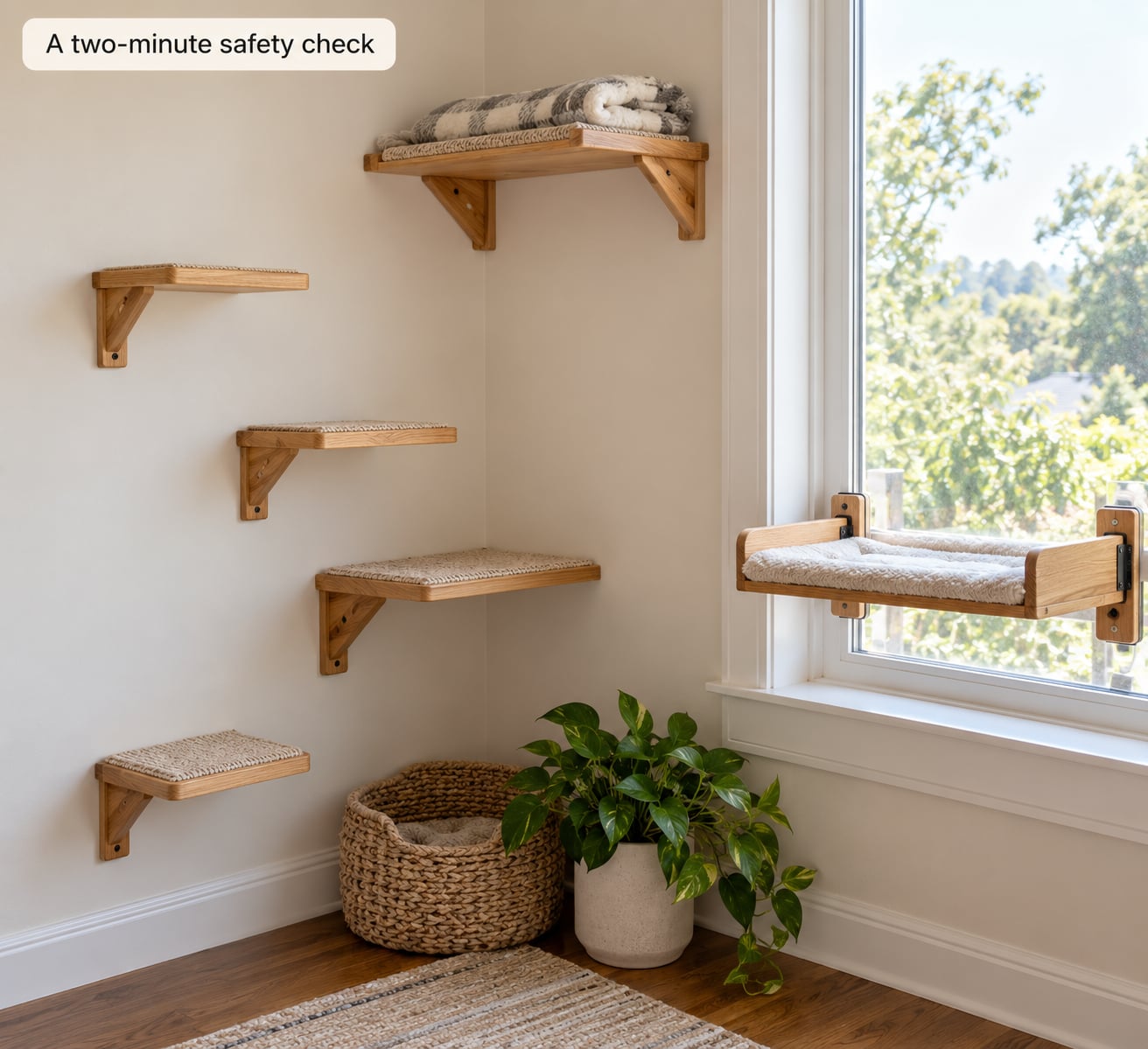
At least two elevated resting spots a cat can reach without jumping from the floor. Wall shelves, a cat tree, a cleared top of a wardrobe, or a window perch all count. Stability matters more than height, and cats use the routes between spots as much as the spots themselves.
Interactive toys, not just self-play toys
Two wand toys with replaceable feathers or fur, plus a couple of balls or crinkle items for the floor. Skip the pile of battery-driven mice for now. Many cats ignore them within a minute, and you can judge a toy properly only during play with you.
Scratching options
At least two scratching surfaces, ideally in different styles: one vertical sisal post and one flat cardboard scratcher lying horizontally. Cats stretch their back and shoulders on vertical surfaces and scratch flat while lying down, so the two formats suit different moods.
Something to make food harder
A slow-feeding bowl, a lick mat, a ball-style dispenser, or simply a muffin tin with a treat in one cup. Puzzle feeders earn their keep over weeks, not days, so start with the easiest option you have.
Hiding and resting places
Two covered or enclosed spots in different rooms. Cardboard boxes with two holes cut in the side are the cheapest hiding place that works, and a bed in a quiet corner counts too. In a multi-cat home, the number of resting spots should exceed the number of cats.
A safe play area
Enough clear floor to run a wand toy, ideally with somewhere to land and hide at the end of a chase. Long narrow hallways are great for this, cluttered lounge rooms are not.
A two-minute safety check
Look for anything the cat could swallow or chew the pieces off: string, ribbon, small detachable parts, and toxic plants. True lilies, poinsettias and tulips are the big three to keep out of reach. Loose cord from blinds and chargers gets secured before play starts, not after a near miss.
Step-by-Step: Building a Richer Indoor Environment
1. Create More Vertical Space
Measure your cat from floor to the highest spot they jump to unaided, then add shelves and perches at or below that height. Put the first shelf close to the floor so a kitten, a senior with stiff joints or a cat recovering from an injury can actually get up there.
This matters because vertical territory is usable territory. A cat with somewhere to go high watches the room from a position where nothing can creep up behind it, which is the arrangement most indoor cats feel safest in. If your cat starts using the shelves within a day or two, the change worked.
2. Set Up Daily Interactive Play
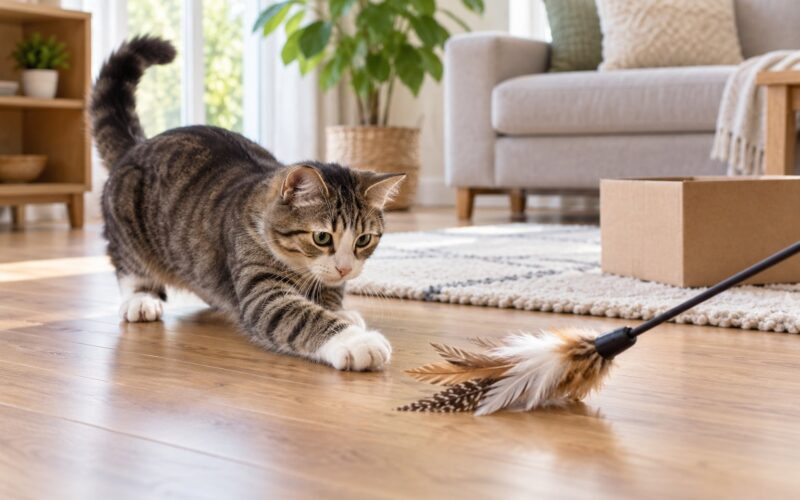
Aim for two sessions of 10 to 15 minutes, one in the morning and one in the evening when the cat is usually most awake. Run the toy low and fast across the floor, let it pause behind furniture, then bring it back out. Finish every session with a meal or a few treats, so play ends in eating the way a real hunt does.
Signs of engagement are pretty clear: pupils widen, the tail flicks, the body drops low before a pounce, and the ears swivel toward the toy. A cat that lies flat and stops watching is done for now, and pushing past that point teaches you nothing.
One technique gets far more response than a standard wand toy: slide the toy under a bedsheet and make it stop dead, as though the mouse heard the cat and froze. Prey-driven cats take that seriously and will play far longer than they will with a toy waved openly in the air.
3. Add Food-Based Enrichment
Split a portion of the daily ration across several hiding places and let the cat hunt for it. This is foraging behaviour, and it takes more of the day than the same kibble in a bowl. From there, move up in difficulty: slow-feeding bowl, lick mat, muffin-tin hunt, ball dispenser, then a full puzzle feeder once the cat is confident with the easier versions.
A wet-food version works too. Put small amounts of wet food in several spots around the home and let the cat find them over the day rather than all at once.
The rule that keeps this from causing harm: enrichment treats stay inside the daily calorie allowance. If your cat is already at a healthy weight, work some of the daily kibble into the puzzle and skip extra treats entirely. You will know the puzzle works when the cat keeps coming back to it.

4. Provide Scratching and Hunting Outlets
Put the scratching post where the cat already scratches, even if that means the hallway rug edge, and only move it later once the new post is being used. Add a second post near a window so scratching and watching the street happen together.
For hunting, match the toy to the cat. Some cats chase anything that moves. Some ignore fast toys entirely and stalk a slow one. Some only engage with something that moves under its own power, such as a string running low along the floor. When a cat loses interest in a minute or two, change the speed and the height before you buy anything new.
5. Make Hiding and Exploring Easier
Place boxes and covered beds in several rooms and let the cat choose. Leave the flaps on tunnels on rather than off, and route cords through cable covers so the cat has clean paths instead of obstacles.
The point is choice. A cat with a bed it can leave instantly, somewhere to watch from a distance, and a place to be completely out of reach can handle a busy household far better than one forced to stay in the open. In homes with several cats, spread these out so the quiet spots are not all in one corner, or the second cat owns them all.
6. Rotate Toys and Change the Environment
Keep four or five toys out at a time and store the rest somewhere the cat cannot reach. Swap the groups every week or two, so a wand toy feels new again after a fortnight. Follow the same idea with the room: move a perch to a different window, open a door that is usually shut, put a box somewhere new.
Watch what the cat chooses most and leave that one out permanently. Toys your cat ignores can go in a donation bag rather than the back of a cupboard, and buying replacements only makes sense once you know which style that particular cat prefers.
7. Sensory Enrichment and Other Ways to Enrich an Indoor Cat’s Environment
Cat-safe plants such as spider plant, Boston fern and bamboo palm give something green to sniff and nibble. Cat grass or wheatgrass in a pot works the same way and is easy to grow. Scent play is worth trying too: scatter a pinch of catnip across a mat, or offer silvervine, also called matatabi, which many cats respond to more strongly. Store dried herb in a sealed bag and offer it every few weeks rather than constantly, so it stays potent and stays novel.
Skip essential oils, diffusers, human perfume and new laundry detergent. Skip toxic plants entirely. Skip anything string-like unless you are watching, because a wand toy left on the floor invites swallowing the string and that is a surgical emergency, not a funny story.
8. Add Rhythm So the Bored Hours Have a Job
This last one is less about adding objects than about adding rhythm. A predictable sequence of events through the day does more for a cat than any single toy. Play in the morning, food puzzle after that, a few hours of quiet observation by the window, play again in the evening, then dinner and grooming.
On the days you are out for nine or ten hours, set the routine up in advance. Food puzzles out before you leave, a bird feeder outside the window, a rotating station on a stand rather than scattered on the floor, and a second play session when you get home. Window watching is useful visual enrichment on its own, though most cats need interaction and foraging on top of it.
Common Mistakes When Enriching an Indoor Cat’s Environment
Most failed enrichment plans fail the same way. These are the ones I see most, and what to do instead.
Outsourcing it to too many toys
Twenty toys on the floor produces choice paralysis and a bored cat. Keep a small selection out, rotate the rest weekly, and put your own hands back in the game. Interactive play beats a room full of self-moving toys nearly every time.
Unstable or blocked climbing furniture
A cat tree that wobbles, or a shelf route that ends in a dead end, teaches distrust rather than enrichment. Test every new piece of furniture by pushing it hard with your weight. If it moves, anchor it to the wall.
Leaving string, ribbon or wand toys unsupervised
String and thin ribbon are the two things you should never leave out. Supervise every string toy, put it away when the session ends, and skip dental-floss toys that shed pieces.
Using human medication on a cat
Never give a cat ibuprofen, paracetamol, acetaminophen, aspirin or any human painkiller or cold medicine. These are dangerously toxic to cats. If your cat seems painful or unwell, call a veterinarian.
Letting enrichment treats run the calorie budget
Play treats add up fast and end up as weight gain. Feed part of the daily ration through puzzles, count the rest, and skip extra treats if the cat is already at a healthy weight.
Ignoring a sudden behaviour change
New hiding, new overgrooming, a sudden change in appetite, limping, or a cat that stops using the litter tray can signal pain or illness rather than boredom. Overgrooming in cats is often a stress or pain signal, not a boredom signal. Call a veterinarian before adding enrichment to a cat whose behaviour changed overnight.
Frequently Asked Questions
Do cats get bored staying inside all day?
Yes. Indoor cats are obligate predators built for a hunt-eat-groom-sleep cycle, and they sleep 14 to 16 hours a day, so several waking hours go unfilled. Without hunting, climbing, scratching and foraging outlets, that time turns into zoomies, night yowling, destructive scratching or overeating. Enrichment gives those hours a job, which is why bored cats so often settle down after a few weeks of structured play and puzzles.
What does an indoor cat need to be happy?
Indoor cats need five things: vertical space to climb and observe, daily interactive play that mimics prey, food presented so it takes some work to get, scratching surfaces in more than one style, and quiet places to hide and rest. Add a predictable routine and a safe window to watch the world. All of it can be assembled from a few household items.
How do I calm a bored cat quickly?
Try a wand toy session ending in a meal rather than leaving food out. A cat that stalks, chases, catches and then eats settles down far more effectively than a cat handed a treat. For long daytime gaps, put food puzzles and a foraging toy out before you leave and give the cat a bird feeder outside a window. A tired cat is a quiet cat, mostly at night.
How often should I play with my indoor cat?
Twice a day, about 10 to 15 minutes each, is the practical baseline for an adult indoor cat. One session in the morning and one in the evening match the cat’s natural hunting rhythm better than one long session. Kittens and high-energy cats often want three or four short bursts instead. Finish each session with a meal so the hunt ends in eating, which is what settles most cats before bed.
Does an indoor cat need toys, or is play with the owner enough?
Owner-led play does most of the work, but toys have their own job. Wand toys, balls and soft toys give the cat something to hunt independently while you work or sleep, and a food puzzle turns eating into a task. Best results come from both: interactive play twice a day, plus four or five toys left out on rotation and one food-based activity.
When should I take my cat to the vet instead of adding toys?
Take your cat in when the change is sudden rather than gradual. New hiding places, overgrooming, a drop in appetite, limping, straining in the litter tray or a sudden change in vocal behaviour can all point to pain or illness. Enrichment helps a cat in stable health express itself, but it does not treat illness, so call a veterinarian first when the behaviour appeared without warning.
Conclusion
Start with four changes and give each one a fortnight before adding more. Put up stable shelves or a cat tree the cat can reach from the floor. Commit to two 10 to 15 minute play sessions, ending in a meal. Feed part of the daily ration through a slow feeder or a hidden hunt. Then leave a box or covered bed in a quiet room.
Watch which of those your cat actually uses, and build from there rather than from a list of toys. To enrich an indoor cat’s environment, add opportunity, movement and choice in small doses, then let the cat tell you what it wants next.