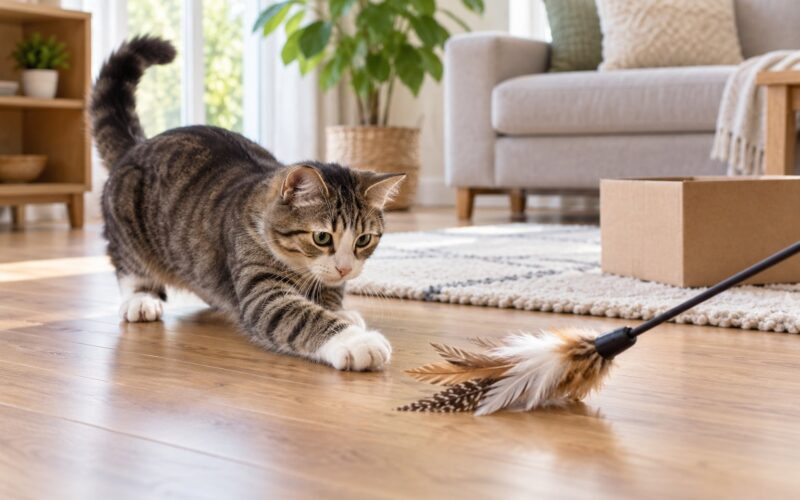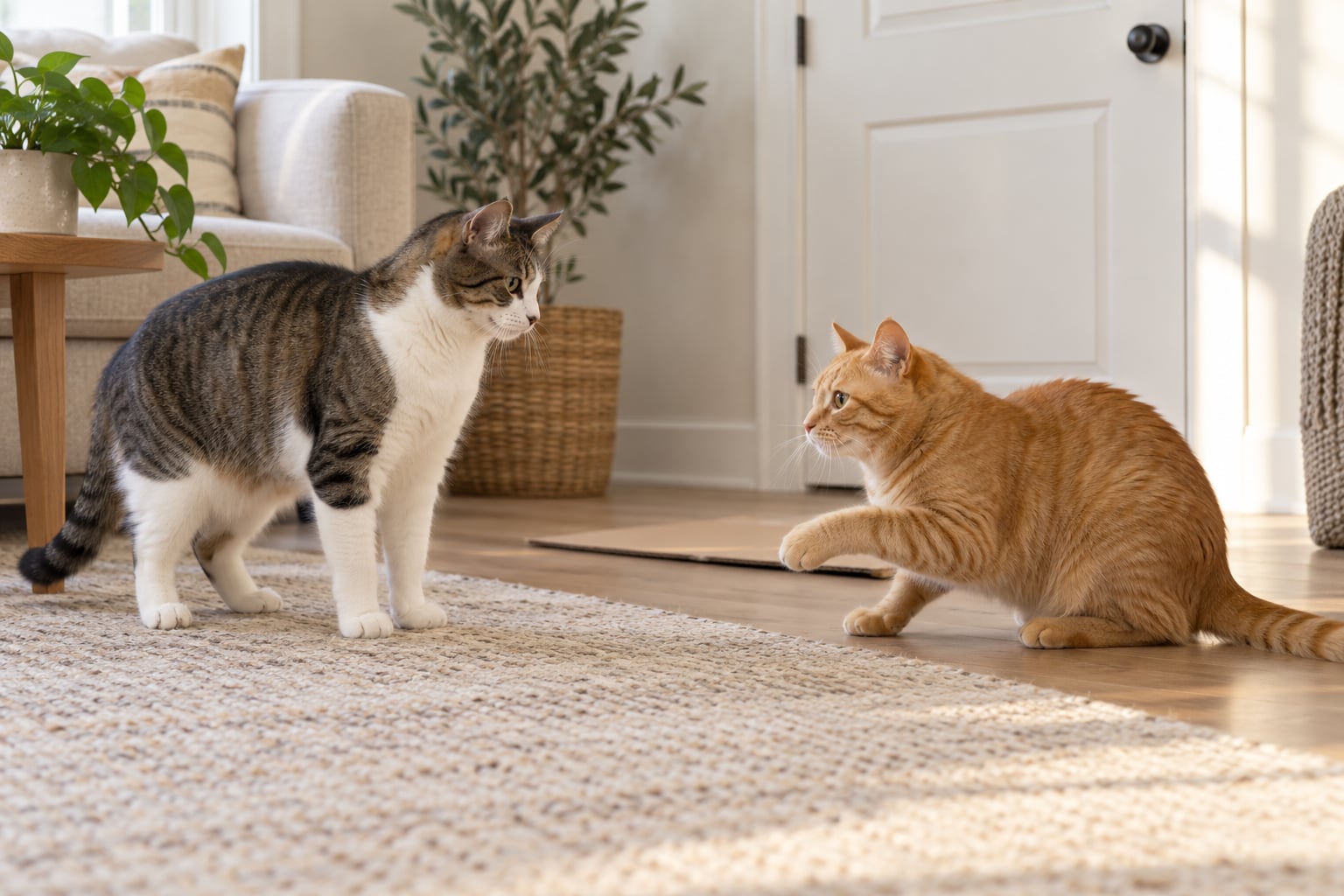
How to tell if cats are playing or fighting comes down to four things: sound, body tension, fairness, and what is left over afterwards. Play stays near-silent, stays loose, and keeps swapping roles. Fighting gets loud, gets puffed and stiff, turns one-sided, and leaves marks. Watch the whole exchange rather than one snap or one hiss.
That matters because the two states use the same movements. A pounce, a chase and a bite to the scruff of the neck all show up in both. The difference is entirely in how the cats are holding their bodies and how they behave toward each other over thirty seconds, not three.
Here is how to read each signal, where play crosses over into aggression, and what to do when it does.
Table of Contents
- How to Tell If Cats Are Playing or Fighting: Four Things to Watch
- What Does Playful Cat Behavior Look Like?
- What Are the Signs Cats Are Fighting?
- Play Versus Fighting: Key Differences at a Glance
- How to Tell If Play Is Becoming Too Rough
- A three-step decision check
- How to Stop a Cat Fight Safely
- How to Prevent Future Fights Between Cats
- Frequently Asked Questions
- Should I let my two cats fight it out?
- How can I tell if cats are playing too aggressively?
- Do cats hiss while playing?
- How long do cat fights usually last?
- What is the 3-3-3 rule for cats?
- What is Tarzan syndrome in cats?
- Conclusion
How to Tell If Cats Are Playing or Fighting: Four Things to Watch
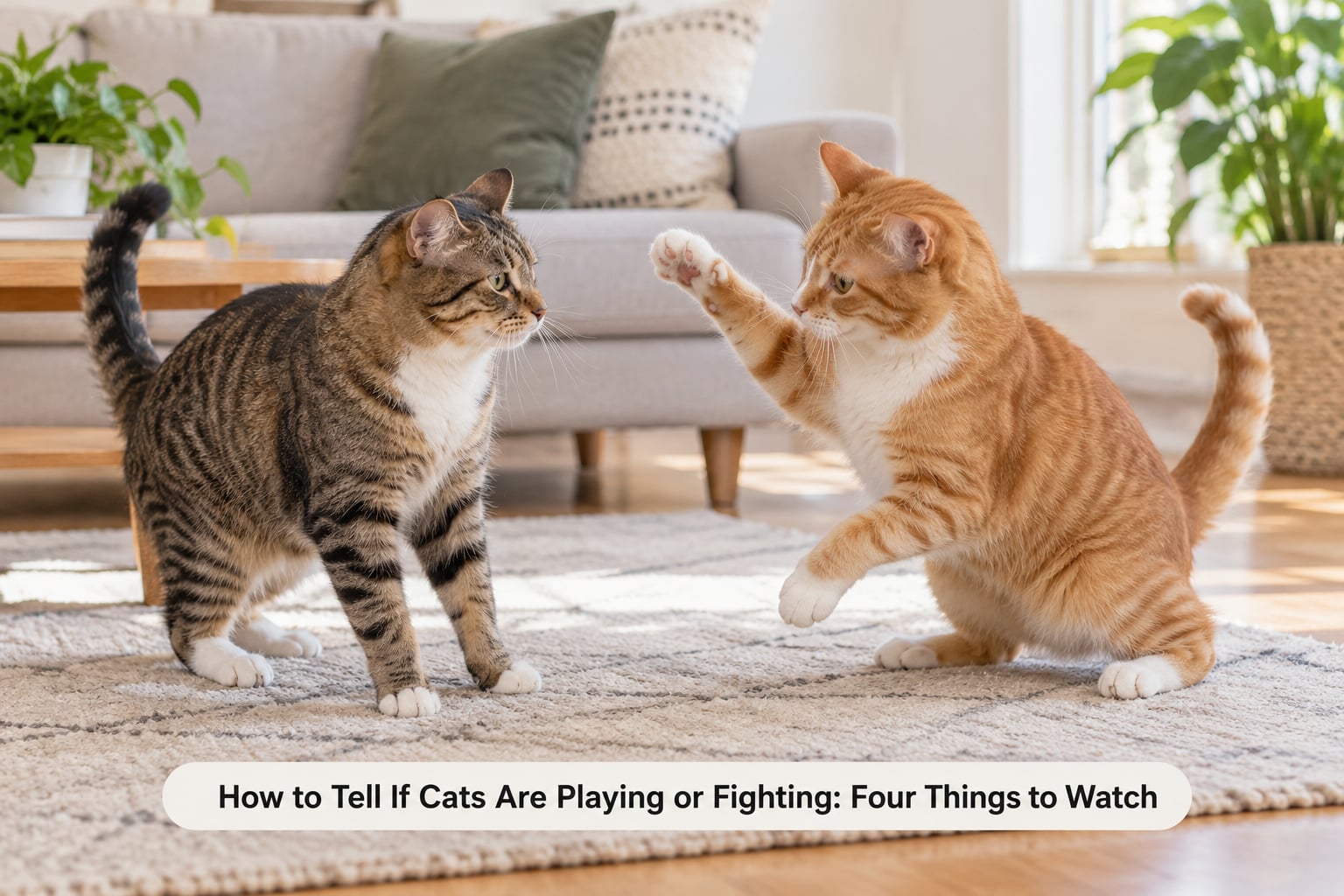
Play is quiet, reciprocal and full of pauses; a fight is loud, tense, one-sided and hard to stop. Watch sound first, then body tension, then whether the roles ever swap, then what happens in the minute after it ends.
- Sound: near-silent play with thumps and the odd squeak, versus hissing, growling, yowling and screaming.
- Body tension: loose, bouncy, rolling bodies versus rigid, arched, frozen bodies with fur standing up.
- Fairness: roles swapping constantly versus one cat always starting and the other always running or hiding.
- Aftermath: grooming and napping versus hiding, licking a paw, or licking a fresh puncture.
The most repeated line in owner threads on r/CatAdvice and r/CATHELP is basically this: if you are genuinely wondering whether they are fighting, they are playing. A real fight announces itself loudly enough that nobody sits there asking.
That heuristic is useful but not complete. It fails in two situations, and both are covered below: the intermediate session that starts playful and turns ugly, and the one-sided chasing that looks like play because nobody gets scratched.
What Does Playful Cat Behavior Look Like?
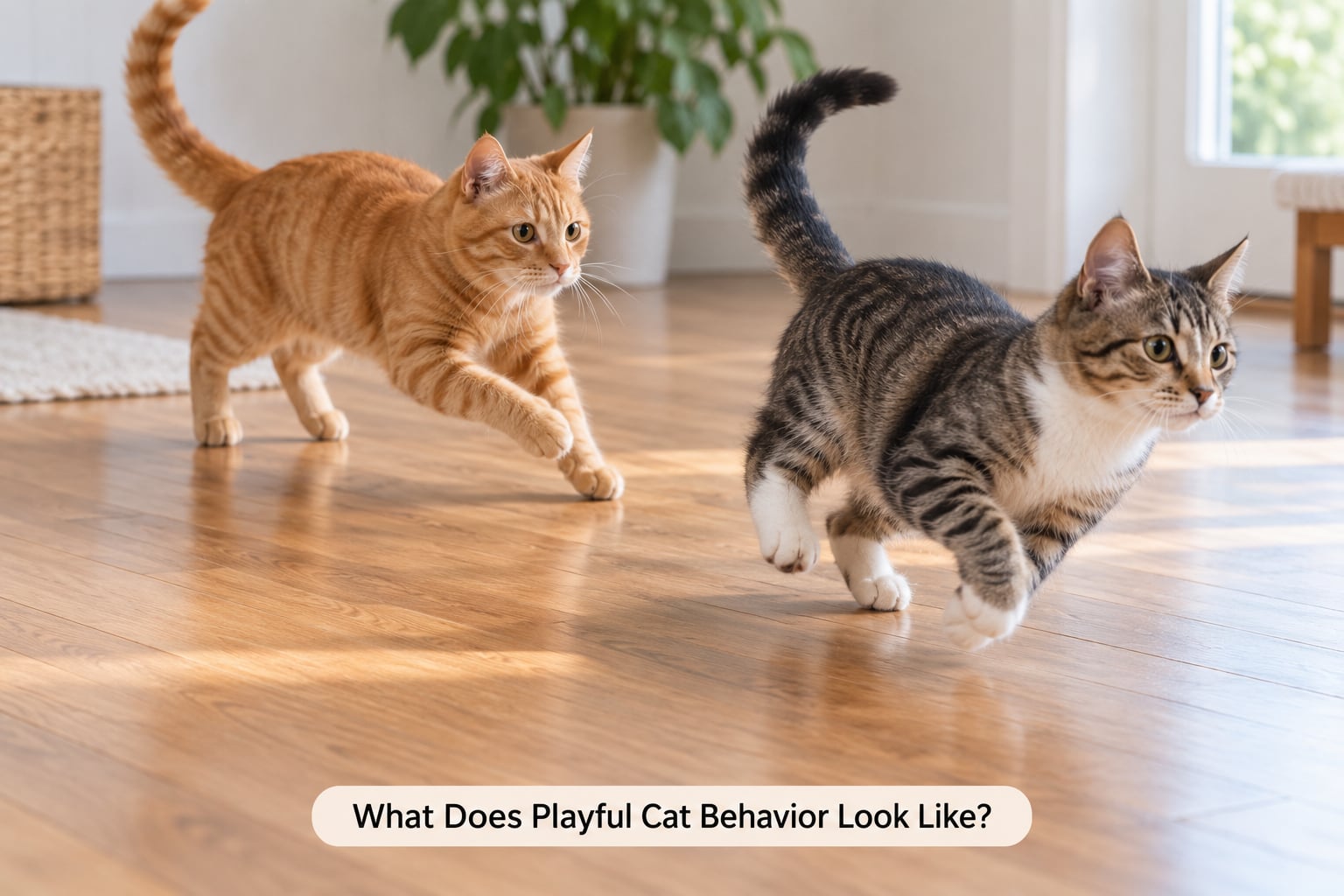
Playful cats move in bursts with breaks between them, take turns, and use inhibited bites that do not break skin. You will see chasing, batting at each other’s front legs, pouncing from behind, climbing, and rolling onto the back in mock surrender.
The single most useful marker is role reversal. The cat doing the chasing turns around and gets chased, or the cat pinning ends up underneath. Both cats also pause regularly to sit, stretch, look away, or groom, and those pauses are what keep play from tipping into a fight.
Play biting looks rough and is not. Cats learn bite inhibition early, and well-socialised adult cats carry that lesson into adult play: the mouth opens, the teeth touch, the neck is gripped for a second, and nothing is punctured. A bit of drool on the fur is normal.
Kittens are the roughest players, and that is not the same as aggressive. A young cat has not yet learned the limits, so play with an adult can look far more punishing than the adult would ever start. Redirect it early with a wand toy and it settles within weeks.
What Are the Signs Cats Are Fighting?
A fight is loud, stiff and one-sided. The clearest signs are escalating vocalization, ears pinned flat, fur puffed along the back and tail, and one cat trying hard to get away.
- Vocalization escalates fast: a low growl becomes a yowl, then open-mouthed screaming.
- Ears pin flat back against the skull and stay there.
- Fur stands on end along the back, the tail and the haunches, making the cat look bigger.
- Pupils blow wide and stay wide, even in a bright room.
- Bodies go rigid and arched, with skin rippling along the back before a lunge.
- One cat blocks a doorway, a shelf, or a route to a litter box.
- Bites repeat and harden, leaving punctures, scratches and clumps of fur in the loser’s mouth.
- The fleeing cat is not coming back out, or comes out only to hide.
Watch for the freeze before the lunge. A cat that stops dead, crouches low, then explodes forward is not playing. In play, the body stays loose from the moment of the pounce to the moment of release.
Play Versus Fighting: Key Differences at a Glance
This table is the whole decision in one place. Read down the columns for the signal that catches your eye, then scan across for whether the rest agrees. Most real fights give you four or five fight-column answers at once; healthy play gives you play-column answers almost every time.
| Signal | Playing | Fighting |
|---|---|---|
| Sound | Quiet, occasional thump or squeak | Hissing, growling, yowling, screaming |
| Ears | Forward, swivelling, flicking side to side | Pinned flat back and held there |
| Tail | Upright, curled, or tip twitching | Straight and rigid, hard lashing, or puffed |
| Fur | Lying flat and smooth | Standing on end along back and tail |
| Pupils | Normal, blinking often | Wide and fixed on the other cat |
| Body | Loose, bouncy, rolling, belly-up | Arched, rigid, crouched, leaning away |
| Roles | Swap often; each cat chases and is chased | One cat always starts; the other always runs or hides |
| Pauses | Frequent, with grooming or sitting | Rare; one burst straight into the next |
| Bites | Soft, inhibited, no skin broken | Hard and punishing; punctures and scratches |
| Afterwards | Grooming, eating, napping together | Hiding, crouching, licking a paw or a wound |
| Evidence | Nothing to find | Crusting ears, bald patches, limping, fur clumps |
Do not rely on one row. A single hiss happens during play, and a single flattened ear can mean one cat got startled by a door slam. It is the pattern across rows that tells you which state you are in.
How to Tell If Play Is Becoming Too Rough
Play becomes too rough when the pauses disappear. The bout that started as chasing runs for minutes without a break, the vocal noise climbs, and one cat is no longer able to disengage.
Watch for a longer chase sequence, escalating sound rather than settling sound, the same cat pinned repeatedly in the same spot, and a cat that runs and then gets cornered instead of getting a break. When one cat starts grooming itself anxiously mid-session or freezes against a wall, the session has already crossed over.
There is a genuinely intermediate state here. In a peer-reviewed study published in Scientific Reports, researchers watched 105 cat-to-cat interactions and sorted them into three categories: playful, intermediate and agonistic. Wrestling dominated the playful category, while chasing and vocalizing dominated the agonistic one. The intermediate category is the grey zone most owners describe, where the session starts reciprocal and quietly tips one-sided.
A three-step decision check
First, ask whether the roles swapped in the last thirty seconds. If only one cat has chased, bitten or pinned the whole time, this is not mutual play.
Second, ask whether you heard anything beyond thumps and squeaks. Growling and sustained yowling mean the arousal is climbing past what play should reach.
Third, ask whether anyone is hiding, limping, licking a paw or refusing to come out. Injury plus ongoing pursuit is the point where intervention stops being optional.
How to Stop a Cat Fight Safely
Never put a hand between two cats. You will get bitten, and a cat that associates your hand with a fight learns to fear you. Spray bottles and shouting make it worse for the same reason.
- Throw a pillow, a folded blanket or a cardboard sheet between them to break visual contact and startle them apart.
- Slide a baby gate, a large piece of cardboard or a closed door across the space they are using.
- Clap loudly or bang a metal pan once. Startle works better than anything you say.
- Put each cat in a separate closed room, then check both for wounds once the dust settles.
- Give them water, a litter box and somewhere to hide before you do anything else.
Triage the injuries like this. Go to an emergency vet now for a bite that punctures the skin, any wound near the eye, jaw or neck, uncontrolled bleeding, a fight involving a very young or very old cat, or a cat that is not eating within hours. Book a same-day appointment for scratches, a limping cat, or ears that are crusting from bites. Watch at home for one to two days if there is no blood, no limping and normal appetite.
After a genuine fight, separate the cats completely for about a week before starting over. Then reintroduce slowly using scent swapping, cracked-door feeding and short supervised sessions. Weeks is the realistic timeline, not days, and the goal is peaceful coexistence rather than friendship.
How to Prevent Future Fights Between Cats
Most intercat fights are about resources, not personality. Spread the resources out so there is no reason to compete in the first place.
Give each cat one food bowl, one litter box and one resting spot of its own, then add one extra of each. Put them apart, not side by side, since two cats eating next to each other is a fight waiting to happen. Add vertical space, cat trees and shelves, so one cat can always get out of the other’s path.
Give both cats daily play to burn off arousal, using a wand toy rather than your hands, and finish a session with a meal so hunting, chasing and eating all happen in one positive sequence. Puzzle feeders do the same job at a lower intensity.
Watch for redirected aggression. A cat that sees a stray through the window can come back inside and attack a housemate who did nothing wrong. Close the line of sight with a solid curtain before the sighting, because the two cats will not work that out on their own.
Sudden aggression in a cat that has always been calm is a medical question first, not a behaviour question. Pain, dental disease, urinary problems, hyperthyroidism and cognitive decline in older cats all show up as new aggression, so book a veterinary exam before you start a behaviour plan.
If fights keep happening despite better resource management, a certified feline behaviourist or your vet can build a desensitisation and counterconditioning plan. Some pairs never become friends, and managing that honestly is more useful than waiting for a reconciliation that may never come.
Frequently Asked Questions
Should I let my two cats fight it out?
No. Let play run its course, but interrupt anything that reaches sustained growling, yowling, screaming, puffed fur or one-sided chasing. Owners who wait for it to finish usually describe injuries and weeks of tension afterward. Startle the cats apart with a pillow or a loud noise, never with your hands or a spray bottle, then check both cats for punctures and give them separate rooms while you assess the damage.
How can I tell if cats are playing too aggressively?
Look for the loss of pauses. Play breaks into short bursts with sitting, grooming or looking away between them. When the chase runs for minutes without a break, the sound climbs instead of settling, one cat gets pinned repeatedly, and the other starts hiding or freezing, the session has gone past play. Rough-looking is not the same as too rough; inhibited bites, belly-up rolling and frequent role swaps still mean play.
Do cats hiss while playing?
A short hiss or a single offended squeak during play is common, especially when one cat grabs an ear or a paw and the other objects briefly. Sustained hissing with flattened ears, puffed fur and no pausing is different, because that combination shows rising arousal rather than a moment of protest. The deciding factor is what happens next: play resumes after the squeak, a fight keeps escalating.
How long do cat fights usually last?
Most single-cat fights are over in under a minute, sometimes ten or fifteen seconds, and the loser usually runs rather than stays. A fight that keeps going past that point, or one that restarts immediately after a break, is worth interrupting. After a real fight, expect the tension itself to last days to weeks, which is why a full week of separation and a slow reintroduction is the standard advice.
What is the 3-3-3 rule for cats?
The 3-3-3 rule is a rule of thumb for introductions: three days in separate rooms with scent and food swapped under the door, three more weeks of that before the cats see each other, then three more weeks of supervised contact. It applies just as well to the other direction. After a fight, the same slow pace is what stops the pair from re-fighting the moment the door opens again.
What is Tarzan syndrome in cats?
Tarzan syndrome is the pattern where an intact male mounts, grips or rides on other cats or kittens as a sexual behaviour rather than as play. The mount looks aggressive, with biting and stalking, and the other cat often reacts as if it is being attacked. It is not the same as a fight: the driving behaviour is sexual and usually aimed at one target. Neutering, redirecting with play and separating the cats during mounting are the usual first steps.
Conclusion
Reciprocal, relaxed, pause-filled play is normal, even when it looks rough. Escalating, one-sided, tense behaviour deserves interruption and separation.
Start by watching one full exchange from start to finish rather than judging a single movement or sound. Note whether the roles swap, whether anything louder than a squeak comes out, and what the cats do in the minute afterwards. If the answer to those three questions points to play, let it run. If it points to a fight, startle them apart and check both cats over.