Spay and neuter recovery care day by day follows one simple rhythm: 10 to 14 days of restricted activity, two incision checks a day, and the medicines your own veterinarian prescribed on schedule. The first 48 hours are usually the hardest, because of grogginess, soreness and a dog who insists on standing up. After that, healing is mostly quiet, and the job is simply to keep your dog calm until the tissue underneath is genuinely closed.
Most complications after this surgery come from three things: licking the incision, doing too much too soon, and missing an early warning sign. A ten-minute check twice a day catches nearly all of them. Everything below is general guidance for education, and your dog’s discharge sheet always outranks it.
Table of Contents
- What You Need
- Step-by-Step: Spay and Neuter Recovery Care Day by Day
- Days 1-2: Protect the Incision and Reduce Activity
- Days 3-5: Support Eating, Rest, and Elimination
- Days 6-10: Increase Low-Impact Activity Gradually
- Days 11-14: Check Healing Before Returning to Normal Activity
- Common Mistakes
- Frequently Asked Questions
- How long does it take to fully recover from a spay or neuter?
- Can I leave my dog alone 2 days after a spay?
- What can my dog do 7 days after a spay?
- Is swelling or a small lump normal after surgery?
- Why is my dog not pooping after surgery?
- When can I remove the cone or let my dog bathe?
- What To Do First
What You Need
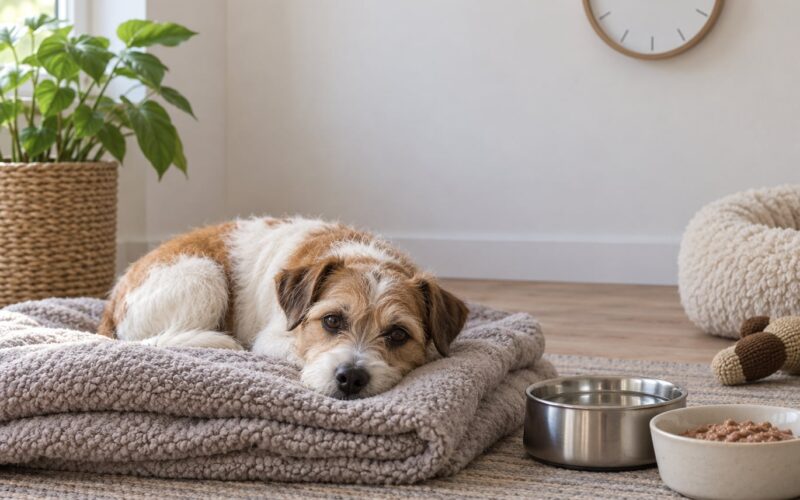
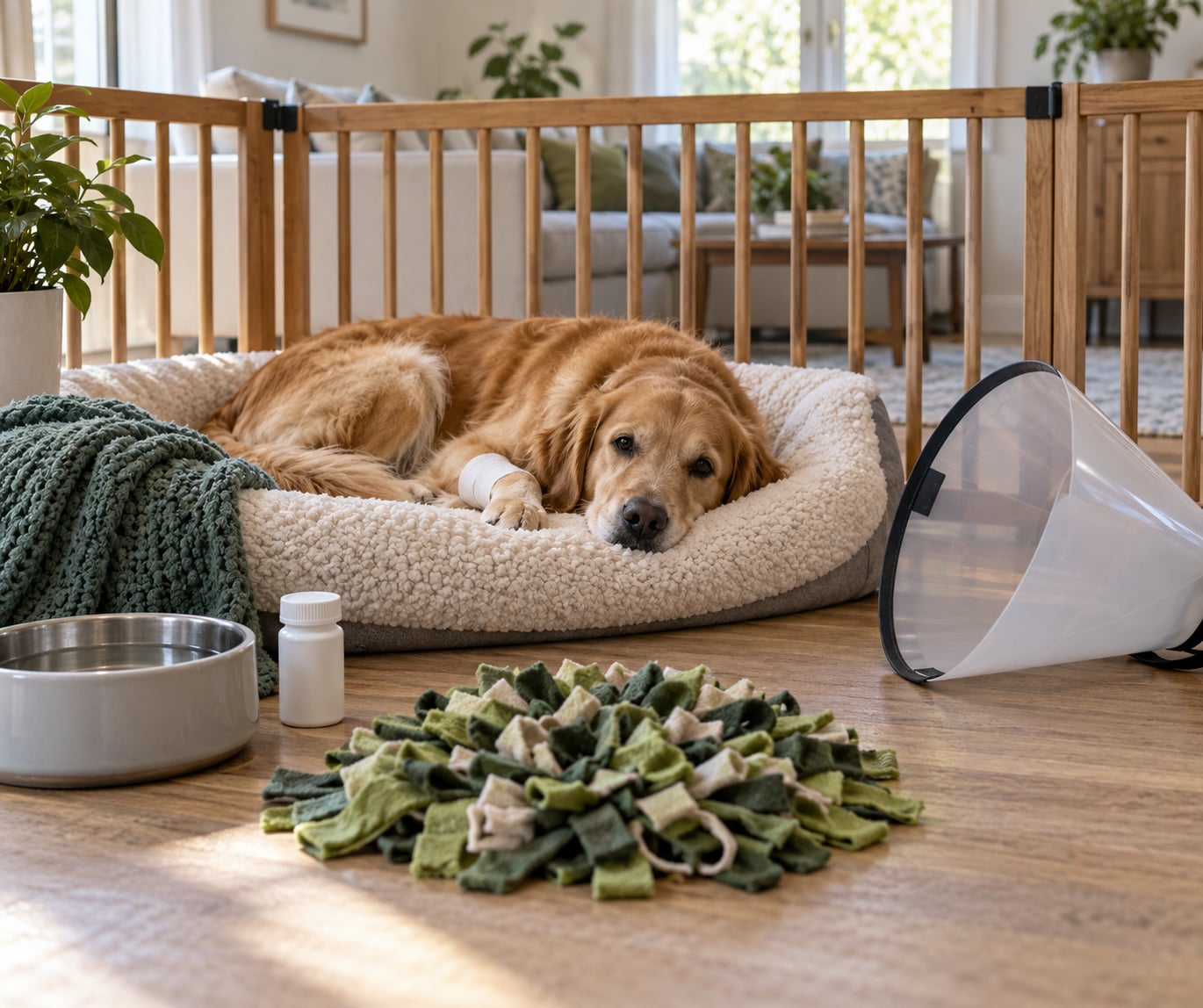
Prepare the recovery room before you bring your dog home. Pick one quiet room, block the doorway with a baby gate, and put his bed on the floor so he does not have to climb steps to lie down. No stairs, no furniture, no dog park down the hall.
- A quiet recovery room away from other pets, with a gate or closed door.
- Floor-level bedding, ideally washable and scratch-free, so nothing catches a claw or a collar edge.
- The food your vet approved, usually his normal diet for a spay and often a lighter, easily digestible option. Ask the clinic before surgery day what they want you to feed the evening you get home.
- Every prescription with the label attached, including the dosing schedule in writing, so nobody has to read tiny text at 2 a.m.
- An Elizabethan collar or a surgical recovery suit, if your vet says the incision needs covering. Get it fitted before pickup day.
- A thermometer, only if your veterinarian asked you to monitor temperature at home. Most clinics do not ask for routine temperature taking.
- The clinic’s after-hours emergency number, written on paper and stuck on the fridge.
- Something quiet to chew on: a lick mat, a snuffed snuffle mat with his regular food, or a frozen food puzzle. Boredom drives most of the bad decisions in a restricted dog.
- A leash for bathroom breaks, even for a dog who normally goes out in the yard.
Set all of it up the week before, not the day of. The single most common owner regret I hear is getting home with a groggy dog and no food, no gate and no plan for the night.
Step-by-Step: Spay and Neuter Recovery Care Day by Day
Days 1-2: Protect the Incision and Reduce Activity
Days 1 and 2 are about keeping your dog still, medicated and away from his incision. Expect grogginess, unsteady legs and disorientation for the first several hours, and mild swelling around the wound that often looks more noticeable than it feels.
- Positioning: keep him on a padded floor-level bed, ideally near you but away from stairs and other animals.
- Prevent licking: collar or recovery suit on before he is alert enough to reach the incision. Check it twice, including overnight, since that is when he does his best work.
- Medication: follow the label exactly, on time. Owners frequently describe pain relief as the difference between a miserable night and a manageable one, and under-dosing is common because he looks fine.
- Feeding: offer a small meal in the evening if your clinic approves it. A few nausea tablets work for a lot of dogs before that meal.
- Movement: bathroom breaks on a leash, nothing else. No stairs, no jumping on the couch, no wrestling.
- Incision check: look twice a day. Do not remove dressings, apply ointment, peroxide or anything from a first-aid aisle.
Call the clinic the same day if he has not eaten anything within about 24 hours of coming home, is vomiting repeatedly, or seems painful when you touch near the incision. Cats are different here: a cat that does not eat for 48 hours can develop hepatic lipidosis, which is a liver problem driven by fasting. That is a real emergency, not a slow recovery.
Days 3-5: Support Eating, Rest, and Elimination
Days 3 to 5 are when appetite returns and the real risk starts, because your dog feels good again. Most owners at this stage describe the opposite problem: an energetic animal who has to be told no.
- Meals: move back to his normal food gradually, split into smaller meals. Keep table scraps and new treats out of the picture, since a sudden diet change is hard on a gut that just went through anesthesia.
- Hydration: fresh water at all times, with a bowl on the floor rather than lifted to chest height.
- Bathroom breaks: leash only, short and calm, morning and night plus as needed. Notice whether he is urinating and whether he is straining.
- Elimination: no bowel movement for two or three days is common after anesthesia, especially with opioids on board. It passes on its own once he eats and moves. Straining with nothing produced, or a belly that swells and hardens, is a different story and needs a call.
- Activity: strictly no stairs, jumping, running or rough play. No visitors, no dog park, no throwing a ball. Leash walks of three to five minutes in a quiet area are fine.
- Collar and suit: stay on. Dogs find a way to reach the wound even through an Elizabethan collar, especially at night.
Enrichment does the heavy lifting this week. A lick mat frozen with wet food, a snuffle mat, or a stuffed food puzzle buys you twenty quiet minutes and takes real energy out of a restless dog. Place things within easy reach of his bed so standing and stretching stay low-key.
Days 6-10: Increase Low-Impact Activity Gradually
Days 6 to 10 are the most dangerous stretch, because the incision looks closed on the surface while internal sutures are still mending. This is when owners say their dog seems totally fine, and then a two-hour romp at day seven sets the healing back by a week.
- Walks: extend to 10 to 15 minutes of calm walking on a flat route. Still on the leash, still no play with other dogs.
- Stairs: carry him for the first stretch, or block them entirely. Once he is steady, use the stairs slowly, one at a time, no rushing.
- Play: no running, jumping, tug, fetch or frisbee. Gentle nose-to-hand sniffing on a long line is the best substitute there is.
- Floor sleeping: keep bedding on the floor until your vet says otherwise.
- Protective gear: keep the collar or suit on until the incision is fully closed with no gaps, no redness and no discharge. Usually that means day 10 to 14.
If you work outside the home, days 3 to 5 are the hard ones. A short adult dog can manage a few hours alone in a gated, bedded room with water and no stairs, but not a bouncing puppy. Crate or pen time works better than free-roaming, and a dog that gets an honest chew at the start of the workday usually settles.
Days 11-14: Check Healing Before Returning to Normal Activity
Days 11 to 14 are for assessing healing and getting a green light, not for testing the incision. A healed spay incision is closed, dry, flat or nearly flat, and the skin color matches the surrounding fur, with no discharge and no warmth.
- Absorbable sutures: many stitches dissolve on their own, and the visible thread can hang on long after the wound has closed underneath. A small dangling loop is normal; do not cut or pull it.
- Swelling and the lump: a firm, soft lump under the incision is usually a seroma, a pocket of harmless fluid. It often peaks in week two and reabsorbs over a few weeks.
- Non-absorbable stitches: if the clinic used stitches that do not dissolve, they come out at a scheduled appointment, usually around day 10 to 14. Do not remove them yourself.
- Returning to normal: normal walks resume at the end of the two-week window if the incision looks good. Full running, jumping, stairs and rough play usually come a few days after that.
A few simple checks make the last stretch easy: take a photo of the incision on day 1 and again on day 14, and compare. If something looks worse instead of better, that comparison is the fastest way to explain it to your vet.
Common Mistakes
- Giving human pain medicines. Ibuprofen, acetaminophen, aspirin and naproxen are toxic to dogs. Give only what your veterinarian prescribed or approved by name, at the dose on the label.
- Letting the collar come off or go missing. One night without it is often how a clean incision turns into a chewed one. Check the fit nightly.
- Exercising early. It looks healed at day seven. The tissue is not. Premature running, jumping and play are the top causes of wound separation and post-surgical hernias.
- Removing sutures yourself. Either your vet removes them or they dissolve. Pulling a stitch opens the wound.
- Using wound products from your own shelf. No peroxide, no ointment, no sprays, no powders unless your vet told you to use them by name.
- Skipping doses because he looks fine. Pain relief works best taken on schedule. Stopping early tends to bring the pain back with interest.
- Changing food abruptly. New diet during recovery means vomiting and constipation on top of everything else. Keep it steady, and wait a couple of weeks for any switch.
Frequently Asked Questions
How long does it take to fully recover from a spay or neuter?
Most dogs recover well enough for normal activity in 10 to 14 days, but internal healing continues for several weeks after the skin closes. The first 48 hours are the hardest part. Full activity, including running, jumping and rough play, is usually cleared a few days after the two-week mark, and your veterinarian’s discharge instructions always decide the real timeline.
Can I leave my dog alone 2 days after a spay?
A few hours is usually fine if your dog is steady on his feet, but only in a gated room with bedding on the floor, fresh water and nothing to climb. Do not leave him alone for a full workday during the first 2 to 3 days while he is still groggy. Puppies and high-energy breeds need someone in the house until they can settle calmly.
What can my dog do 7 days after a spay?
Short calm leash walks of about 10 to 15 minutes, sniffing, and lying quietly are all fine. Running, jumping, stairs, fetch and playing with other dogs are not, because the incision looks closed while the deeper tissue is still mending. Keep the collar or recovery suit on until you are near day 14 with no redness or discharge.
Is swelling or a small lump normal after surgery?
Mild swelling and firmness for the first few days is expected and should shrink daily. A soft lump under the incision that shows up in week one or two is usually a seroma, a pocket of fluid that the body reabsorbs over a few weeks. Call your vet if swelling grows instead of shrinking, becomes hot, or comes with pus, a bad smell or opening of the wound.
Why is my dog not pooping after surgery?
Not stooling for two or three days is common after anesthesia, especially when pain medication is an opioid, and it usually clears once he eats and walks normally. Watch him drink, eat and urinate normally. Straining with no result, a hard swollen belly, vomiting or no urinating within 24 hours all need a same-day call to your veterinarian.
When can I remove the cone or let my dog bathe?
Take the collar off only when the incision is fully closed, dry and free of redness, usually around day 10 to 14, and when your vet agrees. Skip baths, swimming and grooming until about two weeks after surgery, and keep any water off the incision. Dishwasher-safe cones are worth buying if your dog breaks out of a fabric one at night.
What To Do First
Get spay and neuter recovery care day by day right by starting a week early. Build the recovery room before pickup day, keep the collar on through the whole 14-day window, and check that incision twice a day. Give the prescribed pain medicine on time, keep walks short and leash-only, and call your veterinarian the same day you see swelling that grows, discharge, a bad smell, a wound that opens, or a dog who has not eaten in 24 to 48 hours.