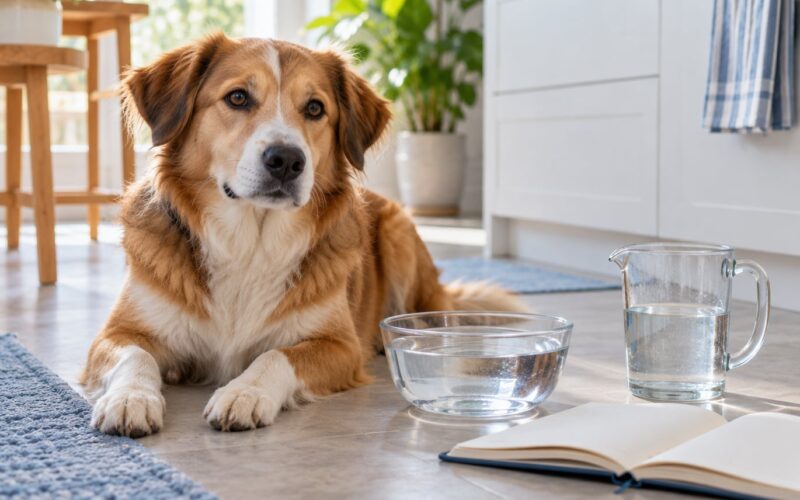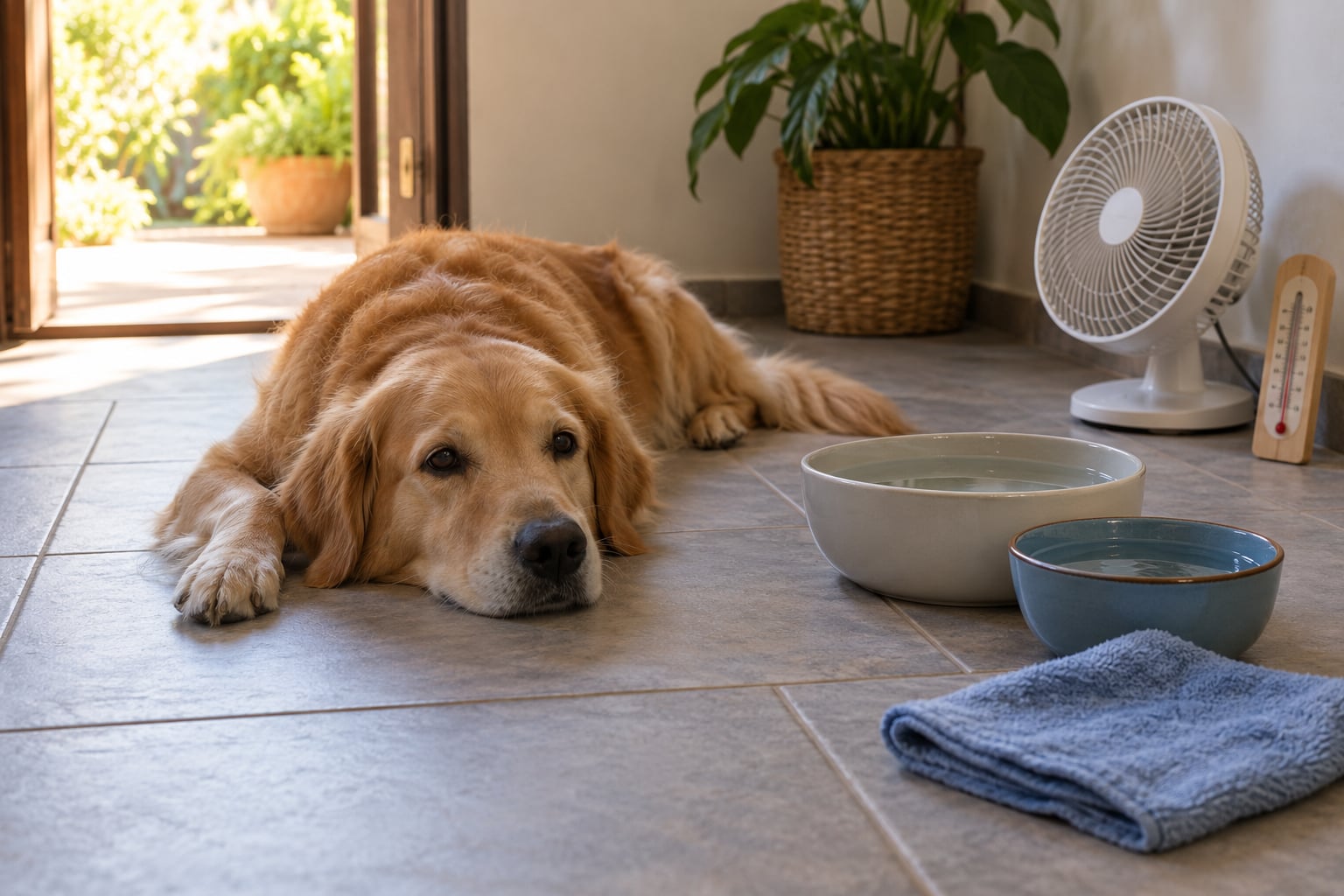
To keep a dog cool in hot weather safely, move them out of direct sun early, give constant access to cool (not icy) water, walk at dawn and dusk instead of midday, and cool the belly, paws, armpits and inner thighs with cool water if they start overheating. Prevention is far easier than treating heatstroke, and most of it costs nothing.
Dogs cannot sweat the way we do. They shed heat almost entirely by panting, with a little extra coming out through the paw pads, which is why a Labrador can be lying on cool tile and still running hot while a human in the same room is fine. Those two facts decide everything that follows.
Before the detail, here is the short version. Eight cooling actions cover almost every hot day:
- Keep fresh, cool water in more than one bowl, indoors and out.
- Walk at first light and after sunset, and skip the midday window entirely.
- Run the back of your hand on the pavement for five full seconds before crossing it.
- Give your dog shade plus a cooled floor surface to lie on.
- Add airflow with a fan pointed across the body, never straight at the face from close range.
- Offer water play: a hard plastic paddling pool, a sprinkler, a mister.
- Freeze treats such as a lick mat or a Kong stuffed with xylitol-free peanut butter.
- Watch the gums and the breathing, and call a vet at the first emergency sign.
The single most useful habit is knowing your dog’s normal. A dog who is cool, eating, and mildly playful at 7am has a baseline you can measure against at 2pm.
Table of Contents
- What You Need
- Step-by-Step: How to Keep a Dog Cool in Hot Weather Safely
- 1. Start the Day With Cool Water and a Temperature Check
- 2. Create Shade and a Cool Resting Area
- 3. Change Walk Times and Keep Exercise Short
- 4. Use Cooling Techniques Without Risky Remedies
- 5. Watch for Early Signs of Overheating
- 6. Act Quickly if You Suspect Heatstroke
- 7. Make a Heat Safety Plan for Every Setting
- Common Mistakes
- Frequently Asked Questions
- How hot is too hot for a dog to go outside?
- Is it safe to give a dog ice or cold water to cool down?
- How can I tell if my dog is overheating?
- Should I exercise my dog on hot days?
- How much water should a dog drink in hot weather?
- What should I do if my dog has heatstroke?
- Conclusion: What to Do First
What You Need
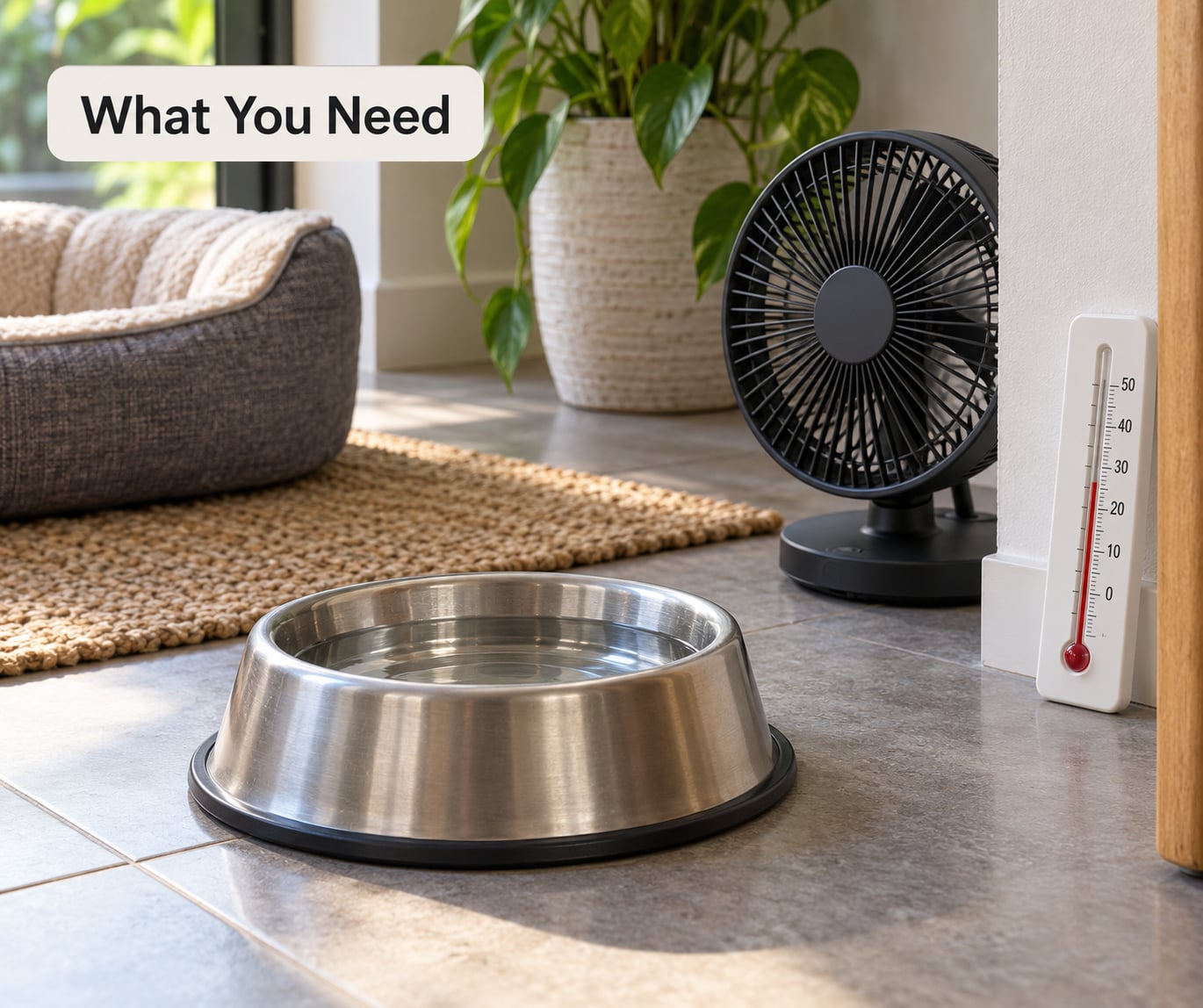
The list is short because almost everything that works is free. What you actually need is a water source you can keep refilling, somewhere shaded with a hard cool floor, and a way to check conditions before you head out.
- Two or more water bowls, placed in different rooms so your dog never has to travel far to drink.
- A shaded area with airflow. Indoors that means a room away from west-facing windows; outdoors it means a canopy, an awning, or shade cast by a building or tree all day.
- A cool surface to lie on — tile, concrete, or a raised cot that lifts the dog off warm ground.
- A thermometer if you own one. A dog’s rectal temperature sits around 100 to 102.5 F, and knowing your dog’s normal number turns “he seems off” into something you can act on.
- A phone and a plan for the vet, with the nearest emergency clinic number saved in your contacts before the hot season starts.
- Optional but useful: a portable water bottle or collapsible bowl, a fan, booties for hot pavement, and a cooling mat or evaporative vest.
For households with no air conditioning, add one more thing: a plan for the night. That deserves its own section later, because overnight heat is the most under-served problem owners bring up.
Step-by-Step: How to Keep a Dog Cool in Hot Weather Safely
The seven steps below build on each other, in the order they matter on a hot day. Steps one to three prevent most problems. Steps four to six are what you do when something has already gone wrong.
1. Start the Day With Cool Water and a Temperature Check
Fill the bowls at 6am and again at noon, and top them up whenever they drop below full. Cool water encourages drinking; lukewarm or room-temperature water often does not. Add a second bowl outside and one near the bed, because a dog that has to cross a hot room to reach water will drink less.
As a rough guide, a dog needs roughly one ounce of water per pound of body weight across the day, and noticeably more in heat. A 50-pound dog drinks somewhere around 50 ounces, which is about six normal bowls. Watch how much your own dog actually finishes, because that number is the hydration baseline nobody else can give you.
Ice cubes in the bowl are fine for most dogs as an extra, but do not make the whole bowl ice-cold water. Very cold water can cause stomach upset and some dogs will refuse it entirely.
2. Create Shade and a Cool Resting Area
Shade is the single most effective tool you own. Make sure it covers the hours your dog actually uses the space — a shady spot at 9am is useless if the sun swings over it at noon.
Pair the shade with a cool floor. Tile, sealed concrete and vinyl release heat quickly. If your dog lives on carpet all day, an elevated cot gets the body off the trapped warmth. Outdoors, the ground itself can get hot enough to burn pads, so a raised bed protects the paws as well as the body.
A fan helps by moving air across the coat so saliva and moisture evaporate off the skin. Aim it across the body from a few feet away. Flat-faced breeds such as French Bulldogs, Pugs and Shih Tzus can be overwhelmed by a fan blowing straight at their face, and in that case aim it along the wall so air circulates without blasting their shortened airway.
3. Change Walk Times and Keep Exercise Short
Move the walk to first light or after sunset. If your work schedule leaves you with only the middle of the day, do a two-minute toilet break instead of a proper walk and make up the exercise indoors with a snuffle mat, a puzzle feeder or a scatter of treats to find. Breed makes a difference too: a short-coated hound shrugs off midday heat far better than a Husky, a Samoyed or a Bernese Mountain Dog does, so the higher-maintenance coats get the shorter windows.
Always run the pavement test. Press the back of your hand flat against the surface and hold it there for a full five seconds. If you cannot keep it there, your dog cannot stand on it. Asphalt and metal are the worst offenders, and a surface that feels merely warm to you can be hot enough to blister thin paw pads.
Use this table as a working guide rather than a guarantee:
| Air temperature | Most adult dogs | High-risk dogs |
|---|---|---|
| Below 21 C / 70 F | Normal walk, normal duration | Normal, watch closely |
| 21 to 24 C / 70 to 75 F | Shorter walk, shade breaks | Short outing only, on the shaded side of the street |
| 24 to 27 C / 75 to 80 F | Toilet breaks early and late | No exercise, indoor enrichment instead |
| Above 27 C / 80 F | Indoor play, minimal outdoor time | Indoors only, monitor constantly |
Humidity changes these numbers more than most people expect. Dogs cool themselves mainly by evaporation — panting moisture, and any damp coat drying out. On a muggy day that evaporation stalls, so 32 C with high humidity can be more dangerous than a dry 35 C.
Slow things down for the dogs who need it most: flat-faced breeds, double-coated breeds such as Huskies, Golden Retrievers, Bernese Mountain Dogs and Samoyeds, dark-coated dogs, light-skinned or hairless dogs, puppies, seniors, overweight dogs, and any dog with a heart, airway or kidney condition. Break outdoor play every ten to twenty minutes into shade with water.
4. Use Cooling Techniques Without Risky Remedies
Safe cooling is targeted and cool, never icy. Pour cool tap water over the belly, the armpits, the inner thighs and the paw pads, and blot rather than rub. The big blood vessels that run along the inner thighs sit right under that skin, which is why cooling there works so quickly.
Wet towels go on the floor or on the dog only in specific ways. A damp towel laid under the body on cool tile is fine. Draped over a warm dog, the same towel traps a layer of warm air and slows the whole process. If you use one on the body, wet it again as soon as it warms.
Frozen water bottles wrapped in a towel make a cheap, reusable cold pad for an office, a garage, or a kennel. A self-cooling gel mat works by evaporating water off the gel surface; a soaking mat for paws does something similar. If your dog chews things, take the mat away once the chewing starts — swallowed gel has caused intestinal blockages.
For shade-free play, a hard plastic paddling pool beats an inflatable one, which a determined dog can puncture. Start water-shy dogs in shallow water and let them set the pace. Never force a dog into water; a bad first experience creates a dog you cannot cool on the worst day of the year.
Cooling vests and bandanas soaked and wrung out use evaporation against the chest and neck. Hang them to dry indoors, because a damp vest worn in a warm room does nothing useful. Skip doggie sunscreen unless you are dealing with genuinely high UV and a light-skinned dog, and avoid booties on dogs who chew them.
One grooming note: do not shave a double coat. That coat insulates against heat and reflects UV, and shaving can leave the skin exposed to sunburn. Trim long hair and do a proper groom instead.
5. Watch for Early Signs of Overheating
Early signs show up as behaviour before they show up as collapse. Watch for panting that will not settle, restlessness, heavy drooling, weakness in the back legs, and bright red or unusually pale or bluish gums.
Heat exhaustion and heatstroke are not the same thing. Exhaustion means the dog is hot, uncomfortable and struggling to shed heat, and cooling at home can resolve it. Heatstroke is a true medical emergency where heat begins damaging tissue, and the signs are vomiting, stumbling or circling, confusion, collapse, and a very hot body. Once you see those, stop the home routine and call a vet immediately.
6. Act Quickly if You Suspect Heatstroke
There is a strict order to this, and speed matters more than technique.
- Move the dog into shade or air conditioning and stop all activity.
- Pour cool, not icy, water over the belly, armpits, inner thighs and paws.
- Run a fan across the wet coat to speed evaporation.
- Replace towels or re-wet them as soon as they warm up.
- Offer small amounts of water if the dog is alert and swallowing. Do not pour water into the mouth of a confused or collapsed dog.
- Call the vet or the nearest emergency clinic on the way, not after.
Cool toward, not past, the point where things look normal. A dog can appear recovered and still have damage that shows up hours later, so veterinary follow-up matters even when the panting slows down.
Never give human medication to cool a dog down. Ibuprofen, acetaminophen and similar drugs are toxic to dogs, and cooling patches intended for humans can burn skin.
7. Make a Heat Safety Plan for Every Setting
Car travel. A parked car is the most dangerous place a dog can be on a hot day. With the windows up, a car at 24 C can pass 38 C in ten minutes, and a car starting at 32 C can reach 48 C within twenty. Never leave a dog unattended in a parked vehicle, even for a few minutes and even in partial shade. For travel, run the air conditioning, never just the vents, and leave the car running with the dog secured in a crate harness rather than loose.
Outdoor, kennel and crate dogs. Outdoor dogs have almost no control over their environment, so shade structure, a raised bed and a water source that cannot run dry do the heavy lifting. Post-and-rail kennels can be vented with shade cloth on the sun side, and frozen bottles in towels work well because they last hours without electricity.
Events and dog parks. Bring your own water rather than trusting communal bowls, keep sessions short, and leave early when the dog starts searching for shade instead of playing. Keep the dog in the car with air conditioning rather than in a queue on hot asphalt.
At night and in the crate. This is where most households lose ground. Move the crate away from direct sunlight and off the bare floor, place it where air moves, and put a cooling mat or a frozen-bottle towel under it. Open the bedroom door so the dog can follow you to the coolest room. Freeze a lick mat before bed so the last hour of the day involves licking rather than panting.
Common Mistakes
Most of the bad advice around summer dog care comes from reasonable-sounding rules that are simply wrong. These are the ones that come up again and again.
| The myth | What to do instead |
|---|---|
| Dump ice and freezing water on a hot dog | Cool tap water. Very cold water constricts surface blood vessels and can limit the very heat loss you are trying to create. |
| Drape a wet towel over the dog | The towel traps warm air like a dome. Wet the belly, paws, inner thighs, and floor instead. |
| Shave a double-coated dog for summer | Leave the coat. It insulates against heat and UV. Trim and groom only. |
| Panting means the dog is fine | Panting is how dogs shed heat. Persistent panting, drooling and weakness are early warnings, not reassurance. |
| A cooling mat is always safe | Take it away from a chewer. Swallowed gel has caused intestinal blockages. |
| Exercise hard to tire the dog out early | Skip midday exertion entirely and use indoor enrichment instead. |
| Give an aspirin or other human pill | Never. Ibuprofen and acetaminophen are toxic to dogs. Call a vet. |
| Wait to see if it passes | Once you see vomiting, confusion or collapse, call an emergency clinic immediately. |
Two more mistakes that catch people out. Brachycephalic breeds do not handle fans pointed at their faces well, and they cannot pant efficiently at all, so they need shade and airflow arranged gently rather than aggressively. And a dog that refuses water on a hot day may be nauseous rather than fussy, which is a reason to call a vet, not a reason to add ice.
Frequently Asked Questions
How hot is too hot for a dog to go outside?
Above 27 C (80 F), most dogs should be doing indoor enrichment rather than exercise, and high-risk dogs should not go out at all. Between 24 and 27 C (75 to 80 F), keep walks to early morning, evening, and short toilet breaks. Below 21 C (70 F) most adult dogs walk normally. Humidity matters as much as the number, because dogs rely on evaporation to cool themselves. Always run the five-second pavement test before you cross any surface.
Is it safe to give a dog ice or cold water to cool down?
Ice cubes in the drinking bowl are fine for most dogs and many enjoy them. Icing water poured over the body is not recommended, because very cold water constricts surface blood vessels and can slow heat loss. Offer cool tap water for drinking and for wetting the belly, paws, armpits and inner thighs. If your dog refuses cold water, that refusal is information: try cool water instead of forcing the point.
How can I tell if my dog is overheating?
Early signs include panting that will not settle, restlessness, heavy drooling, weakness in the back legs, and bright red or unusually pale gums. Emergency signs are vomiting, stumbling, circling, confusion and collapse. The gums are the fastest check: lift the lip and look. If you see the emergency list, move the dog somewhere cool, start cooling with cool water, and call a veterinarian on the way rather than waiting.
Should I exercise my dog on hot days?
Move the walk to first light or after sunset and shorten it. Break any play session every ten to twenty minutes in shade with water. On days above 27 C (80 F), skip outdoor exercise and use a snuffle mat, puzzle feeder or nosework indoors instead. Flat-faced breeds, double-coated breeds, puppies, seniors and overweight dogs need shorter windows and more frequent breaks than the rest of the household.
How much water should a dog drink in hot weather?
A common guide is about one ounce of water per pound of body weight per day, so a 50-pound dog drinks roughly 50 ounces across the day, and more in hot weather. Keep two or more bowls filled in different rooms and outside, and check them at least twice a day. Urinating less than usual, dry gums and a sunken eye are reasons to contact a vet, since dehydration in heat escalates quickly.
What should I do if my dog has heatstroke?
Move the dog into shade or air conditioning and stop all activity. Pour cool tap water over the belly, armpits, inner thighs and paws, run a fan across the wet coat, and re-wet towels as they warm. Offer small amounts of water only if the dog is alert and swallowing. Call a veterinarian or emergency clinic immediately and keep cooling on the way, because internal damage can appear hours after the dog seems better.
Conclusion: What to Do First
Start with the three things that cost nothing. Refresh the water bowls, move the dog into shade with a cool surface to lie on, and stop whatever activity is going on.
Then watch breathing and alertness rather than the thermometer alone. If the panting settles and the gums return to a normal pink within ten or fifteen minutes in the shade, you have bought time. If you see drooling that will not stop, weakness, vomiting, confusion or collapse, call a veterinarian or emergency clinic while you start cooling with cool water over the belly, paws and inner thighs.
On any day that hot, the safest routine is the boring one: walk early, walk short, drink often, stay in the shade. Prevention here is measured in minutes and bowls of water. Heatstroke is measured in emergency surgery.