If you are wondering how often should you bathe a dog, the short answer is every 4 to 8 weeks for most healthy adults — but coat type, breed and lifestyle can move that number a lot. Dogs are not self-cleaning like cats, so they do need regular baths, yet too many washes strip the skin’s natural oils and cause flakes and itching. This guide breaks the schedule down by coat type, breed and age so you can set a routine your dog can live with.
The reason most guides disagree is that they all quote a different number. Four to eight weeks comes up constantly, and so does once a month. Both are right, for different dogs. Once you know what kind of coat you are dealing with and how much time your dog actually spends outside, the interval basically picks itself.
Table of Contents
- How Often Should You Bathe a Dog?
- Bathing Frequency by Coat Type
- How often to bathe a double-coated dog?
- What if you never bathe your dog?
- How Often Should You Bathe a Dog After Exercise or Outdoors?
- How Often Should You Bathe a Puppy, Senior, or Sensitive-Skin Dog?
- How to Bathe a Dog Without Causing Skin Problems
- Signs You Should Bathe Your Dog More Often—or Less Often
- Frequently Asked Questions
- What if I never bathe my dog?
- How often should indoor dogs take a bath?
- Are you supposed to bathe a dog every week?
- What happens if I bathe my dog every day?
- What if my dog gets stinky after two weeks?
- Should I bathe my dog before a grooming appointment?
- Where This Guidance Comes From
- Conclusion
How Often Should You Bathe a Dog?
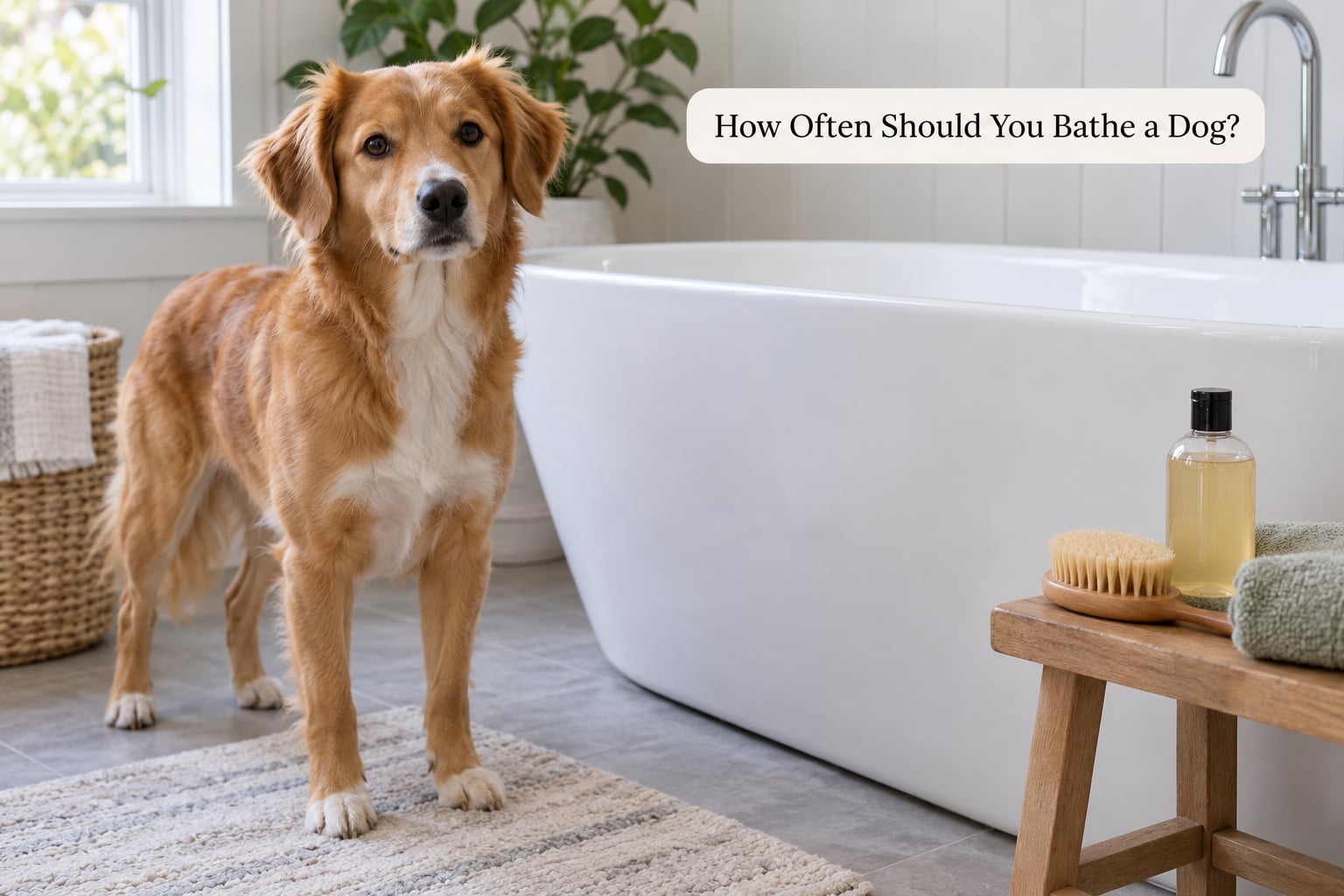
Most healthy adult dogs need a bath every 4 to 8 weeks, and every 2 to 4 weeks suits most dogs whose coat gets dirty or smelly quickly. Short-coated dogs can often stretch to 2 to 3 months, double-coated dogs usually need less washing than owners expect, and hairless breeds need a bath every 1 to 2 weeks because their skin produces oil with nothing to absorb it.
The rule that works better than any calendar is the sniff test. Lean down near your dog’s coat, or take the towel it sleeps on and smell it. When your dog smells on your hands and the couch, it’s time. Many owners on pet forums follow exactly that: one described a schedule of a bath every 6 to 8 weeks plus a good brush every second day, which is about the shape of a routine that works.
Over-bathing is the more common mistake. Most dogs are washed far more often than they need to be, and owners of double-coated breeds often worry they are ruining the coat. If you take one thing away from this guide, it is that bathing less but better beats bathing often and badly.
Bathing Frequency by Coat Type
Coat type is the single biggest factor in how often you bathe a dog. It decides how much oil the skin makes, how fast that oil spreads along the hairs, and whether the coat repels water on its own. Here are the usual intervals.
| Coat type | Typical interval | Why it works that way | Watch out for |
|---|---|---|---|
| Short and smooth (pugs, greyhounds, Chihuahuas) | Every 2 to 3 months | Little undercoat, so oils spread easily and the coat stays relatively clean | Skin folds in pugs trap moisture and need drying after every bath |
| Medium coat (beagles, border collies) | Every 6 to 8 weeks | Holds a layer of natural oil that works well when brushed | Brushing matters more than frequency here |
| Long and silky (Shih Tzu, Yorkshire Terriers, Maltese) | Every 4 to 6 weeks | Long hair matts and traps dirt, urine staining and tear staining near the eyes | Daily brushing or the coat mats within days of the bath |
| Thick and double-coated (Labradors, Siberian Huskies, German Shepherds, Newfoundlands) | Every 2 to 3 months | Guard hairs plus a dense undercoat form a water-repellent, self-cleaning shell | Undercoat dries slowly; wet patches can turn into hot spots |
| Curly (poodles, cockapoos, bichons) | Every 4 to 6 weeks | Curls trap water, loose hair and debris instead of shedding it | A damp curl layer can smell within days, so dry fully |
| Wire or bristly (German wirehaired pointers, dachshunds) | Every 2 to 3 months | Coarse hair is slow to get dirty but slow to dry too | Stubble traps smell from the skin itself |
| Oily (Basset Hounds, Newfoundlands, some retrievers) | Every 2 to 4 weeks | The skin overproduces sebum faster than the coat can absorb it | Oily coat can also signal a skin condition worth asking a vet about |
| Hairless (Chinese Crested, American Hairless Terrier, Xoloitzcuintli) | Every 1 to 2 weeks | No hair to distribute oil, so it builds up directly on the skin | Sun exposure on the skin; avoid midday sun and use dog-safe sun protection |
How often to bathe a double-coated dog?
Less often than most people guess. A Labrador, Husky or German Shepherd coat is designed to shed water and dirt on its own, and one thorough bath every 2 to 3 months suits most of them well. Wash too often and you strip the oily guard hairs, and the coat can take months to recover its usual texture.
What double-coated dogs need instead is thorough drying. Get right down to the skin with a blow dryer on cool, and separate the coat down to the undercoat so warm water can’t hide underneath. Wet undercoat is the fast route to a bacterial skin infection on a heavy dog.
What if you never bathe your dog?
Occasional skipping is fine, and most indoor dogs manage a couple of months between full washes with brushing alone. Owners on r/dogs described a very clean dog bathed every 2 to 3 months and another whose only baths came with a groom every 6 to 8 weeks, and neither had skin trouble.
Never, though, causes problems that show up later. Sebum builds up, matting sets in where you cannot see it, and the dog starts leaving a strong scent on your sofa. It is also common for a dog that smells bad to be hiding a skin or ear problem, and a bath would only cover that up. If your dog smells worse than usual right after a bath, that is a vet question, not a shampoo question.
How Often Should You Bathe a Dog After Exercise or Outdoors?
Most dogs do not need a full bath after every walk. A dog that walks on a lead, comes in clean and dries off has had enough. Washing off after every outing takes the natural oils off, and then the next walk puts the smell back faster, which is exactly the cycle owners notice.
There are clear exceptions where water is worth the effort:
- Swimming. Rinse with plain lukewarm water after a lake or sea swim. Salt and chlorine left behind dull the coat and irritate skin, and a wet coat that never fully dries is the fastest route to that damp-dog smell.
- Hiking and muddy trails. If legs and belly are caked, either hose off those areas or give a full bath. Mud that dries and later gets groomed out can irritate the skin underneath.
- Rolling in something foul. Skip, bury or another animal’s mess. Most owners are relieved to hear they only need to manage the smell, not scrub the whole dog.
- Dog daycare or a busy dog park. Dogs sharing space pick up whatever the others carry. A rinse of paws, belly and rear keeps things manageable between full baths.
- Working, hunting or show dogs. These are routinely bathed far more often, sometimes 1 to 2 times a week in show season, and it can be done safely with a high-quality moisturizing shampoo and conditioner rather than harsh soap.
How Often Should You Bathe a Puppy, Senior, or Sensitive-Skin Dog?
Puppies. Most puppies can be bathed from around eight weeks, once your vet has given the go-ahead, using a small amount of mild puppy shampoo. Until then, wipe the coat with a damp cloth instead. Keep bath days short, warm and boring, and treat the tub with towels and a non-slip mat.
Seniors. Older dogs often produce less oil, and their skin is thinner and more sensitive. Every 8 to 12 weeks is usually plenty unless your vet prescribes otherwise. Watch for incontinence or a dull coat, both of which are worth mentioning at the next checkup.
Sensitive skin and medical situations. If your dog has allergies, a recurring skin infection, fleas, a surgical wound or an ongoing medicated shampoo routine, the interval belongs to your veterinarian, not to this page. Medicated products also need their contact time honoured, which means leaving the shampoo on for the stated number of minutes before rinsing, and that instruction outranks anything written in a general guide.
Never give a dog human medication, including a cream or a shampoo made for people. Dog skin runs at a different pH than ours, and one common owner mistake is reaching for dish soap on a greasy dog; it strips oils far more aggressively than any pet shampoo and leaves the coat worse than it started.
How to Bathe a Dog Without Causing Skin Problems
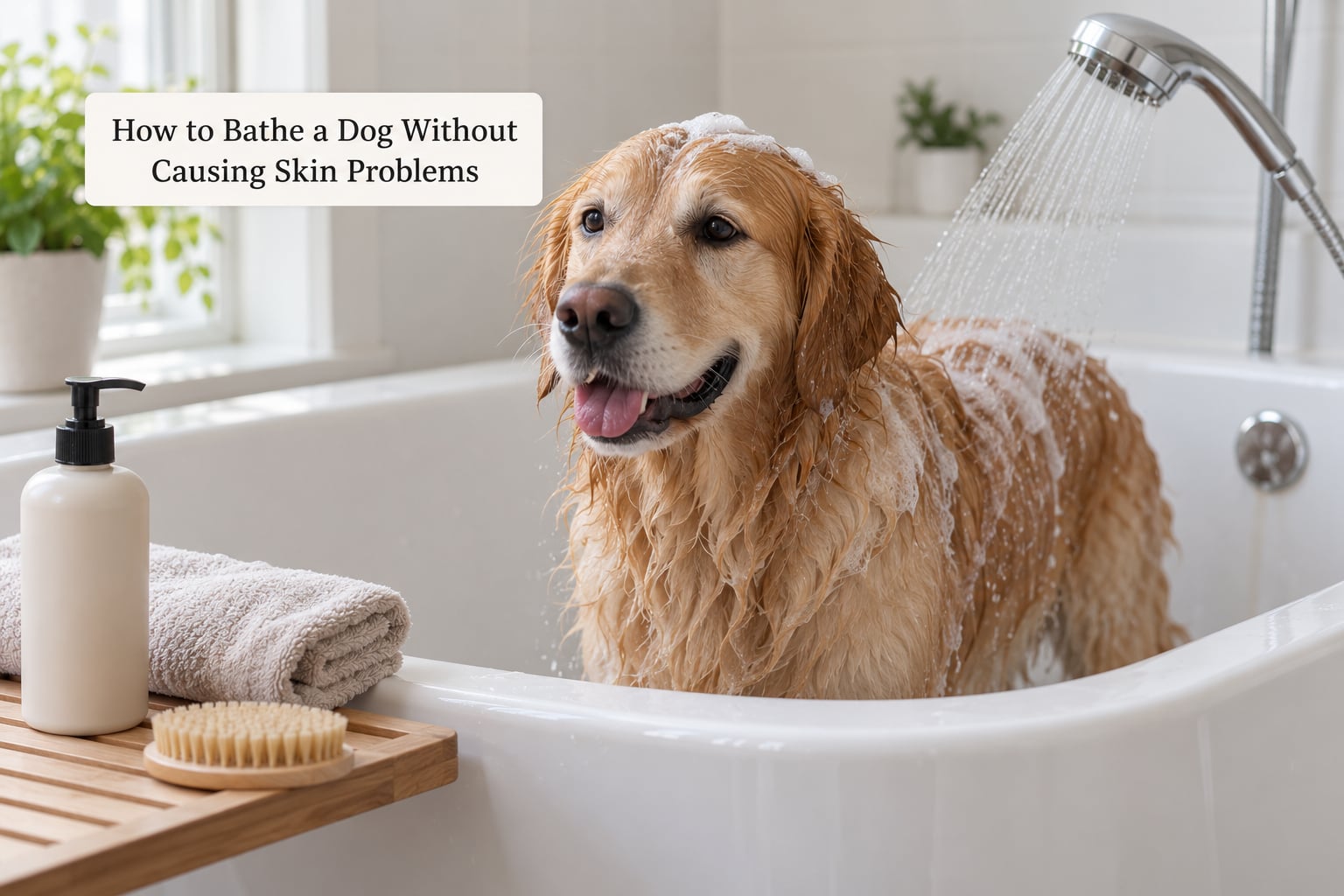
The bath itself does most of the damage when it goes wrong, not the frequency. Ten careful minutes beats three rushed ones.
- Brush the dog out first. Water turns mats into tight ropes. A dog with a heavy undercoat should be brushed down to the skin before it ever sees the tub.
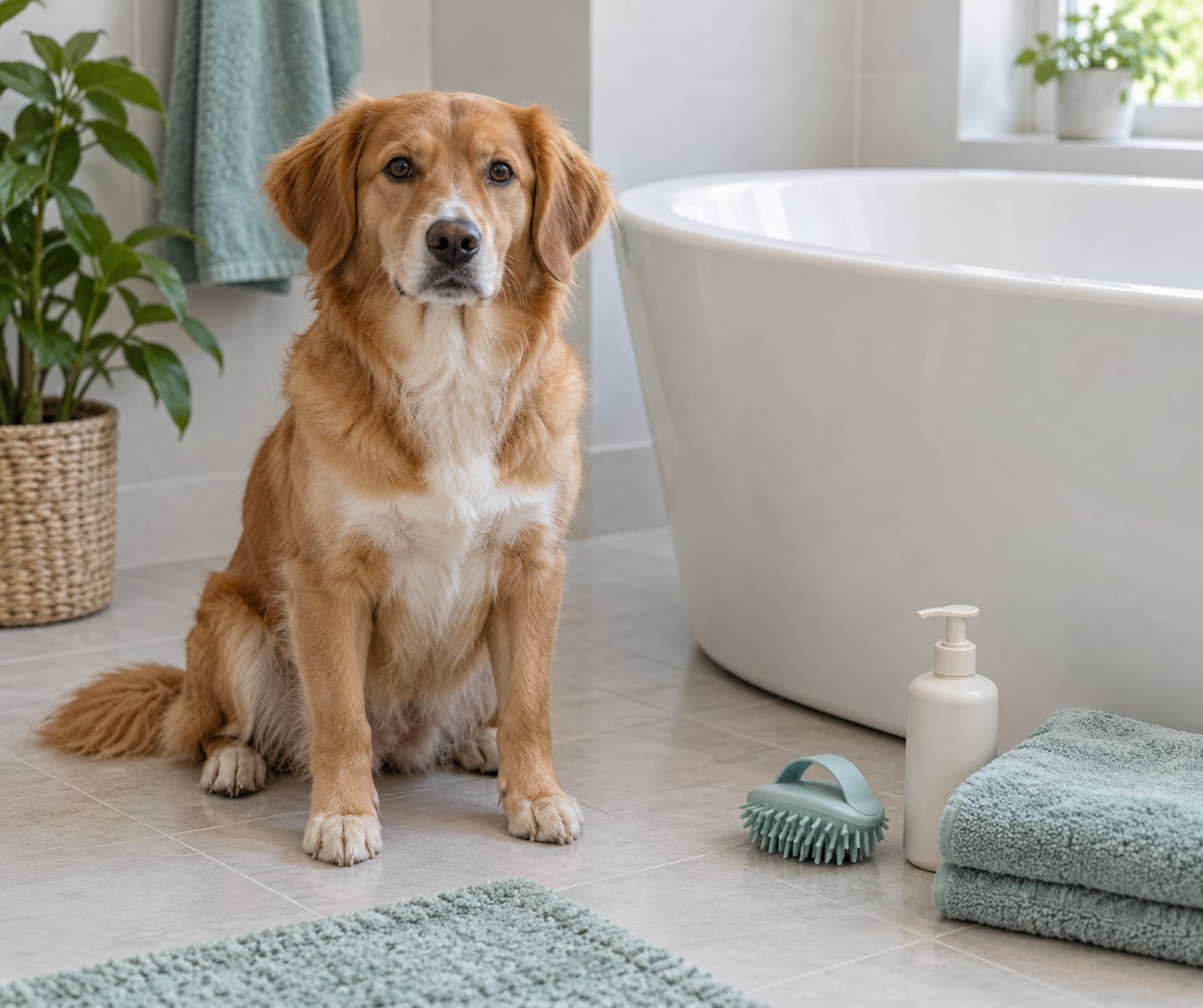
- Set up the space. Lay down a non-slip mat, gather a towel, a cup and dog-specific shampoo within reach, and use lukewarm water. Warm towels for a nervous dog help a lot.
- Wash from the neck down. The face and ears are the sensitive parts, so handle those last and gently, with a damp washcloth rather than pouring water over the head.
- Protect ears and eyes. Put a small cotton ball loosely in each ear canal and keep water and shampoo out of the eyes. Never stick anything deep into the ear.
- Respect contact time. Lather the dog-specific shampoo and leave it a couple of minutes before rinsing. Medicated products have their own longer contact time that you should follow exactly.
- Rinse until it runs clear. Leftover shampoo is a common cause of post-bath itching.
- Dry properly. Towel first, then a blow dryer on cool, working down to the undercoat. Walk and check the armpits, belly and groin areas for damp patches before you call it done.
Watch your dog’s stress signals during all of this. Lip licking, yawning, a tucked tail or repeated escape attempts mean the bath should end and be retried another day with treats and a lick mat. One owner in r/puppy101 described switching to a garden hose because their dog would not tolerate a bath, and that worked better than forcing it.
Signs You Should Bathe Your Dog More Often—or Less Often
There are two lists here, and knowing which one you are looking at saves a lot of guessing.
Bathe soon: your dog smells on your hands or your sofa; the coat feels greasy or filmy to the touch, especially along the back and tail base; visible mud, urine staining or fecal contamination; tangles that a brush cannot pass; a wet or salty coat after a swim that has dried on the surface; a coat that has gone dull and flat between regular brushes.
Hold off: the coat looks clean, smells normal and feels soft; your dog has just been brushed thoroughly; it is within a week or two of a professional grooming appointment, because groomers generally bathe the dog themselves; the weather is cold and your dog is a double-coated breed that dries slowly.
These signs mean a bath will not fix it, and a veterinarian should look instead:
- Odour that returns within days of a proper bath
- Persistent itching, paw chewing or licking at the skin
- Redness, bumps, crusts, sores or bald patches
- A coat that suddenly gets greasy with no change in diet or activity <li A strong smell from the ears rather than the coat, which usually points to an ear infection <li Any skin problem after a surgery, or a hot spot on a heavy-coated dog
Frequently Asked Questions
What if I never bathe my dog?
Skipping baths occasionally is fine. Most healthy indoor dogs stay clean for two to three months with regular brushing alone, and some owners on pet forums manage on a bath every two or three months with no skin trouble. But never bathing lets oil and matting build up, and a strong smell can hide an ear or skin problem. Brush weekly and wash when the sniff test says so.
How often should indoor dogs take a bath?
An indoor-only dog with a short or medium coat usually needs a bath every 6 to 8 weeks, sometimes longer if brushed well and walked in a clean coat. Indoor dogs pick up far less dirt than outdoor dogs, so their schedule sits at the slower end of the normal range. Long-haired indoor breeds such as Shih Tzus and Yorkies need closer to every 4 to 6 weeks because their hair mats and traps staining.
Are you supposed to bathe a dog every week?
For most dogs, no. A weekly bath strips the coat’s natural oils faster than the skin can replace them, which leads to a dry, flaky coat and itching. Weekly washing is reasonable for hairless breeds, for oily-coated dogs, and for show or working dogs using a high-quality moisturizing shampoo and conditioner. If you want a weekly routine, ask your vet to confirm it suits your dog’s skin.
What happens if I bathe my dog every day?
Daily bathing removes the protective oil layer the skin produces, so the coat loses shine and the skin turns dry and flaky. The skin then itches, and that itching leads to scratching, hair loss and sometimes a secondary bacterial skin infection. It also takes months for a double coat to recover its normal texture after repeated stripping. Daily bathing is rarely justified except under veterinary direction.
What if my dog gets stinky after two weeks?
Odor that returns that fast is worth a look rather than a bath. It can mean your dog’s skin produces more oil than the coat can absorb, that moisture is trapped in the undercoat or a skin fold, or that there is an underlying skin, yeast or ear condition. Switch to a dog-specific shampoo, dry your dog completely after every wash, and if the smell keeps coming back in under two weeks, book a vet visit.
Should I bathe my dog before a grooming appointment?
Usually not. Most groomers bathe the dog themselves as part of the appointment, so an extra bath beforehand just leaves them bathing twice and adds drying time. A quick brush to remove loose hair and mats beforehand helps far more. If your dog is extremely dirty or matted, call the groomer first and ask whether they need to see the coat before it is washed.
Where This Guidance Comes From
The frequency ranges here follow what veterinary and animal-welfare organisations publish on this question, including the American Kennel Club, PetMD and the RSPCA, along with guidance on skin and coat health from the American Veterinary Medical Association.
Owner experience from dog forums fills in the practical half: grooming-every-6-to-8-weeks plus brushing routines, show-season schedules, and the recurring question of when a smell means a bath and when it means a vet. Last reviewed in 2026.
If your dog has a skin condition, is recovering from surgery or is on a medicated shampoo, treat your veterinarian’s instructions as the schedule that applies, not this one.
Conclusion
Start by looking at your dog’s coat and its week, not at a calendar. Pick the coat-type row above that fits, set that interval as your baseline, and run the sniff test whenever you are unsure. Then adjust only as you watch the skin and coat, adding a bath when the coat gets oily or smelly and adding a brush when it starts to dull. If odour returns within days or the skin starts itching or reddening, stop guessing and book a vet visit.