Heartworm prevention for dogs works by giving a veterinarian-approved medicine on a set schedule, so it kills heartworm larvae before they mature into adult worms in the heart and lungs. It is not the same thing as treatment: an infected dog needs a diagnosis and a plan from a veterinarian, and most dogs are given preventive medication on the same visit as their annual exam.
That is the short version. The rest of this guide walks through how the parasite actually spreads, which forms of prevention exist, when testing matters, and what to do when a dose slips by. It is written for first-time owners and for people who inherited a dog and are not sure what has been given so far. Updated for 2026.
Nothing here replaces an exam. Your veterinarian decides which product fits your dog, when to start, and what to do about a gap in coverage.
Table of Contents
- What Heartworm Disease Is and Why It Matters
- Heartworm Prevention Explained for Dog Owners
- How Heartworm Prevention Works
- How Often Should Dogs Take Heartworm Prevention?
- When Does Your Dog Need a Heartworm Test?
- How to Make Heartworm Prevention Easier to Remember
- What If My Dog Misses a Heartworm Dose?
- What Side Effects Should Dog Owners Watch For?
- How to Choose a Heartworm Preventive for Your Dog
- Frequently Asked Questions
- Can heartworm prevention be given year-round?
- How late is too late to give a missed heartworm dose?
- Does a heartworm test replace preventive medication?
- Can puppies start heartworm prevention early?
- Is human heartworm medicine safe for dogs?
- What Should You Do First?
What Heartworm Disease Is and Why It Matters
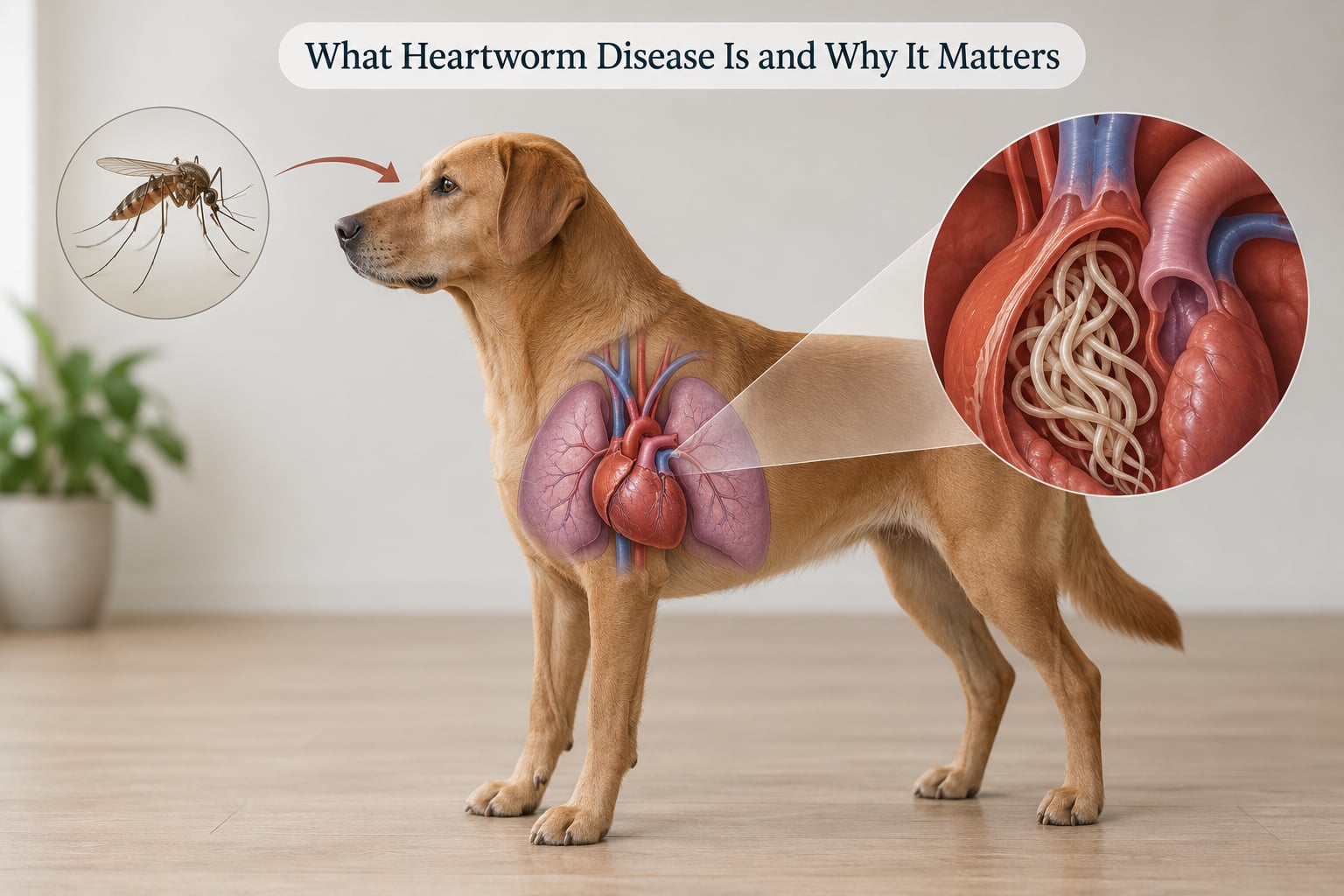
Heartworm disease is caused by a parasitic roundworm called Dirofilaria immitis. Adult worms live in the pulmonary arteries, the blood vessels carrying blood from the heart to the lungs, and in the right side of the heart itself. A heavy infection puts real strain on circulation, and the damage often lingers even after the worms are gone.
The parasite cannot get from one dog to another directly. It needs a mosquito, which makes it a mosquito-borne infection and explains why the disease turns up in places people do not think of as hot and humid.
Here is the sequence that matters, because every preventive is designed around one step of it:
- A mosquito takes a blood meal. The mosquito bites an infected animal and picks up baby worms called microfilariae.
- Larvae develop inside the mosquito. They mature into the infective stage, known as L3 larvae, over roughly two weeks.
- A second mosquito bites your dog. The L3 larvae are deposited into your dog’s skin and enter the bloodstream.
- The larvae grow over about six to eight weeks. This is the window in which preventive medication can still kill them. This is the only stage medication can reliably eliminate.
- Adult worms settle in the pulmonary arteries. They reproduce, release new microfilariae into circulation, and the cycle starts again.
Step four is the whole argument for prevention. Once worms reach adulthood, they are firmly established in the arteries, and clearing them is a demanding medical process with activity restriction and follow-up testing. Many dogs with a cleared infection still have lasting heart and lung damage.
Disease can also be quiet. Dogs with a light infection may show nothing for months, and some show nothing for years. A dog that looks completely normal may still be infected, which is exactly why a routine blood test matters even in a dog on prevention.
Heartworm Prevention Explained for Dog Owners
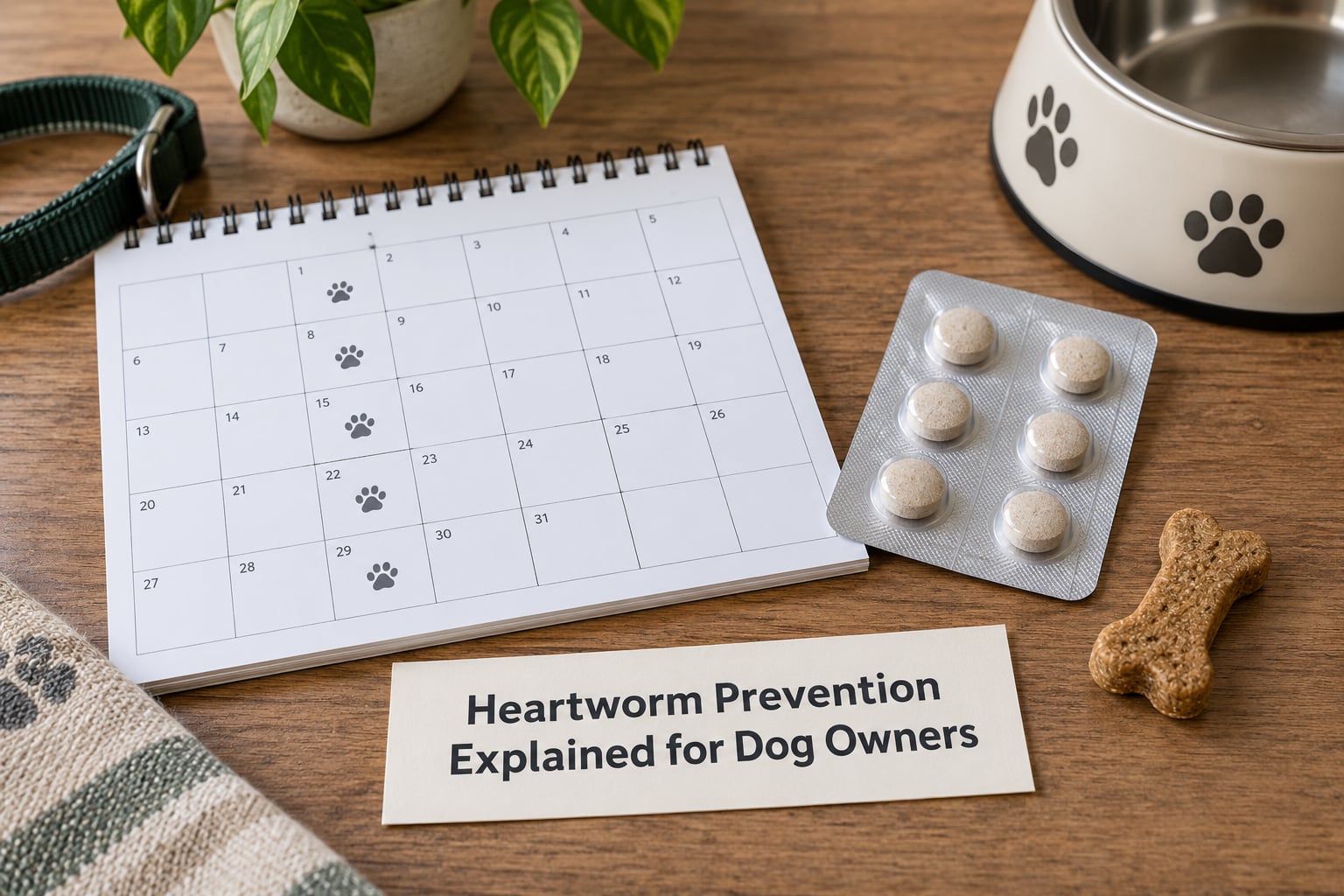
Heartworm prevention for dogs means giving the medication your veterinarian prescribed, at the interval on the label, whether or not mosquitoes are active and whether or not your dog is indoors. The medicine does not stop a mosquito from biting. It kills the larvae that bite delivers, during the short window before those larvae can grow up.
That distinction trips people up more than anything else on this topic. Owners often assume a preventive creates a barrier against infection, so they assume a missed dose during mosquito season is the only real risk. In practice the drug has to be in the dog’s system on a schedule, because a single bite deposits larvae that keep developing for weeks afterwards.
How Heartworm Prevention Works
Most canine heartworm preventives belong to a drug class sometimes described as macrocyclic lactones. Taken on schedule, they clear immature heartworm larvae before they reach maturity. Several products also cover intestinal parasites, and some cover fleas and ticks as well, which is often the reason a veterinarian suggests a combination product instead of heartworm alone.
Year-round dosing matters for three reasons. Mosquitoes can be active far longer than most owners expect, indoor dogs still get bitten, and a preventive that is given only in warm months leaves a stretch of the year with no larval protection at all. In warmer regions transmission can happen nearly year-round; in cooler areas there is usually a defined season, but the exact dates shift with local conditions and your veterinarian’s local guidance.
No preventive is a perfect shield. Adherence slips, a tablet gets spat out, a pet spits it in the grass, dosing is late. That is why most guidance pairs consistent prevention with a yearly heartworm test rather than treating the medication as a substitute for testing.
What preventive cannot do is treat an established infection. If a dog already has adult heartworms, giving the same preventive on its own is not a treatment plan, and some products require a veterinarian’s supervision in a positive dog precisely because the process needs to be managed. Get the diagnosis first.
How Often Should Dogs Take Heartworm Prevention?
Most dogs take heartworm prevention once a month, but there are also products given every six months by injection, and the interval belongs to the product rather than to the disease. Follow the schedule on the label your veterinarian prescribed, and do not stretch or shift the interval on your own. If the label says monthly, treat it as monthly in the calendar sense, not “roughly every four weeks whenever I remember.”
Dosing also tends to be by body weight, so a growing puppy or a large breed dog may move into a different band as they grow. If your dog crosses a weight band mid-month, ask your veterinarian what to do rather than guessing.
The table below compares the formats you are most likely to be offered. It describes the approach, not a prescription.
| Format | How it is given | Frequency | What else it may cover | Often a good fit for |
|---|---|---|---|---|
| Oral chewable or tablet | By mouth, usually flavoured | Monthly | Some also cover intestinal worms, fleas or ticks | Dogs that take treats readily; most households |
| Topical liquid | Applied to the skin between the shoulder blades | Monthly | Many also cover fleas and some ticks | Dogs that refuse pills, or that need broader parasite control |
| Six-month injectable | Given by a veterinary professional | Twice a year | Heartworm protection only | Dogs with a history of missed or refused monthly doses |
Owners of large dogs sometimes run into weight-band limits with a particular product and need a different one or a different plan. That is a common enough conversation that it is worth raising at the yearly visit instead of discovering it at dose time.
When Does Your Dog Need a Heartworm Test?
A blood test is needed at several points: before starting prevention in a dog whose history you cannot confirm, after any period without coverage, at the time of treatment and again afterward as your veterinarian directs, and at least annually as part of routine care. A test also matters before starting any preventive if your dog may already be positive, because treatment and prevention follow different paths.
The common blood test looks for antigen from adult female worms. It tends to detect infection only once a dog has been infected for a while, so a negative result in a freshly exposed dog does not always mean the dog is clear. A smear or concentration test looks for microfilariae in the blood, which can be present without being visible on a routine drop, and a positive result in a dog with no antigen is still meaningful. Your veterinarian interprets the combination.
Testing is not the same as prevention, and one does not replace the other. Preventive medication can keep a dog clear and a test can catch what slipped through. Owners sometimes hear from a cooler-climate clinic that testing is unnecessary when prevention is consistent, which leaves them unsure what to do. If you are in that position, ask your veterinarian directly what their recommendation is for your dog’s specific risk, and get the answer in writing if you plan to change anything.
How to Make Heartworm Prevention Easier to Remember
Dosing fails for boring reasons: a busy month, a travel day, two dogs at once, a tablet spat into the grass. Building the dose into something that already happens on schedule fixes most of them.
- Pick a date, not a day. The same calendar day each month is easier to remember than “some time in the first week.” Put it in a repeating phone reminder or a paper calendar you actually see.
- Anchor it to an existing habit. Breakfast, the evening walk, or the coffee you make every morning. The habit is the alarm.
- Tie it to another chore. Giving the dose right after you put the coffee on, or before the dog goes out, reduces the number of decisions involved.
- Refill early. Order the next batch before you run out, and buy the full year’s supply at the annual visit if your veterinary clinic offers it. Running out is one of the most common causes of a gap.
- Track doses for multi-dog homes. One shared calendar with a tick per dog beats four sets of memory.
- Write down the last date given. If you are unsure whether the tablet went in, it is better to check the record than to guess, and to ask your veterinary team what to do next.
For a dog who hides every pill in the grass, talk to your veterinarian about a topical or a six-month injectable rather than repeating the same struggle monthly. Compliance is a solvable problem, not a character flaw.
What If My Dog Misses a Heartworm Dose?
Call your veterinary clinic as soon as you notice, and give them the date of the last dose you are sure about. How late is too late depends on the product, the length of the gap, the time of year and your dog’s mosquito exposure. A missed dose is a phone call, not an emergency you have to solve on your own, and the clinic can tell you whether to give the next dose as scheduled or whether testing makes sense first.
A few things to avoid in the meantime. Do not double the next dose unless a veterinarian specifically tells you to, because the dosing intervals for heartworm products are not interchangeable. Do not assume a dog that looks fine is uninfected, because early infection is usually silent. Do not wait for the next scheduled visit to mention it if your dog has been exposed in the meantime.
Why timing matters: a gap in coverage means larvae may have had the entire development window to reach maturity. The earlier your veterinarian knows, the more options you have. This is also the one question that comes up most often on dog forums and it has a simple answer, which is that nobody can calculate your dog’s risk without knowing your dog’s product and dates.
What Side Effects Should Dog Owners Watch For?
Most dogs take heartworm prevention without any problem. When something does happen, watch for vomiting, diarrhoea, lethargy, weakness, or a drop in appetite after a dose. More urgent signs include coughing, difficulty breathing, facial swelling, hives, or a sudden collapse. Any of those mean stop and contact a veterinarian, and breathing difficulty or collapse means going in immediately.
One safety point belongs here plainly: human heartworm medication is not safe to give to a dog. Human products differ in composition and dose, and what is sold for people is not formulated or dosed for dogs. If you have any question about what your dog can take, ask a veterinarian or a veterinary pharmacist rather than working it out from a label.
Different dogs react differently to every medicine, and a reaction can appear after a product your dog has taken happily for a year. Watch your dog after each new product or each new weight band, and keep your clinic’s number somewhere you will actually find it.
How to Choose a Heartworm Preventive for Your Dog
There is no single safest heartworm preventive. The right choice for your dog depends on several things, and the combination usually matters more than the brand.
- Age and weight. Puppies have age and weight limits, and large dogs can exceed a product’s upper weight band.
- Health and current medications. A dog with an existing condition or on another regular medicine may have a narrower set of options.
- Whether the dog has been tested. Starting prevention in a dog that may already be positive is a decision for a veterinarian, not a supply question.
- Lifestyle and mosquito exposure. Outdoor dogs, hunting dogs, dogs that travel, and dogs in higher-transmission regions have different pressure on them than an indoor dog in a low-risk area.
- What else you need to control. If your dog also needs flea, tick or intestinal parasite cover, a combination product may simplify the routine.
- How reliably you can dose. If you know you will struggle with a monthly chew, saying so is more useful than guessing.
On safety specifically, the questions owners ask most are about how gentle the drug class is over years of use, whether a product suits a sensitive or herding breed, and whether one brand is safer than another. Those are breed- and patient-specific, and the honest answer is that your veterinarian, who knows your dog’s history, has more information than any page can. A breed-club recommendation or a breeder’s advice is worth hearing, but it does not replace that conversation.
On natural and non-chemical options: mosquito control around your home, avoiding known mosquito habitat at peak times, and reducing standing water are sensible supporting habits. Garlic, citrus, and herbal preventives are not supported as replacements for a veterinarian-approved preventive, and some of them are genuinely unsafe for dogs. Keep them as a conversation with your clinic rather than a substitute for it.
Frequently Asked Questions
Can heartworm prevention be given year-round?
Most veterinary guidance recommends year-round prevention, including for indoor dogs, because mosquitoes can be active for long stretches and indoor pets still get bitten. In warm regions transmission can occur nearly all year. Your veterinarian can tell you whether your area has a defined season, but stopping and restarting often creates gaps in coverage that are harder to manage than a steady monthly routine.
How late is too late to give a missed heartworm dose?
There is no single deadline that applies to every dog. It depends on the product, how long the gap is, your dog’s mosquito exposure and where you live. Call your veterinary clinic as soon as you notice, give them the date of the last dose you are certain of, and let them decide whether to give the next dose as scheduled or to test first. Do not double a dose on your own.
Does a heartworm test replace preventive medication?
No. A test tells you whether a dog is infected right now. Preventive medication is what keeps larvae from maturing between tests. Most guidance pairs consistent monthly or six-month prevention with at least one heartworm test a year, because no preventive is completely foolproof and some dogs are difficult to dose reliably. Ask your veterinarian which schedule fits your dog’s risk.
Can puppies start heartworm prevention early?
Many puppies can start at a certain age and body weight, and some products have lower age limits than others. The exact starting point depends on the product, the puppy’s weight, and local guidance. Puppies also cross weight bands quickly, so ask your veterinarian how to adjust as your dog grows rather than guessing between visits. Starting late is far worse than starting on the recommended schedule.
Is human heartworm medicine safe for dogs?
No. Human heartworm products are not formulated or dosed for dogs, and giving one can cause serious problems. The same goes for over-the-counter or herbal remedies marketed as natural protection. Keep your dog on a product a veterinarian has prescribed or recommended, and check with your clinic before giving any medication that was not dispensed for your dog.
What Should You Do First?
Start by checking what your dog is actually on today and when the last dose was given. If you cannot find a record, that is the conversation to have at the next visit: ask your veterinarian to confirm the product, whether a test is needed before you continue, and what interval fits your dog.
Then set up one reminder you will actually see, refill before you run out, and keep your clinic’s contact details handy. If a dose goes missing, a reaction shows up, or you are simply unsure, call. Heartworm prevention is one of the easier things in dog ownership to get right, and the questions above are the ones worth asking early.