
Positive reinforcement vs correction training explained: positive reinforcement adds something your dog wants right after a behaviour so that behaviour grows, while correction training removes something your dog values or adds an aversive so an unwanted behaviour fades. Veterinary behaviour organisations favour reward-based methods, and most owners see faster, safer results with them.
The confusion is understandable. Both approaches use the same learning machinery, so both produce visible results at first. The difference shows up months later, in how your dog handles uncertainty, how fast they recover from mistakes, and whether they still want to work with you at all.
This guide walks through what each method actually is, where the line sits between a fair correction and punishment, how timing changes everything, and how to pick an approach for a specific behaviour. Nothing here needs equipment to start.
Table of Contents
- Positive Reinforcement vs Correction Training at a Glance
- What Is Positive Reinforcement Training?
- What Is Correction Training?
- How Do the Two Methods Differ?
- Different purpose, same learning machine
- Timing and repetition
- Skill required from the handler
- What each one teaches the dog to do
- How Does Timing Change the Learning Process?
- How Does Positive Reinforcement vs Correction Training Work Step by Step?
- Which Method Is Safer for Dogs and the Handler-Dog Relationship?
- What Tools and Skills Does Each Approach Require?
- Can the Methods Be Combined Responsibly?
- Which Should You Choose?
- Frequently Asked Questions
- Is correction training the same as punishing a dog?
- Can positive reinforcement stop a dog from pulling on the leash?
- When should I use a correction instead of a reward?
- Does positive reinforcement work for fearful or aggressive dogs?
- How long should I train each behaviour before changing methods?
- Conclusion: Start With One Clear Consequence per Behavior
Positive Reinforcement vs Correction Training at a Glance
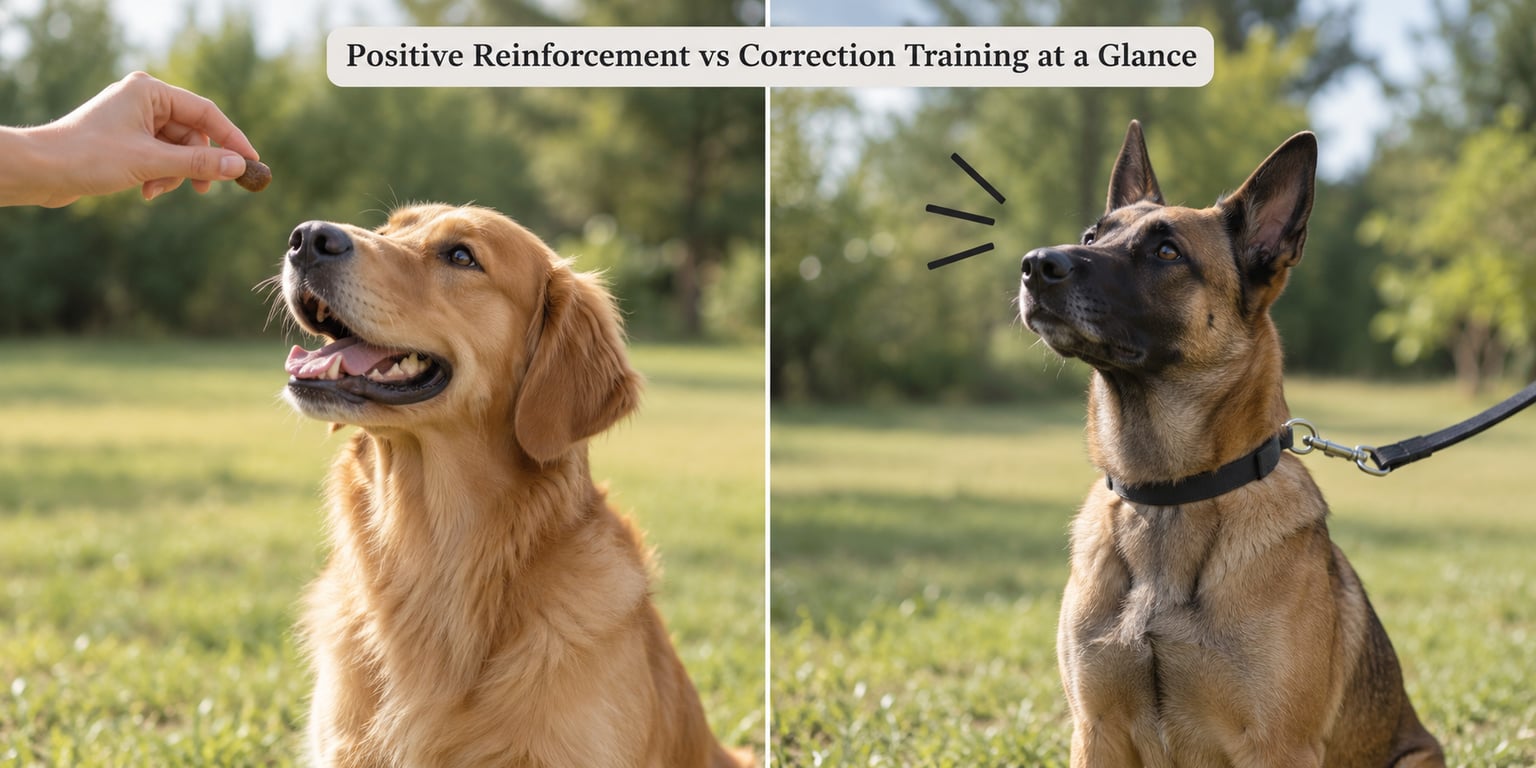
| Point of comparison | Positive reinforcement | Correction training |
|---|---|---|
| Learning goal | Teach a behaviour by making it pay off | Reduce a behaviour by making it unpleasant or unrewarding |
| Typical tools | Treats, play, praise, clicker or marker word, mat, long line | Leash pressure, prong or choke collar, e-collar, spray, sharp verbal cues |
| Timing | Must land within about half a second of the right behaviour | Must land within a second or two of the wrong behaviour |
| Risk to the relationship | Low; some risk of reward dependence if poorly faded | Moderate to high; fear, avoidance and shutdown are documented risks |
| Ease for beginners | Easier to start, needs patience with timing | Feels faster, needs more control to stay proportionate |
| Best use case | Everyday skills, new behaviours, fearful or reactive dogs | Emergency interruption only, with a reinforcement plan attached |
Read that table as a starting position, not a rule. Owners who mix methods responsibly can teach very hard behaviours. What the table describes is the default, not the ceiling.
What Is Positive Reinforcement Training?
Positive reinforcement is the technical name for adding a consequence the dog likes, immediately after a behaviour you want to repeat. That is the whole mechanism. In operant conditioning terms, the behaviour increases because something good reliably follows it.
The examples that matter most are boring ones. Ask your dog to look at you and mark the instant the eyes arrive, then give a treat or a chin scratch. Walk on a loose lead and reward the moment the leash goes slack, not when you reach the end of the block. Call your dog from the kitchen, mark the head turn, feed a piece of cheese while you are still moving toward him.
Two mechanics make this reliable. First, the marker: a clicker, a whistle or a single word like “yes” that tells the dog exactly which behaviour earned the treat, so timing errors do not teach the wrong thing. Second, shaping, which reinforces successive approximations — reward the head lift, then the step toward you, then the arrival.
Reinforcers fall into two groups. Primary reinforcers such as food, water and some toys carry innate value; a puppy will work for cheese without ever having learned the exchange. Everything else — clicker, verbal praise, a specific toy, a chin rub — becomes a conditioned reinforcer through pairing.
The honest criticism of this approach is that food can become the only currency. Fade deliberately: reward the behaviour, then reward it sometimes, then reward a different behaviour. If the dog stops listening the moment the treat pouch disappears, the fade was never finished.
What Is Correction Training?
Correction training, in its operant sense, means applying a consequence intended to decrease a behaviour. Most correction-based training adds an aversive — leash pressure, a prong collar, an e-collar, a spray, a shouted name. Some correction styles instead remove access to something valued, which is negative punishment: ending the interaction, putting the toy away, sending the dog to another room for a few seconds.
A leash correction is the clearest example. The dog pulls, the handler adds downward pressure on the leash, the pulling stops, pressure lifts. The dog learned that pressure predicts relief, so the behaviour stopped. Nobody hit anybody, and it still counts as an aversive method.
What separates correction from punishment is not the name the trainer uses. It is the effect on the dog. A proportionate interruption the dog can still engage with afterwards is a redirect. A correction that makes the dog flinch, freeze, hide, snap or shut down is punishment, whatever the marketing says.
Owners often ask where the boundary sits with real examples. A dog lunges at another dog and the handler says “leave it” once, calmly, while moving away — that is an interruption. A dog lunges and the handler grabs the scruff, hangs the dog off the ground or holds its muzzle shut — that is punishment, and it damages the relationship rather than the behaviour.
How Do the Two Methods Differ?
Different purpose, same learning machine
Both methods run on operant conditioning. The single distinction that matters is whether the consequence increases or decreases the behaviour it follows. Reinforcement pays the dog to repeat something. Punishment makes an action less likely next time. Everything else — the tools, the tone, the trainer’s confidence — sits on top of that one choice.
Timing and repetition
Reinforcement needs a tight window: the dog has to connect the treat with the behaviour, and that link weakens fast. Corrections need a slightly looser window, but they must still be immediate, or the dog links the consequence to whatever happened next instead.
Repetition patterns differ too. Reinforcement is usually continuous at first, then thinned to intermittent once the behaviour is solid. Corrections repeated at low intensity can teach a dog to push through mild discomfort, which is why some behaviour professionals argue a weak correction is worse than none.
Skill required from the handler
Reward-based training demands precise timing and honest observation of your own dog’s behaviour, and that is genuinely hard for beginners. Correction-based training demands restraint: keeping a consequence proportionate, reading early stress, and stopping the instant the behaviour changes. Both fail when the handler is distracted or tired.
What each one teaches the dog to do
Reinforcement teaches an offered behaviour — a thing the dog does. Most corrections teach avoidance, which is a narrower outcome. A dog that stops pulling has not learned to walk politely, only that pulling is now expensive. You still have to teach the behaviour you actually want, which means reinforcement has to enter the plan eventually.
How Does Timing Change the Learning Process?
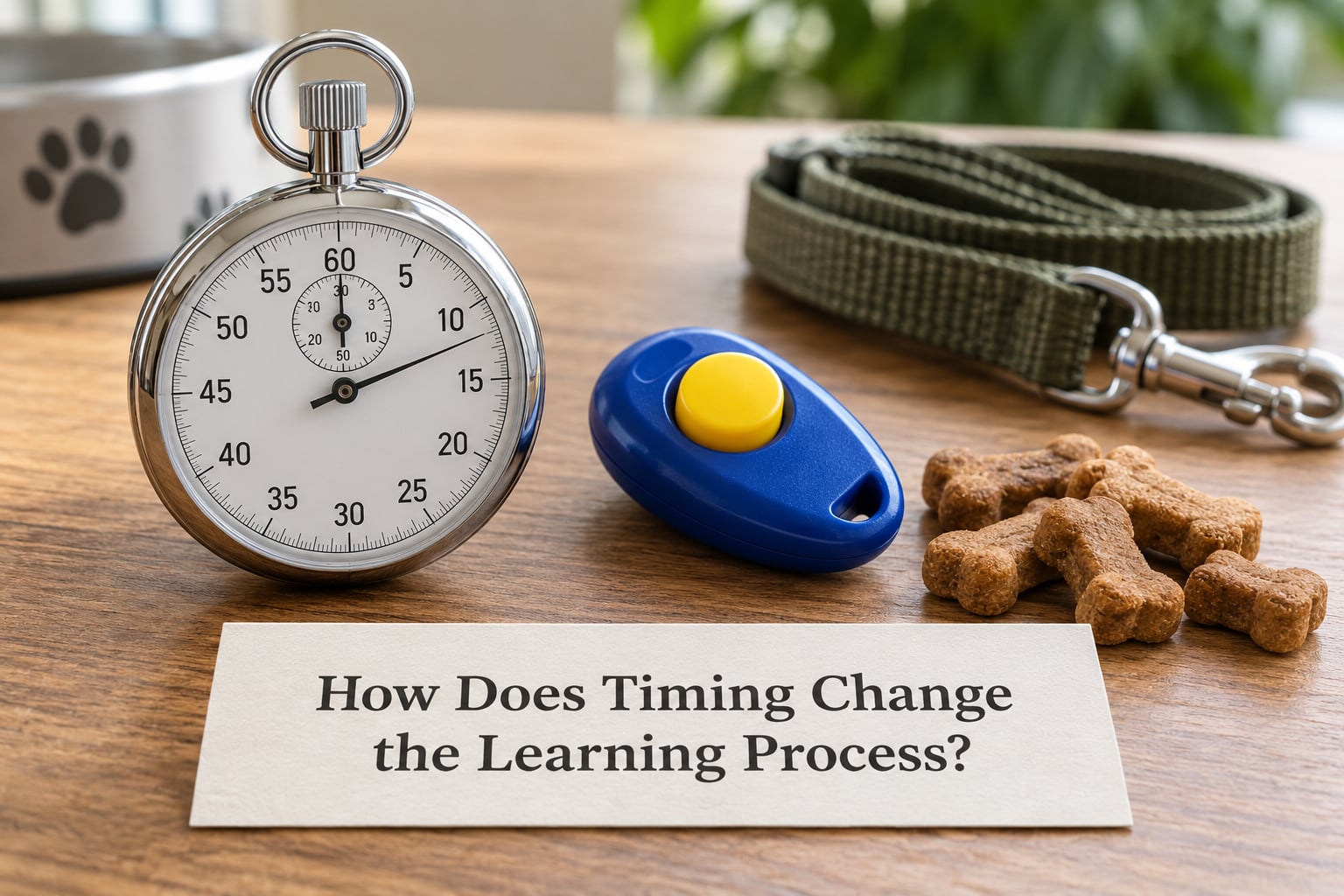
Timing is the variable that changes results more than any tool. A perfectly timed small reward beats a generous reward delivered ten seconds late, because the dog has to attach the consequence to the behaviour to learn anything at all.
For reinforcement, aim to mark within roughly half a second. After that, you are marking the wrong thing — a sit after the dog has already looked away is a sit rewarded for wandering off. When you cannot catch the moment, mark a movement you did catch, like the head turn, and shape from there.
For a correction, the window is about a second or two, and the tone matters more than people expect. The consequence should read as information: this stops here, do something else. Handlers who add anger change what the dog learns, from “that behaviour ends the fun” to “my person is unpredictable and sometimes dangerous”. Same tool, completely different lesson.
How Does Positive Reinforcement vs Correction Training Work Step by Step?
Both approaches collapse into the same six steps when they are done well. Here is the walkthrough for positive reinforcement vs correction training explained as a repeatable cycle you can run in two minutes of ordinary life.
- Define one behaviour precisely. Not “be calmer” but “four feet on the floor and leash slack”. You cannot reward or correct what you have not written down.
- Set the environment up. Train on a quiet street before the café, not on a pavement with a skateboard rattling past.
- Capture or prevent the wrong action. Reinforcement shapes what the dog offers; correction interrupts what the dog starts. Mat training, a long line and distance are all ways of preventing.
- Deliver the chosen consequence immediately. Mark and feed within half a second, or interrupt within a second.
- Keep repetitions short. Three good reps, then stop while the dog still wants more. Long sessions produce boredom, not learning.
- Judge progress by observable criteria. Count the successful reps on a piece of paper. If the count is not rising over a week, change the plan, not the dog’s character.
Which Method Is Safer for Dogs and the Handler-Dog Relationship?
Reward-based training carries the lower risk for the dog, for a reason that is not sentimentality: aversive tools reliably produce fear and arousal in a substantial minority of dogs, and fear is the raw material of most bites.
Here is the stress-signal checklist. Watch for lip licking or sudden tongue flicks, yawning when nothing is tiring, a lowered body or a tail that tucks, ears pinned flat, panting that seems out of context, freezing, or a dog that suddenly stops responding entirely.
That last one deserves attention because it is the failure mode owners miss most. A shut-down dog looks perfectly obedient. It stops giving warnings, stops moving, stops offering anything — and trainers often call it progress. Look for the accompanying signs: a dog who has stopped offering behaviour, avoids eye contact with you, or lies down the moment you reach for the lead is not learning, it is complying out of fear.
Any correction you choose must clear four conditions to be defensible. It must be proportionate to the behaviour, predictable so the dog can anticipate it, non-injurious, and delivered without deliberately causing fear or pain. If any one of those fails, it is punishment wearing a different label.
The relationship itself is part of safety, not a soft extra. Dogs who are taught to expect pain from their handlers learn to avoid handling, which makes nail trims, muzzles, veterinary exams and even leashing harder, not easier.
What Tools and Skills Does Each Approach Require?
Positive reinforcement asks for treats or play, a marker, and management gear: a mat, a long line, a harness, a head collar if the dog will tolerate one, and a treat pouch that opens with one hand. A clicker is optional. Good timing is not optional.
Correction-based training uses equipment that applies pressure or pain: a leash, prong collar, choke collar, head collar, e-collar, spray bottle or shake can. Those tools are cheap and immediately available, which is part of why they spread. No equipment substitutes for timing, consistency or observation, and a well-drilled handler can cause real damage with a plain leather lead.
Two markers worth knowing in the second column. The AVSAB position statement on humane dog training rejects aversive tools, and the American College of Veterinary Behaviorists takes a similar position. Separately, terms like “balanced training”, “obedience”, “pack leader” and “alpha” are marketing language with no scientific definition, and are frequently used by trainers who do use aversives.
Two questions screen a trainer quickly. Ask what they do when the dog gets a cue right — the answer should describe a reward or a release, never a leash pop. Then ask what they do when the dog gets it wrong — if the answer is “nothing, we reset”, that is a marker-and-reset correction and a good sign; if the answer involves a collar, you are looking at punishment.
Can the Methods Be Combined Responsibly?
Yes, and reward-based training is where the useful version of combining lives. Experienced reward trainers correct constantly — they simply never add an aversive. When your dog misses a cue, they mark the miss, guide the dog back to the starting position, and reset without any consequence beyond the lost time.
That marker-and-reset is the real crossover point. It communicates information, it carries no pain or fear, and it leaves the relationship intact. Compare it with grabbing the dog’s muzzle: identical outcome on paper, entirely different effect on the dog.
Worked example. Your dog will not drop a stolen sock. Reinforcement path: teach a trade — pick up the sock, mark, deliver a high-value treat, then release the sock. Correction path: interrupt with a neutral cue, wait, and take the sock without ceremony. Combine them by interrupting first when the behaviour is about to escalate into swallowing, then switching to the trade for the rest of the session.
Where combining goes wrong is the grey zone. Repeated leash pressure while a dog pulls, corrections scaled up until the dog complies, or aversives used when the handler is frustrated turn into punishment regardless of the reward mixed in. If the aversive is doing the work, the dog is being punished.
Which Should You Choose?
Choose positive reinforcement by default. It is the method with broader veterinary behaviour support, it teaches offered behaviours rather than avoidance, and it is the safer option for anxious, reactive, rescue or young dogs. It is also simply more durable, because a dog that enjoys working with you keeps working with you.
Reach for a qualified behaviourist or your veterinarian when the behaviour involves genuine bite risk, predation around wildlife or livestock, severe separation distress, or a dog that has already shut down under previous corrections. At that point you need a behaviour assessment, not a technique comparison.
If you are currently correcting, the transition is gradual. Drop the most aversive tool first and keep the two you use every day. Raise the value of your reinforcers and reward the behaviours you wish for, then remove one correction at a time and watch for regression before removing the next. Expect three to six weeks of flat or wobbly progress. That plateau is normal and is where people quit, which is why the second week matters most.
Frequently Asked Questions
Is correction training the same as punishing a dog?
Not by definition, but often in effect. Operant conditioning defines any consequence that decreases a behaviour as punishment, so a correction is a punishment applied on purpose. The useful distinction is practical rather than technical: a correction that stops a behaviour and leaves the dog willing to keep working is a redirect, while one that makes the dog flinch, freeze, hide or shut down is punishment whatever it is called. Judge by the dog’s body language, not the trainer’s vocabulary.
Can positive reinforcement stop a dog from pulling on the leash?
Yes, though not through rewarding the absence of pulling. Reward the behaviour you want instead: the moment the leash goes slack, mark and treat, and keep moving so the dog has to follow to earn anything. Practise first at a distance from distractions, on a long line indoors. If your dog is reactive or fearful, start with a harness and a head collar only if he tolerates one, and ask a qualified reward-based trainer for help if pulling is tied to fear rather than excitement.
When should I use a correction instead of a reward?
Use one when you need to interrupt something unsafe in under a second, such as a dog about to snap at a child’s face or chase a cat into traffic, and always pair it with an alternative you will reward. Outside of genuine emergencies, reward training is the better tool. The habit worth building is treating every correction as a marker-and-reset: mark the mistake, guide the dog back to the starting position, and lose the repetition. That communicates information without pain.
Does positive reinforcement work for fearful or aggressive dogs?
It is the recommended approach, because fear and aggression are exactly the states that aversive tools tend to amplify. The work is slower: build distance from the trigger, reward calm observation, and raise your dog’s ability to handle the situation before you decrease distance. For a dog already biting, or one whose fear is severe, get a veterinary behaviourist involved before training alone. A reward plan cannot replace an assessment of what is driving the behaviour.
How long should I train each behaviour before changing methods?
Give any behaviour two to three weeks of short, consistent sessions before judging it, and count successful repetitions rather than minutes. If the number is not rising, change one variable first: the value of the reward, the environment, the distance from distractions, or your timing. Switching methods after a single bad session is the most common reason owners conclude that reward-based training does not work. Keep sessions under five minutes and stop while the dog is still engaged.
Conclusion: Start With One Clear Consequence per Behavior
Positive reinforcement vs correction training explained comes down to one sentence: reward the behaviour you want, interrupt the behaviour you cannot have right now, and never add something painful to get there. For most dogs, and for most situations, that means reward-based training with marker-and-reset corrections where a mistake is made.
Start small. Pick one behaviour, write down what success looks like, and reward that action within half a second for two minutes a day for two weeks. Leave the corrections out until the plan is clear and the dog is somewhere safe to learn. If something feels off, talk to your veterinarian or a certified reward-based trainer before adding pressure.