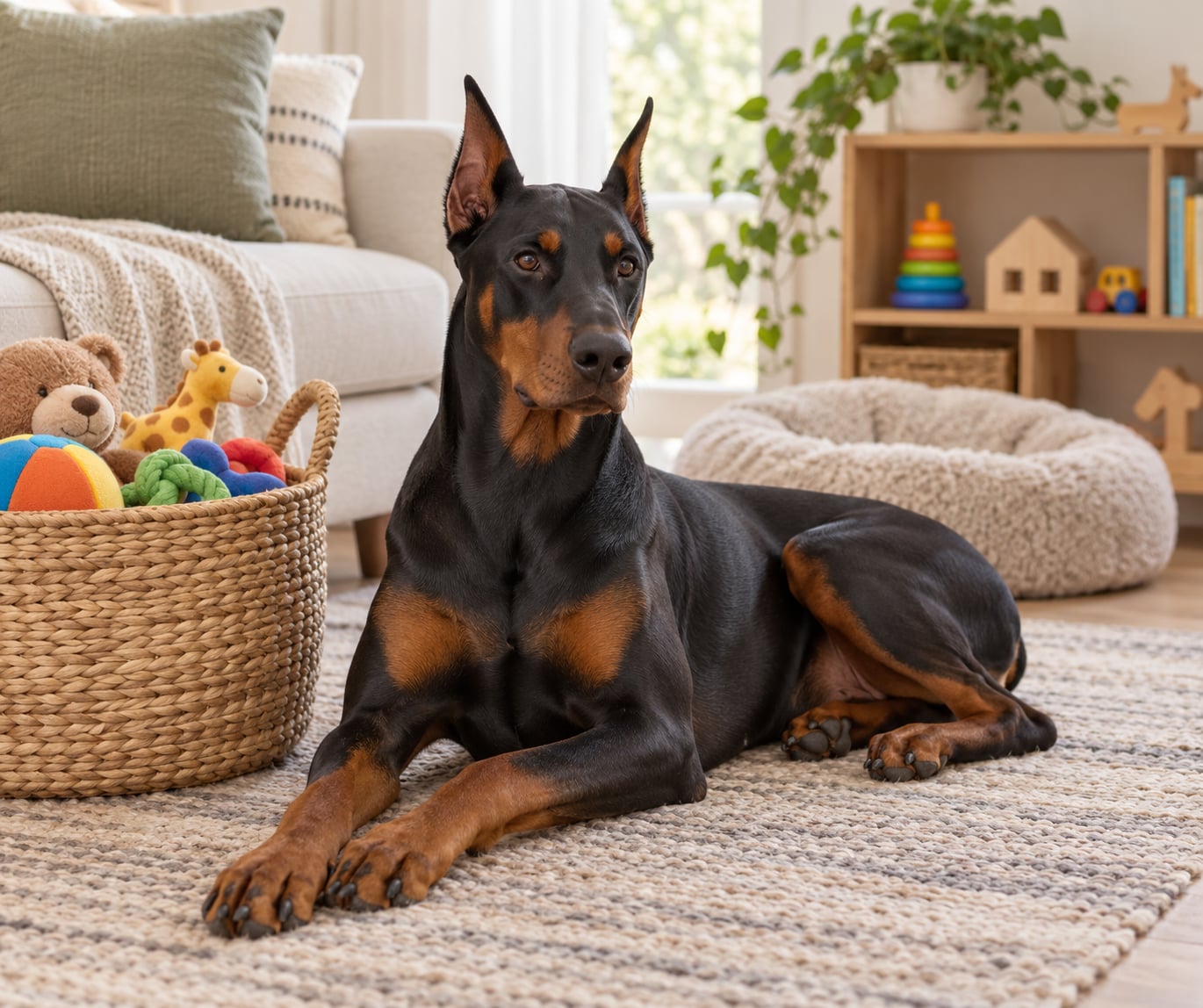
Doberman temperament with kids comes down to three things: the individual dog’s personality, how it was socialised as a puppy, and how closely adults supervise. Raised alongside children, Dobermans are usually affectionate, loyal and watchful — owners often call them gentle giants — but at 60 to 100 pounds and 24 to 28 inches tall, most real incidents are accidental knock-overs rather than bites.
Last reviewed: October 2026
Table of Contents
- Doberman Temperament With Kids: What to Expect
- Are Dobermans Good With Children?
- What Is the Typical Doberman Temperament?
- How Doberman temperament with kids traits show up day to day
- How Doberman Behavior Changes Around Children
- Why Dobermans May React to Children
- How to Introduce a Doberman to Children Safely
- How to Teach Kids and Dobermans to Respect Each Other
- Signs a Doberman Is Comfortable With Kids
- Warning Signs to Watch For
- Training and Socialization for a Family With Children
- Doberman Size, Energy, and Play With Children
- When a Doberman May Not Be the Right Family Match
- Key Takeaways for Choosing a Doberman Family Dog
- Frequently Asked Questions
- Are Dobermans safe around children?
- Are Dobermans good around kids?
- What is the downside to Dobermans?
- Do Dobermans have behavior problems?
- Are girl or boy Dobermans better with children?
- At what age do Dobermans start to calm down?
Doberman Temperament With Kids: What to Expect
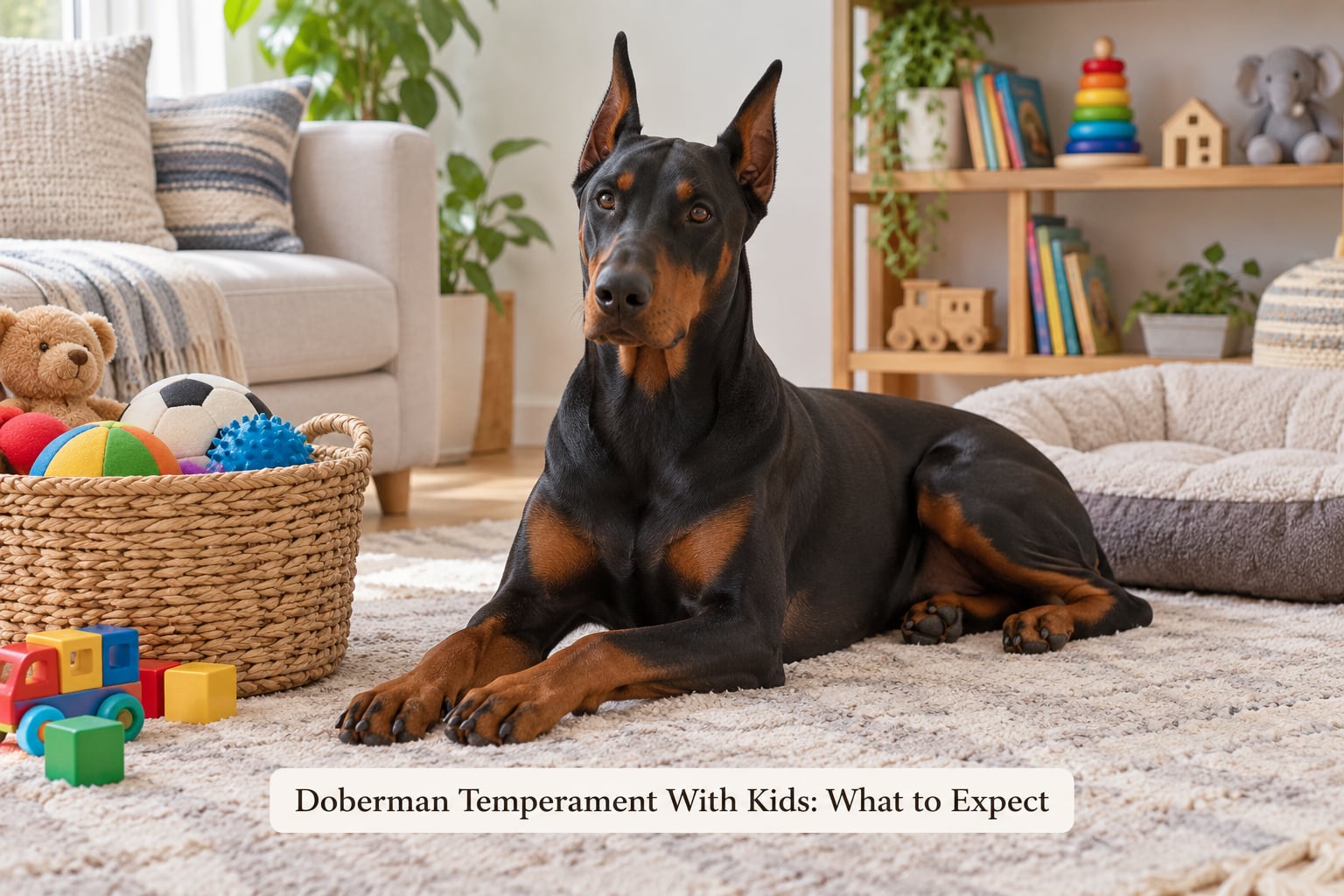
Expect a dog that treats the household as its pack and the children as part of that pack. Dobermans are working dogs with a strong protective instinct, and that instinct usually shows up as positioning themselves between a child and an open door, watching the room, or giving a single warning bark when someone unfamiliar comes in.
Whether that works for your family depends on five things: the dog’s individual genetics, early socialisation, training and impulse control, how much energy it has left over after exercise, and whether your household can supervise every dog-and-child interaction. Get all five right and the breed is genuinely good with children.
Get the supervision wrong and you have a large dog with poor manners and a toddler who does not know when to stop. That combination is where most problems come from, and it is fixable with training rather than temperament.
Are Dobermans Good With Children?
Many Dobermans live well with children. They are not automatically safe or automatically unsafe — the breed label tells you very little about one individual dog.
Breed-club guidance from the Doberman Pinscher Club of America is more cautious with young children, and parents searching for answers online often see the same threshold repeated: household setups work best once children are around eight or older, and homes with toddlers need far more management.
Dobermans that grow up with a family often become what owners call self-appointed guardians of the children — attentive, mildly supervisory, and quite happy to follow a child from room to room.
What Is the Typical Doberman Temperament?
The AKC places the Doberman in the Working Group, and the standard describes a breed that is intelligent, alert, loyal and highly responsive to training. Owners add a few descriptors that show up constantly in family homes: affectionate, sensitive, vocal, and physically clumsy.
How Doberman temperament with kids traits show up day to day
| Trait | What it looks like with children | What it means for your child |
|---|---|---|
| Loyalty | Follows the family from room to room, leans against legs | Constant supervision, never a yard-dog setup |
| Protectiveness | Stands between a child and the front door, watches visitors closely | One warning bark is normal; guests need managing |
| Sensitivity | Picks up on a child’s distress or a raised voice | Calm adults matter more than calm commands |
| High energy | Plays hard, bounces, spins when excited | Two long walks a day, or expect rowdiness indoors |
| Clumsiness | Knocks over small children during greeting and play | Teach children not to run at the dog |
| Vocal nature | Tells you when a stranger arrives, barks at play | Teach kids that barking is talking, not aggression |
| Velcro bonding | Follows one family member more than the rest | Expect separation anxiety if left alone long |
None of these traits predicts how your specific dog will behave with your specific children. Temperament is individual, and it can shift with age, pain, hormones and past experience.
How Doberman Behavior Changes Around Children
A Doberman puppy is a bouncy, clumsy, mouthy animal with no idea how big it is. Between roughly eight and sixteen weeks is the socialisation window that shapes how a dog reads people for life, and that is exactly when children are often telling the puppy to stop.
Adolescence brings a second wave. Somewhere around eight to eighteen months the dog becomes more reactive, more interested in outside dogs, and more likely to bark at unfamiliar children at parties. That is normal development, not a personality change.
| Child age | How it usually works | Risk level | What you must do |
|---|---|---|---|
| Toddler (0–4) | Exciting, unpredictable, grabby | Highest — most incidents happen here | Never unsupervised; gate off; separate feeding; teach the toddler to leave the dog alone |
| Preschool (4–6) | Fast, loud, still unpredictable | High | Constant adult presence; no rough play; no hugging |
| School age (6–8) | Can follow simple household rules | Moderate | Walk beside the dog, ask before petting, no tail pulling |
| 8–12 | Understands boundaries and reads the dog’s signals | Lower | Supervision still required, but genuine friendship often develops |
| Teen | Handles the dog well, can help with exercise | Lower | Good household work partner for walks and training |
Dobermans usually settle into a calmer adult temperament around two to three years of age, which is later than most people expect. Until then, manage them like the excited puppies they are.
Why Dobermans May React to Children
When a Doberman reacts around kids, the cause is usually one of six things rather than a mysterious breed trait:
- Lack of socialisation. A dog that has never met a child treats every child as a stranger, and strangers get barked at.
- Resource guarding. This is the real safety issue in family homes. A dog sharing a family can still guard food, chews, toys or a sleeping child, and that behaviour has to be worked on immediately.
- Fear. A dog pinned down or cornered by enthusiastic hands will try to create space.
- Excess excitement. The bounce, the lean, the wrestling — pure overflow that reads as rough.
- Pain. An older dog that snaps at a child reaching over it may simply have a sore back or hips.
- Energy mismatch. A dog with two hours of pent-up energy meets a chaotic birthday party at full force.
Dobermans are also often blamed for guarding behaviour that is really protective instinct. Protection looks like positioning, alert barking and monitoring. Resource guarding looks like a dog refusing to give up a toy or a bowl. They need different solutions.
How to Introduce a Doberman to Children Safely
A slow, boring introduction beats an excited one every time. Never force contact and never hold a child’s hand near a dog that has not chosen to approach.
- Start in a quiet room. No running children, no parties, no visitors. Ask a visitor or relative to leave the room if it is too much.
- Let the dog choose. Put the dog on a lead, sit down, and let it approach when it is ready. Reward calm behaviour from a distance with treats tossed sideways.
- Keep greetings low. Teach children to approach from the side, keep hands flat and low, and stroke the chest rather than reaching over the head.
- Interrupt, don’t scold. If either side gets wound up, separate without ceremony and reset. A fuss creates more noise.
- Give the dog an exit. A bed in a quiet room, a gate across a hallway, or a “go to your mat” cue the dog can use on its own.
- Build up over days. Several short, boring, successful sessions beat one exciting afternoon.
For puppies, keep a lead on indoors for the first weeks. It sounds extreme, and it works.
How to Teach Kids and Dobermans to Respect Each Other
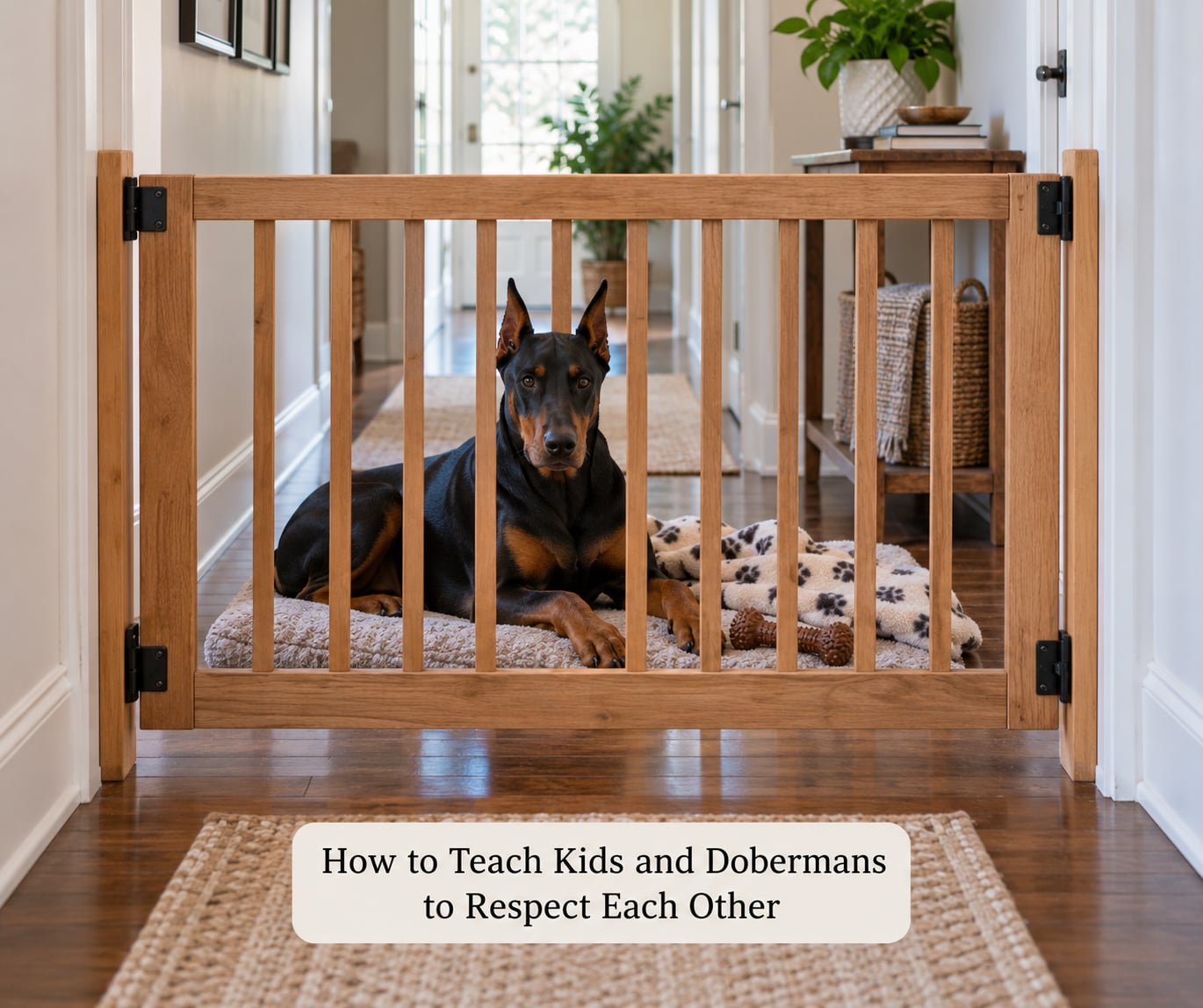
Children who have been given clear rules behave better around large dogs, and dogs who have clear rules settle faster. Print this list, read it out loud, and repeat it for every babysitter and visiting relative.
- Ask the dog before touching him. Walk up, ask a parent, wait.
- No hugging on the dog. Humans sit on dogs. Dogs do not enjoy being sat on.
- No climbing or riding on the dog’s back. Even gentle dogs object to weight on their spine.
- No ear or tail pulling. The obvious one, and still the most common.
- No eating near the dog, and never near his bowl or chew. This is the rule that prevents most bites.
- Never open a crate, gate or car door for the dog. Children are the most likely accidental escape artists in a dog household.
- Walk away when the dog moves off. A dog that leaves is telling you something. Nobody follows a dog that leaves.
Adults have to model it. If a parent hugs the dog in front of the children, rule two is already broken.
Signs a Doberman Is Comfortable With Kids
A relaxed Doberman has a loose body, soft eyes, a closed mouth that occasionally opens into a loose play face, and a willingness to move away and come back.
- Loose, wiggly body rather than a stiff stance
- Soft, relaxed face with no hard stare
- Initiates contact and then disengages on its own
- Normal play that includes pauses and role reversal
- Taking breaks, turning away, drinking water, leaving the room
Quiet behaviour is not the same as comfort. A dog frozen in place, lying in a corner or avoiding the child entirely is not fine — it is a dog managing stress alone.
Warning Signs to Watch For
Warning signs are about tension, not obedience. Read the two columns below together, because the same behaviour means very different things depending on context.
| Normal Doberman behaviour | Genuine warning sign |
|---|---|
| Barking once when a stranger enters | Repeated frantic barking with no way to settle |
| Moving away from a child who is too loud | Freezing, hard stare, pinned ears, raised hackles |
| Standing between a child and the door | Following a child into a corner, blocking their escape |
| Grabbing a toy and carrying it away | Refusing to release food or a toy when a child reaches in |
| Yawning or licking lips during handling | Snapping at air during play with escalating intensity |
| Pulling back when a child climbs on | Biting with no preceding warning, in any context |
Never punish growling. A growl is a warning you were lucky to get; punishing it teaches the dog to skip the warning and bite instead. When a dog shows repeated stress or aggression around children, involve a qualified behaviour professional and your vet, and keep children out of the situation while you work.
Training and Socialization for a Family With Children
Dobermans are highly responsive to training and they do best with reward-based methods. Harsh handling shuts a sensitive breed down fast.
Prioritise four things: a solid recall, a reliable leave-it, calm greetings with visitors, and a “go to your mat” decompression cue. Socialise the puppy in the eight-to-sixteen-week window with vaccinated children of different ages, calm adult visitors, and everyday household noise.
If you adopt an adult rescue, ask the shelter specifically about the dog’s history with children and whether it has shown any resource guarding. Many families do better with a settled adult Doberman than with a puppy, precisely because the adult’s temperament is already known. What you are reading on day one is what you will be living with for ten years.
Doberman Size, Energy, and Play With Children
The most common Doberman-and-child incident is not a bite. It is a 30-kilogram dog colliding with a small child during an enthusiastic greeting, in a hallway, at full bounce.
Manage it with space and boring routine: walk the dog before guests arrive, keep play in a room with no furniture to bump into, avoid wrestling and chasing games, and schedule a break every ten or fifteen minutes. A dog that has had two hours of exercise and a training session that morning is a completely different animal at a birthday party.
When a Doberman May Not Be the Right Family Match
Honest answers build more trust than reassurance. A Doberman is probably wrong for your household if:
- You have a baby or toddler and no adult who can supervise every moment
- The individual dog shows persistent fear, guarding, or aggression that a professional has not been able to change
- Nobody in the house wants to spend an hour or more a day on exercise and training
- You cannot separate them when guests arrive or when the child is upset
- Your household has a history of serious dog bites and no realistic plan to manage it
- You want a low-effort dog that entertains itself
Choosing the individual dog matters more than choosing the breed. A calm six-year-old rescue may suit a family better than an eight-month-old puppy, regardless of what either one is called.
Key Takeaways for Choosing a Doberman Family Dog
Assess the actual dog’s behaviour and history rather than its reputation, and ask a responsible breeder or shelter about temperament testing and the dog’s experience with children.
Set household rules before the dog comes home, not after the first incident. Plan for daily exercise and reward-based training from day one, and book a vet visit early.
And keep one rule non-negotiable: never leave a dog and young children unsupervised, however well trained the dog is.
Frequently Asked Questions
Are Dobermans safe around children?
A well-socialised Doberman raised with children is usually safe and very affectionate. The realistic risks are accidental knock-overs from size and high energy, and resource guarding around food or toys. Keep children and dogs supervised at all times, especially with toddlers, and work on guarding behaviour the moment it appears.
Are Dobermans good around kids?
They can be excellent with children, particularly those eight and older who can respect a dog’s space. Dobermans are loyal, sensitive and protective, and many become self-appointed guardians of the household. What matters most is early socialisation, impulse control training, and whether your family can manage a large, energetic dog.
What is the downside to Dobermans?
The honest list is size and clumsiness, high exercise needs, heavy shedding, a vocal nature, separation anxiety when left alone, and poor cold tolerance. Add the training commitment: this is a sensitive, intelligent breed that needs consistent reward-based work from a young age. Size is the one that matters most around small children.
Do Dobermans have behavior problems?
Not as a rule. Breed-specific concerns are resource guarding, reactivity around unfamiliar people, separation anxiety and adolescent heightened arousal. All are manageable with early socialisation and training. Watch for guarding around food and toys, and bring in a qualified behaviour professional if the dog shows repeated stress or aggression around children.
Are girl or boy Dobermans better with children?
There is no reliable evidence that one sex is calmer with kids. Males tend to be more energetic and food-motivated, females more reserved and watchful, but individual dogs vary far more than the trend. Choose on temperament and health testing rather than sex, and consider neutering after your vet advises on timing.
At what age do Dobermans start to calm down?
Most Dobermans settle into a calmer adult temperament between two and three years old, which is later than many owners expect. They remain energetic and playful well beyond that. A settled adult rescue is often a better fit for families with young children, because the adult temperament is already visible when you adopt.
Doberman temperament with kids is usually the loyal, watchful, affectionate version of the breed — not the aggressive one the reputation suggests. Start with the individual dog’s temperament rather than the breed label, put rules in place before the dog arrives, and never leave a dog and young children unsupervised.