If someone asks me how often to do a water change in a fish tank, my answer is short: change 20 to 30 percent of the water once a week for a typical filtered community aquarium. Small tanks, crowded tanks and goldfish setups need more frequent and larger changes, while lightly populated or heavily planted systems can get away with less. The interval matters far less than what your test kit tells you, so the real skill is reading the water rather than the calendar.
I keep a 30 gallon community tank with live plants and a canister filter, and a smaller 10 gallon betta tank. They need two completely different routines, and treating them the same is the most common mistake I see in local fish shop conversations. This guide covers the equipment, the schedule, the technique and what to do when something goes wrong.
Table of Contents
- What You Need
- Step-by-Step
- How Often to Do a Water Change in a Fish Tank
- Match the Schedule to Your Tank
- Change the Water Safely
- Test After the Water Change
- Common Mistakes
- Common Mistakes and Quick Fixes
- Frequently Asked Questions
- Is a weekly water change enough for every fish tank?
- How much water should I replace at one time?
- Should I change the water in a newly cycled aquarium?
- Can I use untreated tap water for my fish tank?
- Why do my fish seem stressed after a water change?
- Does cloudy water always mean I need an immediate water change?
- Conclusion: Start With a Weekly Schedule
What You Need
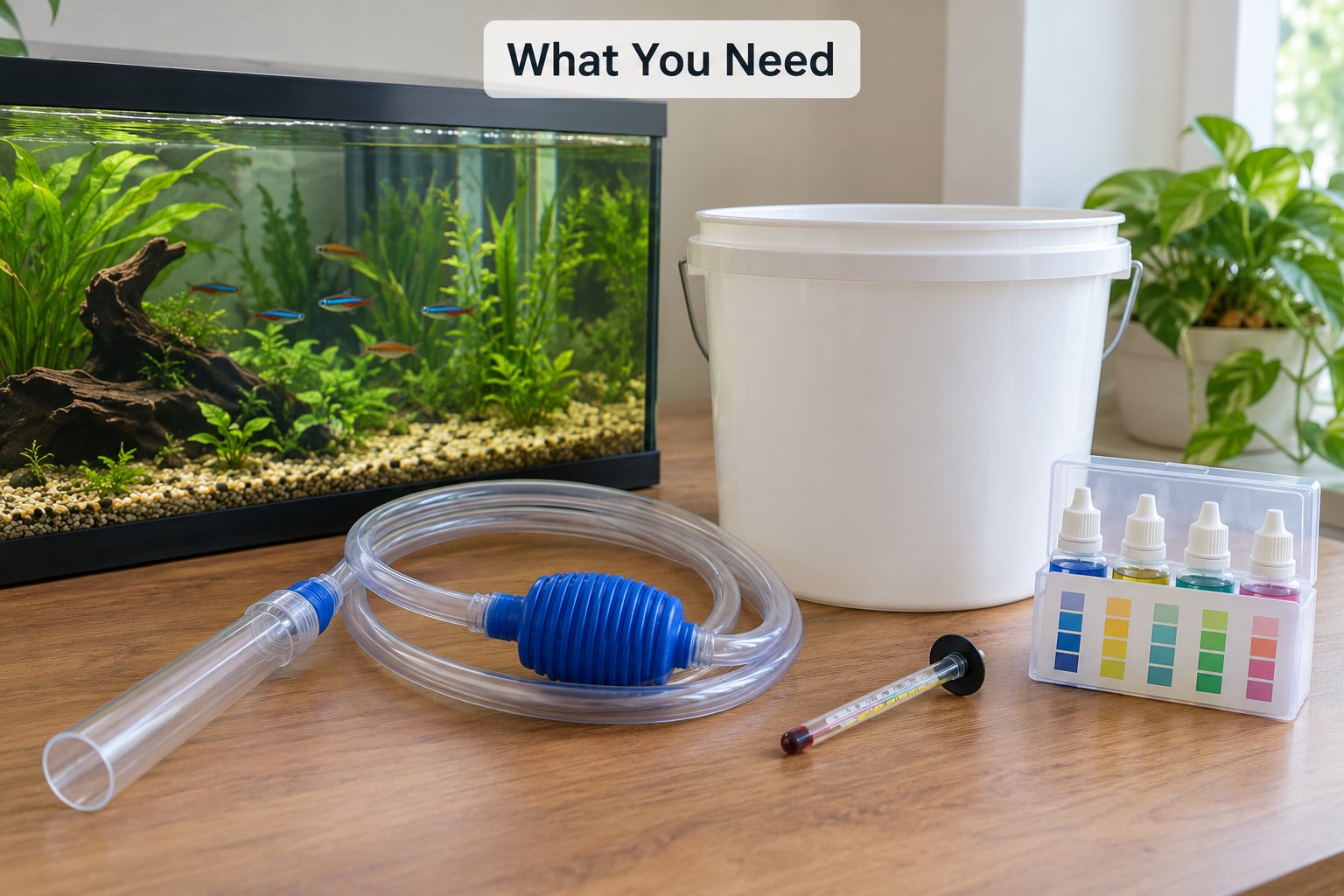
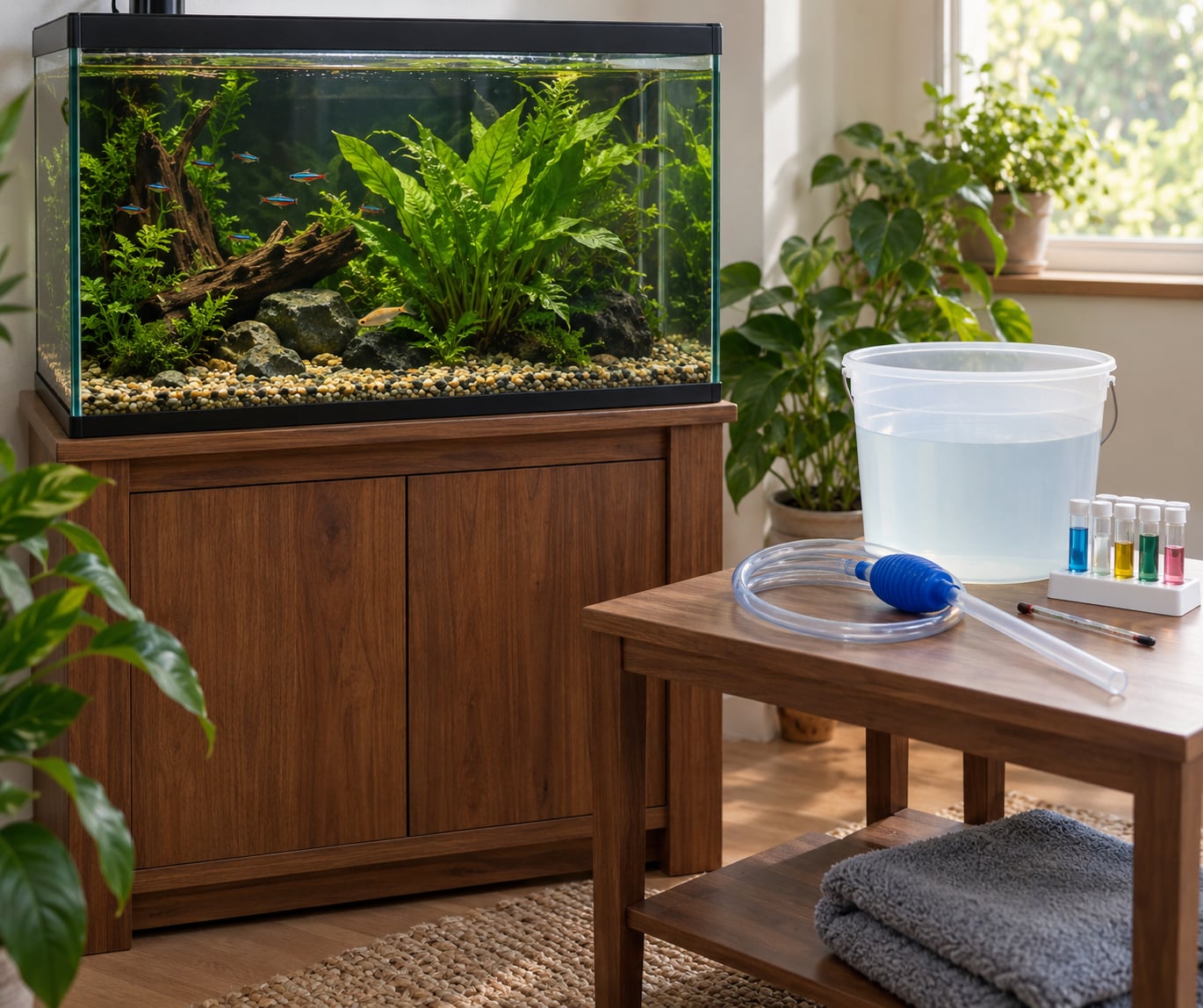
Five things, and nothing else is genuinely required to do this well:
- A fish-safe water conditioner. Every municipal tap supply carries free chlorine or chloramine, both of which burn gills and destroy the protective slime coat on fish. Chloramine is the nastier of the two because it does not evaporate off over a few days of leaving water standing. One millilitre of conditioner per ten gallons of replacement water is a sensible dose to keep in mind.
- An aquarium siphon or gravel vacuum. A simple tube works for water removal, but a wide-head gravel vacuum also pulls waste and uneaten food out of the substrate while you drain.
- A clean bucket that is only ever used for aquariums. Traces of detergent or disinfectant left in a bucket are enough to wipe out a tank. Never borrow the food mixing bowl.
- An aquarium thermometer. Matching temperature within a degree or two of the tank is what keeps a change from causing thermal shock.
- A water-testing kit or test strips. Liquid kits are more accurate for nitrate; strips are fine for a quick weekly ammonia and nitrite check. Do check the expiry date, because old reagents give false low readings.
Treating tap water is not optional. It protects the fish directly, and it also protects the beneficial bacteria living in your filter media.
Step-by-Step
How Often to Do a Water Change in a Fish Tank
For a typical established freshwater community tank, change 20 to 30 percent of the water once a week. Tanks under 30 gallons and setups with a heavy bio-load need roughly 50 percent weekly, or 30 percent twice a week. Lightly populated, heavily planted aquariums with strong filtration usually cope with 15 to 25 percent every one to two weeks. The honest answer to how often to do a water change in a fish tank is that this range is a starting point, and your water tests are what move it.
Beginner guides tend to say 20 percent every two weeks, while experienced hobbyists often say 40 to 50 percent weekly. Both are right in their own conditions. The first suits a large, sparsely populated, heavily filtered tank. The second suits small tanks and crowded ones. The keepers who get this right are not the ones with the strictest calendar, they are the ones who run a test before every change and let the number decide.
Match the Schedule to Your Tank
Read your tank with five indicators before you settle on a schedule: nitrate, ammonia, nitrite, water clarity and fish behaviour. Nitrate is the useful one because it rises predictably as waste accumulates, which makes it a countdown. Ammonia and nitrite should read zero in a healthy aquarium, so any detectable reading is an emergency rather than a schedule adjustment.
The table below maps the common setups. The trigger column matters most, because it is the condition that overrides any interval you had in mind.
| Tank setup | Frequency | Amount | Change-now trigger |
|---|---|---|---|
| New tank, first four weeks | Daily, tapering to weekly by week four | 30 to 50 percent | Any ammonia or nitrite reading above zero |
| Nano or small tank under 10 gallons | Twice weekly | 30 to 50 percent | Nitrate above 30 ppm, any sign of stress |
| Standard community tank, 20 to 40 gallons | Weekly | 20 to 30 percent | Nitrate above 30 to 40 ppm |
| Small tank or crowded setup under 30 gallons | Twice weekly | 25 to 30 percent | Nitrate above 30 ppm |
| Goldfish tank | Weekly, or 30 percent twice weekly | 40 to 50 percent | Nitrate above 30 ppm, cloudy water |
| Lightly populated, heavily planted tank | Every 10 to 14 days | 15 to 25 percent | Nitrate above 40 ppm |
| Saltwater or reef system | Weekly, plus frequent top-offs | 10 to 20 percent | Nitrate or phosphate above target, alkalinity drift |
Two more factors sit outside the table. Source water matters, because well and some municipal supplies arrive with nitrate already in them, which can raise your reading even as you change water. And feeding drives everything: over-feeding is the most common cause of an ammonia spike that forces an unplanned large change.
Change the Water Safely
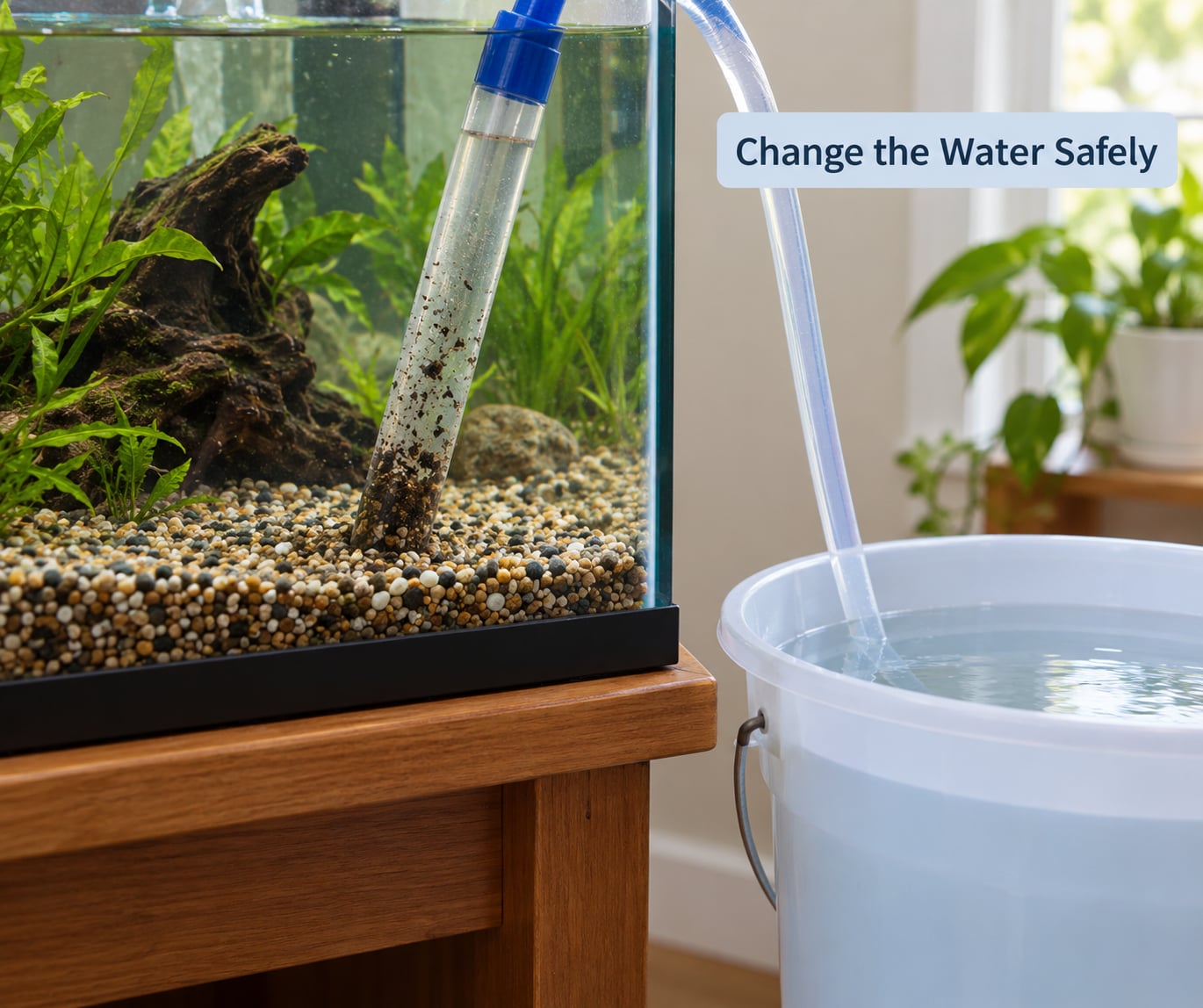
Test the water before you start, not after. If you drain first and test afterwards, you have lost the information you needed to size the change.
Then work in this order:
- Unplug the heater and filter. Ten minutes of stillness is enough to keep debris from being pushed around the tank.
- Prepare the replacement water first. Fill the bucket, add conditioner, dose it for chlorine and chloramine generously, and let it sit until the temperature matches the tank.
- Siphon the substrate. Run the gravel vacuum across the substrate slowly so you do not suck up sand or disturb the layout, and clean around decorations where debris collects.
- Remove only the amount you planned. Most of the bacteria live in the filter and substrate, so a partial change leaves the colony in place.
- Clean the filter media in the dirty water you just removed. Squeeze sponge material gently, rinse mechanical media in a bucket, and never rinse anything under the tap. Chlorinated water running through the media can wipe out the colony overnight.
- Add the new water slowly. Pour down the glass or onto a sponge so the flow does not blast fish across the tank, especially in a shallow betta or nano setup.
- Plug everything back in and let the filter run for a few hours before feeding.
If a fish is sensitive, such as a betta, discus or shrimp, split one large change into two smaller ones on consecutive days. Twenty-five percent twice feels very different to them than fifty percent at once.
Test After the Water Change
Test again the next day, and immediately if the tank is new, newly stocked or already under stress. Watch ammonia, nitrite, nitrate, temperature and pH. A healthy partial change brings nitrate down and leaves everything else roughly where it was; a sharp swing in pH is a signal that your source water is very different from the tank water, which is common where hardness varies between municipalities.
A water change treats a symptom. It does not fix an unstable or overpopulated aquarium, so if ammonia and nitrite stay high after a large change, the problem is stocking, feeding or a filter that never finished cycling. A rising ammonia reading after a death or after a large addition of livestock usually means the cycle has been overloaded, and the recovery is a sequence of frequent smaller changes until the bacteria catch up.
Same idea for travel. Reduce feeding a few days before you leave, then set up an automatic top-off system or ask a sitter who will follow a written schedule. A week away with a 30 percent weekly change is manageable; a week away with no one watching a small crowded tank often is not.
For water changes during or after medication, follow the product label first. Many treatments call for a large change on the following day, and dosing a conditioner afterwards can interfere with some medicines, so pause the conditioner when the label says to and add it again once the course is finished.
Common Mistakes
These six errors account for most of the water-change problems I hear about:
- Adding untreated tap water. The single fastest way to hurt fish, and the most avoidable.
- Changing too much water at once. More than half the volume in a crowded freshwater tank is a shock even when the new water is perfectly conditioned.
- Using a bucket that has held soap, cleaner or paint. Residue is enough to wipe out a tank.
- Rinsing filter media under the tap. This kills the beneficial bacteria and often restarts a cycle that had been running for months.
- Replacing all the biological media or carbon at once. Same problem in a different disguise.
- Changing water straight after a heavy feeding, then feeding again the same evening. The tank has just been topped up with nutrients and the fish are producing more waste than usual.
Common Mistakes and Quick Fixes
When a change goes wrong, the symptoms usually show up within a few hours. Here is how to read them.
Fish look stressed after a change. Gasping at the surface, clamped fins or hiding usually point at temperature mismatch or a chlorine and chloramine exposure, occasionally to a pH shock. Fix: test ammonia and nitrite, confirm the temperature, and do a small conditioned change rather than a large one. If the source water pH is very different from the tank, mix a portion of tank water into the bucket first.
Cloudy water that will not clear. A bacterial bloom usually appears a day or two after a large change or a filter service, and it clears on its own as the bacteria consume the dissolved organics. Do not keep changing water in response, because each change removes more oxygen and the bloom can persist. Keep the filter running, avoid adding more food, and aerate if fish are showing effort at the surface. A cloudy tank does not automatically need a change.
Ammonia or nitrite that stays high. One large change is not enough when the bio-load exceeds the filter. Do a 25 to 30 percent change daily for several days, feed sparingly or not at all during that period, and re-test each morning. If readings refuse to fall, the cycle was probably never established, and the tank needs a fishless cycle rather than more frequent partial changes.
Nitrate that will not come down after a change. Test your source water in a clean cup before the conditioner. If the tap water itself reads 20 to 30 ppm, a large change adds more nitrate than it removes. Switch to a cleaner source, use a smaller and more frequent change, or add nitrate-reducing media. Also check your test kit expiry, since old reagents are a common culprit.
Algae appearing out of nowhere. That is usually a feeding change, not a cleaning failure. Cut back to what the fish can eat in two minutes, and let the plants use the excess rather than removing water.
Frequently Asked Questions
Is a weekly water change enough for every fish tank?
No. Weekly is the baseline for a standard filtered community aquarium of 20 gallons or more, with modest stocking. Tanks under 30 gallons, goldfish setups and crowded tanks usually need 30 to 50 percent weekly, or two smaller changes. Large, lightly populated or heavily planted tanks with strong filtration often do fine on 15 to 25 percent every ten days to two weeks. Your nitrate reading is the tie-breaker.
How much water should I replace at one time?
Replace 20 to 30 percent for most established freshwater aquariums, and up to 50 percent for small, crowded or high-bio-load tanks. Match the replacement water to the tank temperature and condition it for chlorine and chloramine before it goes in. Sensitive species such as bettas, discus and shrimp tolerate a large change far better as two 25 percent changes on consecutive days.
Should I change the water in a newly cycled aquarium?
Only if the water tests demand it. A fully cycled tank with zero ammonia and nitrite, and stable nitrate, does not need an immediate change just because the fish were added that day. For a tank still cycling, change 30 to 50 percent daily during week one and taper to weekly by week four, stopping as soon as ammonia and nitrite both read zero. A water change does not reset a cycle, it just lowers the load while the bacteria catch up.
Can I use untreated tap water for my fish tank?
No. Tap water carries chlorine or chloramine at levels that damage gills and the protective slime coat, and chloramine does not simply evaporate when the bucket sits overnight. Condition every bucket with a fish-safe dechlorinator at the labelled dose, then match the temperature before adding it. The same rule applies to filter media: rinse it in water you removed from the tank, never under the tap.
Why do my fish seem stressed after a water change?
The usual causes are a temperature difference between the new water and the tank, unconditioned chlorinated water, a large percentage change in a crowded aquarium, or a pH mismatch with your source water. Test ammonia and nitrite first, then check the temperature. If both read zero and the temperature matches, make the next change smaller, add the water slowly, and mix some tank water into the bucket to bring the pH closer.
Does cloudy water always mean I need an immediate water change?
No. Most cloudy water is a bacterial bloom triggered by a large change, a filter service or an overfeeding episode, and it clears on its own once the bacteria consume the dissolved organics. Keep the filter running, aerate the tank, and hold off on food for a day. Change water anyway if ammonia or nitrite are detectable, or if fish are gasping, since those point to a real toxicity problem rather than a bloom.
Conclusion: Start With a Weekly Schedule
Start by testing: ammonia and nitrite at zero, and a nitrate number to work from. On a cycled tank that is correctly stocked, run a partial weekly change of 20 to 30 percent as your baseline, then move the interval in either direction based on what the water tells you. If nitrates climb toward 30 to 40 ppm faster than your schedule can hold them, change more or more often. If they stay near zero for weeks, you can relax. The schedule is a habit built around the tests, not a rule carved in stone.
As of 2026, the tools have not changed: condition the water, match the temperature, siphon the substrate, and leave the filter bacteria alone. Get those four right and how often to do a water change in a fish tank stops being a worry and becomes part of the routine.