Brushing a cat’s teeth at home is the single most effective thing you can do to prevent dental disease, and it takes less time than most owners expect: about five minutes on the outer teeth, most days, once your cat has accepted the routine. That is how to brush a cat’s teeth and prevent dental disease without a fight. The technique is easy. The slow build-up is the real work.
Plaque starts forming on cat teeth within hours of eating and hardens into tartar in roughly a day or two. Veterinary references put periodontal disease in 70 to 85 percent of cats over the age of three, and much of that damage happens below the gum line where no toothbrush can reach. Brushing is the only home method that removes plaque before it sets.
What follows covers the supplies, a five-step progression you can move through at your cat’s pace, the mistakes that derail most attempts, and the signs that mean you should stop brushing and call a veterinarian.
Table of Contents
- What You Need Before You Start
- Step-by-Step: How to Brush a Cat’s Teeth and Prevent Dental Disease
- Step 1: Get Your Cat Comfortable With Handling
- Step 2: Introduce the Toothbrush Slowly
- Step 3: Brush the Outer Teeth, Not the Whole Mouth
- Step 4: Reward and Repeat Consistently
- What is the 3-3-3 rule for brushing teeth?
- Step 5: Use Other Dental Care Between Brushings
- Common Mistakes That Set Cats Back
- When to Ask Your Veterinarian
- Frequently Asked Questions
- How often should I brush my cat’s teeth?
- What toothpaste is safe for cats?
- Does dry food or dental food remove tartar?
- What do bleeding gums in a cat mean?
- How do I brush a cat that hates being handled?
- Conclusion
What You Need Before You Start
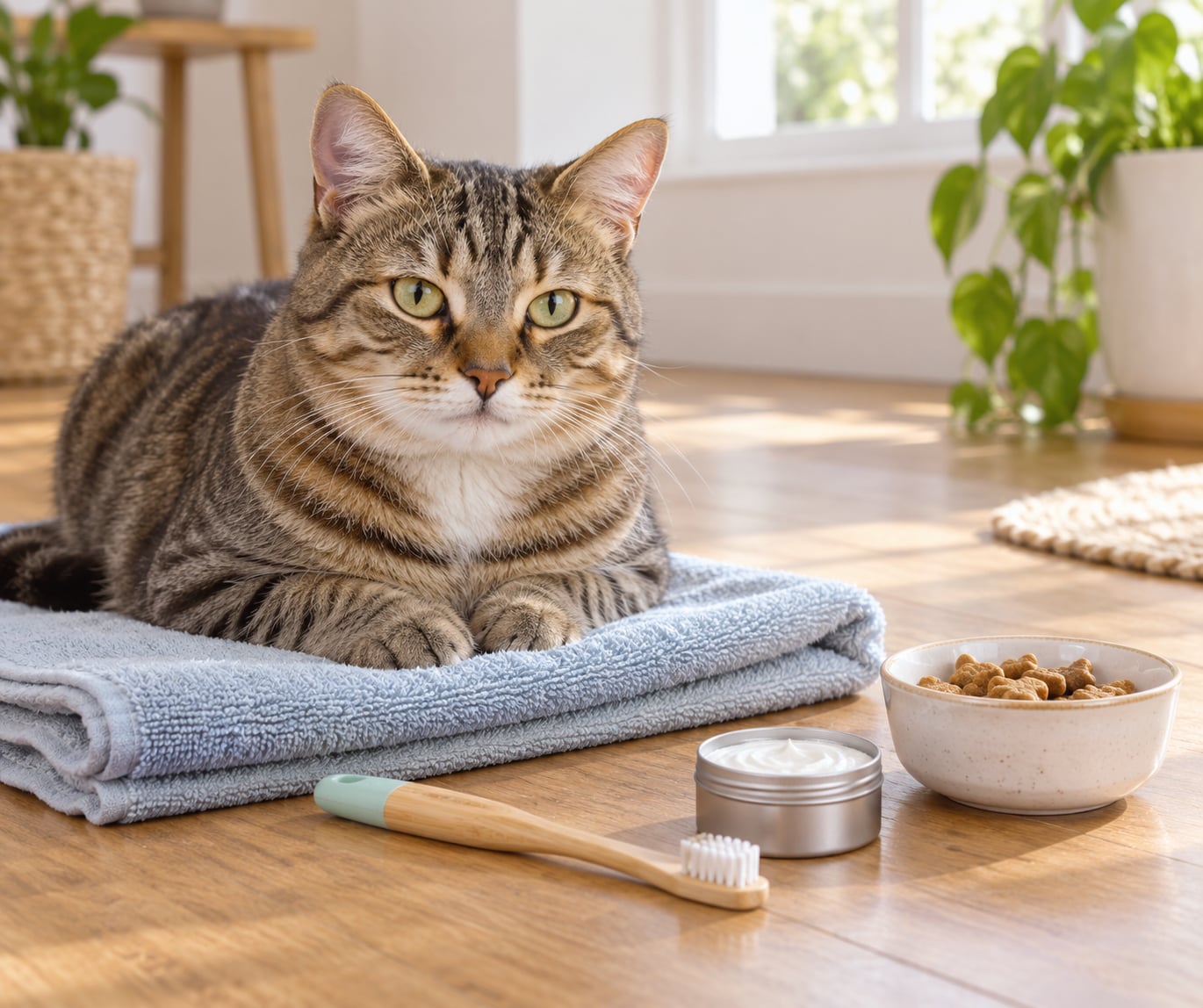
Six items cover everything, and only the first three really matter. A cat-specific toothbrush with a small angled head and very soft bristles is your main tool. A finger brush or a silicone finger sleeve is a useful stand-in during the first week, while your cat is still learning that a mouth is a normal place for hands. A veterinarian-approved enzymatic toothpaste for cats is not optional; the enzymes in it are what break up plaque rather than just scrubbing it off.
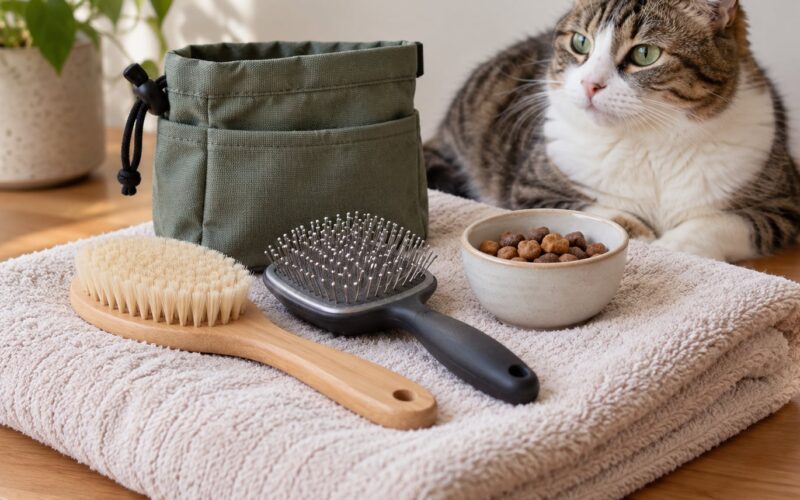
The other three are about the session, not the teeth. Have the treats you will always use ready in a small pouch or cup, because you will reach for them constantly. A warm towel over your lap or a non-slip mat on the table gives your cat something to brace against, and a quiet room where you have ten uninterrupted minutes removes most of the drama before it starts.
What not to use matters just as much. Human toothpaste is made to be spit out, and it can contain fluoride, foaming agents, and in some formulas xylitol, which is not safe for cats. Baking soda-based human formulas are not a substitute either. A full-size human toothbrush is too big for a cat’s mouth, its bristles are too stiff for the cheek-side surfaces, and the handle makes it impossible to keep the angle you need.
Ask your own vet which paste they recommend, since formulas change. If you want an independent check on any dental product you buy, look for the seal of acceptance from the Veterinary Oral Health Council, which awards it only after controlled clinical trials.
Step-by-Step: How to Brush a Cat’s Teeth and Prevent Dental Disease
Work through these in order and let your cat set the pace. Most owners need three to four weeks to get to a comfortable routine, and there is no prize for finishing faster.
Step 1: Get Your Cat Comfortable With Handling
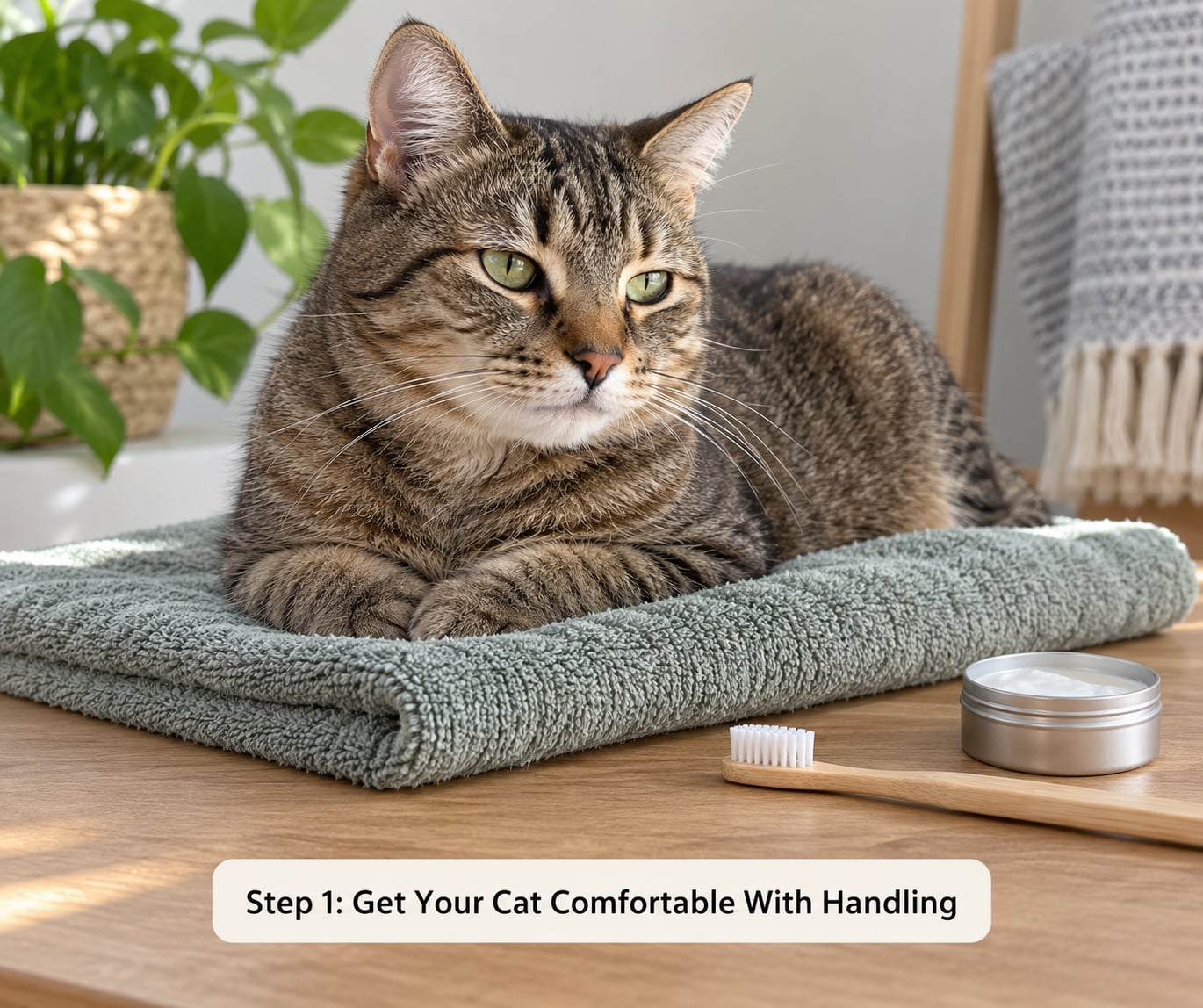
Pick a quiet moment when your cat is already relaxed, ideally just after a meal or a play session, and sit at the cat’s level rather than standing over it. Start with chin scratches and cheek rubs, the kind your cat already enjoys. Then lift the lip for one second, look at the cheek-side teeth, drop the lip, and reward immediately.
That is the whole exercise for the first few sessions. The goal is not teeth, it is a cat who notices a hand near its mouth and stays put.
You will get the same read every time. Tolerance looks like loose body weight, normal ears, a tail that is still or lazily moving, and a cat who leans back into the touch. Stop before the first real sign of stress: flattened or rotated ears, a lashing tail, skin twitching on the back, a head turning away, crouching, hissing, swatting, or any attempt to leave. If you catch one of those, end the session and give the treat anyway, so the last memory of brushing is a reward rather than a struggle.
Step 2: Introduce the Toothbrush Slowly
Only move on when a session ends with a calm cat. Put a small dab of paste on your finger and let your cat sniff and lick it, several days in a row if you need to. Owners on r/CatAdvice describe exactly this as the step that finally unlocked brushing for them: a week of nothing but lickable paste, no brush in sight at all.
Next, rub that same finger gently along the outside of the cheek-side teeth for one or two seconds, then reward. Repeat a few times before the brush ever appears. When you are ready for it, set the toothbrush where your cat can see it, let it be sniffed, touch it to the cheek and gum area, and reward again.
Do not towel-wrap a beginner or hold your cat’s head. Restraint teaches distrust fast, and a cat who associates your hands with restraint will fight harder next time. A frightened cat needs to build a memory of a hand near its face meaning treats and calm, nothing else.
Step 3: Brush the Outer Teeth, Not the Whole Mouth
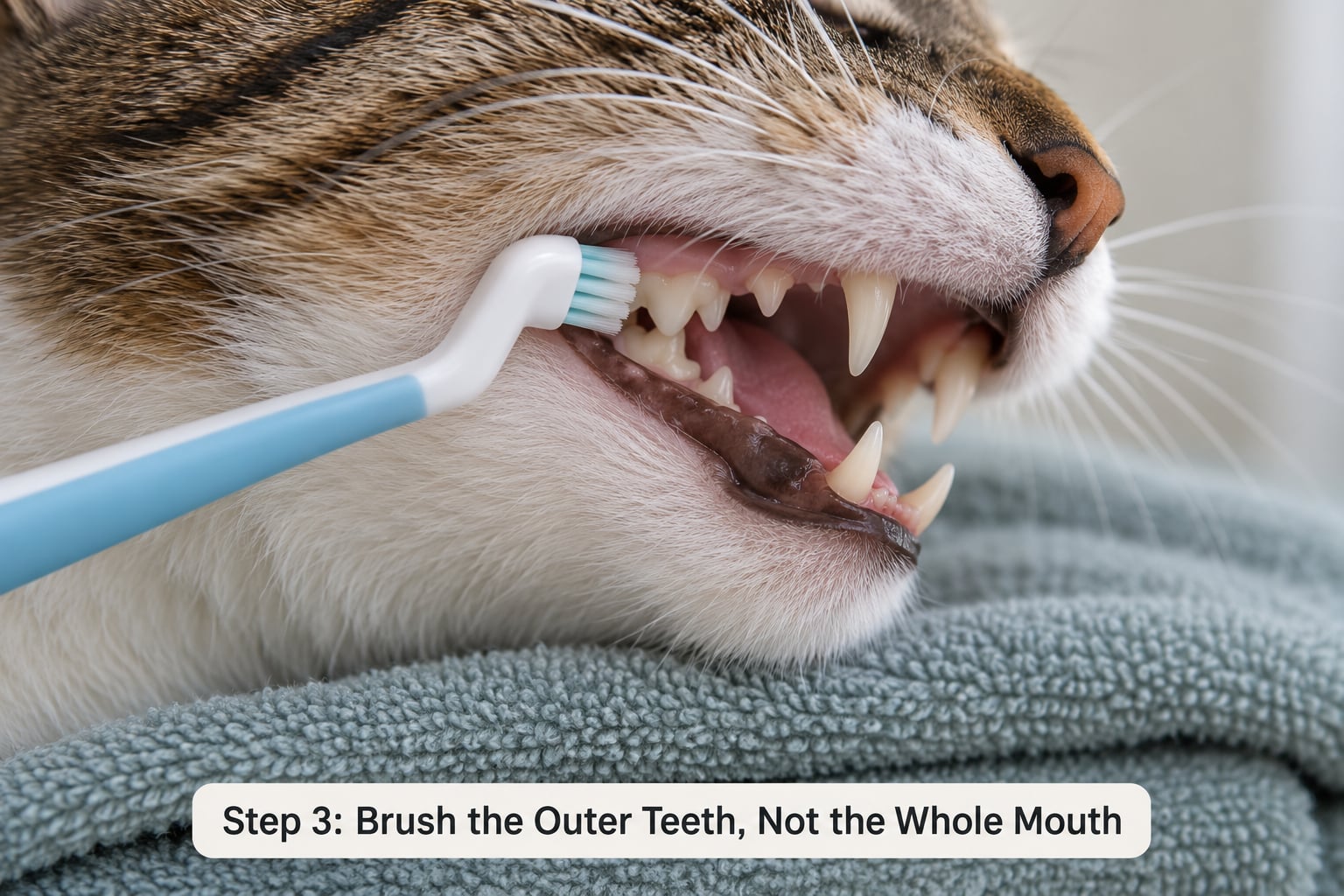
Once your cat accepts the brush near its face, the technique takes about thirty seconds to learn. Lift the cheek, angle the brush so the bristles meet the outer surfaces of the teeth, and use small circles or short gentle strokes. Work along the row from a front tooth back toward the big premolars, which is where plaque builds fastest and where you can see it best.
Fifteen seconds on one side is a real session. A twenty-second pass that you repeat most days removes far more plaque than a thorough two-minute struggle you abandon after a week.
Two honest limits. The inner surfaces of the teeth and the area under the gum line are much harder to reach and you should not chase them at home; that is where the disease usually is, and a professional cleaning with dental X-rays is the only way to deal with it. And brushing removes plaque, never tartar. Once calculus has hardened onto a tooth, no brush, chew, or dental diet will lift it off.
Step 4: Reward and Repeat Consistently
End every session with praise and a treat, even the bad ones. A session that ends on a reward is a session your cat will accept again, and that matters more than how many teeth you managed to reach.
Daily is the ideal, because plaque reappears within hours. Three or four times a week still clears most of what builds up, and owners who cannot manage daily do far better by brushing on set days than by aiming for perfect and quitting. Judge progress by the average across a month, not by the quality of any single session.
What is the 3-3-3 rule for brushing teeth?
The 3-3-3 rule is a guideline from human dentistry: brush three times a day, for three minutes each time, within three hours of waking. It is a useful idea for cats, but not a useful number. A cat will not sit through three minutes, so map the principle instead of the arithmetic: several short sessions spread across the day beat one long session at the end of it. Two fifteen-second passes, morning and evening, deliver more plaque control than a single grudging minute.
Step 5: Use Other Dental Care Between Brushings
Everything here is a supplement. None of it replaces brushing, and it is worth being honest about how well each one works.
A dental diet is the most useful of the lot. These foods use a larger, textured kibble designed to scrape plaque off the cheek-side teeth as the cat chews, and several carry the VOHC seal. Feed them as a complete diet rather than as a topper, or the abrasion stops. Dental treats only help if your cat actually chews them; a cat that swallows the treat whole gets a snack and no cleaning at all.
Water additives are moderate at best, and only work in a single-cat household where your cat drinks all the water offered. Dental wipes are essentially a gentler schedule of the same work, useful for a cat who tolerates touch but panics at bristle contact. Enzymatic gels and powders you can mix into food are another option owners like, since they need no handling at all; check the label and run it past your vet first.
Skip hard bones, antlers, hooves, and cooked bones. They fracture cat teeth cleanly rather than cleaning them.
Common Mistakes That Set Cats Back
Almost every stuck routine comes down to one of these, and each has a simple correction.
Using human toothpaste. It is not formulated to be swallowed and can contain ingredients that are not safe for cats. Switch to an enzymatic cat paste and check with your vet.
Starting with the whole mouth. Trying to open the mouth fully on day one guarantees a fight. Work the cheek-side teeth a section at a time instead.
Brushing too hard. Pressure is not what removes plaque, contact time is. Use light pressure and let the enzymes do the work.
Saving the treat until the end. If the reward only arrives when the session finishes, your cat learns to endure and then escape. Reward the small moments, the lip lift, the first tooth.
Forcing a squirming cat to finish. Wrapping, pinning, or holding the head down buys you ten seconds of brushing and costs you months of trust. Go back one step and shorten the next session.
Ignoring bleeding gums and bad breath. These are pain and inflammation signals, not a brushing technique problem. Stop and see a vet.
Treating treats and dental food as a replacement. They manage plaque to a degree. They do nothing for tartar, for disease under the gum line, or for a cat that is already in pain.
Disappearing and coming back months later. A common pattern after a bad month, and it is fixable. Restart at step one with a fresh short session rather than trying to catch up on missed work.
When to Ask Your Veterinarian
Any of the following means the mouth needs to be examined before you brush again: persistent bad breath, red or bleeding gums, visible brown or yellow tartar, a broken or loose tooth, pawing at the mouth, drooling, dropping food, chewing on one side only, or a general drop in appetite.
One condition deserves its own mention. Tooth resorption, sometimes called FORL, is a painful breakdown of the tooth structure that is estimated to affect 20 to 60 percent of adult cats, and it is largely invisible from the outside. A cat with resorption may keep eating normally and show nothing but a preference for one side of the mouth. Dental X-rays are usually the only way to find it, which is a good reason to keep up with routine exams rather than waiting for obvious pain.
A professional dental cleaning for a cat is done under general anesthesia, with a full mouth exam, dental radiographs, and scaling above and below the gum line while the cat is safely still. It is generally recommended every one to three years depending on the individual cat, and flat-faced breeds such as Persians, whose teeth are crowded, often need it more often. Cats over seven are usually given pre-anesthetic bloodwork first.
Never give a cat human medication, including over-the-counter pain relievers. Ibuprofen and acetaminophen are toxic to cats. If your cat is in pain, the right move is a phone call to your vet and soft food in the meantime, not a pill from the bathroom cabinet.
This article is general information for cat owners and is not a substitute for a veterinary examination. Your own vet can examine the mouth, take dental X-rays, and tell you what treatment your cat actually needs.
Frequently Asked Questions
How often should I brush my cat’s teeth?
Daily brushing is the goal because plaque reappears within hours, but three or four sessions a week still removes most of it and is far better than none. Start with what your cat tolerates, keep sessions to fifteen or thirty seconds, and build up over several weeks. Judge progress by the average across a month, not by any single session.
What toothpaste is safe for cats?
Use a toothpaste made for cats, usually labeled enzymatic, in a poultry, seafood, or malt flavor your cat enjoys. Never use human toothpaste: it is not meant to be swallowed and can contain fluoride and other ingredients such as xylitol that are not safe for cats. Ask your veterinarian which paste they recommend and use a small dab, not a squeeze.
Does dry food or dental food remove tartar?
Only partly, and it depends on the cat. Dental diets use a larger textured kibble designed to scrape plaque off the cheek-side teeth as the cat chews, and a chew-style treat only helps if your cat actually chews rather than swallowing it whole. Once tartar has hardened, no food removes it; that needs scaling under anesthesia by a veterinary team.
What do bleeding gums in a cat mean?
Bleeding or red gums usually mean gingivitis, an inflamed gum line, and sometimes a more serious periodontal problem underneath. Stop brushing and arrange a veterinary dental exam. Continuing to scrub a sore mouth causes pain and can make your cat wary of your hands for weeks afterward. Only a veterinarian can diagnose dental disease and choose the treatment.
How do I brush a cat that hates being handled?
Go back one step rather than pushing forward. A cat that bolts, bites, or scratches is reacting to a stage that came too soon. Return to chin rubbing and lip lifting for a few sessions, move slower, and reward anything close to cooperation. Owners on r/CatAdvice often found the breakthrough came from letting the cat lick paste off a finger for several days first.
Conclusion
Start with one small action: put a dab of enzymatic cat toothpaste on your finger, let your cat lick it, and reward it. Do that for a few days before any brush appears, then add fifteen seconds on the outer cheek-side teeth, most days, and build from there.
Knowing how to brush a cat’s teeth and prevent dental disease is only half the job. Home brushing removes plaque before it becomes tartar, and it is genuinely good at that. It cannot remove tartar, cannot treat disease below the gum line, and should stop the moment you see bleeding gums, drooling, or a cat that will not open its mouth. That is a veterinary appointment, and no home routine substitutes for one.
Sources consulted: the AAHA Dental Care Guidelines, the Merck Veterinary Manual on dental disorders of cats, and the Veterinary Oral Health Council. This article is general information, not veterinary advice. Last updated October 2026.