Bernese Mountain Dog care in hot climates comes down to three things: shade, cool surfaces, and a schedule that moves all exercise to the cool hours. A Berner sheds heat almost entirely by panting, and its dense double coat traps the heat a short-coated dog would simply reflect off. Get those three right and a 70 to 115 pound dog can live comfortably somewhere far warmer than the Swiss Alps it came from.
The honest caveat is humidity. Owners in humid regions report nights that never drop below the mid 80s, so the dog never gets a real recovery window. Every routine below assumes you check the temperature and humidity together, not the thermometer alone.
Table of Contents
- What You Need Before the Heat Arrives
- Bernese Mountain Dog Care in Hot Climates, Step by Step
- 1. Check the Weather and the Dog Before Going Out
- 2. Create a Cool, Shaded Home Base
- 3. Adjust Exercise, Walks, and Playtime
- 4. Provide Water and a Heat-Safe Feeding Routine
- 5. Support the Double Coat, Skin, and Paws
- 6. Watch for Signs of Overheating
- 7. Plan for Travel, Grooming, and Emergencies
- Common Mistakes That Go Wrong Every Summer
- Frequently Asked Questions
- Should you shave a Bernese Mountain Dog in hot weather?
- How long should a Bernese Mountain Dog walk be when it is hot?
- Do Bernese Mountain Dogs need air conditioning in summer?
- How much water should a Bernese Mountain Dog drink on hot days?
- Is panting always a sign that a Bernese Mountain Dog is overheating?
- Conclusion
What You Need Before the Heat Arrives
Most of the equipment is cheap and only useful if it is already in place before the first hot afternoon. Setting it up during a heat wave is too late.
- Cool drinking water, in several bowls, changed at least twice a day. Shallow bowls matter more than big ones for a heavy, panting dog.
- Shade outdoors: a canopy, an umbrella over a resting spot, or a tree line your dog can lie under without being in direct sun.
- An outdoor thermometer and, ideally, a pavement thermometer. Air temperature and ground temperature can be 30 degrees apart on a sunny afternoon.
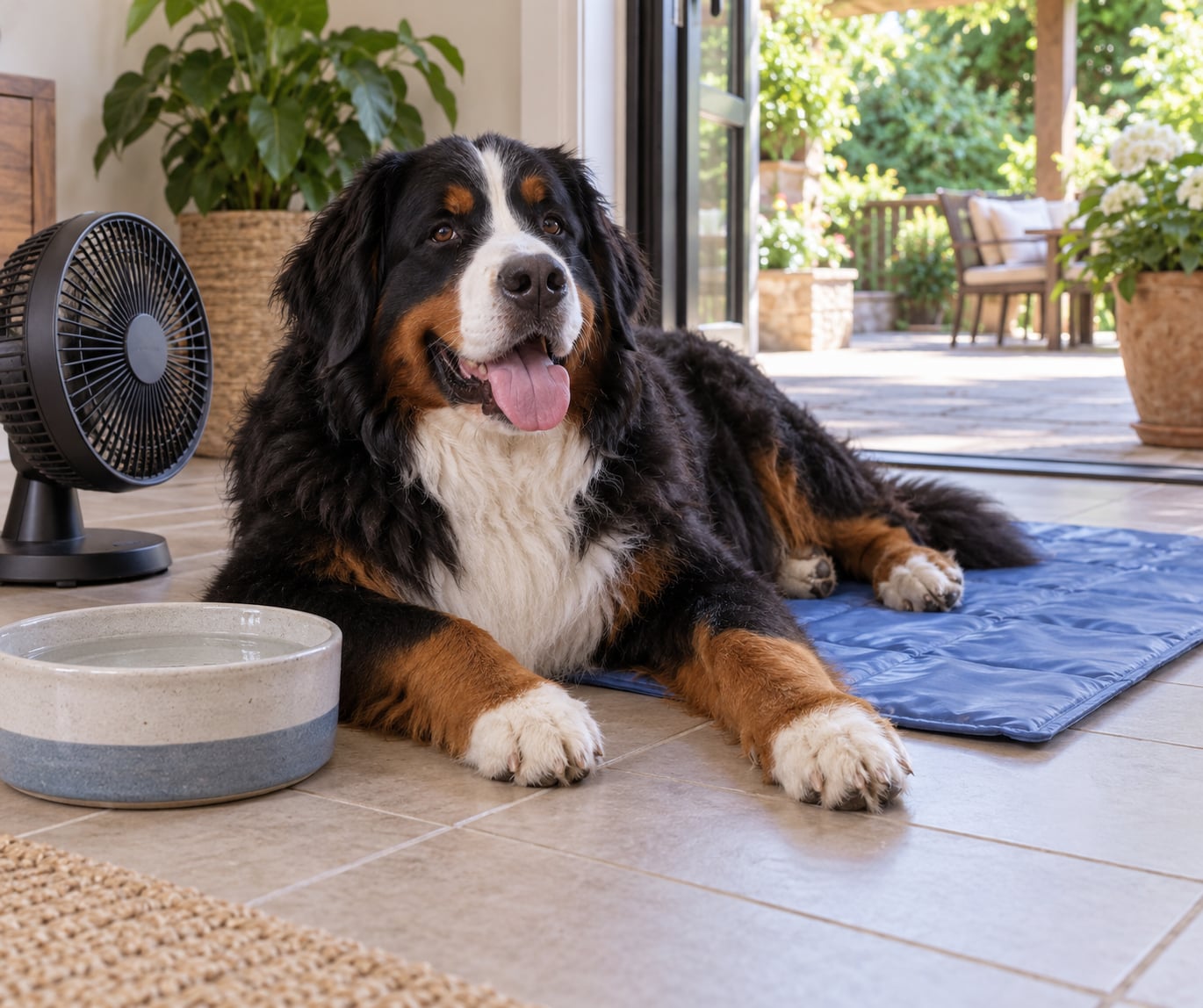
- A cooling mat or cooling vest, plus a fan. Owners treat these as a supplement to air conditioning, never a replacement.
- Breathable bedding placed on a cool floor, away from a wall that has been in the sun all day.
- A dog-safe paw balm for hot, abrasive surfaces, and a soft grooming brush for the undercoat.
- A vehicle cooling plan: where the dog goes while the car is parked, and who checks on them.
- Your vet’s number and the nearest emergency clinic’s address, saved in your phone.
Air conditioning helps most and is not required. Plenty of owners in warm climates get through summer with a shaded room, a fan and a tiled floor. What matters is that the coolest area stays cool for most of the day.
Bernese Mountain Dog Care in Hot Climates, Step by Step
1. Check the Weather and the Dog Before Going Out
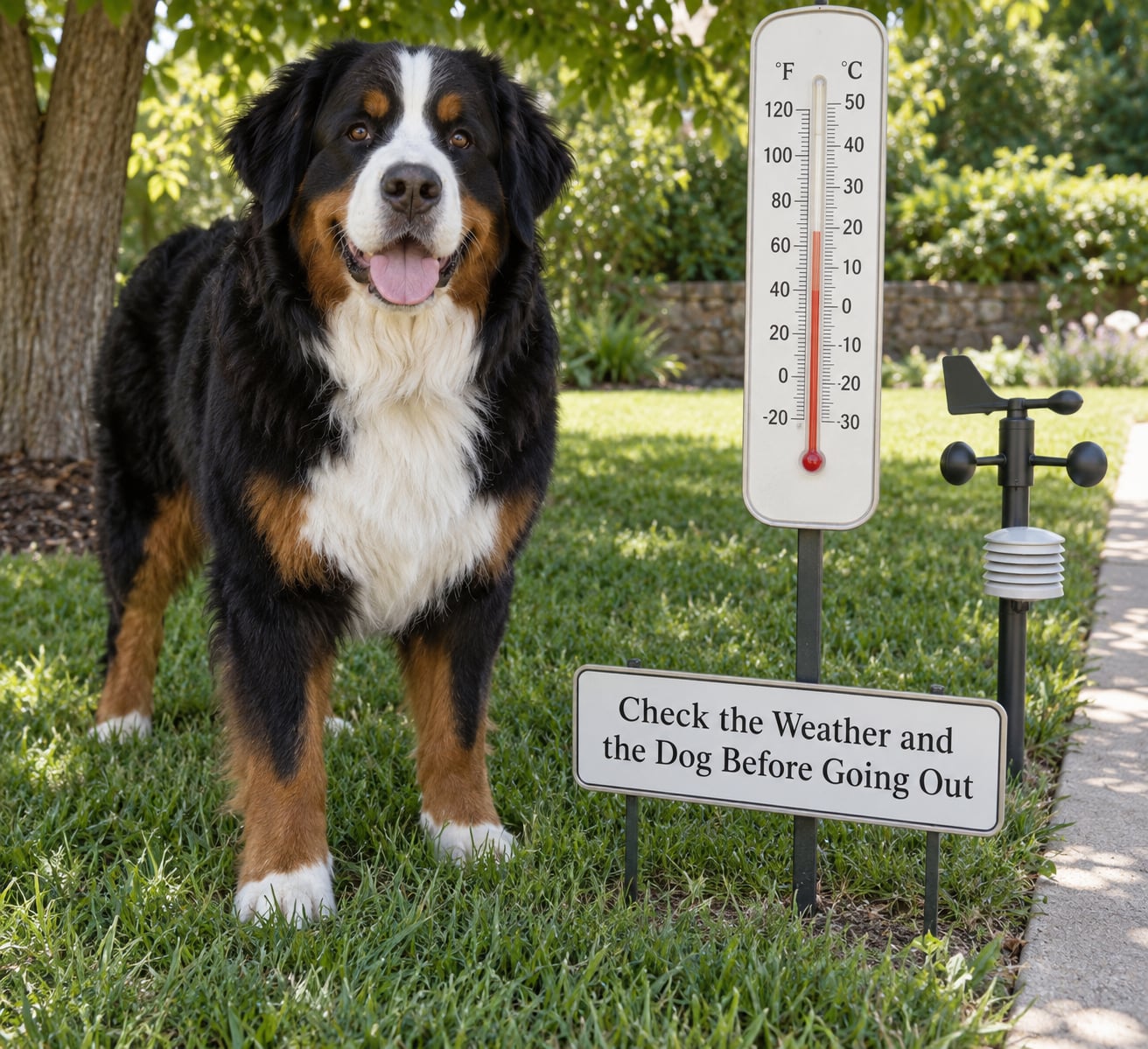
Read temperature and humidity as one number, not two. A 78 degree day at 70 percent humidity is far harder on a heavy dog than an 82 degree day in dry air, because panting evaporates poorly when the surrounding air is already saturated. If your weather app shows a heat index, use that figure instead of the air temperature.
Then check the dog, not the forecast. Look at energy level, how fast the tail wags when you say his name, whether the mouth is open at rest, and the colour of the gums. Press a finger gently against the gum until it blanches and releases; a healthy pink colour returns in under two seconds. Then put the back of your hand on the pavement for seven seconds. If you cannot hold it there, your dog cannot stand on it.
- Under 70F, humidity low: normal walk, normal play.
- 70 to 80F, or any humidity above 60 percent: walk only at dawn and dusk, shorten it, add water breaks.
- Above 80F: no organised exercise. Leash walks only for bathroom relief, early or late.
- Above 85F, or any day when the pavement test fails: the dog stays indoors. This is not a training problem, it is a safety rule.
If the dog is already panting hard before you leave the house, skip the walk and try again later. Postpone rather than push through.
2. Create a Cool, Shaded Home Base
Keep the dog indoors through the hottest part of the day, roughly 10 in the morning to 4 in the afternoon. Owners running air conditioning report keeping the house between 64 and 71F, which is a useful target if you are unsure where to set the thermostat.
Pick one resting spot and make it the best room in the house. Put the bed on tile or bare floor rather than carpet, in a room with airflow but no direct sun. Cooling mats and frozen water bottles work well under a dog that will lie on them for hours. A crate in an unshaded room works as an oven, so if your dog sleeps in a crate, move the crate itself into the cool room or use a covered dog bed instead.
Be careful with fans. A fan pointed at a dog encourages evaporative cooling and is safe, but a corded fan and a chewed cable is a bad combination. Unattended electrical equipment stays out of reach.
3. Adjust Exercise, Walks, and Playtime
Move the walk to before 7 in the morning or after 8 in the evening, and cut the distance by roughly half compared with a winter walk. A Berner will happily signal that it wants more, which is why the decision to stop has to be made before you leave the house, not in the middle of the block.
Substitute thinking for running. On days above the caution threshold, replace a walk with a five-minute scent search, a cardboard-box obstacle course, a lick mat stuffed with wet food, or a short training session where the reward is finding hidden treats. Owners stuck at home through a multi-day heat wave say the mental work is what keeps a dog settled enough to sleep through the afternoon.
Individual tolerance varies more than most breed guides admit. A fit two-year-old in an air-conditioned house handles far more than a nine-year-old with hip dysplasia. Watch your own dog and adjust, rather than borrowing a schedule from someone else’s.
4. Provide Water and a Heat-Safe Feeding Routine
Offer water before you leave the house, during, and immediately after, rather than relying on a single bowl in the kitchen. On the hottest days, top up every few hours. A panting Berner loses water quickly through evaporation, and mild dehydration shows up as thick, sticky gums before anything else.
Feed earlier in the morning or later in the evening, when the dog is cooler. Appetite often drops in high heat; a skipped meal is common, but a dog that eats normally while burning less energy may need its portions adjusted. Ask your vet about that rather than guessing.
One thing to watch: a dog that drinks a large amount of water immediately after exercise may be trying to catch up on a serious fluid loss, and that can signal overheating. Extreme thirst that appears suddenly is worth a phone call to your vet.
5. Support the Double Coat, Skin, and Paws
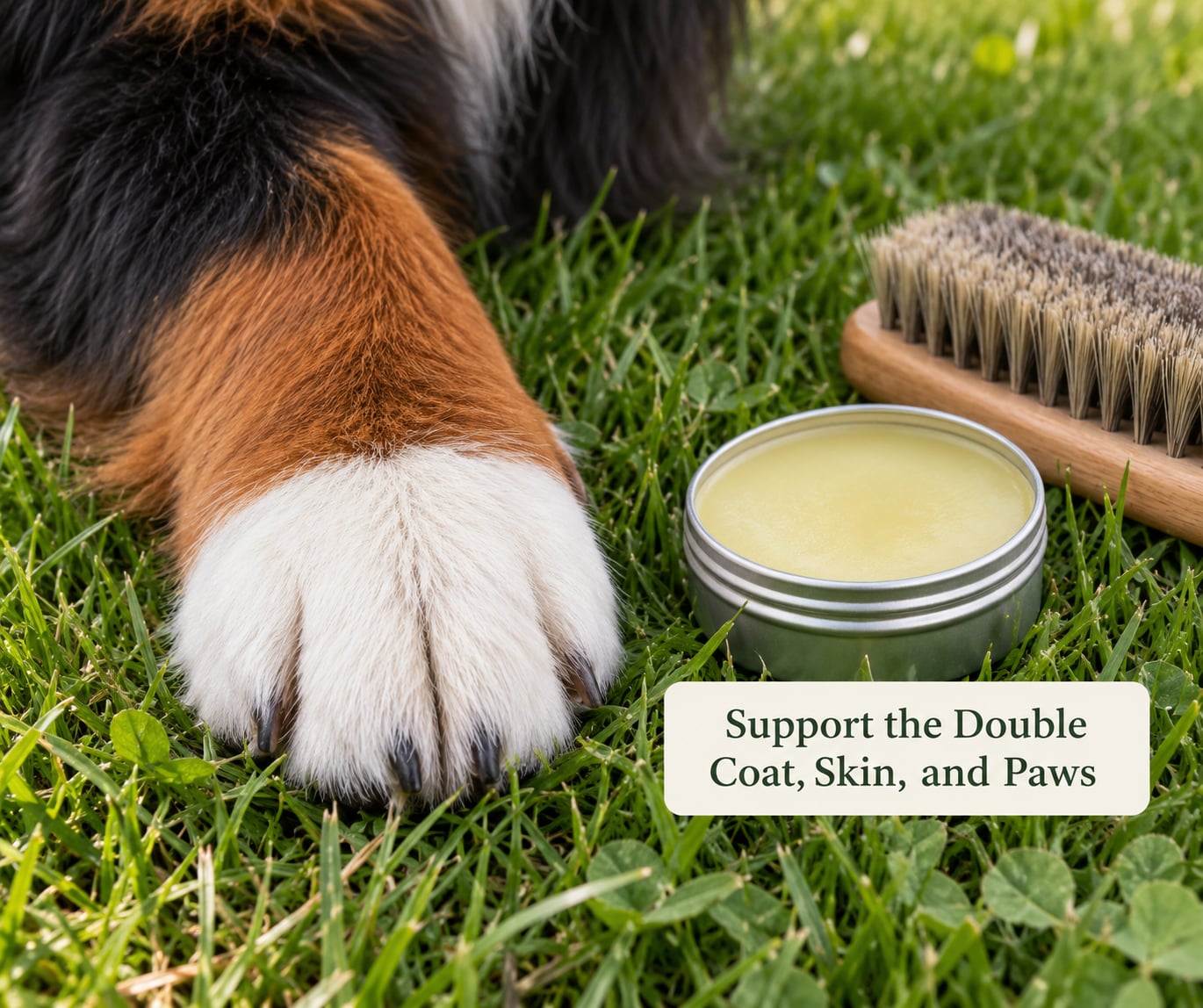
Do not shave a Bernese Mountain Dog, and this is the one rule with no exceptions. The outer coat reflects sunlight and the undercoat insulates against heat. Remove both and the skin burns, the coat regrows patchy, and the dog loses the only protection it has. A professional groomer can take the coat down without removing it, and that is worth arranging a few weeks before summer.
Brush two or three times a week through the shedding season. A Berner drops its undercoat twice a year, and loose hair traps heat against the skin and blocks the airflow owners rely on. Keep the coat clean too; dirt and salt after a swim or a dusty walk reduce its reflective quality.
For paws, wipe after walks with a damp cloth and use a dog-safe balm on hot asphalt or coarse gravel. Rinse and dry between the toes, since damp skin folds invite irritation. Skip human lotions and essential oils unless your vet specifically approves them, and keep your dog from licking anything freshly applied.
Skin folds, ear canals and the area under the tail all hold heat and moisture. Check them weekly, especially in humid weather. Berners are also prone to hot spots in damp, matted fur, so any damp patch should be dried and looked at the next day.
6. Watch for Signs of Overheating
Distinguish normal panting from a warning. Light panting after a walk that eases within a couple of minutes on cool floor is normal. Concerning signs are heavy panting that will not settle, plus weakness, drooling that is thick and stringy, vomiting, stumbling or loss of coordination, confusion, or gums that are very red, very pale, or bluish.
The most alarming sign is a dog that stops panting while still hot. A hot dog that feels better pants. Silence means trouble.
When something seems off: stop activity, move to shade or air conditioning, offer small sips of water, and call your vet. For suspected heat stroke, act immediately.
- Move the dog into air conditioning or the coolest room you have.
- Call the emergency vet clinic while you move, do not after.
- Wet the body with cool, not cold, water and keep air moving across it.
- Do not use ice, ice packs or ice water on the skin. It causes peripheral vasoconstriction, which traps heat in the core.
- Do not put water in the mouth of a confused or barely responsive dog.
- Do not give human medication of any kind.
- Get to the clinic, and transport with air conditioning on and the dog in the coolest spot in the vehicle.
Do not try to treat this at home, and do not wait to see whether the dog improves in the morning. Heat stroke causes organ damage in minutes, and survival depends heavily on how quickly treatment starts.
7. Plan for Travel, Grooming, and Emergencies
Never leave a dog unattended in a parked vehicle, not for a coffee, not with the windows cracked, not in the shade. A parked car on a mild day can climb from 75F to 100F in about ten minutes. Plan the whole outing around the dog: drive in the cool of the day, keep air conditioning running, and make sure every stop has a cool indoor option.
For groomers, boarders and dog walkers, tell them the breed is high heat risk and describe the routine you use. A caregiver who does not know that a Berner needs a mid-day indoor break will happily schedule a 90 minute walk at noon.
Know your nearest emergency clinic before you need it. In a heat emergency, fifteen minutes of deciding where to go can be the difference. Ask your vet at your next routine visit how a large, thick-coated dog would present with heat illness, and what the clinic’s fast-track process looks like.
Common Mistakes That Go Wrong Every Summer
- Shaving the double coat. A common mistake with a kind motive. The fix is to strip the coat with a groomer, never to remove it.
- Walking at midday. The pavement and the air are both at their worst, and a Berner heats up faster than a short-coated dog of the same weight. Fix: dawn and dusk only.
- Using a cold, wet nose as a thermometer. It tells you nothing. Fix: use panting, gum colour, energy and the seven-second pavement test.
- Leaving the dog in a parked car. There is no safe version of this with a parked vehicle.
- Reaching for human medication. Paracetamol and ibuprofen are toxic to dogs. Fix: emergency vet and cooling only.
- Forcing exercise to hit a distance goal. The goal should be dropped on hot days, not negotiated.
- Treating heavy panting as normal. If panting does not ease after a couple of minutes in the cool, that is a reason to stop and watch, not to push on.
Prevention is dull and effective: shade, cool floors, water within reach, exercise at dawn and dusk, and a coat that is brushed but intact.
Frequently Asked Questions
Should you shave a Bernese Mountain Dog in hot weather?
No, and the reason is worth repeating every year. The outer coat reflects sunlight and the undercoat traps insulating air, so both layers work against heat rather than for it. Shaved, the skin burns easily, the coat regrows unevenly, and the dog has nothing between it and the sun. Book a groomer a few weeks before summer to take the coat down without removing it, and brush weekly afterwards.
How long should a Bernese Mountain Dog walk be when it is hot?
Shorten it to roughly half the winter distance, and move it to before 7am or after 8pm. Between 70 and 80F, take water breaks and keep the walk slow. Above 80F, skip organised exercise entirely and offer leash bathroom breaks only, early or late. Above 85F, or whenever the seven-second pavement test fails, the dog stays indoors for the day.
Do Bernese Mountain Dogs need air conditioning in summer?
Not strictly, but it is the easiest way to give a heavy double-coated dog a real recovery window, and owners who use it report keeping the house between 64 and 71F. Without it, a shaded cool room with airflow, a tiled floor and a fan can work in dry heat. In humid weather, where the air never dries out, air conditioning is much harder to replace with a fan.
How much water should a Bernese Mountain Dog drink on hot days?
More than usual, and offered often rather than measured. Keep several bowls out, top them up every few hours on the hottest days, and offer water before, during and after exercise. Signs of dehydration include thick sticky gums and a dull coat. Sudden heavy thirst right after exercise can be a warning sign of overheating, so call your vet rather than just refilling the bowl.
Is panting always a sign that a Bernese Mountain Dog is overheating?
No. Berners pant to cool themselves normally, and light panting after activity that settles within a minute or two on a cool floor is nothing to worry about. Treat it as a warning when panting will not ease, or comes with weakness, thick drooling, vomiting, poor coordination, confusion, or gums that look very red, pale or bluish. A hot dog that stops panting needs a vet now.
Conclusion
Start today with the weather app, not the dog. Look at the heat index, run the pavement test, and decide the day’s routine before anyone gets excited about a walk. Then make sure the cool room, the water bowls and the shade are ready, because those are the parts you cannot improvise at 2pm.
Bernese mountain dog care in hot climates is not a single seasonal treatment or one expensive piece of equipment. It is a dozen small daily adjustments, most of them free, that add up to a dog who sleeps through the afternoon and still wants to play in the evening. Save your emergency clinic’s address now, while you are calm.
Anything medical here, from a first heat episode to a dog on heat-related medication, is a conversation with your veterinarian rather than with a website.