Dachshund back problems prevention tips come down to a few repeatable habits: keep your dog lean, take away the need to jump, control the surfaces they walk and climb on, and catch pain early. Intervertebral disc disease, usually shortened to IVDD, is the condition behind most dachshund back trouble, and the daily routine you build around your dog decides how much of that inherited risk ever turns into an injury.
Nobody needs to pretend a dachshund spine is indestructible. The breed was built with an unusually long back and short legs, a shape that leaves the discs between the vertebrae under more load than a normal dog of the same weight. What you control is the number of impacts, twists and extra pounds that spine carries.
The ten habits below are the ones owners on r/Dachshund and dachshund owner groups keep coming back to after years of living with the breed. They are also the ones that take the least effort, because each one replaces a small daily action rather than adding a new chore.
Table of Contents
- Dachshund Back Problems Prevention Tips at a Glance
- 1. Keep Your Dachshund at a Healthy Weight
- Dachshund Back Problems Prevention Tips for Daily Routines
- 2. Use a Ramp for Stairs, Couches, and Cars
- 3. Support Walks With a Well-Fitted Harness
- 4. Prevent Repeated Jumping On and Off Furniture
- 5. Keep Floors Dry and Stable
- 6. Keep Walks Controlled and Surfaces Predictable
- 7. Use Low-Impact Exercise With Comfortable Movement
- 8. Avoid Human Pain Medicines and Unsafe Products
- 9. Build a Consistent Observation Routine
- 10. Know the Warning Signs That Need a Vet
- Frequently Asked Questions
- Can dachshund back problems be prevented?
- Are dachshunds more likely to develop back problems than other dogs?
- Should a dachshund avoid stairs and jumping?
- What are the earliest signs of a dachshund back problem?
- When should I take my dachshund to a veterinarian for back pain?
- Conclusion
Dachshund Back Problems Prevention Tips at a Glance
The guiding principle behind all ten tips: spinal protection depends on managing weight, avoiding repetitive impact, supporting safe movement, and responding early to pain or weakness. Remove any one of those and the others work harder.
| Preventive action | Why it matters | Where to apply it |
|---|---|---|
| Healthy body weight | Extra weight adds constant downward load to the discs | Meals, treats, weekly weigh-ins |
| Ramps and steps | Removes the landing impact from jumping down | Couches, beds, car, porch steps |
| Fitted chest harness | Spreads leash pull across the chest, not the neck | Every walk and potty trip |
| No furniture jumping | Repeated twist-and-land cycles stress the thoracolumbar spine | Sofas, armchairs, decks |
| Dry, stable floors | Slipping triggers scrambling and sudden posture changes | Kitchen, tile, stairs, entryways |
| Controlled walks | Sudden lunges and repetitive hills add shock loading | Neighborhood routes, dog parks |
| Low-impact exercise | Keeps core and leg muscles working without jarring the back | Daily walks, sniffing games |
| No human pain medicines | Common painkillers are dangerous or fatal for dogs | Medicine cabinet, first-aid kit |
| Weekly observation routine | Subtle changes show up days before a crisis | Sunday check-in, symptom diary |
| Know the warning signs | Hours matter when a disc ruptures | Family, sitters, household notes |
1. Keep Your Dachshund at a Healthy Weight
Weight is the one risk factor most owners can move in a few months, and it changes the load on every single step your dog takes. A few extra pounds spread across a long spine add up quietly, all day, with no dramatic moment you would ever notice.
Start with portion control rather than a new food. Measure meals with a proper measuring cup, count the daily treats in the total, and check body condition by looking over the ribs and running your hands lightly along the sides. You should be able to feel a waist without pressing hard.
Weigh your dog on the same scale at the same time of day every couple of weeks. Small dachshunds pick up and lose weight surprisingly fast, and a slower dog on a level surface is a dog you want to see on the scale.
Ask your veterinarian for a weight plan rather than picking a diet yourself. Restricting food without guidance can strip muscle, and muscle is exactly what supports the spine.
Dachshund Back Problems Prevention Tips for Daily Routines
Weight management works because it is boring, and boring habits are the ones that survive a busy week. The same is true of the other nine tips, which is why it helps to see how they fit into an ordinary day rather than treating them as separate projects.
Walk the dog before the first meal of the day, when energy is highest and the leash is least likely to be a tug-of-war. Weigh the food in the morning so the portion is decided before anyone is hungry. Check the paws, the coat and the posture in the same ten seconds each morning.
Keep a short daily checklist somewhere you will actually see it, near the food or the leash hook:
- Morning weigh-in or body condition check
- Measured meal, treats counted separately
- Ramp positioned before the door opens
- Harness on, fit checked with two fingers of room
- Walk with controlled pace and no free lunging at squirrels
- Floors dry, spills cleared immediately
- Evening check of posture, movement and appetite
Mark the items off for a week and the routine takes over on its own. Miss a day, and nobody panics.
2. Use a Ramp for Stairs, Couches, and Cars
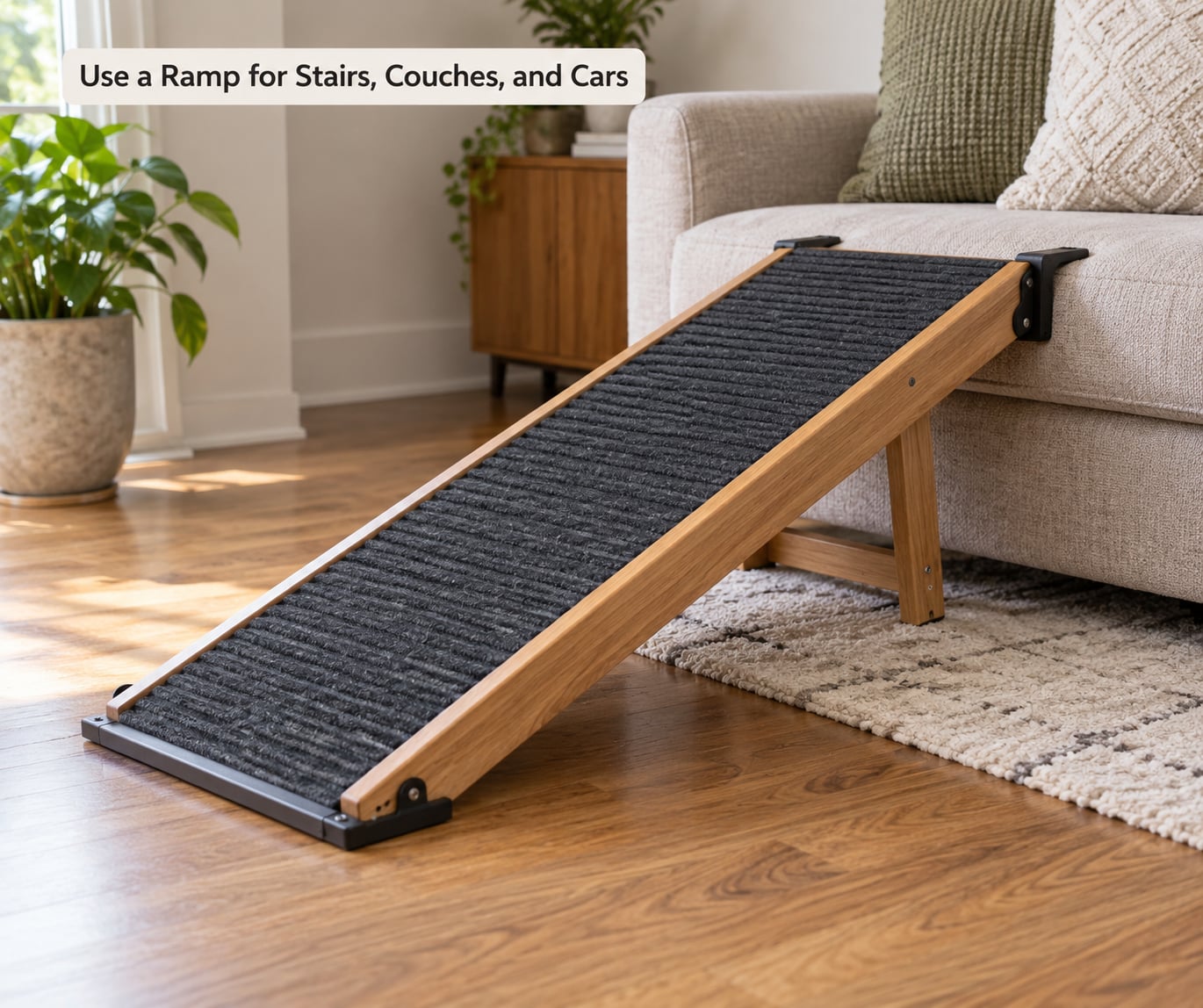
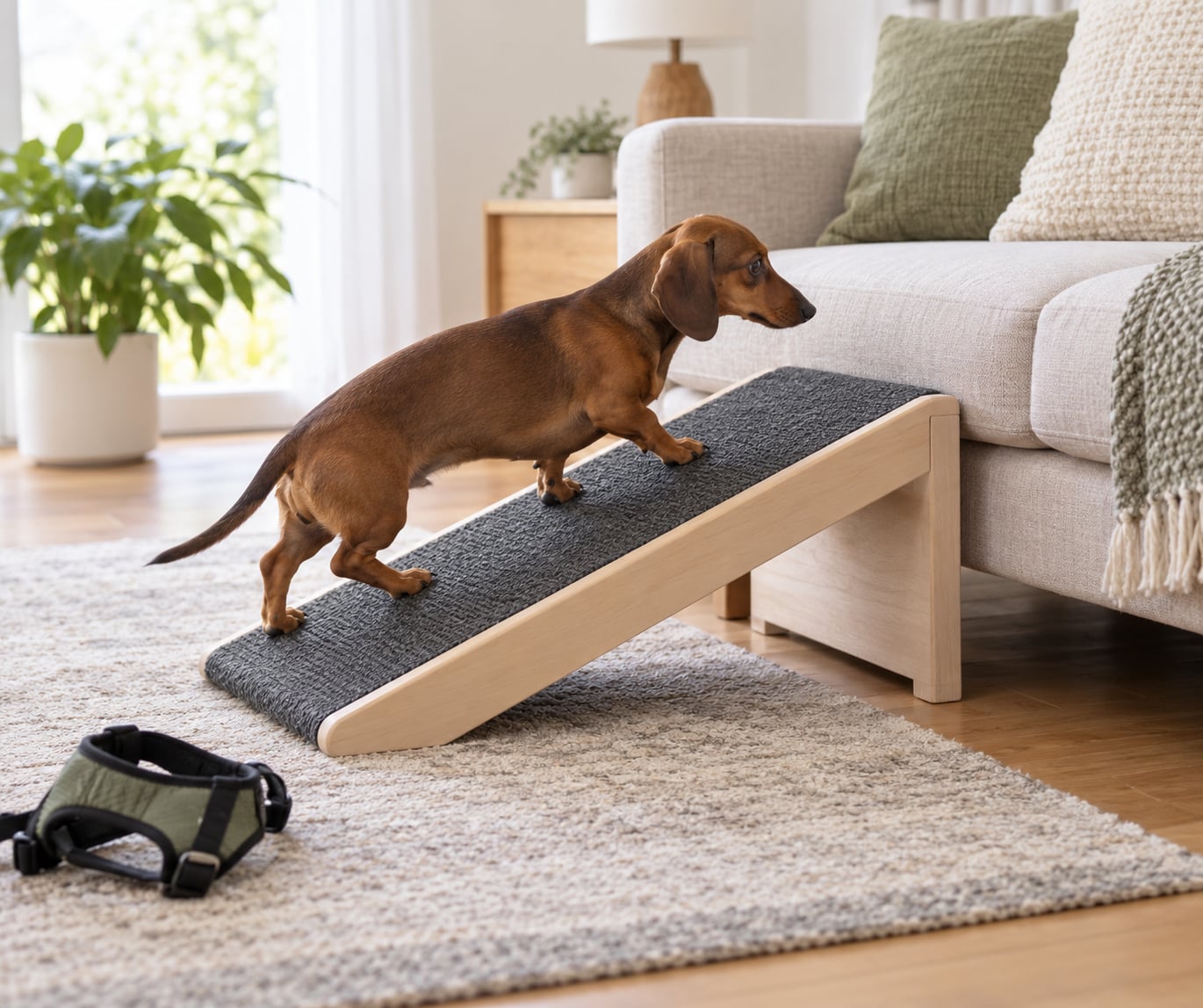
A ramp works because it turns a landing impact into a walk. Dogs that jump off a couch hit the ground with a compression and a twist at the same moment, and that combination is what most often herniates a disc.
Pick one that is wide enough for a steady stance, with a surface your dog can actually grip. A smooth plastic ramp on smooth flooring is a slide, and a sliding dog twists. Look for a nonslip tread or a surface you can add a mat to.
Position it so your dog walks straight up and straight down, not at an angle, and push it against the furniture or vehicle so it cannot slip backward mid-stride. A gentle slope is kinder than a steep one, so measure the height of the couch against the length of the ramp before you buy.
Ramps are not treatment. If your dog already shows pain, get veterinary advice before adding equipment, and expect a professional to tell you when strict rest matters more than movement.
3. Support Walks With a Well-Fitted Harness
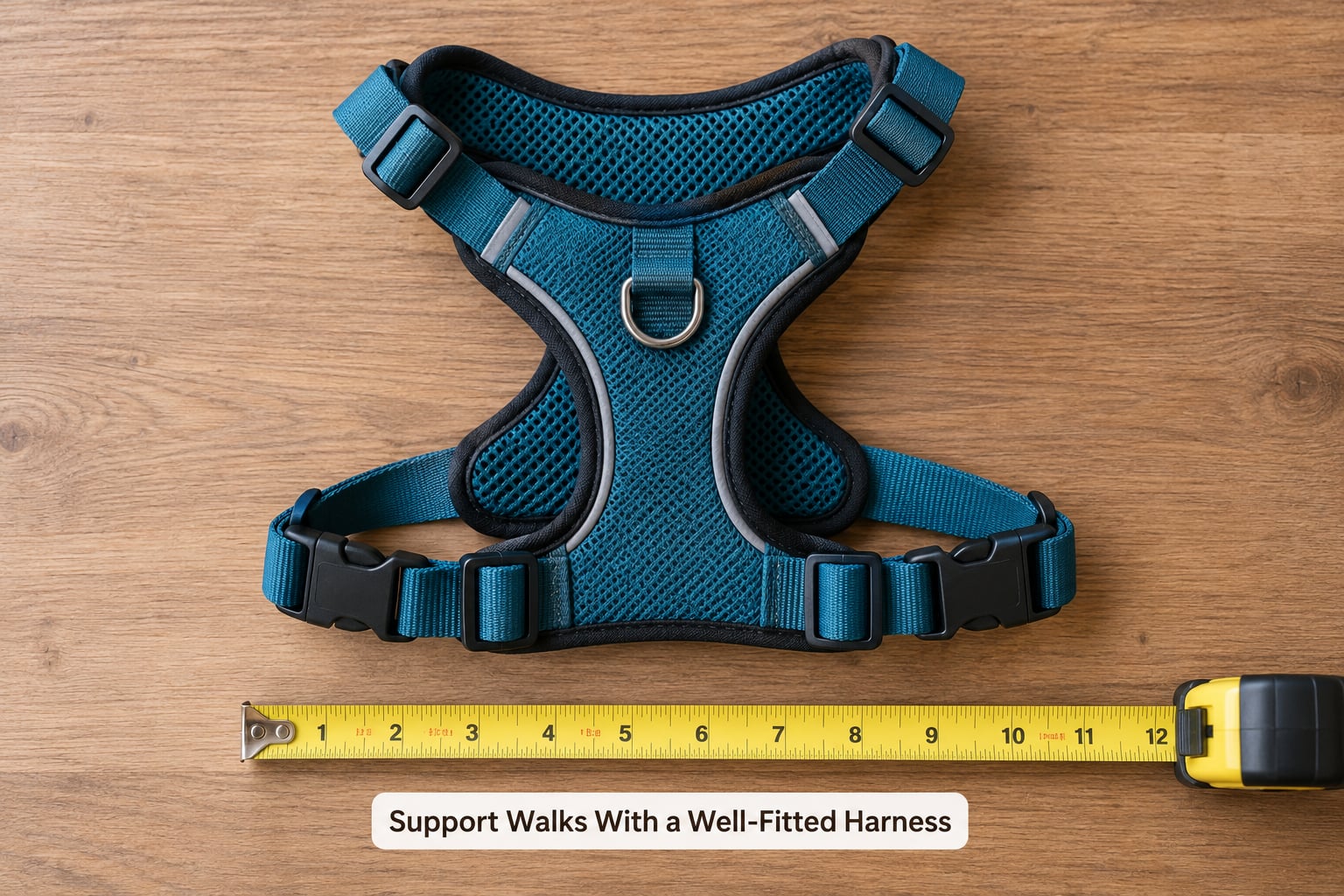
A harness spreads leash pressure across the chest and sternum. A collar concentrates it in the neck, and a dachshund that lunges at a squirrel while wearing one turns every surprise into a spinal jolt.
Fit is where most harnesses fail. You should fit two fingers under the straps, the panel should sit on the chest without rubbing the front legs, and the ring should be on the back rather than pressing into the throat. Check the fit again after a few wears, because these things loosen.
Introduce the harness indoors with treats before the first walk outdoors. If your dog pulls hard, work on loose-leash manners separately rather than correcting mid-stride, and reward calm walking often enough that it becomes the thing that pays.
Stop and go back to the vet if you see chafing under the forelegs, sores on the chest, panting that will not settle, or any sign of pain when the harness goes on.
4. Prevent Repeated Jumping On and Off Furniture
The highest-impact things a dachshund does in a day have nothing to do with exercise. They involve the sofa, the bed, the deck steps and the car, several times a day, often when nobody is thinking about it.
Walk through your home and list every spot your dog jumps down from. Then pick one solution per spot: a ramp, a set of steps beside the sofa, or a low piece of furniture that makes the couch irrelevant.
When you cannot put equipment there, lift the dog instead. Support the chest and the rear end together, keep the spine roughly level, and set the dog down rather than letting them drop. Many experienced owners in dachshund communities describe this two-handed support, often called the football hold, as the habit that makes the biggest difference in a multi-dog house.
Consistency matters more than perfection. Be strict for the first two weeks, including on the days you are tired, because a dog that is allowed to jump sometimes will keep testing every time.
5. Keep Floors Dry and Stable
Slippery floors cause scrambles. A back paw slides out, the dog twists to catch up, and the spine rotates under load. Hardwood and tile are the worst offenders, especially near bowls, entryways and the kitchen.
Low-pile rugs or rubber-backed mats solve most of it. Choose ones you can vacuum easily and that will not slide themselves, because a rug that shifts is its own problem on a slippery floor.
Dry spills the moment you find them. Water and urine are the usual culprits near water bowls, and a wet patch by a door is where a lot of indoor slips start.
Where flooring cannot be changed, keep the route short. A carpet runner from the sofa to the door cuts the distance a dog covers on a slick surface more effectively than any single product you can put down.
6. Keep Walks Controlled and Surfaces Predictable
Walks are good for your dachshund, and stopping them is not the answer. What matters is control: a leash that stays slack, a pace the dog can maintain, and routes that do not turn every outing into downhill sprinting.
Pick routes that avoid long steep hills and avoid the same hard paved loop every single day, which repeats the same motion through the same joints. Grass, packed dirt and sand give a little give underfoot.
Let your dog set the pace part of the way. Sniffing is slow movement and slow movement is what you want, so a walk built around long sniff pauses gives more benefit than one built around distance.
Skip high-impact pursuits that make a dachshund twist midair, including steep fetch angles and leaping for frisbees, and cut the outing short when the dog starts lagging or walking stiffly. Age matters too, so a senior dog and a puppy do not need the same session. Any exercise change for a dog with pain or mobility concerns goes through your veterinarian first.
7. Use Low-Impact Exercise With Comfortable Movement
Walking, gentle sniffing and slow, controlled play keep the muscles around the spine working. Strong back and hip muscles stabilize the vertebrae, and the best way to build them is regular comfortable movement rather than occasional heroics.
Look for signs that the movement is too much and stop. A dog that struggles to rise, favors one limb, hunches its back or vocalizes during movement has told you enough, and the right response is to stop and call a veterinarian rather than push through another block.
Free swimming gets recommended often because water removes impact. It only suits a confident swimmer, and a dachshund in water above the chest is a dog who cannot use that support properly.
Keep sessions shorter and more frequent rather than one long outing on the weekend. Several easy days beat one hard day for a back that has to last a decade or more.
8. Avoid Human Pain Medicines and Unsafe Products
Never give your dachshund human pain medicine without a veterinarian telling you to. Common over-the-counter painkillers, including ibuprofen, naproxen and paracetamol, are dangerous or fatal to dogs, and a single slipped tablet is an emergency call.
The same rule covers the rest of the house. Keep the medication cabinet closed, and tell every person who handles your dog, including sitters and house guests, that nothing goes in that bowl unless you hand it over.
Supplements, back braces, balms and topical products deserve the same caution. Glucosamine and chondroitin come up constantly in owner conversations, and opinions on them are genuinely mixed, so raise any supplement with your veterinarian before you start. Products marketed for pain can also mask the very signs you are trying to watch for.
If your dog is in pain and you want to do something right now, calling your veterinarian is the something. A pain-free week is not worth a damaged liver.
9. Build a Consistent Observation Routine
A weekly ten-minute check catches more than a yearly vet visit. Pick a fixed day, put your dog on a flat non-slip floor, and watch how they get up, walk a few paces, turn around and lie back down.
Note posture, appetite, weight, bathroom habits and how long the dog takes to recover after a walk. A short written diary beats memory, and your veterinarian will find patterns in it that neither of you would have spotted alone.
Write down when it started, what the dog was doing beforehand, and anything that changed that week, including food, treats, company or furniture. Sudden symptoms after an unusual event can be informative.
Observation narrows things down. It does not diagnose anything, and a checklist cannot tell you whether a problem is a disc, a joint, a pulled muscle or something else entirely.
10. Know the Warning Signs That Need a Vet
Some dachshund back problems arrive slowly and some arrive in an afternoon. These signs belong to the group that needs a veterinarian, and many of them need one today rather than next week.
- Sudden weakness in the back legs, or a hind leg that drags on the floor
- Struggling to stand, or a dog who cannot get up at all
- A hunched back, or a dog who flinches when the spine is touched
- Crying or yelping when lifted, sat down on, or jumped off something
- Stumbling, crossing the back legs, or knocking into door frames
- Scuffed toenails on the back feet, which suggests dragging
- Suddenly refusing stairs, ramps, or the sofa they used daily
- Losing interest in food or play, or hiding more than usual
- Loss of bladder or bowel control, which is an emergency
- Breathing difficulty, collapse, or any sudden severe pain
Loss of bladder control, inability to stand and breathing difficulty go straight to an emergency clinic, day or night. Do not wait to see if the dog improves in the morning.
Until you are seen, keep the dog still and quiet on a flat, nonslip surface, and move them only to relieve themselves. Jumping, stairs and climbing back up them are all risks while you wait. Then call the vet and describe exactly what you saw and when.
Frequently Asked Questions
Can dachshund back problems be prevented?
Partly. Genetics set the baseline risk, and many dachshunds carry the FGF4 retrogene associated with chondrodystrophy, which you cannot change. What you can change is how much load, impact and twisting the spine handles each day. Lean body weight, ramps instead of jumps, harness walks, nonslip floors and early recognition all reduce risk, though no routine makes IVDD impossible. Think of it as lowering the odds rather than removing them.
Are dachshunds more likely to develop back problems than other dogs?
Yes, and it is largely a shape issue. Dachshunds were bred for a very long spine and short legs, and that cartilage-converted bone shape is tied to early disc degeneration. That is why the breed shows disc Disease so much more often than dogs of similar size. It is also why prevention focuses on the spine in general rather than on one specific injury type, and why your veterinarian matters more here than for many other breeds.
Should a dachshund avoid stairs and jumping?
Jumping is the part worth removing, because landing and twisting in the air load the discs at their weakest point. Stairs are more nuanced: owners on dachshund forums genuinely disagree, some allowing short flights with supervision and others blocking them entirely. The practical answer is to remove the need for the dog to jump alone, add nonslip surfaces to any steps that remain, and support your dog physically on the way up and down when you can.
What are the earliest signs of a dachshund back problem?
The earliest signs are boring ones that owners tend to explain away: a reluctance to jump onto the sofa, a slower rise, a short walk, a hunched posture, or a dog who no longer wants to go up the steps to the door. None of these prove anything on their own, but a change from that specific dog’s normal behavior is worth writing down and repeating for a few days before you dismiss it. A vet call is cheap compared with a compressed disc.
When should I take my dachshund to a veterinarian for back pain?
Go the same day for sudden weakness, a dragging hind leg, inability to stand, severe pain, breathing difficulty or loss of bladder or bowel control. Book a regular appointment for gradual changes such as a hunched back, stiffness, reluctance to jump, or flinching when lifted. In the meantime, keep the dog on a flat nonslip surface, restrict movement, and do not give human pain medicine. Owners often wait hoping it passes; spinal problems rarely resolve that way.
Conclusion
Start with two things this week: check your dog’s body condition and weight against what your last vet visit recorded, then walk through the house and list every spot your dog jumps down from. Fix the one you would reach most often, usually the couch.
Prevention lowers the odds and does not remove them. Back problems still happen in dogs that did everything right, and when a warning sign shows up, the vet call is the step that actually protects your dachshund.