A healthy adult Border Collie needs roughly one to two hours of purposeful activity a day, split into two to four sessions, plus a separate block of daily mental work such as training, scent games or a puzzle feeder. If you are new to the breed, the useful part is not the number itself but how to spread it across the day and adjust it as your dog ages. This guide gives you the chart, the routine and the safety rules, all written for an owner who has never had a herding breed before.
One thing worth saying up front. Border Collie exercise needs are easier to meet than most people expect, because a good chunk of the work happens indoors, in ten-minute blocks, while you make coffee. The dogs that end up in rescue or rehomed are rarely under-exercised in the walking sense alone. They are dogs whose minds never got a job.
What follows was checked against current breed guidance from kennel clubs, veterinary behaviour services and the training forums where owners actually compare notes. I have updated it for 2026. If any part of your dog’s health changes, your vet outranks anything written here.
Table of Contents
- Border Collie Exercise Needs at a Glance
- How Much Exercise Does a Border Collie Need?
- Why border collie exercise needs vary from dog to dog
- How to Build a Daily Exercise Routine
- A sample day you can copy
- If you work a nine-to-five week
- What Activities Are Best for Border Collies?
- Border Collie Exercise Needs by Age and Life Stage
- The five minutes per month rule, explained
- How Much Mental Work Does a Border Collie Need?
- Mental work for the hours you are away
- How to Exercise a Border Collie Safely
- When to call the vet
- Common Exercise Mistakes for First-Time Owners
- How to Tell If Your Border Collie Is Getting Enough Exercise
- Over-stimulation is not the same as over-exercise
- Frequently Asked Questions
- Are Border Collies good for first time owners?
- How much exercise is enough for a Border Collie?
- What is the best exercise routine for a Border Collie?
- How many times a day does a Border Collie need to be walked?
- Is a 30 minute walk too long for a puppy?
- Can Border Collies be left alone for 7 hours?
- Where to Start This Week
Border Collie Exercise Needs at a Glance
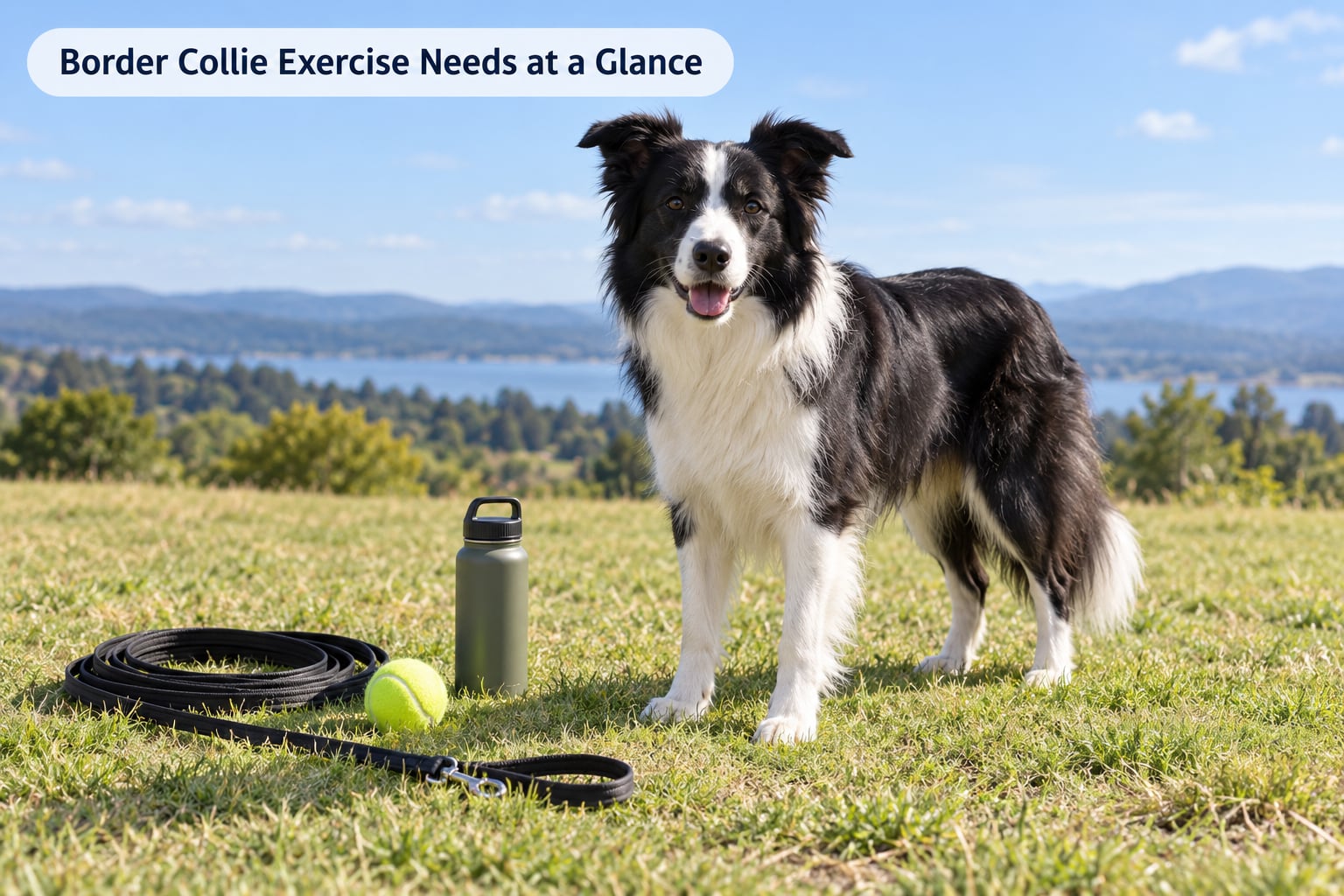
Here is the whole plan on one page. The numbers are starting points, not quotas, and the column on the right is where you adjust for your own dog.
| Life stage | Daily physical activity | Sessions | Mental work | Adjust by |
|---|---|---|---|---|
| Puppy, 8 to 16 weeks | Short walks on soft ground, plus play in a small area | 3 to 5, very brief | Name play, short training sits, chew and puzzle work | Growth plates, so no jumping or stairs |
| Adolescent, 4 to 12 months | 60 to 90 minutes of walking and gentle play | 3 to 4 | Recall, impulse control, scent games, 10 to 20 minutes daily | Brain says adult, body does not, so cap intensity |
| Adult, 1 to 7 years | 1 to 2 hours, including off-lead running where safe | 2 to 4 | 20 to 30 minutes of training or puzzle work | Home energy, age, weather, fitness level |
| Senior, 8 years and over | 45 to 90 minutes of walking and gentle swimming | 2 to 3 | Scent and food puzzles at an easy pace | Mobility, joint comfort, heat tolerance |
| Recovering from illness or injury | Only what your vet clears | As advised | Puzzle and scent work keeps the brain busy during restriction | Always the vet’s plan, never a breed chart |
A few household adjustments sit on top of that table. If you are out for most of the working day, add a morning and an evening session before and after work and give your dog something to do in between. If you work from home, spread the total into four or five blocks instead of one long block. If you have no garden, plan on-lead exercise and indoor scent work as your default rather than a backup.
How Much Exercise Does a Border Collie Need?
Search results give you wildly different answers, from 90 minutes to three hours. The reason is that they are measuring different things. Ninety minutes usually means total walking. Two hours usually means two hours of everything combined, walking and training. Three hours describes a working dog on a farm, or a fit adult running free several times a day, and it is a real figure for a minority of dogs but a poor default target for a pet.
For a healthy adult Border Collie living at home, one to two hours of combined activity is the honest starting point. I would split that as roughly two-thirds physical and one-third mental in the morning, then repeat in the evening. Owners on breed forums describe the pattern that works best as morning walk, short training session, something to do at midday, and an evening activity, and that rhythm is what this guide builds on.
Why border collie exercise needs vary from dog to dog
Some of that variation is down to line and background. Dogs from working lines often carry more drive than show-line dogs, and a rescue dog’s previous life affects how much they can comfortably take on. Age, joint condition, coat, and whether the dog is overweight all shift the number.
Then there is the honest self-assessment most guides skip. Two hours a day is close to 14 hours a week of active time, and a first-time owner should work that out before adopting rather than after. If your realistic total sits closer to 60 to 90 minutes, an adult Border Collie will still do well with that split well between walking and thinking, just with a calmer home life than the breed is often marketed for.
How to Build a Daily Exercise Routine
Routine matters more than any single big outing. Dogs that get their needs met in the same pattern every day settle faster and stop rehearsing barking at the door, and a predictable schedule is easier for you to keep than a heroic weekend.
A sample day you can copy
Here is a routine that totals about two hours for an adult. The blocks are short on purpose, because the breed’s attention shifts faster than most owners expect.
| Time | Block | Length | What it is |
|---|---|---|---|
| 7:00 | Sniff walk | 30 min | Slow, nose-down walking on the way to school or the office |
| 7:35 | Training | 10 min | Recall, loose-lead work, a settle on a mat |
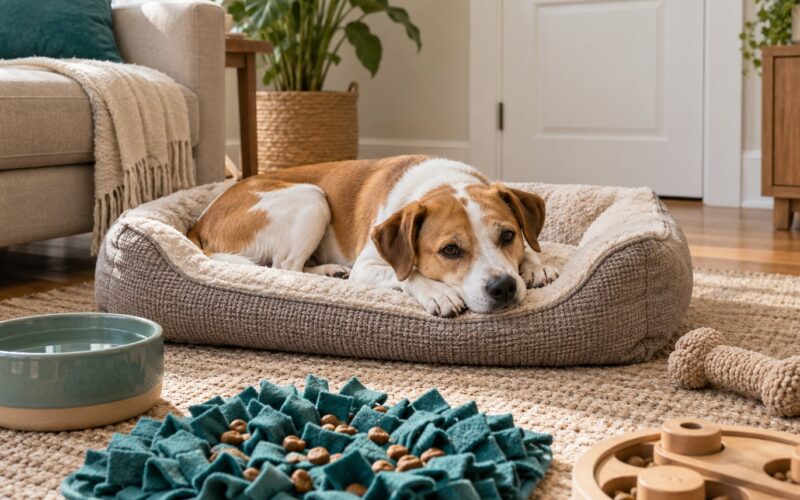
| Midday | Independent task | 20 to 40 min | Puzzle feeder, snuffle mat, scatter feeding or a lick mat |
| 18:00 | Brisk walk or run | 30 to 45 min | The physically harder half of the day’s activity |
| 19:00 | Play and games | 20 min | Fetch, tug, or a short agility session at home |
| 19:30 | Training and settle | 10 min | Two new skills, then a calm finish on the mat |
| Evening | Quiet time | Rest | Dogs sleep 12 to 14 hours a day, and rest is part of the plan |
Three walks a day is the pattern most owners land on, though it is not a rule. Two walks plus a rich training session can work just as well if the training is real training and not a walk in disguise.
If you work a nine-to-five week
Time-poor owners are usually the ones who worry most, and the fix is structure rather than guilt. A dog walker midweek, a longer session at one end and a shorter one at the other, and a reliable midweek independent task usually cover it. Adult Border Collies should not be left alone for seven hours as a default plan, and if yours genuinely has to be, that is a signal to rethink the arrangement rather than to add a bigger evening walk.
Weekends are where the balance usually tips. Two long, hard days and five moderate ones can leave a dog wound up rather than tired, so try to keep the weekend sessions varied instead of simply longer.
What Activities Are Best for Border Collies?
Walking is the baseline, not the answer. The table below compares the activities owners use most, by how much physical demand they place on the dog, how much they ask of the brain, and whether a beginner can run them safely from week one.
| Activity | Physical demand | Mental demand | Good for beginners | Notes |
|---|---|---|---|---|
| Sniff walk | Low | High | Yes | Twenty slow minutes can tire a dog more than a fast hour |
| Brisk walking | Medium | Low | Yes | Supports recall training on a long line |
| Off-lead running | High | Low | Yes, in safe fields | Only where recall is reliable and terrain is safe |
| Fetch | High | Low unless trained | With care | Ball obsession is a real risk; stop before the dog will not release |
| Swimming | Medium | Low | Yes | Low joint impact and good in hot weather; check currents and water quality |
| Hiking | Medium to high | Medium | Yes with limits | Watch paws, altitude and load on descents |
| Agility | High | High | Classes first | Jumping and twisting is a growth-plate risk before 12 months |
| Obedience training | Low | Very high | Yes | The most transferable daily activity the breed offers |
| Scent work and hide and seek | Low | Very high | Yes | Works indoors, in bad weather, and for tired dogs |
| Puzzle feeders | Low | Medium | Yes | Ideal for the hours you are out; start easy and raise difficulty slowly |
If you only add two things in your first month, make them a daily sniff walk and five minutes of proper training. They cover the mental gap that most first-time owners underestimate.
Border Collie Exercise Needs by Age and Life Stage
Puppies, adults and seniors are three different dogs with three different limits, and the single biggest mistake new owners make is treating a ten-month-old as a finished athlete.
From 8 to 16 weeks, keep everything short and low. Growth plates are still open, which means repeated jumping, high stairs and twisting in the air can injure a puppy that looks fully grown at four months. Walks are about socialisation and calm, not distance. Aim for a puppy that settles at home afterwards, and if they collapse on the pavement, you have gone too far for that day.
From 4 to 12 months you get the adolescent phase, which owners consistently call the hardest stretch. The body is close to adult size and the brain is not, so your dog can play happily for an hour and then lose all impulse control the moment a bicycle appears. Keep sessions varied and keep training short and frequent. This is the age where puppy biting, herding children and obsessive chasing tend to appear, and all three improve fastest when you add impulse-control work rather than longer walks.
Adults, from around one year to seven, get the full 1 to 2 hours. Watch weight. A Border Collie carrying a few extra kilos puts noticeably more load on the same joints, and body condition is one of the easiest things to fix without changing the exercise plan.
Seniors need less volume but keep their minds. Two comfortable walks and easy scent or food puzzles will hold a retiring dog’s condition far better than a forced attempt at the routine they had at four.
The five minutes per month rule, explained
The rule of roughly five minutes of exercise per month of age is a conservative starting point for puppy walks, and it is a floor rather than a ceiling for everything else. Owners on puppy forums report the rule leaving them with a puppy that has nothing to do at four months, and that boredom shows up as chewing and nipping long before the growth plates are a problem. Keep walks inside the limit, then add training, chew work and puzzle feeders so the puppy has a full day without overloading the joints.
How Much Mental Work Does a Border Collie Need?
Enough that your dog asks a question and then works on the answer. That is a useful test, because it describes the difference between a walk and a sniff walk, and between a training session and a bowl of food on the floor.
As a rule of thumb for an adult, aim for 20 to 30 minutes of focused mental work a day. A five-minute training session where the dog has to think beats an hour of chasing a ball, because ball chasing builds stamina and little else. The same logic explains the pattern owners complain about most: a dog that is exhausted outside and still buzzing indoors. Muscles tired, brain untouched.
Concrete mental tasks you can use today:
- Five-minute training blocks covering recall, loose-lead walking, a settle on a mat and a calm greeting with visitors.
- Puzzle feeders and snuffle mats for meals, raised in difficulty only as your dog solves them quickly.
- Scatter feeding indoors or in a field, which turns dinner into a searching task.
- Hide and seek with yourself or a toy, a few minutes at a time indoors.
- Scent work using a box of crumpled paper with a treat buried in it, then widening the search.
- Choosing sessions where your dog picks between two toys to walk to, which trains decision-making and impulse control together.
Mental work for the hours you are away
This is where most first-timers under-deliver, because the day’s exercise is not the day’s enrichment. A frozen Kong-type toy, a filled puzzle feeder or a lick mat left before you leave buys you a settled afternoon. Rotate them rather than leaving the same item out, and check any toy you use can hold up to chewing first.
How to Exercise a Border Collie Safely
Most injuries in active dogs come from ordinary things done carelessly: hot pavement, a hard surface under a puppy, or a dog pushed past the point of tiredness.
- Heat. Walk early or late in summer. Place the back of your hand on the pavement for seven seconds; if it is uncomfortable for you, it is too hot for paws. Carry water and offer it every 20 minutes on hot walks.
- Surfaces. Grass and sand are kinder than asphalt. Repeated hard-surface running takes a toll on the back and joints over time, so vary the route rather than running the same paved loop every day.
- Warm-ups. Five to ten minutes of easy walking before anything energetic, especially for adults used to sitting still at home.
- Growth plates. No high jumping, uncontrolled twisting or long high-impact runs before 12 months, and confirm any growth-plate concern with your vet.
- Heat and cold. A thick double coat makes shade vital in summer. In freezing conditions, shorten sessions and watch for shivering, lifting the paws or reluctance to continue.
- Hydration and load. Carrying water on longer walks, avoiding steep descents with an adult or senior, and using a harness that does not restrict the stride all reduce strain.
Stop the session when your dog lags behind, pants hard out of proportion to the pace, sits down repeatedly, or refuses the toy they normally love. That last one matters, because play drive can push a dog past fatigue without them looking tired.
When to call the vet
Book an appointment if you notice limping that lasts more than a day, stiffness after exercise that does not ease with rest, reluctance to jump onto a sofa they used daily, panting that does not settle after a cool-down, or a dog who seems confused. Sudden changes in appetite, thirst, sleep or behaviour also deserve a vet visit rather than an exercise adjustment. Border Collies can develop inherited eye conditions and hip problems, so regular checks are worth the cost and the peace of mind.
Common Exercise Mistakes for First-Time Owners
Five mistakes account for most of the trouble I see in new Border Collie households, and each has a simple correction.
1. Over-exercising to fix behaviour. Owners often add distance hoping a calmer dog will follow, and the result is a fitter dog with more restless energy. Fix the mental side before you lengthen the walks: add training, scent work and impulse control first, then reassess.
2. Relying on walks alone. Two identical walks a day leave most Border Collies short. Swap one walk for a sniff walk and add a training block; you will usually get more settled behaviour from the same number of minutes.
3. Skipping training because the dog is busy. Exercise is not training. Impulse control, recall and an off switch have to be practised deliberately, and they are the three behaviours that decide whether a tired dog can relax in a busy house.
4. Repetitive high-impact activity. Ball chasing on hard ground, endless agility twists and repeated hill sprints are the classic combination for joint problems. Rotate low-impact days, including swimming, into the week.
5. Treating exhaustion as proof of a good day. A dog that cannot settle after the exercise has not had a good day, it has had a stimulating one. Watch the calm hour afterwards, not the tiredness in the moment.
How to Tell If Your Border Collie Is Getting Enough Exercise
The clearest sign is easy: the dog settles. Owners describe a well-exercised Border Collie as willing to train, calm enough to sleep through an afternoon, and mildly interested in the world rather than laser-focused on it.
Look for these signs the balance is right:
- Settles within a reasonable time after exercise instead of pacing or barking.
- Sleeps through the day and eats on a normal schedule.
- Plays enthusiastically with a toy but gives it up when the game ends.
- Greets people calmly and can be interrupted mid-focus.
- Shows appetite for training rather than reluctance or boredom.
Signs of too little exercise show up as redirected behaviour: chewing furniture, barking at the window, chasing cars, herding children or other dogs, and following people room to room. Owners on r/BorderCollie often describe herding the kids as the behaviour they most regret, and the honest answer is that no amount of walking fixes it. Impulse-control training and a settled off switch do more here than a third walk.
A caution about reading behaviour as a fitness signal. Sudden changes in a dog’s energy, appetite or sociability can have medical causes, including pain and thyroid problems, so treat a sudden change as a vet conversation rather than a training one.
Over-stimulation is not the same as over-exercise
Over-exercise is physical tiredness from too much distance or intensity. Over-stimulation is a brain switched on too high to come down, usually after a session full of high-arousal work, a chaotic dog park or a frantic game of chase. The symptoms look similar from the outside: panting, restlessness, jumping, poor sleep.
The fix differs. Over-exercise means cut duration and intensity and add calm sniffing. Over-stimulation means drop the arousal, add calm and quiet, and work on a settle behaviour in boring places until your dog can drop below the noise floor. One expert trainer blog I read put it neatly: the danger is the athlete trap, where more exercise produces a fitter, more restless dog.
Frequently Asked Questions
Are Border Collies good for first time owners?
They can be, but not for everyone. You need a dog who trains easily and lives at your feet for hours, plus one to two hours of daily exercise plus mental work. If you want a low-effort pet or your days are unpredictable, a calmer breed suits you better. Honesty here saves a lot of trouble later.
How much exercise is enough for a Border Collie?
For a healthy adult, one to two hours of combined physical and mental activity a day, split into two to four sessions. Check your dog rather than the clock: a settled dog that eats normally, sleeps well and trains willingly is well exercised. Puppies need far less physical load and much more training and play.
What is the best exercise routine for a Border Collie?
A morning sniff walk, a ten-minute training session, an independent puzzle task around midday, and an evening session combining brisk walking with play and a short training finish. Total about two hours for an adult. The pattern matters more than the exact minutes, because it gives your dog several outlets across the day instead of one long outing.
How many times a day does a Border Collie need to be walked?
Three walks a day is the pattern most owners settle on, and it suits most adult dogs well. Two longer walks plus real training can work just as well, provided something in the day is mentally challenging. What matters is that your dog is not walking the same route at the same pace every single time.
Is a 30 minute walk too long for a puppy?
It can be, especially for a puppy under six months with open growth plates. Use roughly five minutes per month of age as the starting limit for walks, keep the ground soft, and build up gradually. Your puppy also needs more mental work than physical work at that age, so add training and puzzle feeders rather than extending walks.
Can Border Collies be left alone for 7 hours?
Not comfortably, and it is worth reconsidering your plan rather than your dog. Long alone periods lead to barking, chewing and frantic greetings. If it is unavoidable, give a long morning exercise session, a frozen or filled enrichment toy before you leave, a midday walker, and a calm evening routine. Crate training can help if your dog is genuinely comfortable in one.
Where to Start This Week
Day one, walk slowly and let your dog use their nose. Day two, add five minutes of training indoors, two skills at most. Day three, try a puzzle feeder with dinner in it. Day four, add a proper settle on a mat for three minutes and build from there. Day five, take one walk somewhere unfamiliar to work on generalisation. Day six, repeat your favourite session from the week, because repetition is where training actually sticks. Day seven, look at your dog and write down what you saw: settled, restless, tired, or buzzy.
When you increase duration, add about ten percent to the weekly total rather than jumping straight to the adult target. That slow build is what protects joints during growth and gives your dog’s fitness a chance to match your enthusiasm.
Call a vet before you push further if you see limping, stiffness that does not ease, panting that will not settle, or any sudden change in behaviour. Border collie exercise needs are simple to satisfy once you understand the split: less walking than you expected, more thinking than you planned, and the same calm hour afterwards as your proof it worked.