
You have found a cat in your yard, garage or car park, and you want to know whether it is somebody’s lost pet or a cat that has lived outdoors its whole life. The honest answer is that how to tell a stray cat from a feral cat comes down to behaviour, not appearance, and a single glance rarely settles it.
A stray cat is a domestic cat that was lost or abandoned and still remembers people. A feral cat is a domestic cat born outside, or one that has become unsocialised to humans, and it treats a person the way a wild animal treats a person. Watch how the cat behaves around you over several days and the answer usually arrives on its own.
One rule matters more than any other here: do not reach for an unknown cat. Cats that avoid people are not usually dangerous, but they can bite and scratch when cornered, and a frightened cat’s bite is the fastest way to a hospital. Distance, food and time tell you almost as much as touching ever would.
Table of Contents
- How to Tell a Stray Cat From a Feral Cat at a Glance
- What Is the Difference Between a Stray Cat and a Feral Cat?
- Behavior Toward People: The Most Important Clue
- The distance test
- The food test
- The time-of-day test
- The colony test
- The ear-tip and neuter test
- How to Tell a Stray Cat From a Feral Cat Through Body Language
- Appearance and Daily Habits Are Supporting Clues
- Safe Ways to Observe an Unknown Cat
- What You Should Not Assume From One Sign
- Which Should You Choose?
- Frequently Asked Questions
- How do I know if a cat is stray or feral?
- Will a feral cat ever let you pet it?
- How long does it take for a stray cat to become a house cat?
- How long will it take for a feral cat to trust you?
- How long can a stray cat survive outside?
- What not to do with feral cats?
- Conclusion: Start by Watching, Not Guessing
How to Tell a Stray Cat From a Feral Cat at a Glance
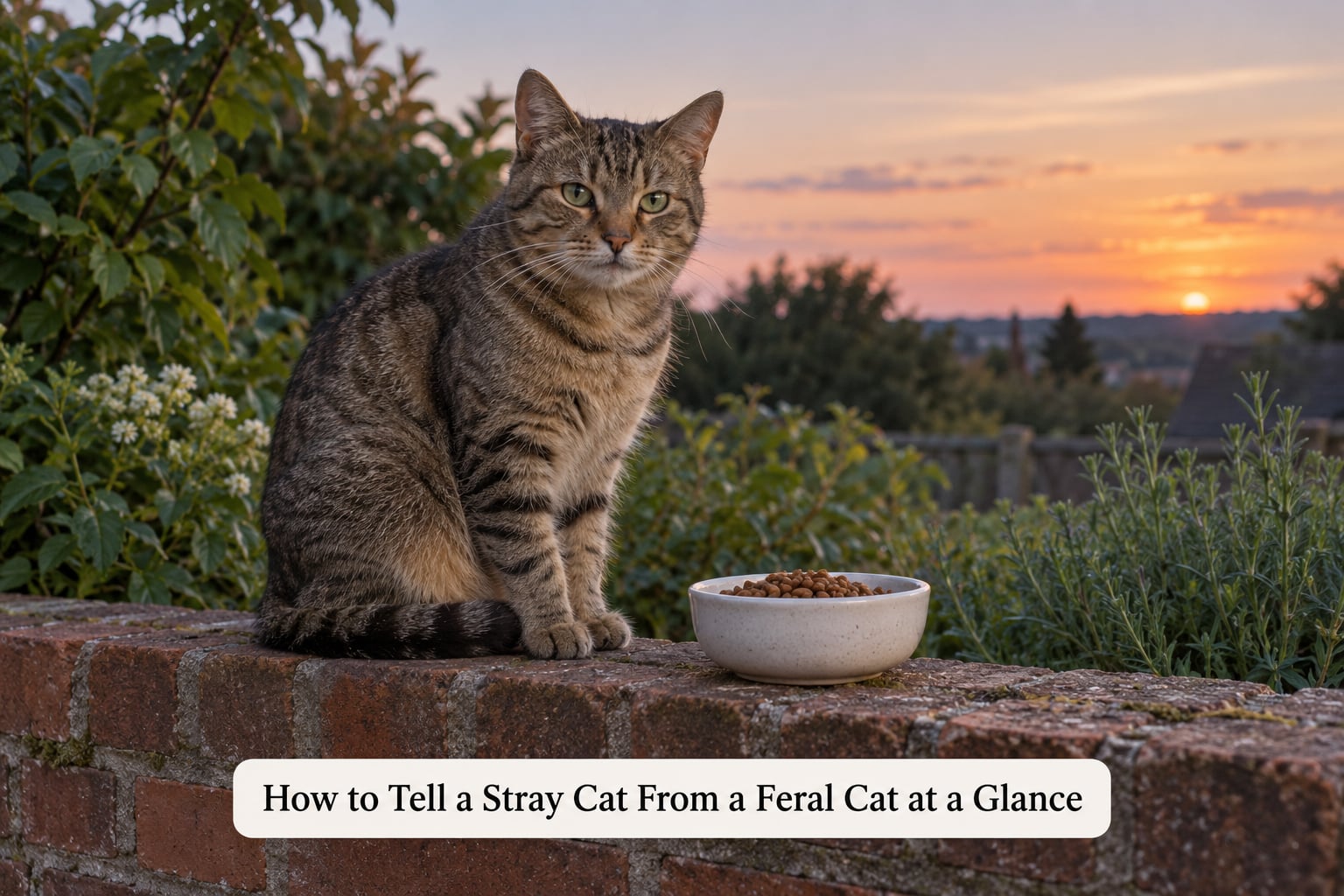
Here is the fast version. If a row below fits the cat you are watching, that is a point in one direction, not a verdict. Experienced rescuers are consistent about this: the line between stray and feral is a spectrum, not a switch.
| Sign | Stray cat | Feral cat |
|---|---|---|
| Origin | Lost or abandoned house cat that once lived indoors | Born outdoors, or reverted after being dumped |
| Reaction to people | Approaches, sits near you, may meow for attention | Keeps distance, bolts, freezes or slinks away |
| Vocalisation | Meows, chirps, talks to you | Mostly silent; hissing, growling or swatting if cornered |
| Body language | Tail held high or relaxed, looks at you directly | Tail low or tucked, crouches, avoids eye contact |
| Activity time | Out and about during the day, following routines | Crepuscular, meaning most active at dawn and dusk |
| Coat and condition | Often scruffy, thin or patchy after weeks lost | Frequently well-groomed and well-fed by a colony |
| Social structure | Often alone, and looking for its own home | Part of a colony with a fixed territory |
| Ear tip or microchip | Collar, ID tag or microchip is plausible | Ear tip means it was neutered and released under TNR |
| Safest response | Scan for a microchip, search for the owner, rehome it if no owner claims it | Contact a TNR group, feed it in place, leave it alone |
What Is the Difference Between a Stray Cat and a Feral Cat?
A stray cat is a domestic cat that lost its way, or was abandoned by people. It is still socialised to humans, which means it expects human contact, even if months of survival on the streets have made it cautious. Alley Cat Allies, the nonprofit that has spent decades on this question, treats stray cats as owned cats who have not yet found their way home.
A feral cat is a domestic cat with no socialisation to people. It was usually born in that state, either to a stray mother or to another feral cat, and it has never had the human contact that would make it comfortable around us. It is not a wild species. Feral cats are domestic cats living a wild lifestyle, and they form organised colonies with territories, social ranks and shared care of kittens.
Two neighbouring categories come up constantly, so it is worth naming them. An outdoor or community cat is a pet that goes outside, or a cat that lives around a neighbourhood with some human contact. A feral-averse cat is the grey area that confuses almost everybody: it is not people-averse, it is simply not interested in people, and it may be a shy stray or a former stray that has learned to keep its distance.
The practical reason the distinction matters comes straight from the outcome. A stray cat needs an owner search, a microchip scan, a vet visit and a home. A feral cat needs a caregiver, a safe feeding station and Trap-Neuter-Return work, not removal. Handing a feral cat to a shelter that expects a cuddly pet ends in euthanasia far too often, and moving a colony without neutering first simply spreads the population.
Behavior Toward People: The Most Important Clue
How the cat handles your presence tells you more than any physical detail. Set food down, sit or stand well back, and watch without moving toward it. Then run five simple tests over a few days.
The distance test
Walk toward the cat slowly and see what it does. A stray usually stops, sits, or turns to face you. A feral cat increases the gap, crouches, or leaves before you get close. If the cat holds its ground with its tail low and its ears flat, back off; that is a stressed cat, not a friendly one.
The food test
Put a shallow bowl down at a normal walking distance from you. A stray cat will often eat where you can watch, or come back for a second meal. A feral cat usually grabs and runs, waits until you have turned away, or will not eat at all while anyone is present. Rescuers make this point constantly: hunger is not the same thing as trust in people.
The time-of-day test
Note what time the cat appears. Strays patrol during daylight hours near houses and bins because that is where the familiar smells and leftovers are. Feral cats are crepuscular, so they concentrate their activity at dawn and dusk and lie up out of the heat or the cold in between. A cat that only appears at 6am and then vanishes for the day is telling you something.
The colony test
Count how many cats come to your bowl, and watch whether they stick together. Feral cats live in groups with clear roles, and adults will bring kittens to a feeding point. A single cat that appears alone, keeps looking back toward the house it came from, and lingers near doors is more likely to be a stray or a lost indoor pet.
The ear-tip and neuter test
Look at the ears from a distance. A straight or angled cut across the tip of one ear, with the corner missing, means the cat was trapped, neutered and released as part of a TNR programme. Healthy neutered males often develop a thick neck jowls, and neutered females may show a small scar on the lower belly, though a coat or a scar is easy to miss without handling the cat. This is the single most reliable physical marker you have.
Two questions settle most cases faster than any other test. Will it let you touch it, even briefly? And does it have an ear tip? If the answer to both is no, treat it as feral until proven otherwise.
How to Tell a Stray Cat From a Feral Cat Through Body Language
Cats tell you how they feel before they open their mouths. Watch what the body does when you are ten feet away, not when you are reaching.
A stray cat typically carries its tail upright or in a loose question-mark curve, the way pet cats do when they greet someone. It will blink slowly at you, which is a friendly signal, and it may rub its cheek on a leg if it is feeling bold. Strays make direct eye contact, or at least do not dodge it.
A feral cat holds its tail low or tucked, moves in a flattened crouch, and keeps its body angled away so it can watch you without presenting its side. It avoids eye contact and drops its head below your eye line. Its ears stay sideways or back rather than forward, and if you do get close it will hiss, growl or swat without much warning.
Watch the ears during feeding. Ears forward or neutral at a bowl means the cat is relaxed around you. Ears pinned flat while eating means the cat is on high alert and one step from bolting, so give it more space rather than less.
Posture after a fright is a useful tell too. A cat that freezes, then slowly creeps away sideways with its tail low, is behaving like a feral cat. A cat that runs a few yards, stops, looks back and meows at you is behaving like a cat that expects you to follow, which is typical of a stray.
Appearance and Daily Habits Are Supporting Clues
Coat condition gets more weight than it deserves. People often assume a thin, disheveled cat is a stray, and a sleek, well-groomed cat is feral. The reality is the opposite in many cases. A cat with a thick, even coat and a healthy weight is usually getting fed, and regular feeding is what colony management produces. A scruffy cat with patchy fur and a thin frame may simply be a lost house cat trying to survive.
Grooming habits also cross over. Cats groom for comfort as well as cleanliness, so a stressed cat may over-groom and leave bald patches, while a healthy feral cat keeps its coat in good order through grooming with its colony.
Daily habits round out the picture. Feral cats hunt, and you may see remains near the wall line. Strays scavenge more, turning over bins and checking porches, because they learned food from people rather than from hunting. Vocalisation matters too: meowing is something cats learn from humans, so a cat that meows at you is a strong stray signal.
The rule is simple. Use appearance and habits to support a behavioural read, never to replace one. Two well-fed cats eating in the same spot at dusk, one with an ear tip, tell you far more than either coat could.
Safe Ways to Observe an Unknown Cat
Here is a nonconfrontational process that works for either outcome.
Observe from a distance first. Sit on your porch or stand by a window and watch for three to five days. Note the time of day it appears, whether it comes alone, whether it uses a regular route, and whether it seems wary of other animals as much as of people.
Provide food in a controlled area. Use a plain bowl, place it at the same spot each time, and sit well back so the cat is never cornered between you and an escape route. Let the cat set the pace; your presence should stay neutral and unthreatening.
Check from a distance for identifiers. A collar with a tag, a clipped ear tip, or a visible scar can all be seen without touching the cat. Avoid trying to read a collar tag on a cat that is not used to being handled, and never reach for a collar that snags under a paw.
Watch for repeated behaviour rather than a single moment. One incident means nothing. A pattern over several days, at the same hour, with the same reaction to your presence, is what makes a diagnosis reliable.
Never trap or corner a cat on your own. If a trapped cat is needed for TNR work, experienced volunteers and local animal control can do it properly. If a cat is injured, bleeding, limping or has an eye problem, contact a veterinarian or an animal control service immediately rather than trying to move it.
What You Should Not Assume From One Sign
A ragged coat does not mean feral. Months of exposure, weather and poor nutrition do that to a lost house cat, and a feral cat in a well-run colony usually looks better than the stray you are worried about.
Friendliness does not prove ownership. Plenty of feral cats will eat beside you, tolerate a scratch behind the ears, or follow you for food. Food-motivated cats behave like strays for the length of the meal and then treat you as a threat again.
Avoiding people does not mean dangerous or untouchable. Many shy strays and former strays are simply cautious. They need space and time, not euthanasia. Conversely, a cat that walks straight at you is not automatically tame; that is what a hungry street cat does.
Kittens are the biggest category of mistake. A kitten born inside is a house cat and belongs in a home. A kitten born outside needs rescuing properly, and the single largest mistake is pulling kittens away from a feral mother too early. Rescue forums repeat the same advice: leave the family alone for several hours, confirm the mother is returning, and only intervene when she is genuinely not coming back.
Never bottle-feed a feral adult cat. It is close to impossible to socialise at that stage, and hand-rearing an adult almost always ends with a stressed cat and, frequently, a bite.
Which Should You Choose?
If your reading is stray, the path is short and concrete. Have a vet or a shelter scan for a microchip on day one; a chip that registers means the owner can usually be traced within hours. At the same time, put flyers on neighbours’ doors and post to local lost pet groups. Keep the cat in one quiet room with water, a litter tray and a covered sleeping spot, separate from your own pets. If nobody claims it within about two weeks, most rescuers say that is when you should start looking at rehoming rather than waiting for an owner who never came.
If your reading is feral, your job is different. Do not try to catch it. Contact a local TNR group or animal control, and if none exists nearby, your county or city animal services can usually direct you. In the meantime, set up a fixed feeding station away from your door, add a weatherproof shelter with dry bedding, and commit to feeding that cat for the rest of its life. A colony without a caregiver eventually spreads.
Two explanations come up here constantly. The 3-3-3 rule says it takes three days for a cat to settle in a new space, three weeks for it to start normal behaviour, and three months for it to feel at home. Rescue groups now use it as a realistic expectation setter rather than a promise. And experienced rescuers repeatedly note that neutering changes more than you would expect: cats described as impossible often become noticeably friendlier afterwards, because the hormonal drive behind a lot of that behaviour is gone.
If the cat already has an ear tip, it has been handled well by someone. Your job is to keep the food coming and let it live where it lives. If it is an adult unhandled feral with no ear tip, the realistic plan is neutering and return, not adoption.
Frequently Asked Questions
How do I know if a cat is stray or feral?
Watch behaviour over several days, not one moment. A stray cat usually approaches, sits near people, meows, holds its tail up and will sometimes eat where you can watch. A feral cat keeps its distance, avoids eye contact, holds its tail low, is mostly silent and grabs food to go. Check for an ear tip, which marks a neutered and released TNR cat, and never reach for an unknown cat.
Will a feral cat ever let you pet it?
Some do, and more do after neutering, but it takes patience measured in months or years. Foraging for hand-feeding, sitting near you while you read, and finally tolerating a brush are the stages rescuers watch for. Many truly feral cats never reach the petting stage and that is a normal, acceptable outcome. Progress can be lost in about five days if you push handling too early.
How long does it take for a stray cat to become a house cat?
For a cat that had good indoor experience, the 3-3-3 rule is the useful guide: three days to settle, three weeks to start behaving normally, and three months to feel at home. Older strays that have been outside for months often need a locked safe room first, with litter, food and hiding places, until they stop eating in the carrier. Cats that spent a year or more outside can take considerably longer.
How long will it take for a feral cat to trust you?
Weeks for the first stage, months for the real ones, and sometimes years. Start by putting food out and sitting quietly at a distance, then move a few inches closer every few days. Wins look like eating in your presence, resting near you, or accepting a scratch while eating. Forum accounts of formerly feral cats becoming lap cats after neutering and patient confinement are common.
How long can a stray cat survive outside?
In mild weather, a healthy adult cat usually manages for weeks to months, hunting rodents and scraps and finding shelter. Kittens, elderly cats and cats in a hard winter have a much worse time, which is when identification matters most. Vehicle strikes, disease and exposure kill many before starvation does. An adult stray found thin and cold needs a vet, not more time outside.
What not to do with feral cats?
Do not put your hands on one, corner it, or try to trap it alone. Do not relocate a colony without neutering first, since that spreads breeding rather than solving it. Do not bottle-feed an adult feral cat, and do not take kittens from a feral mother before confirming she is not returning. Do not stop feeding once you start, because a colony without a caregiver disperses.
Conclusion: Start by Watching, Not Guessing
The first move is never to pick the cat up. Keep your distance, note the same cat’s behaviour at the same hours for several days, and let the tests do the work: does it approach, does it meow, does it eat while watched, does it travel with others, does it have an ear tip. If the answers point to a stray, get that microchip scanned and start the owner search. If they point to a feral cat, contact a TNR group, feed it in the same place every day, and leave it to live there.
And if the cat is injured, ill, aggressive or in immediate danger, stop observing and call a veterinarian, a reputable rescue or animal control today.