To stop algae growth in a fish tank, cut the light to 8 to 10 hours a day on a timer, feed less and remove uneaten food, and keep nitrate at 20-40 ppm with phosphate below 0.1 ppm through regular water changes. Algae is not a disease. It is a plant that grows when light, dissolved nutrients and still water line up, so taking away any one of those three slows it down fast. Most algae clears in 2 to 4 weeks once the cause is fixed.
- Algae needs light, nutrients and calm water. Remove one and growth stalls.
- Run the light 8 to 10 hours daily on a timer, and never near a sunny window.
- Change 10-15% of the water weekly, or 10% daily during an active bloom.
- Aim for nitrate 20-40 ppm and phosphate under 0.05-0.1 ppm.
- Do not deep-clean the filter during an outbreak. It kills the bacteria that keep the tank stable.
Everything below takes an afternoon to start and costs very little. You are adjusting conditions, not adding a chemical that clears the glass for a week and returns.
Table of Contents
- What You Need
- Step-by-Step: How to Stop Algae Growth in a Fish Tank Safely
- 1. Test the Water and Identify the Main Cause
- 2. Reduce Excess Nutrients Without Harming Fish
- 3. Control the Aquarium Light
- 4. Remove Existing Algae and Clean the Tank
- 5. Improve Circulation and Keep Up with Maintenance
- 6. Monitor the Tank and Prevent Algae Returning
- Common Mistakes
- Frequently Asked Questions
- Is algae in a fish tank bad for the fish?
- How long does it take to stop algae growth in a fish tank?
- Do algae-eating fish solve an algae problem?
- Should I remove all algae from my fish tank?
- Why does algae keep coming back after cleaning the tank?
- Can I use bleach or household cleaners to remove aquarium algae?
- Conclusion
What You Need
You can stop an algae problem with a short list of ordinary gear. Most people already own half of it.
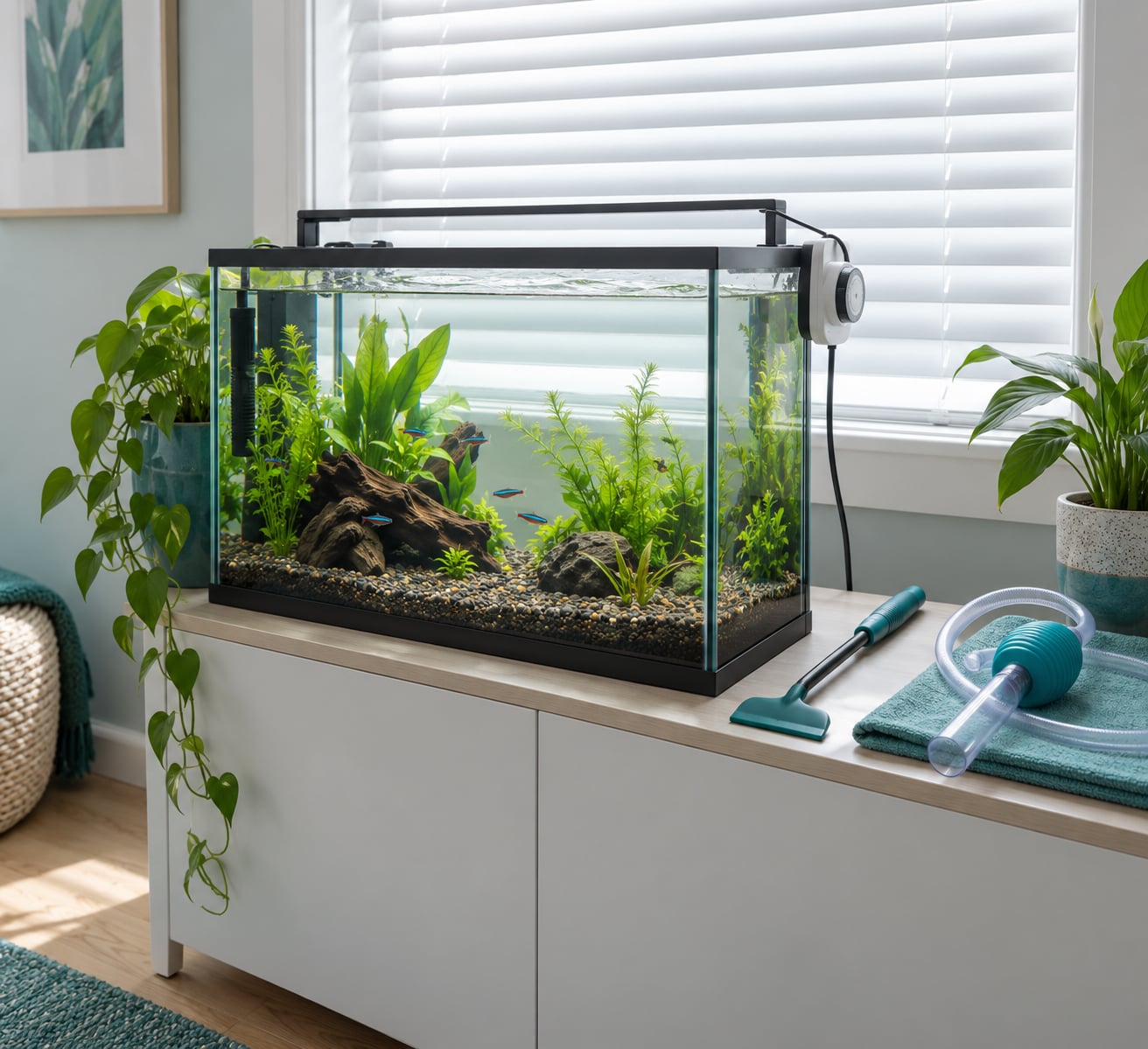
- Algae scraper or magnetic cleaner for glass and hard décor. A soft sponge or algae pad handles cloudy film and delicate plants.
- A dedicated 5-gallon bucket that never touches chemicals, soap or the lawn. Label it. I have seen people siphon a bucket that held wood stain and wondered why the fish died.
- Gravel vacuum or siphon to pull waste and uneaten food out of the substrate.
- Water conditioner and dechlorinator for every drop of new water you add.
- Liquid test kit that covers nitrate, phosphate, ammonia and nitrite. Test strips are fine for trend-watching, but strips miss the low end of the phosphate scale, which is exactly where you need accuracy.
- Light timer so the photoperiod stays consistent on weekends and holidays.
- Microfiber cloths or nitrile gloves for wiping glass and handling décor.
Optional but useful: a phosphate remover such as a carbon-phosorb media, a diatom filter that polishes fine green water particles, and a UV sterilizer for stubborn floating blooms. Skip all three until the basic three causes are handled.
Step-by-Step: How to Stop Algae Growth in a Fish Tank Safely
1. Test the Water and Identify the Main Cause
Start with a water test, because every fix after this one depends on it. Nitrates above 40 ppm, phosphates above 0.1 ppm or any detectable ammonia all point to a nutrient surplus or a bioload problem, not an algae species. A green tank that looks filthy usually has at least one of the three problems.
Nitrates are the end product of the nitrogen cycle, so some nitrate is normal and even useful. Phosphate is the one most aquarists ignore. Experienced planted-tank keepers frequently blame hair algae on excess phosphate and fix it by pausing fertilizer entirely, which is usually the cheapest and fastest correction.
Light and water movement are the other two causes. An aquarium beside a window gets several extra hours of free light every day, and stagnant corners behind large rocks collect algae that a filter never reaches. A brand new LED bar can also trigger a bloom out of nowhere, because brighter or broader-spectrum output means more usable light for plants and algae both.
Name what you are dealing with before you treat it:
| Type | Main cause | Where it appears | How to treat it | Time to clear |
|---|---|---|---|---|
| Hair algae | Excess nutrients, especially phosphate | Soft growth on glass, rocks, plants, filter intake | Lower nutrients, cut light, remove by hand, scrub | 3 to 6 weeks |
| Green spot algae | Heavy feeding, low grazing, lots of light | Round spots on glass and slow-growing leaves | Cut light, feed less, water changes | 2 to 4 weeks |
| Brown diatom algae | Silica in new-tank water; usually harmless | Golden-brown film on glass, gravel and décor | Scrub it off; it fades on its own as the tank matures | 4 to 8 weeks, often with no help |
| Beard algae | Hard to reach, slow growth, old wood | Fuzzy red-brown tufts on wood, plants and hardscape | Spot-treat with a bleach dip off-tank, trim affected leaves | 6 to 12 weeks |
| Green water | Single-celled algae bloom, light plus nutrients | Whole tank goes cloudy, fish hard to see | Light blackout for 3 days or a UV sterilizer, plus water changes | 3 to 7 days |
| Cyanobacteria | Not an algae at all, a bacterium | Peeling blue-green mats, floating sheets, musty smell | Cut light and feed, manual removal, antibac only as a last resort | Weeks, and it returns without changes |
One test tells you whether you are looking at algae or cyanobacteria: algae sticks to glass, wood and leaves, while cyanobacteria forms loose sheets and mats that float and peel off. If the film leaves a clean line where you scrape it, that is algae.
A bloom can also be a warning that the nitrogen cycle is unstable. When ammonia or nitrite shows up in a test, the biofilter is not keeping up with the bioload, and the tank will fight algae and toxic waste at the same time. Overstocking is the usual culprit there.
2. Reduce Excess Nutrients Without Harming Fish
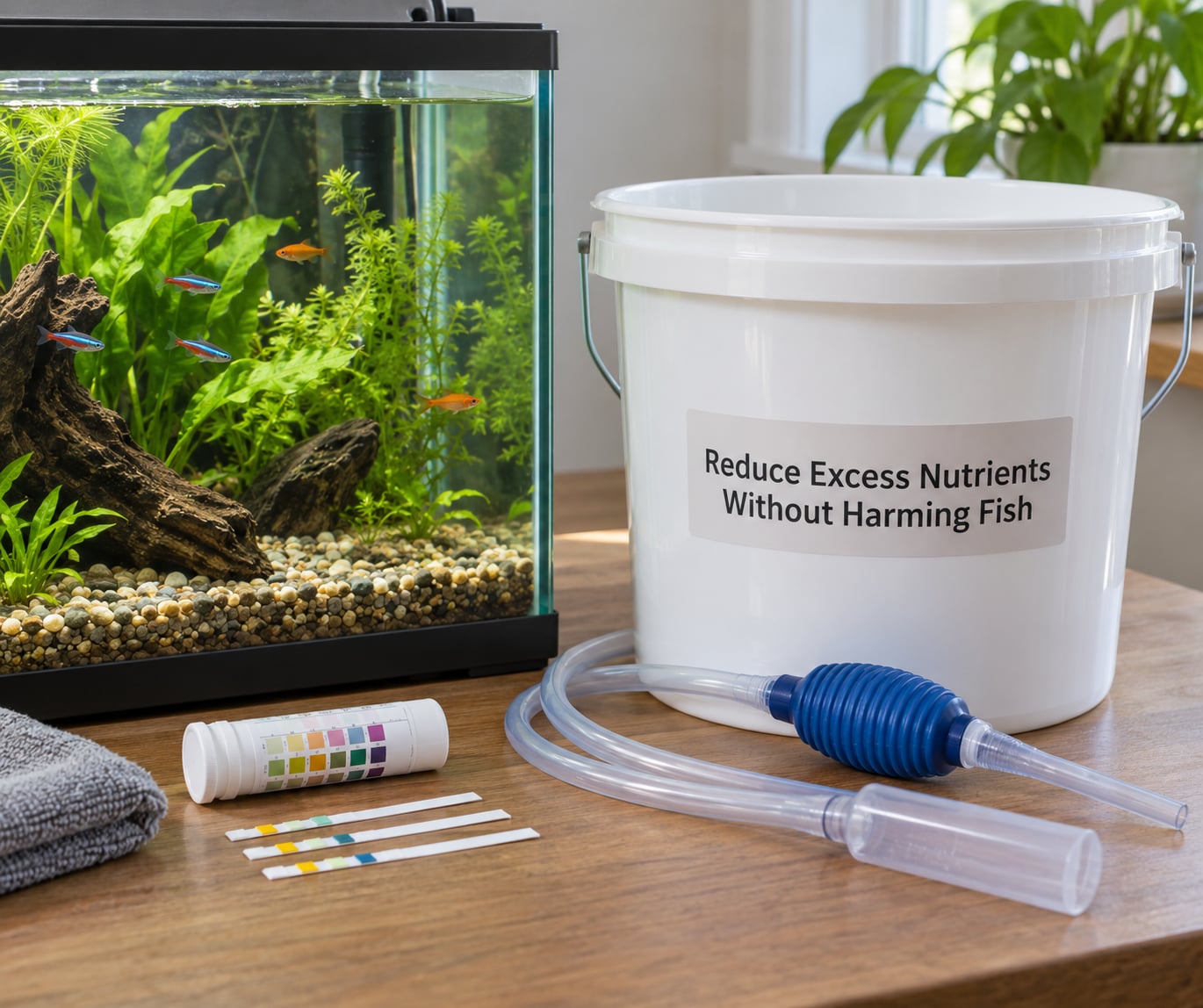
Nutrients enter a tank through food, tap water and fish waste, so you reduce them at the source and dilute what is already there. Changing 10-15% of the water weekly keeps a mature tank in balance, and changing 10% a day clears a bad bloom faster without shocking anything.
Never change more than about 20% at once, and match the temperature. A sudden large swap swings temperature, pH and the osmotic balance your fish are adapted to, and a stressed fish produces more waste, which feeds more algae.
Feed less. Give each fish what it eats in about two minutes, use a five-minute rule as a ceiling, and siphon out anything that hits the bottom. A pinch of food missed on the gravel every day turns into a nutrient load that water changes alone cannot chase.
If phosphate is genuinely high, add a phosphate-removing media bag in the filter and replace it on schedule, since it stops working once it is full. Pause liquid fertilizer in a planted tank at the same time, since fertilizing harder during a bloom is like arguing with yourself.
3. Control the Aquarium Light
Set the light to 8 to 10 hours a day and let the timer handle it. Algae photosynthesises whenever the light is on, while plants and fish do fine on a shorter, predictable day. Constant or 14-hour lighting is the single most common reason algae keeps winning.
Watch for free light. A tank near a window, behind glass, or under a lamp that stays on overnight is effectively on 14 hours without anyone noticing. Close the blinds, move the tank, or hang a simple shade.
Yes, LED lights cause algae growth if you leave them on too long. Brighter, multi-spectrum bars support plant growth, and algae uses the same spectrum, so a new light does not create a problem on its own but often tips an already balanced tank over the edge. If you upgraded your lighting and the algae appeared two weeks later, that is the cause.
Keep the light off for the first hour after turning it on and for the last hour before turning it off. That simple habit shortens the effective day without any new equipment.
4. Remove Existing Algae and Clean the Tank
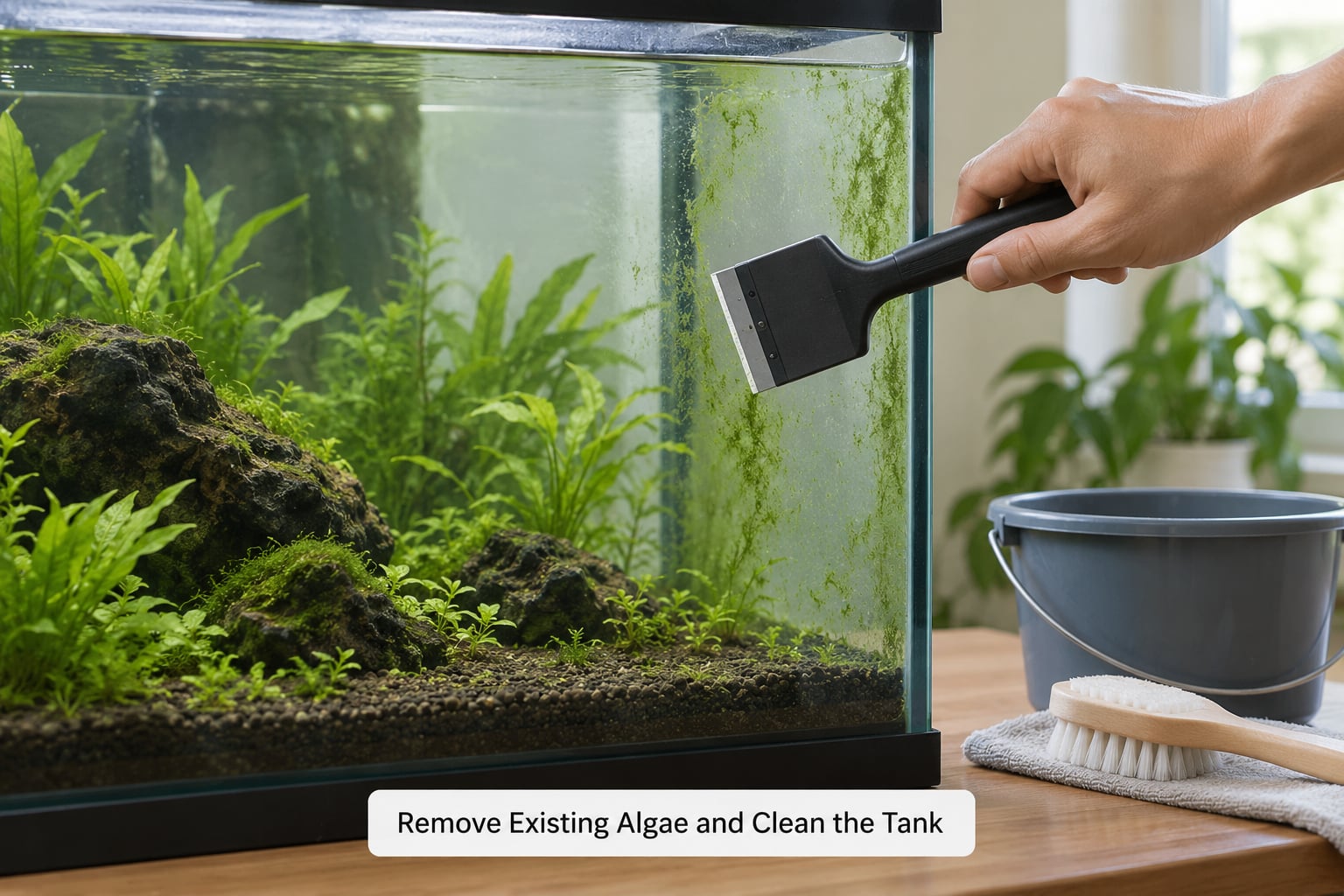
Manual removal does not fix algae, but it removes the growth you can see so the remaining population has less to work with. Squeegee the glass, wipe décor, and vacuum the substrate where algae sits on rocks and plant bases.
Pull hardscape and trim affected plant leaves out of the tank for cleaning. A diluted bleach dip kills beard algae hiding in the pores of wood, and doing it away from the water keeps residue from returning. Never put bleach, soap, vinegar or spray cleaner into a stocked aquarium. Some of these kill fish outright and all of them kill the biofilter.
When you touch the filter, rinse the media in removed tank water rather than replacing the cartridge. Deep-cleaning a filter or swapping media mid-outbreak strips the beneficial bacteria, the nitrate reading spikes, and the algae gets an easier environment. Many people trigger a worse bloom by cleaning too well.
5. Improve Circulation and Keep Up with Maintenance
Algae settles where water does not move. Aim the filter outlet across the tank or add an inexpensive power pump in long tanks so surface, corners and the substrate all get some flow. Gentle circulation helps; a violent current does not, and it stresses fish into producing more waste.
Hold the routine that keeps the tank stable: a water change every week, a glass wipe, a substrate vacuum and a filter rinse in old tank water, all on the same schedule. Consistency matters more than intensity, because spikes in nutrients are what algae feeds on.
Stocking plays a part too. Fish that were fine in a 20-gallon when they were juveniles can overload the filter as adults. Watch surface breathing, since heavy gasping in the morning often means the bioload is past what the filter can process.
6. Monitor the Tank and Prevent Algae Returning
Stopping algae growth in a fish tank is a weeks-long process, not an overnight one, because the tank has to grow back into balance. Know roughly what you are waiting for:
| Problem | What improvement looks like | Realistic timeline |
|---|---|---|
| Green water bloom | Water clears enough to see the back glass, then fully clears | 3 to 7 days after a blackout or UV run |
| Surface film or green dust | New glass stays clear between wipes | 1 to 3 weeks |
| Hair algae | Growth slows, then new growth stops | 3 to 6 weeks |
| Green spot algae | Fewer spots appear on clean glass | 2 to 4 weeks |
| Diatoms in a new tank | Brown film thins without intervention | 4 to 8 weeks as the tank matures |
| Beard algae | Tufts stop spreading, then existing tufts shrink | 6 to 12 weeks |
| Bacterial clouding after a bloom dies off | Water clears as particles settle or the filter catches them | 2 to 5 days |
If algae is still spreading after a month of changes and lower nutrients, one of three things is off: light is still reaching the tank longer than you think, the tap water is bringing in phosphate, or the tank is overstocked for its filter. Test the tap water in a bucket, watch the tank for one full day with the blinds closed, and count your fish against your filter’s rated capacity.
A simple weekly checklist prevents most of this:
- Test nitrate, and phosphate every couple of weeks.
- Change 10-15% of the water and condition the new water.
- Wipe the glass and vacuum the substrate.
- Feed small amounts and remove anything uneaten after five minutes.
- Check the filter intake and rinse the media in removed tank water.
- Confirm the light timer is still on the same schedule.
If the water goes cloudy white or green during a bloom die-off, keep the filter running hard and test ammonia and nitrite daily for a few days. Losing that algae mass means the tank briefly has less biological surface to process waste, and that is the one window where a cycle crash happens.
Common Mistakes
Most algae attempts fail for the same handful of reasons. Each one feels productive and makes the tank worse.
- Deep-cleaning the filter during an outbreak. It wipes out the biofilter and spikes nitrate, feeding the algae you are fighting. Rinse media in old tank water instead.
- Overfeeding. Uneaten food breaks down into nitrate and phosphate, which is the entire diet of hair algae. Feed what gets eaten in two minutes.
- Using bleach, soap or household cleaners in the tank. These kill fish and destroy the nitrogen cycle. Use bleach only on décor removed from the tank, then rinse thoroughly.
- Treating algaecide as the first move. It knocks back visible algae without touching light or nutrients, and many products trouble fish and plants. Correct the causes first.
- Expecting algae-eaters to solve it. They nibble. Fish and snails cannot out-eat an unbalanced tank, and an overpopulation of snails is its own problem.
- Keeping the tank dark permanently. A blackout of three days is a useful emergency tool. Permanently dark water damages live plants, blocks normal fish behaviour, and fixes nothing about nitrate or phosphate.
- Changing most of the water at once. Large swings stress fish, which produce more waste, and the bloom comes straight back.
- Chasing clarity with clarifier. Clarifiers only clump suspended particles together. Dissolved nutrients that feed algae stay in the water.
On algae eaters specifically: Siamese algae eaters do real work on hair algae but need a group of five or six and can turn territorial as adults. Otocinclus tackle hair algae but are fragile and want a group too. Bristlenose plecos are better than common plecos, which grow large and chew plant leaves. Nerite snails are useful and cannot reproduce in most freshwater tanks, though they struggle in very soft water. Amino shrimp clean surfaces gently but never touch beard algae. Treat all of them as cleanup crew, not as the plan.
For a fish health question beyond algae, talk to a veterinarian experienced with aquatic animals rather than working from a forum thread.
Frequently Asked Questions
Is algae in a fish tank bad for the fish?
Not directly. Small amounts of algae are normal and even helpful, since they absorb nitrates and give fish something to graze on. Problems start when algae dies off, when it clogs filter intakes, or when it raises oxygen demand at night. Heavy oxygen use is why fish can gasp at the surface after lights-out during a bloom. Watch for that, not for the green color.
How long does it take to stop algae growth in a fish tank?
Plan on 2 to 4 weeks for most green spot and hair algae once light, food and nutrients are corrected. A green water bloom can clear in 3 to 7 days with a short light blackout or a UV sterilizer, while beard algae on wood often takes 6 to 12 weeks. Brown diatom algae in a new tank fades on its own in 4 to 8 weeks and rarely needs treatment.
Do algae-eating fish solve an algae problem?
No. Siamese algae eaters, otocinclus, bristlenose plecos and nerite snails reduce small amounts of algae, but none can control an unbalanced tank on their own. They also need correct group sizes, and otocinclus are sensitive enough that they can die in a new or unstable tank. Fix light, feeding and nutrients first, then add cleanup crew if the tank supports them.
Should I remove all algae from my fish tank?
You can and should remove what is visible, using a scraper, sponge and gravel vacuum, because algae still present keeps multiplying. But do not aim for a sterile tank. The remaining algae supports beneficial bacteria, and live plants should occupy the space so they compete with algae for nutrients instead of leaving bare glass for it to settle on.
Why does algae keep coming back after cleaning the tank?
Because cleaning removes what is growing without removing the cause. Algae returns in days when the tank still gets more than 8 to 10 hours of light, still has phosphate above 0.1 ppm, or still receives food that sinks to the substrate. Test the water instead of cleaning harder, and check whether a window, a new light or extra fertilizer has quietly changed the balance.
Can I use bleach or household cleaners to remove aquarium algae?
Never in a stocked tank. Bleach, soap, ammonia cleaners and vinegar sprays kill fish, burn gills and destroy the beneficial bacteria that process ammonia. A weak bleach dip is only safe on décor and wood removed from the tank, rinsed thoroughly, and never near livestock. The fix for algae on surfaces is light, nutrient and water discipline, not chemicals.
Conclusion
Start with a water test this week, then change one thing at a time. Cut the light to 8 or 10 hours on a timer, move the tank away from any window, feed smaller amounts and remove leftovers, and make a 10-15% water change with conditioned water. Scrape the glass and vacuum the substrate while you are in there, and leave the filter media alone.
Give it two to four weeks and re-test. If the glass stays clear between wipes and the nitrate and phosphate numbers sit in range, the balance has held and keeping the weekly routine will stop the algae from coming back.