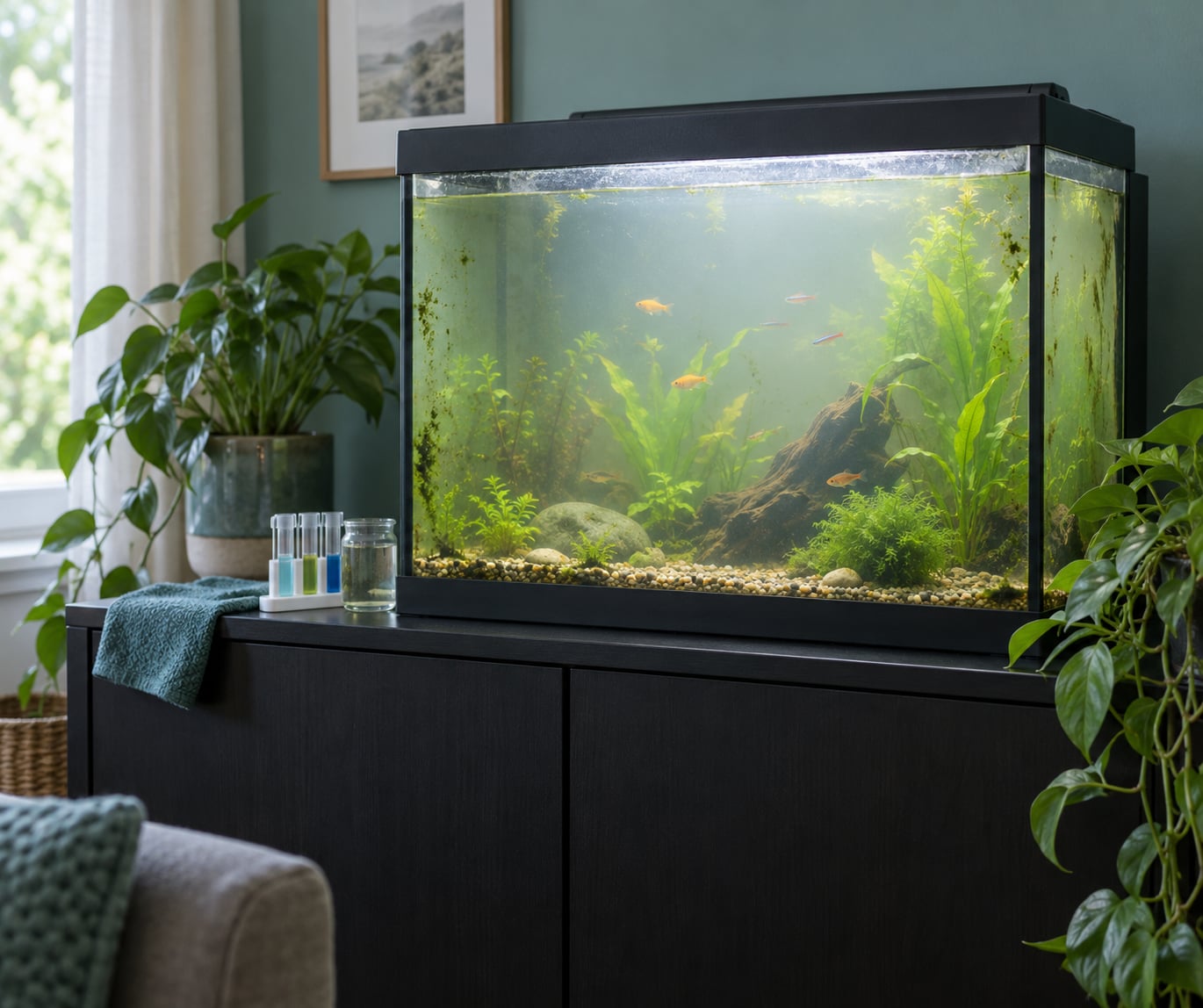
If you are asking why is my aquarium water cloudy, the honest answer is that it is nearly always one of four things: a bloom of beneficial bacteria, fine particles stirred up from the substrate, decaying food and organic waste, or a bloom of microscopic algae. In three of those four cases the water clears on its own once the cause is handled. The single most useful thing you can do is identify which one you have before you touch anything.
Here is the honest version most guides skip. Cloudiness is a symptom, not a diagnosis, and the color of the water plus what happened in the last two weeks tells you more than any product ever will. A tank that went cloudy the day you replaced the filter sponge and a tank that went cloudy because someone dumped a week’s worth of food in it look identical and need opposite treatment.
I break this down the way I would for a friend standing in front of their tank at midnight: what to look at, what to test, what to stop doing, and how long to wait before worrying. If the water is only hazy and the fish are behaving normally, you are probably in a much better spot than you think.
Table of Contents
- Why Is My Aquarium Water Cloudy? Common Causes by Color and Timing
- Why Is My Aquarium Water Cloudy? How to Tell Each Cause Apart
- Milky white water with a swampy smell
- White haze with clean test results and no smell
- Green water
- Yellow-brown or gray water
- Slime or film on the surface
- The harmless haze versus a real imbalance
- How to Test Your Water Before You Change It
- How to Clear Cloudy Water Without Resetting the Tank
- How Long Does Cloudy Aquarium Water Take to Clear?
- Is Cloudy Water Safe for Fish? When to Act Quickly
- Frequently Asked Questions
- Does cloudy aquarium water mean there are harmful bacteria?
- Should I use a water clarifier to make my aquarium clear?
- Can I clean a cloudy aquarium filter right away?
- Is it safe to add fish while the water is still cloudy?
- Why did my aquarium become cloudy after a water change?
- Does a cloudy aquarium need a complete water change?
- Conclusion: Start With the Cause, Not a Water Clarifier
Why Is My Aquarium Water Cloudy? Common Causes by Color and Timing
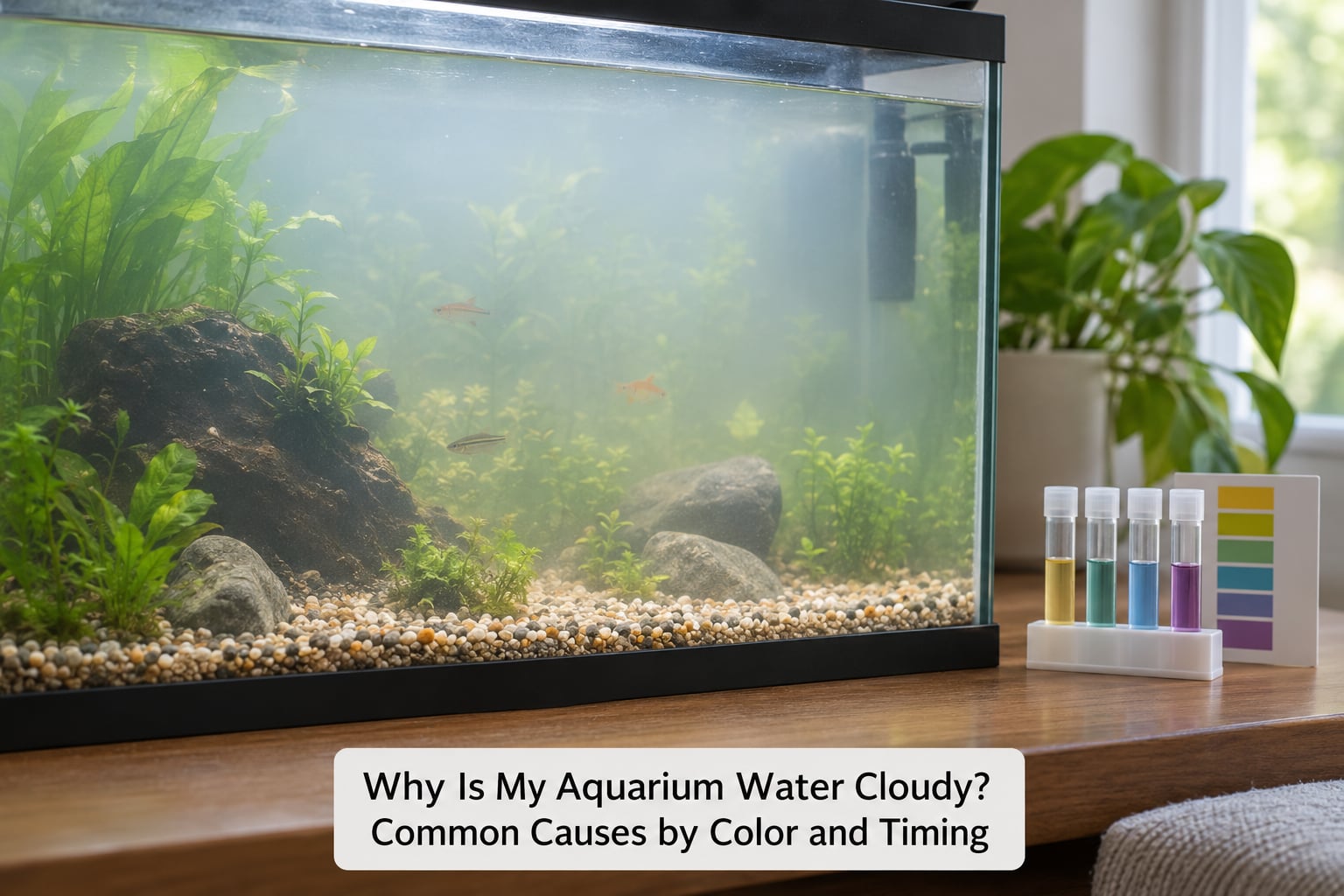
Before any cause-by-color breakdown, here are the four real causes in the order I check them. Each one has a mechanism and a realistic time to clear, which is the part that actually answers “why.”
Bacterial bloom. Your filter houses nitrifying bacteria that process fish waste. When the colony is smaller than the waste being produced, the population multiplies faster than the filter can trap it, and millions of free-floating bacteria scatter light. The water goes milky white, smells faintly like a swamp or a wet dog, and clears once the colony catches up.
Unwashed substrate. New gravel, soil or sand releases a storm of fine dust that hangs in the water column for a day or two. This one is entirely physical, it settles on its own, and no biological explanation is needed. Almost always gone within 24 to 48 hours.
Decaying food and organic waste. Overfeeding or uneaten flake produces ammonia faster than the cycle handles it. Partially digested organic matter also feeds bacteria and algae directly, so this cause usually drags a green tint behind it within a week.
Algae bloom. Green water means photosynthetic algae have hit a growth window, usually after a lighting change, longer photoperiod, or a nutrient spike. There is also a red or rust-colored variant in marine and brackish tanks caused by dinoflagellates, which behaves quite differently from freshwater green water.
Timing narrows it down fast. Cloudy the day the tank was filled points to substrate dust or a brand-new cycle. Cloudy within a week of a filter service points to a lost bacteria colony. Cloudy that arrives gradually, weeks into an established tank, usually means the feeding or cleaning routine changed without you noticing.
| What the water looks like | Most likely cause | Do this first | Typical time to clear |
|---|---|---|---|
| Milky white, uniform, no particles visible | Bacterial bloom | Test parameters, then leave it alone | 3 to 10 days |
| White haze right after filling or adding gravel | Substrate dust | Do nothing, avoid siphoning the bed | 24 to 48 hours |
| Cloudy with visible specks, brown patches on the glass | Decaying food and organics | Cut feeding, remove debris | 3 to 7 days |
| Green throughout, glass and decor tinted | Algae bloom | Cut light hours and feeding | 5 to 14 days |
| Rust or red-brown tint in marine or brackish water | Dinoflagellate bloom | Keep fish dark, remove manual filtration | 2 to 4 weeks |
| Thin film only on the surface, water clear below | Surface biofilm or oily organics | Skim or wipe the film, check for oily foods | 1 to 3 days |
Why Is My Aquarium Water Cloudy? How to Tell Each Cause Apart
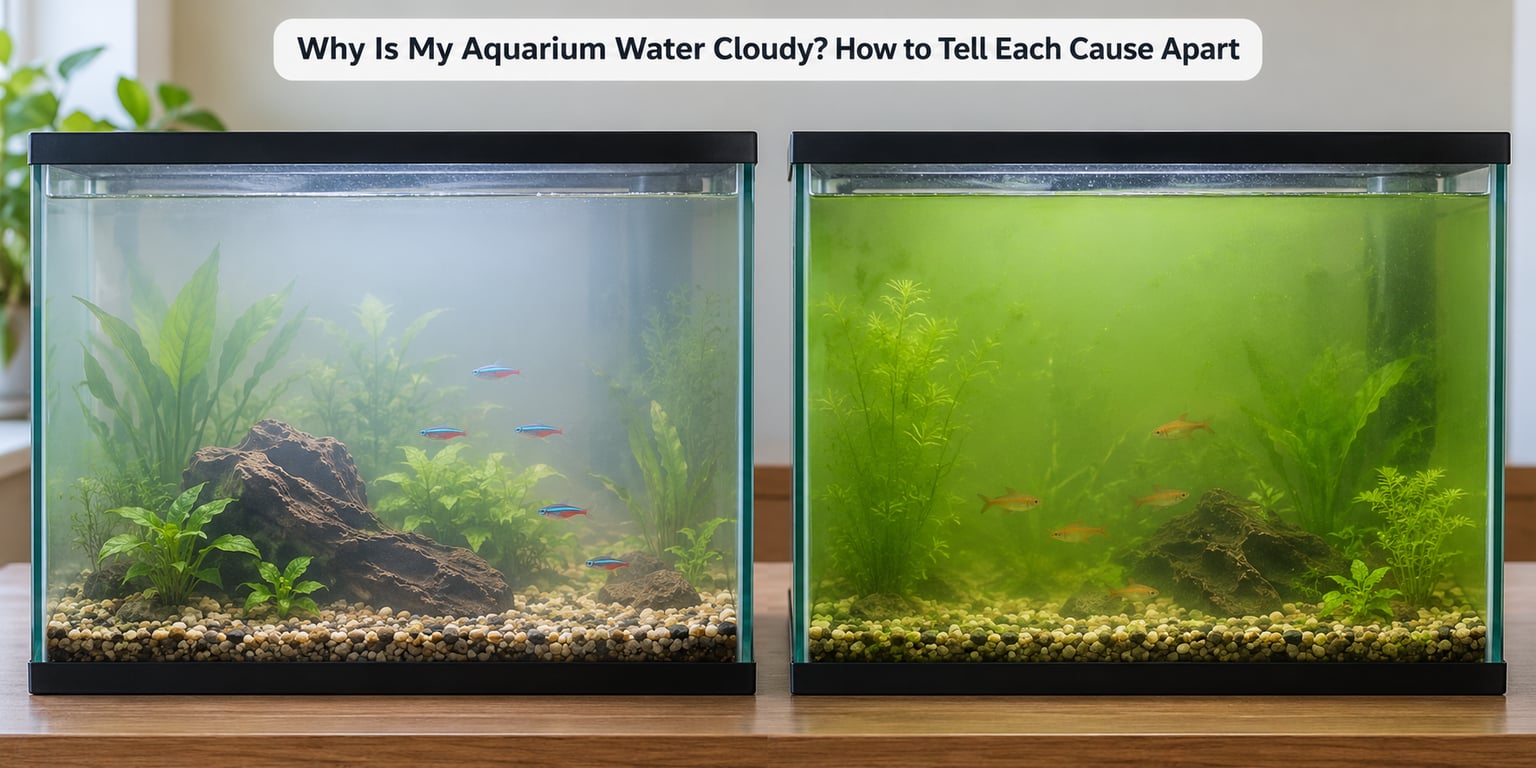
Two clues separate causes better than anything else: what the water smells like, and whether the cloudiness is suspended in the water or sitting on surfaces. Start there.
Milky white water with a swampy smell
This is the classic bacterial bloom, and the smell is the tell. Peels and vegetables left in the tank also produce a bacterial bloom, so if you have a snail population exploding, that may be your actual cause. Tests normally read zero ammonia and zero nitrite, because the nitrogen cycle itself is working. What fails is physical filtration, not chemistry.
On a Fishlore thread about cloudy water after swapping a sponge filter, the diagnosis was exactly this: the old sponge held the bacteria, the new one did not, and the cycle had to re-establish. That thread is old and still the most useful example of the pattern I see.
White haze with clean test results and no smell
Parameter readings of zero ammonia, zero nitrite and low nitrate with cloudy water and no odor usually means suspended particles rather than bacteria. Fine filter floss, a micron pad or a slow-down sponge diffusing the return flow settles it. Aquarium enthusiasts on r/walstad describe planted tanks staying cloudy through a clarifier with perfect parameters, and the answer in those threads is almost always mechanical capture, not chemistry.
Green water
Green water is photosynthetic and responds to light, not to filter changes. If you cut the light to two hours a day and the tank stops getting greener, you have confirmed it. Blacking the tank out entirely for a day or two also works and is the most common tactic in aquarium Facebook groups.
Yellow-brown or gray water
Brown usually points to decaying plant matter or driftwood tannins, and gray points to heavy organics plus fine sediment. Both smell earthy. Check for a dying plant, stirring the substrate during a water change, or a filter that is too strong for a lightly stocked tank and keeps lifting bed particles into the column.
Slime or film on the surface
A film that floats on top with clear water below is biofilm or a protein and oil layer, not a bloom. Bubble placement gives it away. Scrape the glass at the surface and watch whether the haze moves with it. In a marine or reef tank, that same film can turn into a dinoflagellate bloom, which is the version that genuinely needs fast action.
The harmless haze versus a real imbalance
Temporary haze has one signature: it changes day to day. You can see the substrate edge more clearly in the evening, or the cloudiness thins after a filter service. An ongoing imbalance looks static. It sits at exactly the same opacity for a week, the fish show stress, and the water never improves no matter what you do.
How to Test Your Water Before You Change It
Testing before you change water is the difference between fixing a tank in ten minutes and resetting it. Do this in order and stop when you have an answer.
1. Run a full parameter test. Ammonia and nitrite at zero, nitrate under roughly 20 to 30 ppm, and pH stable. If ammonia or nitrite is detectable, stop reading about cloudiness and deal with the cycle.
2. Look at the fish. Normal behavior with cloudy water points at a cosmetic cause. Gasping at the surface, clamped fins or fish hanging near the filter outlet mean something else is going on.
3. Check flow. Put a hand in the outlet and feel for actual movement. A partly blocked intake or a dying impeller reduces circulation, and reduced circulation lets everything stay suspended. Filter media packed too tightly does the same thing.
4. Review the last two weeks. Filter media change, water change, new substrate, new gravel rinse, added livestock, longer light hours, a different food, a power outage. This list finds the cause more often than anything else I know.
5. Pour a glass and hold it to the light. Backlighting shows whether particles are still moving or have settled. Moving particles point to inadequate filtration or a bloom. Settled particles point to debris.
Water clarity itself is not a parameter you can test. Nothing on a test kit tells you whether the water is clean-looking. That is why appearance gets you to a hypothesis and chemistry decides whether the hypothesis is safe.
How to Clear Cloudy Water Without Resetting the Tank
Once you know the cause, the fix is usually small. Match the action to the cause and change one variable at a time so you can tell what worked.
If it is a bacterial bloom. Do nothing drastic. Feed sparingly, skip the filter, and let the colony catch up. Water changes here are counterproductive. Every change dilutes the nutrient load the bloom is feeding on and disturbs the media, which is why people on aquarium forums report cloudiness getting worse after a large change rather than better.
If it is debris or decaying food. This is the one case where a water change is right. Do a 10 to 30 percent change, siphon only the open water and not the substrate bed, remove any uneaten food, and cut portions for a week.
If it is algae. Cut the photoperiod to six hours or less, drop to a single small daily feeding, and stop feeding entirely for a couple of days if the tank is heavily stocked. Removing nitrate-reducing bacteria colonies makes it worse, so leave the filter alone.
If it is suspended particles. Add fine filter floss or a micron pad in the filter path, and spread the return flow with a sponge on the outflow so it does not blow bed sediment around the tank. Slowing the flow is often the whole fix.
On clarifiers. A water clarifier does not clean water. It clumps microscopic particles together so the filter can physically catch them. That means it does nothing for dissolved organics, dissolved nutrients, or bacteria that are alive and swimming around, which is exactly why people report still cloudy tanks after using one.
Over-dosing is the common mistake. Too much coagulant binds together with gunk, clogs filter flow, and can drop oxygen enough to stress fish. Dose it once, at the labeled amount, and change the water the next day rather than stacking repeated doses.
On hardware. A UVC sterilizer is the single most effective addition for a bacterial or green bloom. Sized properly, forum reports run about three to four days to visibly clearer water. A water polisher, which is often just fine filter floss in its own stage, does the same job for physical particles and costs far less.
What not to do. No full tank resets in the middle of a bloom. No replacing all filter media at once. Never rinse media in tap water, because chloramine kills the colony that clears the water for you. Sponge filters outlive most people who buy them. No bleach, no chemical coagulants past the label dose, and no panic intervention while the parameters are still safe.
If the tank is genuinely overloaded with organics and a clarifier is not enough, a UVC unit or a staged mechanical polisher is the right hardware call. If the cloudiness comes with dying fish or unreadable parameters, that is a health problem rather than a clarity problem.
How Long Does Cloudy Aquarium Water Take to Clear?
Nobody can promise a date, and anyone who does is guessing. The honest ranges below come from what keepers actually report on Fishlore, Reddit and the planted-tank communities, and they assume parameters are safe and you change one thing at a time.
| Confirmed cause | Typical time to clear | Signs you are on the right track |
|---|---|---|
| Substrate dust after filling | 24 to 48 hours | Specks collect on the substrate |
| Surface biofilm or oily film | 1 to 3 days | Film stops re-forming within a day |
| Overfeeding and decaying food | 3 to 7 days | Smell fades before the water clears |
| Bacterial bloom in an established tank | 3 to 10 days | Haze thins gradually each morning |
| Bacterial bloom in a new cycling tank | 2 to 4 weeks | Nitrite appears, then both go to zero |
| Green water with reduced light | 5 to 14 days | Glass clears before the water column does |
| Dinoflagellates in marine or brackish | 2 to 4 weeks | Needs full dark periods and no manual filtration |
| Clarifier plus floss on fine particles | 24 to 72 hours | Clarity changes within a single day |
Signs of progress are easy to miss. You will usually see the substrate edge sharpen before the whole column clears. Fish activity usually improves before the water looks better, because oxygen is often the first thing to suffer. A bloom can also change color as it runs its course: one r/Aquariums thread describes milky water that turned green after about two weeks before finally clearing, with parameters in range the whole time.
Repeated cloudiness is the signal that the original cause was never fixed. If the tank clears and then goes cloudy again within a few weeks every time, the driver is still there. Overfeeding, an undersized filter, or a return flow strong enough to keep lifting sediment are the usual repeat offenders.
Is Cloudy Water Safe for Fish? When to Act Quickly
Mildly cloudy water with fish that are eating, swimming and behaving normally is usually cosmetic. The visibility problem is real for you, not for them.
The risk worth knowing about is oxygen. A dense bloom respires heavily, especially at night, and the bacteria and algae consume dissolved oxygen as it breaks down. That is why fish at the surface gasping at night is a more serious sign than the water color itself.
Act quickly if you see gasping at the surface, fish clustering near the filter outlet, clamped fins, sudden loss of color, visible fungus or lesions, or any detectable ammonia or nitrite on a test. Test immediately rather than guessing from appearance. Add surface agitation or an air stone while you work out the cause, and cut feeding rather than adding food to a stressed tank.
Contact an aquatic veterinarian when fish show persistent illness, when cloudiness comes with a die-off, or when the tank has been unstable for weeks with no clear cause. Never use human medication in an aquarium, and do not add salt or other remedies without knowing what is in the tank, because both can stress fish already dealing with low oxygen.
Frequently Asked Questions
Does cloudy aquarium water mean there are harmful bacteria?
Usually not. In most cases the cloudiness is caused by beneficial nitrifying bacteria and other organisms that have multiplied faster than the filter can trap them, which is a sign the filter is working, not failing. Harmful bacteria are a concern only when fish are already sick or stressed, with symptoms like clamped fins, lesions or gasping. Test your parameters: ammonia and nitrite at zero with healthy fish behavior means the cloudiness is not a health emergency.
Should I use a water clarifier to make my aquarium clear?
Only after you know what is making the water cloudy. A clarifier clumps fine particles so the filter can catch them, which works well for suspended sediment. It does nothing for dissolved organics, excess nutrients or free-swimming bacteria, which is why many aquarists report a tank staying cloudy after using one. Dose it once at the labeled amount, never stack repeated doses, and change the water the following day.
Can I clean a cloudy aquarium filter right away?
Leave it alone if parameters are safe. A bacterial bloom means the bacteria population is ahead of what your filter media can capture, and servicing that filter removes the small colony you need to clear the problem. Rinsing media under tap water is worse, because chloramine kills nitrifying bacteria. Instead, rinse sponges and media in a bucket of water from the tank, and only when flow is visibly restricted.
Is it safe to add fish while the water is still cloudy?
Water clarity alone does not decide this, the nitrogen cycle does. If the tank has been running with a filter and you are getting reads of zero ammonia and zero nitrite, the water clearing or not is cosmetic. If the tank is still cycling, wait until nitrite has spiked and returned to zero. Adding livestock to a tank that never completed a cycle is far riskier than adding them to cloudy but stable water.
Why did my aquarium become cloudy after a water change?
Two usual reasons. If you changed large amounts of water at once, you diluted the nitrifying bacteria on the media and interrupted the nitrogen cycle, which often produces a bacterial bloom within days. If your source water has high phosphate or you used unwashed gravel, you may have added a nutrient spike that feeds algae. Smaller changes of 10 to 30 percent, dechlorinated and temperature-matched, usually avoid the problem.
Does a cloudy aquarium need a complete water change?
Rarely, and a full change can make things worse by stripping nitrifying bacteria and removing the nutrient load the filter needs to re-establish balance. For a bacterial bloom, the correct action is usually no water change at all. A partial change of 10 to 30 percent helps when the cause is physical debris, decaying food or a detectable ammonia reading. Always dechlorinate and temperature-match replacement water.
Conclusion: Start With the Cause, Not a Water Clarifier
If your aquarium water is cloudy, the first move is not a product. It is to stop feeding heavily, look at the color, and check whether anything changed in the last two weeks. Then test the water before you clean anything.
Milky white with a smell means a bacterial bloom, and the fix is patience. Green means light and feeding. Particles mean slow the flow and add mechanical filtration. Debris and detectable ammonia mean a partial water change. Match the action to the cause, change one thing at a time, and leave the biological filter alone.
So the next time you ask why is my aquarium water cloudy, resist the urge to pour something in it. Look at the color, run the tests, and let the water tell you which of the four causes you actually have.