Kidney disease in cats is usually silent for a long time, and the first things an owner notices are thirst, urination and weight loss rather than anything dramatic. Here is the short version: watch the trends over weeks, not one odd afternoon, and treat a vet diagnosis as the only real starting point for diet decisions.
A cat’s kidneys can lose roughly 75% of their working units, called nephrons, before any clinical sign shows up. That is why a cat can look perfectly normal at home and then arrive at the vet with a diagnosis that feels sudden. It was not sudden. It was just quiet.
Two things change what you do next, and they are why this topic splits in two. The first half is spotting the early signs of kidney disease in cats soon enough that diet still has leverage. The second half is the diet question a lot of owners land on right after a diagnosis: what a cat kidney disease diet should actually contain, and what to do on the days your cat refuses it.
If your vet has just used the words kidney disease, the diet section further down is the useful one. If you are still at the worrying stage, the early signs section is written for you.
One thing to be clear about before we start: this article is general information, not veterinary advice. Only a veterinarian can diagnose kidney disease in your cat and select a diet for them.
Table of Contents
- What Is Kidney Disease in Cats?
- Kidney Disease in Cats: Early Signs and Diet at a Glance
- What Are the Earliest Signs of Kidney Disease in Cats?
- How Do Owners Usually Notice Kidney Disease in Cats?
- How to Tell Kidney Thirst Apart From Other Causes
- Which Cat Health Changes Need Urgent Veterinary Care?
- How Is Kidney Disease Diagnosed and Monitored?
- What IRIS Stages 1 to 4 Mean Day to Day
- How Long Does a Cat Live at Each Stage?
- What Diet Helps a Cat With Kidney Disease?
- How Do You Transition a Cat to a Kidney Diet?
- Should Cats With Kidney Disease Eat Wet Food, Dry Food, or Both?
- What Foods, Supplements, and Home Remedies Should Be Avoided?
- How Can Owners Support a Cat After Diagnosis?
- Frequently Asked Questions
- Can a cat with kidney disease live a normal life?
- How long does it take for kidney disease symptoms in cats to appear?
- Is dry cat food bad for a cat with kidney disease?
- Can I give my cat human food when its appetite declines?
- What blood or urine changes confirm kidney disease in cats?
- What Should You Do First?
What Is Kidney Disease in Cats?
Chronic kidney disease in cats is the slow, irreversible loss of kidney function over months or years. The kidneys filter waste out of the blood, hold on to water and electrolytes, and make the urine that lets a cat get rid of waste without losing too much fluid. When that system fails, waste builds up and the urine becomes very dilute.
It is common in older cats. Roughly 30% of cats over 10 and up to 80% of cats over 15 are affected to some degree, which is one reason senior wellness bloodwork matters so much.
Age raises the odds but it does not cause the condition on its own. Plenty of cats are diagnosed in the early stages with no cause found at all, which vets call idiopathic kidney disease. Other cats reach it through a toxin, an infection, high blood pressure, a lack of blood supply to the kidney, a stone or obstruction, immune-mediated disease, or a tumour.
Then there is acute kidney injury, or AKI. AKI is a sudden loss of kidney function, usually over hours to days, and it is an emergency rather than a slow disease. Common triggers include a toxin such as antifreeze, a lily exposure, certain medications, severe dehydration, an obstruction, or an infection that overwhelms the kidneys. The distinction matters because the urgency is completely different, and an owner who assumes a sudden crash is just chronic kidney disease getting worse can lose a day that mattered.
CKD is not only a senior cat condition. Cats have been diagnosed from routine bloodwork in their early years, with high creatinine and low potassium showing up alongside perfectly normal behaviour. That is worth knowing, because it means the disease is not purely an ageing story and a young cat with odd drinking habits deserves the same workup.
One more thing about causes. Owners often carry guilt long after a diagnosis, hunting for the toxin they must have missed. In most cases no cause is ever found, and the honest answer is that idiopathic kidney disease is the most common category in cats. Keep lilies out of the house and keep human painkillers away from cats, because those precautions are worth having, but they are not a reason to blame yourself for a diagnosis you could not have prevented.
Kidney Disease in Cats: Early Signs and Diet at a Glance
The earliest changes are drinking more, urinating more, and losing weight without trying. What needs same-day veterinary care is a different list entirely: repeated vomiting, collapse, marked weakness, inability to keep water down, or straining in the litter box with nothing produced. The central diet principle is a complete and balanced therapeutic renal diet, chosen by your vet, aimed at phosphorus, hydration and keeping weight on.
- Watch over weeks: more water, more urine, looser and larger litter clumps, weight loss, a smaller appetite, a scruffy coat.
- Don’t watch single days: one skipped meal or one hot afternoon means very little on its own.
- Go to a clinic the same day: repeated vomiting, collapse, sudden marked weakness, heavy breathing, obvious dehydration, or straining to urinate with no output.
- The diet principle: reduced phosphorus, controlled high-quality protein, added potassium where needed, and enough water in the bowl or the pouch.
- Never do: cut your cat’s water back to reduce the urination, or add supplements or human medication on your own.
Only a veterinarian can confirm kidney disease in cats, stage it, and tell you how much dietary change your cat actually needs. Many early-stage cats need far less restriction than owners expect.
What Are the Earliest Signs of Kidney Disease in Cats?
The very first signs are increased thirst, increased urination, and unexplained weight loss, often with a smaller appetite and a duller coat. Many cats show nothing at all until roughly 75% of nephron function is gone, because the remaining kidneys compensate. That is why bloodwork catches cases that behaviour does not.
Ordered roughly from earliest to latest, these are the changes owners report:
- Drinking more water than usual. An empty bowl, a fountain that needs refilling twice as often, or a cat that heads for the tap after every meal.
- More frequent urination. More trips to the litter box, often overnight, and sometimes accidents outside the box because the routine changed.
- Larger, looser litter clumps. More frequent, bigger, flatter clumps than the norm for that cat.
- Weight loss you cannot explain. A cat that looks bonier along the spine and hips without anyone noticing a change in how much it eats.
- Muscle wasting. Skinny legs and shoulders while the body still looks normal, which owners on renal forums often describe as the sign that frightened them most.
- A smaller or pickier appetite. Turning away from a favourite food, eating slower, or leaving the bowl.
- Nausea signs. Lip-smacking, licking the lips, food refusal that comes with drooling or vomiting.
- Constipation. Small, dry, hard stool, which often comes and goes with dehydration.
- A bad smell in the mouth. Halitosis is listed by veterinary sources, though owners rarely notice it early because cats are covered in their own scent anyway.
- A scruffy coat. A coat that has lost its shine and lies flat instead of sitting smoothly, plus less grooming.
- Behavioural changes. Hiding, avoiding the person who normally feeds them, less interest in play, lower or more difficult jumping, and longer sleeps than usual.
How Do Owners Usually Notice Kidney Disease in Cats?
Owners rarely notice one clean symptom. They notice a drift: the water bowl is empty on arriving home and empty again two hours later, or the litter box has three large clumps where it used to have one. The cat eats the same amount but the bowl is left with a little more in it each day, or the cat comes running at the sound of the can opener and then loses interest halfway through.
Weighing helps more than looking. A cat can lose several hundred grams over a couple of months and still look normal, and a weekly weight on the same kitchen scale tells you something a photograph never will.
Watch the litter box, because owners use it as a home gauge and most veterinary pages never teach them to. Bigger, flatter, more frequent clumps suggest the kidneys are struggling to concentrate urine. Straining with little or no output is a different problem entirely, and an emergency.
Notice the pattern between food, litter and behaviour: the cat that drinks a lot and eats a lot is not the same picture as the cat that drinks a lot and stops eating. The second one gets seen faster, and rightly so.
Compare against that individual cat’s normal, not against a generic cat. Older cats drink more and sleep more on their own. The question is whether this cat is different from the cat you had three months ago.
How to Tell Kidney Thirst Apart From Other Causes
Increased thirst is not a diagnosis. Cats that drink noticeably more can have hyperthyroidism, diabetes, or simply be older and less active, and a small number of cats have a preference for running water that has nothing to do with their kidneys at all.
The pattern helps. Kidney-related thirst tends to come with larger, more frequent litter clumps and often with weight loss, because reduced kidney function affects appetite and muscle. Hyperthyroid thirst often arrives with a cat that eats more, loses weight anyway, is restless, and sometimes has a racing heart. Diabetic thirst comes with heavy clumps and often more litter, alongside increased hunger. None of this replaces a blood panel, but it tells you how firmly to insist on one.
Appetite is the other discriminator people miss. The cat that drinks a great deal and stops eating needs to be seen quickly. The cat that drinks a lot and eats enthusiastically is still worth testing, just not at midnight.
Which Cat Health Changes Need Urgent Veterinary Care?
Some changes mean book an appointment this week. Others mean go to an emergency clinic today, and the difference is not subtle once you know it.
Book an appointment soon for: increased thirst and urination, weight loss, a smaller appetite, more sleeping and hiding, vomiting once or twice with no other signs, a scruffy coat, or stale breath and mouth ulcers.
Go to the clinic the same day for any of these:
- Repeated vomiting, or a cat that cannot keep water down.
- Sudden marked weakness, collapse, or a cat that cannot stand or jump.
- Breathing changes that are not normal for the cat.
- Severe dehydration signs such as very tacky gums, sunken eyes, or skin that tenting.
- Straining in the litter box, crying, or licking at the genital area with little or no urine produced.
- A cat with known kidney disease that suddenly stops eating for a day, or refuses everything including water.
That last litter box point deserves its own line. A complete urinary blockage, most often in a male cat, is a separate emergency from chronic kidney disease and it kills fast. A blocked cat will strain, visit the box repeatedly, may cry, and can pass blood. If you cannot find a clue of urine in a cat that keeps trying, treat it as an emergency, not a litter box habit.
A sudden crash over hours to days, in a cat of any age, fits acute kidney injury better than chronic disease. That is an emergency until a vet says otherwise. Forum threads repeatedly mix these two up, and the confusion is understandable, because the symptoms overlap.
How Is Kidney Disease Diagnosed and Monitored?
Kidney disease in cats is diagnosed with blood and urine tests taken alongside a history and physical exam, and confirmed by repeating abnormal results rather than by symptoms or a checklist. A cat that drinks a lot of water may have hyperthyroidism or diabetes instead, and only testing separates them.
What your vet is likely to use:
- Blood chemistry for creatinine and BUN. Creatinine rises late, once roughly 75% of function is gone, so a normal value does not rule anything out on its own.
- SDMA, or symmetric dimethylarginine. It tends to rise earlier, around 25% of function lost, which makes it the useful early marker. It still needs a second abnormal result before most vets call it CKD.
- Urinalysis with urine specific gravity. A cat with kidney disease produces a large volume of dilute urine, so the specific gravity reads low.
- UPC, the urine protein-to-creatinine ratio, which shows how much protein is leaking through. Persistent protein loss matters in its own right.
- Blood pressure. Hypertension is common and can damage the eyes and brain, which is why sudden vision loss in a cat with kidney disease is an emergency sign rather than a curiosity.
- Imaging, usually ultrasound, to look at kidney size, cysts, stones or obstruction.
Trends beat single numbers. One abnormal result gets repeated, because lab values move with hydration, diet and stress. Recheck intervals depend on the stage, and a stable early-stage cat might be retested every three to six months while a later-stage cat is seen far more often.
What IRIS Stages 1 to 4 Mean Day to Day
Veterinary teams stage CKD with the IRIS system, which groups cats by creatinine and SDMA levels. These ranges are typical adult cat values, and your vet interprets yours in context.
| Stage | Creatinine (typical range) | What you may notice at home | What usually changes in management |
|---|---|---|---|
| Stage 1 | Under about 1.6 mg/dL, with SDMA above the lab range | Often nothing at all. Diagnosis is usually incidental, found on a wellness panel | Repeat testing to confirm, hydration focus, diet discussion. A single Stage 1 result usually needs a second abnormal value before it is called CKD |
| Stage 2 | About 1.6 to 2.8 mg/dL | Drinking more, bigger litter clumps, mild weight loss, a smaller appetite | Renal diet discussed, phosphorus control, blood pressure checks, more frequent rechecks |
| Stage 3 | About 2.9 to 5.0 mg/dL | Visible weight loss and muscle wasting, nausea, constipation, poor coat, thirst | Diet becomes the priority for keeping weight on, plus anti-nausea support, potassium or acid-base management, phosphate binders, home fluids discussed |
| Stage 4 | Over about 5.0 mg/dL | Eating very little, strong thirst, weakness, a dull and painful-looking cat | Comfort, appetite support, fluids, and an honest quality-of-life conversation |
Owners often find Stage 1 surprising in the opposite direction: it sounds serious and means very little on its own. Many cats sit at Stage 1 or early Stage 2 for years with a good quality of life on a managed diet, which is exactly the group that benefits most from catching it now.
How Long Does a Cat Live at Each Stage?
Be cautious with any prognosis number you are given, including on this page. Owners who were told three months in one online thread and were still going strong years later are common, and the opposite happens too. What moves the estimate is stage at diagnosis, whether phosphorus is being controlled, whether the cat keeps eating, blood pressure, and whether other illnesses are present.
What can be said honestly is directional. A cat caught at Stage 1 or Stage 2 has the most room, and many are managed comfortably for years with diet and monitoring. Stage 3 cats often do well for a further extended period once appetite, phosphorus and blood pressure are under control, which is why a Stage 3 diagnosis is not automatically a short timeline. Stage 4 is where the conversation becomes about comfort and quality of life, and where owners are right to ask their vet directly what good days would look like for this particular cat.
Renal diets themselves are among the better-evidenced interventions in veterinary medicine, and are generally reported to extend survival compared with maintenance feeding. That is the core reason the diet question matters so much after a Stage 1 or Stage 2 diagnosis, and the reason it is worth the effort to get the cat actually eating it.
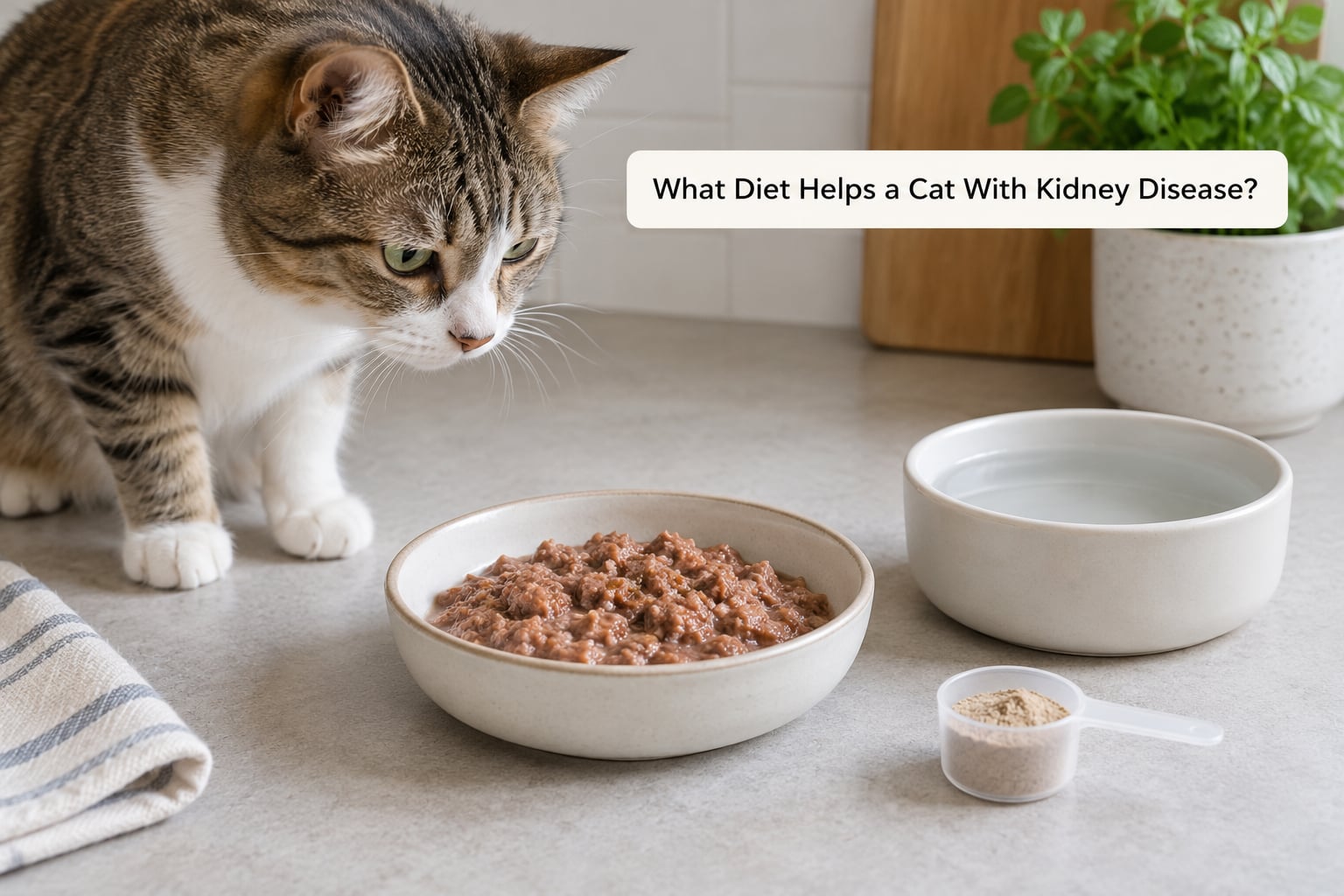
What Diet Helps a Cat With Kidney Disease?
A veterinarian-guided renal diet works on four fronts at once: less phosphorus, controlled protein of good quality, more water, and enough calories to hold body condition. That combination matters more than any single ingredient, and the balance shifts with the stage.
What a therapeutic renal diet is built to do:
- Reduce phosphorus. This is the most evidence-based lever in the whole topic. Dietary phosphorus drives the blood phosphorus level, and high phosphorus is linked to worse outcomes in cats with CKD.
- Control protein quality rather than cut protein hard. Blanket severe restriction is now considered counterproductive, because a cat that eats too little loses muscle, and muscle loss is what owners see and fear. Current guidance favours controlled amounts of high-quality protein.
- Add potassium. Kidney disease often drives potassium down, which contributes to weakness. Many renal diets are supplemented for that reason.
- Add omega-3 fatty acids and B vitamins, and use a mildly alkalinising formulation to help with the acid-base problems CKD causes.
- Deliver calories and water at the same time. Wet formats do both jobs in one bowl, which is why they are usually preferred.
Stage changes the priorities. In Stage 1 and early Stage 2, a full renal diet is often not required and your vet may simply recommend controlled phosphorus and more moisture. At Stage 3 and 4, palatability and calorie density take over as the main worry, because a cat that eats is worth more than a cat eating the theoretically correct food.
Reading the panel matters more than brand loyalty. Look at the guaranteed analysis for dry matter phosphorus, check the moisture content if you are comparing a wet food with a dry one, and ask your vet for the target range for your cat’s stage. Treats count. A handful of high-phosphorus commercial treats can undo a careful day’s feeding, so ask how much of the daily allowance treats may take.
On cost and access: prescription renal diets cost meaningfully more than standard food, and it is fair to raise that with your vet rather than quietly substituting. Options that genuinely exist include buying from veterinary-only pharmacies, asking about a larger-bag discount, and asking whether a non-prescription renal support food is reasonable for a cat at an early stage. Decide any of that with your vet, not on a forum.
How Do You Transition a Cat to a Kidney Diet?
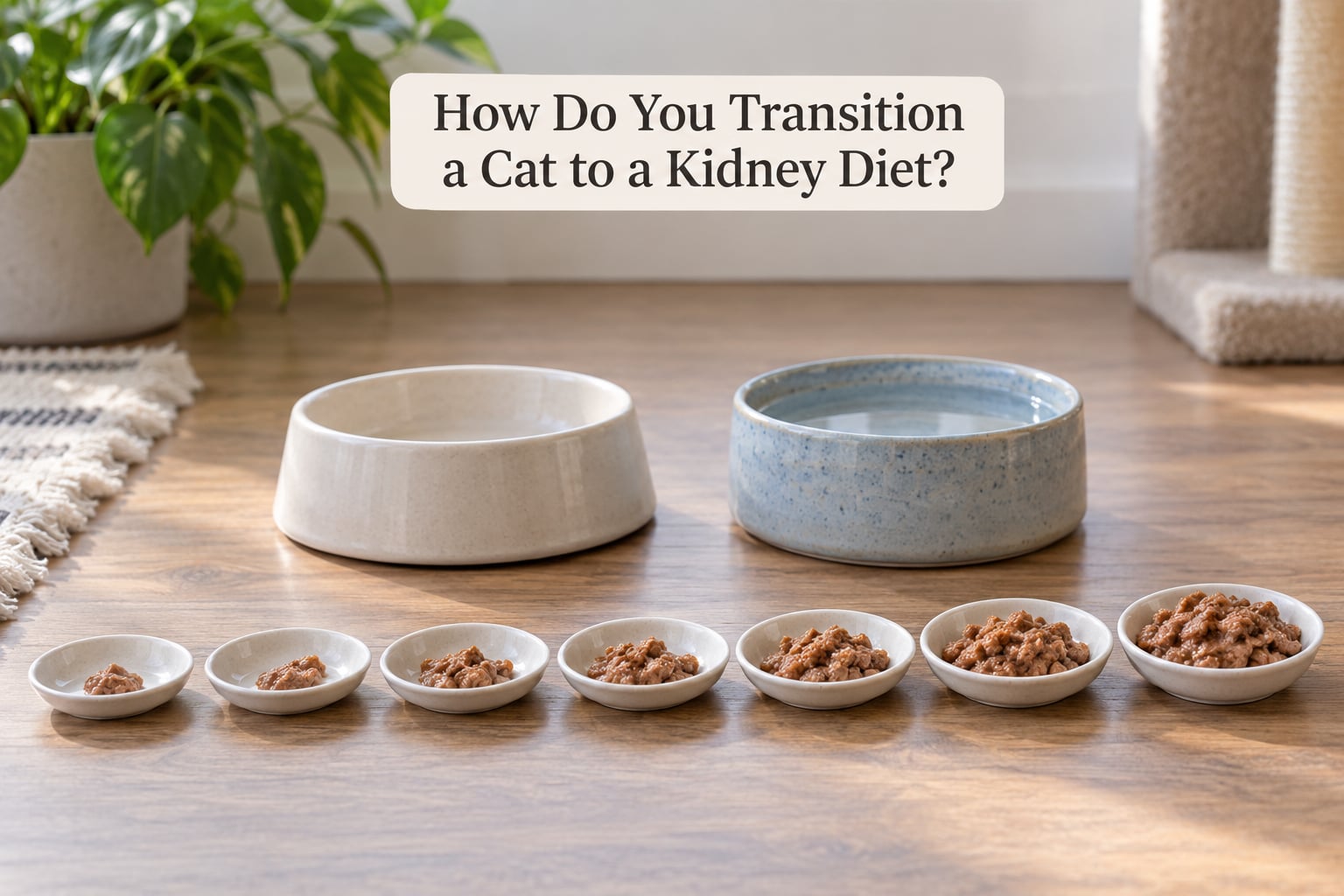
Change the food gradually over one to three weeks, in small steps, and never faster than your cat’s appetite tolerates. A cat that eats is always better off than a cat on the ideal food that refuses to eat.
- Days 1 to 3. Keep the current food and add a few pieces of the new food. If your cat sniffs and walks away, that is normal and fine.
- Days 4 to 7. Replace about a quarter of the meal, then half as the week goes on.
- Week 2. Mostly the new food. Watch stool, which often loosens briefly during the swap and settles.
- Week 3. Full transition, provided appetite and weight are steady.
Three practical things help. Warm the food slightly, in warm water rather than a microwave, because cold food smells flat to a cat with a poor nose. Loosen it with warm water into a thin slurry, which is the workaround owners on renal forums repeat most often and it works. And offer small frequent meals instead of two large ones, since a nauseous cat often manages a little more often.
Owners describe partial compliance as the normal state rather than the exception, and it is better than a cat eating nothing. If your cat reliably eats the renal diet and occasionally accepts a spoonful of something else, that is a workable routine rather than a failure. The question for your vet is how much of the day must stay strictly renal, and that answer usually depends on the stage.
If your cat eats almost nothing for more than a day, stop the transition and contact your vet. A cat that stops eating can develop a dangerous condition from the lack of food itself, and that needs veterinary help. Do not force-feed at home and do not leave it to sort itself out.
Should Cats With Kidney Disease Eat Wet Food, Dry Food, or Both?
Wet food is usually the better choice for a cat with kidney disease, mainly because of the water in it. CKD cats lose the ability to concentrate urine, so total water intake matters more for them than for a healthy cat.
What wet food does well:
- Delivers water with every meal, which is easier than persuading a thirsty cat to drink more.
- Offers small, frequent, portion-friendly meals, useful for a cat with a small appetite.
- Usually reads as higher in moisture and lower in calorie density, which suits a cat that needs fluids without extra calories.
What dry food does well, and where it falls short:
- Cheaper per day, keeps longer, and is easy to portion out for free-feeding.
- Carries no water at all, so the cat has to drink more to make up for it, and calorie-dense food can be harder for a nauseous cat to finish.
- Older cats often chew dry food less well as their jaws weaken.
Either format can be a complete and balanced renal diet if it is formulated as one. Only your vet can tell you whether your cat’s needs at its stage call for a wet diet, a dry diet, or a mix, and whether a dry option needs extra water or a topper. Mixing formats changes the nutrient balance of the whole meal, so the mixing decision is the vet’s, not the label’s.
For hydration beyond food, spread several bowls around the house and place them away from the food dish and away from the litter box, since cats drink more when the water source is not near something unpleasant. A fountain helps some cats simply because moving water is interesting.
What Foods, Supplements, and Home Remedies Should Be Avoided?
Avoid self-prescribing kidney diets, phosphorus or potassium supplements, herbal remedies, and any human medication given without a veterinarian. What is safe and what is not turns on substances a cat’s failing kidneys cannot handle.
| Avoid | Why it matters |
|---|---|
| Restricting water to reduce urination | The single most dangerous mistake on this list. More urine means more water lost. Dehydration in a CKD cat worsens kidney function |
| Lilies, in any form | Extremely toxic to cats and a well-known cause of acute kidney injury. This is one to act on immediately |
| Antifreeze and ethylene glycol | A leading cause of acute kidney injury in cats. Check garage and shed storage |
| Human painkillers, including ibuprofen, naproxen and paracetamol | Dangerous for cats at any dose, and a common route to fatal kidney injury |
| Grapes and raisins, chocolate, alcohol, onions and garlic | All toxic to cats. Onion and garlic powder turns up in many human foods, sauces and baby food |
| High-phosphorus commercial treats and chew sticks | Treats are not neutral. They are a meaningful share of the day’s phosphorus in a cat on a renal diet |
| Salt and salty snacks | A sodium-heavy diet can worsen hypertension and thirst in a cat with CKD |
| Phosphate binders, potassium supplements or herbal remedies added on your own | These exist as prescription products managed to a blood test result. Self-dosing can push levels in the wrong direction |
A note on human food, since it comes up constantly: a small amount of plain, cooked, unseasoned protein as a treat or a topper is something many vets agree to, but it changes the balance of the diet and it matters in later stages where phosphorus and potassium are being managed precisely. Ask your vet what is acceptable, how much, and how often, and run it past them rather than deciding at 11pm.
How Can Owners Support a Cat After Diagnosis?
Support after diagnosis is mostly steady monitoring and small comfort adjustments, alongside the veterinary plan. The aim is to keep the cat eating, drinking and comfortable for as long as possible.
What you can track at home:
- Weight, weekly, on the same scale in the same room. This is the most informative number you have.
- Litter box clumps, size, shape and how many times a day.
- Water intake, by counting bowl or fountain refills.
- Appetite and how long it takes to eat. An appetite diary, even a rough one, is more useful than a memory from three weeks ago.
- Body condition and muscle condition. Run your hands over the spine, ribs and hips weekly. Loss along the hips with a normal-looking body is muscle loss, and it is worth mentioning at the next visit.
- Activity and comfort, including whether jumping to a favourite spot still works. A non-slip mat on hard floors helps a cat that has lost grip in the back legs.
Keep the litter box low-sided and easy to find for a cat that is weak or arthritic, and offer a heated bed. Ask about home subcutaneous fluids if your cat is not drinking enough; they are the standard top-up for later-stage cats, and clinics will teach an owner to do them.
Rechecks are part of the care, not an optional extra. They usually cover weight and body condition, blood pressure, and repeat blood and urine values at an interval set by the stage.
Worth asking at the appointment: what stage is my cat in and how often do we recheck; what is the phosphorus target and how do we know we are hitting it; how much should my cat be eating per day; is an appetite stimulant appropriate; would home fluids help; and what are the specific signs that mean I should not wait for the next appointment.
On quality of life: good days and bad days can be counted honestly, and that number becomes the basis for a later conversation with your vet. Nobody regrets asking about it early enough to know what they want to hear.
Frequently Asked Questions
Can a cat with kidney disease live a normal life?
Yes. Many cats with early-stage kidney disease live a good, ordinary life for years. Cats managed at IRIS Stage 1 or early Stage 2 often hold their weight, keep their routine and enjoy normal activity. Diet changes, hydration and regular recheck appointments are what make that possible. Your veterinarian can give you the most honest picture for your cat, because stage and other health problems change the outlook a lot.
How long does it take for kidney disease symptoms in cats to appear?
Often it takes months to years, and sometimes symptoms never appear at all. Because the kidneys compensate, clinical signs usually show only after roughly 75% of nephron function is lost, while SDMA can rise at around 25% of function. That is why many cases are found on routine bloodwork. Early signs of kidney disease in cats appear gradually, so comparing your cat with how it was three months ago is the practical approach.
Is dry cat food bad for a cat with kidney disease?
Not necessarily. Dry food can be a complete and balanced renal diet if it is formulated as one, and it is easier to portion and cheaper to store. The catch is water: dry food delivers none, and a cat with kidney disease already struggles to concentrate urine, so total fluid intake matters. Wet food is usually easier for hydration, but format is a preference question. Ask your vet which suits your cat’s stage and health.
Can I give my cat human food when its appetite declines?
Some human food is fine in careful moderation, but it is a decision to make with your veterinarian rather than at the kitchen counter. Plain cooked chicken, for example, may be an acceptable topper, while cooked onions, garlic or seasoned sauces are not. Human medication is a different matter entirely and can be fatal for a cat with kidney disease. Small frequent meals of the prescribed diet usually help more than an unplanned change.
What blood or urine changes confirm kidney disease in cats?
Diagnosis of kidney disease in cats rests on a combination, not one number: creatinine and BUN from blood chemistry, SDMA as an earlier marker, urine specific gravity showing dilute urine, UPC for protein loss, and blood pressure. Your vet usually repeats abnormal results, because one raised value can follow dehydration, diet or stress. Symptoms alone cannot confirm it, and a single normal creatinine does not rule it out in an early cat.
What Should You Do First?
Write down what has changed and when: water, litter clumps, weight, appetite, coat, activity. Weigh your cat if it is safe and calm to do so, and take a couple of photos from the same angle so you have a comparison later. Then book a veterinary appointment, sooner if the signs are recent and obvious.
At the appointment, ask for blood and urine testing including SDMA, ask for the IRIS stage, and ask what your cat’s diet should be and how quickly to change it. Do not start a renal diet or add anything to the bowl before that conversation.
If your cat collapses, vomits repeatedly, cannot keep water down, seems severely dehydrated, or strains in the litter box with no urine produced, skip the wait and go to an emergency clinic today. That last one is a urinary blockage, and it is a different and faster emergency than chronic kidney disease.
And do not cut the water back to tidy up the litter box. More urine means more fluid lost, and a cat with kidney disease cannot spare it.