If your cat is drooling, it is usually something in or around the mouth: dental pain, inflamed gums, a stuck foreign object, or nausea. A little clear drool while a cat purrs, kneads or waits for food is normal. Sudden, heavy or thick drooling, especially with vomiting or pawing at the mouth, is not normal and needs a vet.
Cats drool far less than dogs, so owners tend to treat any visible saliva as a problem. Most mild cases really are harmless, and most of the time the answer is a sore tooth or an upset stomach. The trick is telling the two apart quickly, because the causes that matter — dental disease, swallowed string, toxins, kidney or liver problems — all get worse while you wait.
This guide covers the eight most common reasons, how to read the drool itself, and the specific signs that mean you should stop monitoring and drive to the clinic. It is general information, not a diagnosis, and nothing here replaces an examination by a veterinarian.
Table of Contents
- What Does It Mean When My Cat Is Drooling?
- 8 Common Reasons Your Cat May Be Drooling
- 1. Dental disease, gingivitis or stomatitis
- 2. Nausea, hairballs or an upset stomach
- 3. A foreign object in the mouth
- 4. Oral ulcers, mouth sores or an electrical burn
- 5. Stress and anxiety
- 6. Heat, exertion or excitement
- 7. Swallowed irritants, toxins or toxic plants
- 8. Kidney, liver, thyroid or other systemic illness
- How to Tell Whether the Drooling Seems Normal or Concerning
- What You Should Do If Your Cat Is Drooling
- When Is Cat Drooling a Veterinary Emergency?
- How Veterinarians Investigate Excessive Drooling in Cats
- How to Reduce Irritants and Prevent Future Episodes
- Frequently Asked Questions
- Is it normal for cats to drool?
- Why is my cat drooling and not eating?
- Can stress make a cat drool?
- What should I do if my cat is drooling after eating?
- How much drooling in a cat is an emergency?
- What to Do First
What Does It Mean When My Cat Is Drooling?
Healthy cats make saliva constantly and swallow it silently. The medical term for visible drooling is sialorrhea, also called hypersalivation, and it shows up in one of three ways.
- Too much saliva is being made. Nausea, pain, toxins, stress and the smell of food all trigger the salivary glands.
- The cat cannot hold the saliva in. Painful teeth, inflamed gums, oral ulcers or a mouth injury make the mouth hurt when it closes, so the saliva escapes.
- The cat cannot swallow it. Nausea alone can trigger the gag reflex, and a blocked throat, a damaged jaw or a neurological problem can stop swallowing altogether.
That third group is the one to take seriously. A cat that produces saliva but cannot move it is a different situation from a cat that produces a lot of it.
The other half of the answer is duration. A cat that drooled once while being petted last Tuesday and is completely normal today is in a different category from a cat that has had a wet chin and chest for four days without eating properly.
8 Common Reasons Your Cat May Be Drooling
Only a veterinarian can tell which of these applies to your cat. The order below roughly matches how often each one turns up in practice.
1. Dental disease, gingivitis or stomatitis
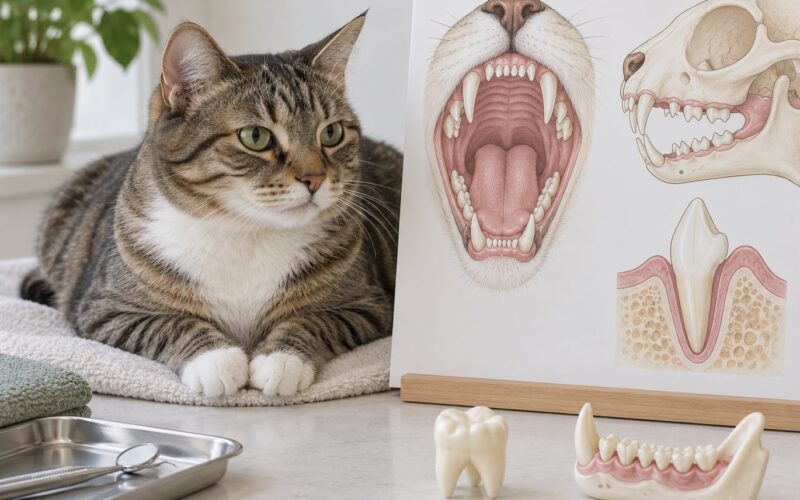
The most common medical reason by a wide margin. Tartar, inflamed gums, tooth resorption (painful lesions at the root that are often invisible until an x-ray) and stomatitis all make chewing hurt, and a cat in mouth pain drools. Bad breath, red or swollen gums, dropping food, chewing on one side, or pawing at the mouth usually travel with it.
2. Nausea, hairballs or an upset stomach
Nausea triggers the salivary glands before it triggers vomiting, so drooling often shows up minutes before or instead of a vomit. Owners on cat forums frequently describe drooling that starts right after dry food or a rich meal, then stops. Repeated vomiting, lip licking and refusing food point the same way.
3. A foreign object in the mouth
String, thread, fish bones, dental floss and small toy parts can lodge between teeth, under the tongue or in the cheek. The signs are sudden drooling, pawing at the face, gagging and often one-sided chewing. Never pull a visible string or thread: it can be anchored deep inside and cutting it or yanking it can injure the intestine.
4. Oral ulcers, mouth sores or an electrical burn
Upper respiratory infections, kidney disease and calicivirus can all leave painful ulcers in the mouth. Cats also chew electrical cords, and a small burn to the tongue or lips makes them salivate heavily. Drooling with no other symptom, in a cat that suddenly hides, is worth taking in.
5. Stress and anxiety
Salivation is part of the fight-or-flight response, so cats drools during car rides, vet visits, thunderstorms or the arrival of a new person or animal. Foster carers and forum owners describe a very consistent pattern here: the drooling appears during the stressful event and settles within 15 to 30 minutes once the cat is calm again.
6. Heat, exertion or excitement
Cats do not sweat much and cool themselves by panting and through their paws, so heat, hard play or excitement can produce heavy drool and panting. It settles with rest and a cool room. In a very hot home or with a flat-faced breed, overheating is a real emergency in itself.
7. Swallowed irritants, toxins or toxic plants
Lilies, tulips, oleander, philodendron, onion and garlic, chocolate, xylitol, human medication, cleaning products and antifreeze can all cause sudden drooling, often with vomiting or foaming. If your cat has had access to any of these, treat it as urgent rather than as a wait-and-see situation.
8. Kidney, liver, thyroid or other systemic illness
Veterinarians call excessive drooling that has no obvious mouth or stomach cause sialorrhea of unknown origin, and it is often the first clue to illness elsewhere. In older cats the usual suspects are kidney disease, liver disease, hyperthyroidism, pancreatitis and oral tumours. Weight loss, thirst that has changed, a dull coat or drooling that has crept up over weeks all belong in the same conversation.
Neurological causes — a damaged trigeminal nerve, a tumour near the jaw, an injury to the jaw or face — are rarer, but they show up as drooling with drooping lips, a dropped jaw, a head tilt or a cat who seems unable to close its mouth properly.
How to Tell Whether the Drooling Seems Normal or Concerning
Why is my cat drooling clear liquid? Thin, watery, colourless drool usually means the glands are simply overproducing, which lines up with stress, food anticipation, heat or a mild upset. Consistency tells you more than volume does.
Tracking the small things over a few days — how long the drool lasts, whether it happens at meals, what the gums look like — gives a vet far more to work with than “my cat is drooling.”
| What you see | Most likely | What to do |
|---|---|---|
| Small amount, clear, while purring or being petted | Contentment or food anticipation | Nothing. This is normal. |
| Clear drool during a car ride or visit, gone within an hour | Stress | Note the trigger, reduce it next time. |
| Clear drool for a few hours with no other symptoms | Mild nausea, oral irritation, early mouth problem | Watch closely, call the vet if it persists a day |
| Thick, ropey or stringy drool, wet chin and chest | Significant mouth pain, ulceration, blocked saliva flow or nausea | Book a veterinary visit, ideally the same day |
| Pink, red or bloody drool | Inflamed or injured mouth tissue, ulcer, dental disease | Same-day veterinary visit |
| Foul-smelling drool with bad breath | Dental disease, abscess, stomatitis | Book an oral examination |
Then look at everything that is not the drool. Appetite, water intake, energy, litter box habits, whether the cat is hiding, whether it is chewing on one side, whether the gums are pink or pale, and whether the mouth stays slightly open. Two or more of those changing alongside new drooling is the point at which “monitor it” stops being sensible.
Age changes the odds. In a kitten, mild drool around teething and during the growth spurt of new adult teeth can be unremarkable, though persistent drooling is still worth a check. In an adult cat, a new habit that has appeared in the last few weeks deserves attention. In a senior cat, drooling that has never been there before should be treated as a symptom to investigate, not a temperament quirk.
Some breeds produce a lot of saliva as a matter of temperament — Maine Coons, Ragdolls, Bengals and Sphynxes are often described this way by breeders and owners. That is a description of their baseline, not a diagnosis. In any cat, a change from their own normal still counts.
What You Should Do If Your Cat Is Drooling
Five things you can safely do at home before you call anyone. They take about five minutes and they make the appointment far more useful.
- Look in the mouth, gently. With your cat calm and held firmly, lift the lip and check the gums, teeth and tongue for swelling, redness, a broken tooth, food stuck in the cheek or anything looped around the tongue. Stop the moment your cat struggles. Do not use cotton swabs or anything rigid.
- Check for string or thread. Look under the tongue and around the back of the mouth, but do not pull. If you can see a loop of thread or string, leave it and go straight to an emergency clinic.
- Look at the food and water bowls. Was the last meal eaten and left? Is the water level down? Have you changed food, portion size or bowl type recently? Owners often find the trigger in the bowls rather than in the cat.
- Check the gums and the room. Gums should be pink and moist. Pale, white, blue or very red gums are an emergency. Also scan the floor for string, plant clippings, wrappers, or anything a cat could have chewed.
- Write down what you see and take a photo. Note when it started, whether it happens at meals, and any other change. A short video of your cat drooling is often more useful to a vet than a description.
Keep your cat indoors while you observe, and remove anything suspicious from reach. Do not give human medication, and do not try home remedies such as oil, salt water or over-the-counter mouth sprays — most are toxic to cats when swallowed and they hide the symptoms a vet needs to see.
Here is a question that helps more than any other when you finally pick up the phone: is this new? Owners who can answer “yes, it started on Tuesday and he has eaten about half his dinner since” give a vet something to work with. Owners who say “he has always done this” usually get a shorter appointment, and sometimes a scheduled one rather than an urgent one.
When Is Cat Drooling a Veterinary Emergency?
Some combinations mean you should stop reading this page. Go to an emergency veterinary clinic, or call an emergency line for guidance, if your cat has any of the following.
- Difficulty breathing. Open-mouth breathing, rapid or noisy breathing, or blue, white or very pale gums.
- String, wire or an object visible in the mouth. A linear foreign body can slice the intestine, and it is an emergency the moment it is suspected. Never pull it.
- Inability to swallow or a swollen face, jaw or throat. Drooling with a mouth that will not close, or a face that has visibly puffed, is a trauma or obstruction until proven otherwise.
- Repeated vomiting, or vomit with blood in it, or a bloated hard abdomen. This can point to a gastrointestinal obstruction.
- Seizures, collapse, sudden weakness or inability to stand. Get to a clinic immediately; these can follow a toxin, a head injury or an electrical burn.
- Suspected poisoning. Lily petals or leaves, human medication, chocolate, xylitol, antifreeze, a chewed electrical cord. Bring the packaging with you if you have it.
- Foaming at the mouth with tremors or excitement. Owners often describe this as “she looks fine but she’s foaming,” and that combination needs to be seen, not watched.
- New drooling in a cat with a significant medical history, especially kidney, liver or heart disease, or one taking regular medication.
Foaming and drooling are not the same thing, and the difference matters. Drool is saliva running down the chin and chest. Foam is bubbles at the lips and nostrils, often with rapid breathing, and it points more toward a toxin, a bite, a seizure or a respiratory problem.
On the other end of the scale, a cat that drools a little whenever it kneads and purrs, has eaten normally that day and goes on to play as usual is very likely fine. That pattern has been going on for years in most of the cases described on cat forums, and it is a temperament, not a symptom.
How Veterinarians Investigate Excessive Drooling in Cats
Knowing what happens next tends to take the fear out of the appointment. Your vet is working through a fairly short list.
- History. When it started, whether it is constant or comes and go, what changed in the household or the diet, what the cat has chewed, current medication, and how the cat is eating, drinking and behaving.
- Physical and oral examination. Weight, temperature, lymph nodes, hydration, and a careful look at the gums, teeth, tongue, throat and jaw. Most dental causes are found right here, including tooth resorption, which usually needs an x-ray to confirm.
- Dental radiographs. Two-thirds of a cat’s teeth sit below the gumline, and a lot of painful lesions are invisible without imaging.
- Blood and urine tests. A complete blood count, chemistry panel and urinalysis are the standard way to look for kidney disease, liver disease, hyperthyroidism, pancreatitis or diabetes.
- Imaging. Abdominal or thoracic x-rays, and sometimes ultrasound, if a blockage, organ problem or a mass is suspected.
- A cleaning under general anaesthesia. A full dental cleaning, including dental x-rays and extractions if needed, requires anaesthesia. It is more expensive than any other dental procedure precisely because the cat is unconscious and monitored throughout.
Diagnosis and treatment belong to your vet. If you end up at a clinic with a cat that has string in its mouth or a suspected toxin, say so at the door — it changes how quickly they triage you.
How to Reduce Irritants and Prevent Future Episodes
Most of the useful work here is boring and preventative, and it is much cheaper than a dental cleaning under anaesthesia.
Keep teeth clean. The single most effective thing is a daily routine with a feline toothpaste and a soft brush, introduced slowly over a couple of weeks. If your cat will not tolerate a brush, ask your vet about a veterinarian-recommended dental product rather than a human one. Some cats chew on specially formulated dental treats or a dental-formulated food that reduces tartar, but it is an addition to brushing, not a replacement.
Book regular checkups. Dental disease is common in cats, and it usually shows no symptoms until it hurts. A yearly examination for adult cats, more often for seniors, means problems get caught before they start making a cat drool.
Control string and thread. Put away sewing supplies, dental floss, ribbon, yarn and toy parts with loose threads. Supervise string toys and remove them when your cat is finished. This is the one cause where a five-second habit prevents a surgery.
Remove toxic plants and substances. True lilies (Lilium and Hemerocallis) are the most dangerous plant for cats, and even a small amount of pollen or water from a vase can cause acute kidney failure. Oleander, tulips, philodendron, lilies of the valley and sago palm are all on the list. Keep human medication, cleaning fluids, essential oils and antifreeze in closed cabinets.
Keep parasite prevention current and ask your vet what covers your area, since what is recommended varies by region and by individual cat.
New drooling in a cat with no other symptoms is worth a phone call rather than a diagnosis from the internet. The information here can help you describe what you see; it cannot tell you which of the eight causes you are looking at.
Frequently Asked Questions
Is it normal for cats to drool?
A small amount of clear drool is normal when a cat is relaxed, purring, kneading, being petted or waiting for food. Owners often notice it in cats that have done it since kittenhood. Drooling becomes abnormal when it is new, sudden, heavy, thick or stringy, or when it comes with vomiting, a wet chin that persists, pawing at the mouth, bad breath or a change in eating. If the pattern is familiar and unchanged, note it; if it is new in an adult or senior cat, book a veterinary appointment.
Why is my cat drooling and not eating?
Pain in the mouth is the most common reason a cat drools and stops eating at the same time: a broken or resorbing tooth, inflamed gums, stomatitis or an ulcer. Nausea from an upset stomach or a hairball can do it too, though that usually brings vomiting or lip licking. A foreign object stuck in the mouth and swallowed toxins can also stop a cat eating. Drooling plus refusing food is a same-day veterinary visit, not something to monitor overnight.
Can stress make a cat drool?
Yes. Salivation is part of the fight-or-flight response, so a stressed cat drools during car rides, vet appointments, thunderstorms, unfamiliar visitors or moves to a new home. The pattern owners report is consistent: drooling starts with the stressful event and settles within about 15 to 30 minutes after the cat is calm. Drooling that does not settle once the stress passes, or that comes with hiding, appetite loss or pawing at the mouth, points to something physical instead.
What should I do if my cat is drooling after eating?
Drooling right after a meal is often mild nausea, a food intolerance or a piece of food caught between the teeth. Check that the bowl is not too large and that the food has not changed, and look in the mouth for something stuck. If it happens after dry food only, or comes with vomiting, note it and mention it at your cat’s next appointment. If the drooling continues for hours, is thick, or comes with pawing at the mouth, have a vet look inside.
How much drooling in a cat is an emergency?
The amount matters less than the context, but any drooling with difficulty breathing, a swollen face or throat, a mouth that will not close, visible string or an object, repeated vomiting, blood in the vomit, collapse, seizures, foaming at the mouth or a suspected toxin is an emergency. If you suspect a toxin such as a lily, human medication or antifreeze, call a veterinarian or an animal poison line immediately rather than waiting for symptoms.
What to Do First
Start with the mouth and the bowls. If the drool is thin and clear and your cat is eating, playing and purring normally, you have time to watch it for a day and call your vet to book an appointment if it does not settle.
If it is thick, stringy or bloody, or comes with refusing food, pawing at the face, vomiting or a swollen mouth, call today. And if you can see string, or your cat is having trouble breathing or swallowing, go to the emergency clinic now.