To find a good dog trainer and avoid bad ones, vet every candidate the same way: confirm the credential is real, confirm the method is reward-based, watch them handle a dog in person, and get the plan in writing before you pay. That screening takes about an hour of reading plus one free consultation. Updated for October 2026.
It matters more here than in most pet services because the industry is unregulated. There is no licensing board, no inspectorate and no legal definition of the word trainer, so anyone can hang the title on a website and start charging you. A confident bio is not evidence.
What separates a good one from a bad one is mostly visible if you know where to look: which credential they hold and whether it still stands, which tools are on the belt, how they respond when your dog says no, and whether they promise results nobody can promise.
Table of Contents
- What You Need
- Step-by-Step: How to Find a Good Dog Trainer and Avoid Bad Ones
- Define Your Dog’s Training Needs
- Check Credentials, Methods, and Experience
- Ask Safety and Welfare Questions Before You Pay
- Observe a Trial Session and Watch Your Dog
- Confirm Costs, Policies, and Communication in Writing
- Common Mistakes to Avoid When Hiring a Dog Trainer
- Frequently Asked Questions
- What credentials should I look for in a dog trainer?
- Is dog trainer certification required by law?
- How much should a good dog trainer cost?
- Should I choose a private lesson or a group class for my dog?
- How do I know if a trainer is using unsafe methods?
- What should I do if my dog seems afraid during training?
- Conclusion
What You Need
You need four things ready before you contact anyone, and all four take less than an hour to assemble.
- A written description of the behaviour. When it started, what triggers it, what your dog does in the first three seconds, and what it looked like six months ago. This is what the trainer actually needs, and vague descriptions get vague plans.
- Video. Thirty seconds of the behaviour, filmed from the side, if your dog will do it safely. For a bark, a chew, a leash lunge or a growling body language, video beats any description you can type.
- A vet check for pain. A dog that has stopped responding, started flinching at handling, or turned grumpy with people it used to like may be hurting rather than misbehaving. Your vet should rule that out before behaviour work begins.
- Your screening questions and your red flags. Write both down before you meet anyone. People perform well in a first conversation; a list keeps you honest when you are nervous and impressed.
Add two or three candidate names to that list, from referrals, certifying-body directories and local humane societies. Comparing two trainers against the same checklist is far easier than judging one at a time.
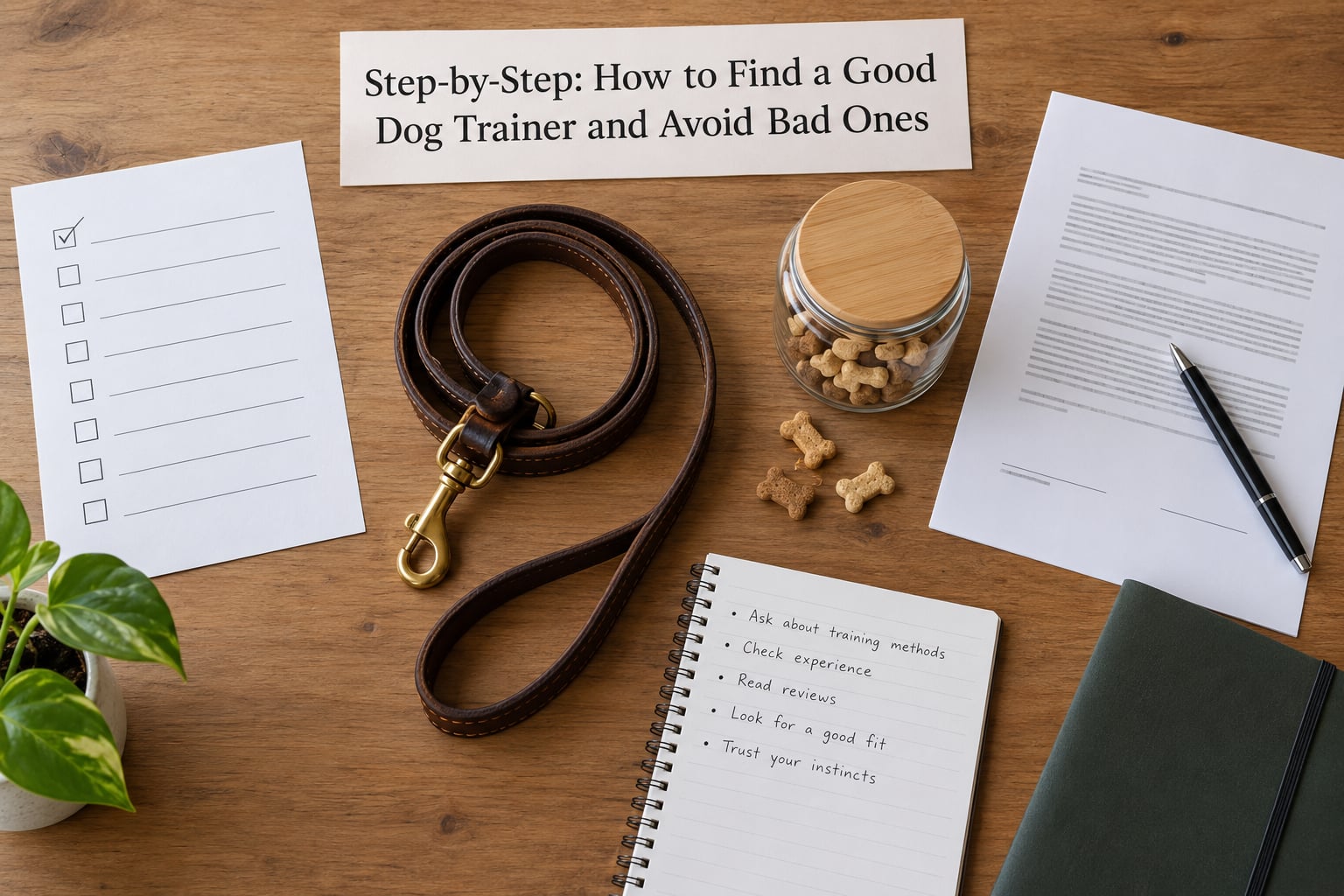
Step-by-Step: How to Find a Good Dog Trainer and Avoid Bad Ones
Define Your Dog’s Training Needs
Write the goal in one sentence a stranger could act on: stop the barking at the door, walk without pulling, stop the growling when you lift a treat.
Then match the severity of the problem to the level of credential. Basic obedience gaps, puppy habits and routine manners are normal trainer work. Leash reactivity, fear of strangers, separation anxiety and resource guarding need someone with behaviour-specific training, either a behaviour consultant or, for separation anxiety, a CSAT specialist. Any bite history, any aggression toward people, and any scenario where your dog could hurt someone belong with a board-certified veterinary behaviourist, a DACVB, who is a veterinarian first and a behaviour specialist second.
Getting this match wrong is expensive. Owners of reactive dogs routinely tell forum threads that they were the fourth or fifth trainer in the room, and that the earlier sessions set the dog back rather than moving it forward.
Check Credentials, Methods, and Experience
Ask for the credential, the issuing body and the date, then check it yourself. These are the ones you will actually meet:
- CPDT-KA (Certification Council for Professional Dog Trainers, Knowledge Assessment) is the most widely recognised entry-level credential. CCPDT is a newer certification from the same body.
- CDBC (Certified Dog Behavior Consultant) from the IAABC, the International Association of Animal Behavior Consultants, requires graded coursework in behaviour science and carries recertification every three years.
- KPA-CTP, the Karen Pryor Academy Certified Trainer Program, is built on reward-based operant conditioning.
- LIMA (Learning Is Motivation Award) and the Fear Free pledge are self-attested commitments, not qualifications. Useful signal, weak proof.
- CSAT is the Certified Separation Anxiety Trainer designation, narrow but relevant if separation is the problem.
- DACVB (Diplomate of the American College of Veterinary Behaviorists) is a veterinary degree plus a residency in behaviour. ABS certified behaviourists hold a master’s or doctorate in a behavioural science field.
Every registry is public. Look the name up, confirm it is current rather than lapsed, and ask what the last renewal cycle required. Then ask for two references with the same problem you have, and for proof of liability insurance.
Credentials tell you about study, not about hands-on skill with your specific dog. Ask how many dogs a month they see, how many of those had your problem, and which breeds they work with most. Someone who has trained fifty cattle dogs knows pressure and arousal in a way a generalist does not.
On method, the evidence is one-sided enough to use as a filter. Studies by Herron and colleagues in 2009, Schilder and colleagues in 2004, and Vieira de Castro and colleagues in 2019 all found reward-based training associated with lower stress markers and lower cortisol, while aversive tools and punishment were linked to higher stress and more defensive and avoidance behaviour, including suppressed warning growls. A trainer who reaches for punishment is not behind the times; they are working against the literature.
Ask Safety and Welfare Questions Before You Pay
Ask these eight out loud, at the consultation, and write the answers down.
- What is your current credential, and when does it expire? A trainer who hesitates here has something to hide.
- What tools do you use with dogs? The honest answer is food, toys, a lead, a harness and their hands. Shock collars, prong collars, choke collars, spray bottles and leash corrections are all reasons to end the conversation.
- What happens when my dog gets it wrong? This is Jean Donaldson’s question and the single most revealing one. A good trainer explains what the dog will do next and how the dog learns from it. An evasive answer means the punishment has to be unpredictable to work.
- How do you tell whether my dog is uncomfortable versus stubborn? They should list signals: lip licking, yawning, tucked tail, pinned ears, whale eye, freezing, panting, refusing food.
- What happens if the behaviour gets worse? You want a plan, not a shrug.
- Do you work with other veterinary professionals, and when would you refer me on? Anyone who never refers out is claiming to treat everything.
- Do I attend the sessions, and what do I practise between them? Owner participation is the strongest predictor of whether the behaviour survives past the last appointment.
- May I observe a session or a trial class before committing to a package? A no here is informative.
Observe a Trial Session and Watch Your Dog
Sit in on a session, yours or someone else’s, before you commit. Watch the trainer, not the dog: are they explaining why each exercise matters, and are they adjusting when a dog is uncomfortable?
Watch the dog too. Stress shows up before it shows up as fear. Tucked tail, pinned ears, lip licking, yawning out of context, whale eye, a frozen posture, panting in a cool room, refusing treats, or repeatedly scanning the exits all mean the dog is trying to make the situation end. One signal in passing is noise; a cluster of them is a message.
Raise it on the spot rather than afterwards. Say: my dog is showing stress, please lower the difficulty. How the trainer responds tells you more than the entire consultation.
Do not take a method label on trust. One owner described on r/reactivedogs hiring a well-reviewed trainer who sold herself as positive reinforcement. When the dog began to resource guard, the trainer suppressed the growl with ground stomps and a spray bottle, which escalated the guarding into lunging, and when that failed she recommended an e-collar. The owner stopped, found someone else, and that trainer allowed the growl as communication and redirected the younger dog instead. The lesson is not that the label is meaningless; it is that you have to watch the handling.
Confirm Costs, Policies, and Communication in Writing
Price varies with region, credential level, travel and session format, so treat any figure you read online as out of date and ask for current rates directly. Group classes cost the least per dog. Private sessions cost more because they include your time and travel, and behaviour consults cost most because they are long, detailed and often involve video review of home footage.
Ask what a first session costs, what a typical block of sessions costs, what is refundable, and what happens if the programme is not working. If the answer contains a guarantee, that is your answer. No ethical trainer can guarantee how a living animal will behave in six months, and the ones who promise it are usually the ones selling a fast fix.
Treat board-and-train with real caution. A programme where your dog boards and trains with little or no owner involvement can produce a well-behaved dog that reverts the day it walks through your door, because the behaviour was never transferred to you. Ask how many hours you attend and what the handover looks like.
Then get the agreement in writing before the first payment: goals, session length and format, cancellation terms, what is included, what homework you owe, who handles emergencies, and how either side ends the arrangement. A trainer who resists a written agreement has a reason.
Common Mistakes to Avoid When Hiring a Dog Trainer
Booking from a directory listing without making a call. Directories are advertising, not vetting. Call, ask the eight questions, and treat a trainer who will not take one as pre-screened out.
Believing a guarantee. A trainer who promises a fixed dog is selling something. Behaviour change is slow, partly luck-dependent, and shaped by everything happening in your house that you cannot control.
Ignoring your dog’s body language because the trainer seems confident. Confidence is not evidence. If your dog is trying to leave, it is trying to leave, regardless of whose class you are in.
Skipping the contract. Most owner-trainer disputes I have heard about come down to no written scope, no cancellation terms and no exit clause. Ten minutes of typing removes most of that exposure.
Treating the first meeting as a real trial when it is really an evaluation. Twenty dogs in a room is a demonstration, not an assessment. A genuine trial is one dog, one problem, one calm handling session, and a conversation afterwards.
Staying too long after things get worse. If two or three sessions in, your dog is more shut down, more reactive or more avoidant than at the start, stop the sessions and write down the specific behaviours that changed.
Tell the trainer in writing what you observed and pause payment, and ask for a written summary plus any records so you can hand them to the next professional. Get your dog checked by a vet for pain, then look for a behaviour consultant rather than another general trainer. Rebuilding your dog’s trust takes distance work, food games and letting your dog opt out of an activity, rewarding the choice every time.
Be aware of one thing when you raise concerns: some trainers take it as a personal insult, and a trainer who badmouths the professionals you came from has just shown you one more reason to leave.
Frequently Asked Questions
What credentials should I look for in a dog trainer?
Look for a credential you can verify yourself in the issuing body’s public registry, not a self-awarded title. CPDT-KA or CCPDT from the Certification Council for Professional Dog Trainers, CDBC from the IAABC, and KPA-CTP from Karen Pryor Academy are the common entry points. A DACVB, a diplomate of the American College of Veterinary Behaviorists, is the medical tier. Always ask when it was earned and when it was last renewed.
Is dog trainer certification required by law?
No. There is no licensing board for dog trainers in the US or most other countries, and no legal definition of the words trainer or behaviourist. Titles like master dog trainer are unregulated and can be self-awarded. Certification is entirely voluntary, which is precisely why you verify it yourself instead of trusting the wording on a website.
How much should a good dog trainer cost?
Prices vary by region, credential level and session format, so any figure you find online will be out of date. Group classes are the cheapest per dog because the trainer’s time is shared. Private sessions and behaviour consults cost more because they include your time, travel and much longer case analysis. Ask for the current rate of a first session, what a typical block costs, and what is refundable before you book anything.
Should I choose a private lesson or a group class for my dog?
Group classes suit healthy puppies and dogs with straightforward obedience gaps, largely because they cost less per dog and build social skills. Private lessons suit dogs that shut down, fear other dogs, or have a bite history, because there is no audience to cope with. Many trainers recommend one private session first to assess the dog, then group work. Ask what the first visit looks like either way.
How do I know if a trainer is using unsafe methods?
Listen for dominance, alpha or pack-leader language, and watch for shock collars, prong or choke collars, spray bottles, leash corrections and alpha rolls. Treat a promise of a quick fix, or any guarantee of results, as a red flag too. Studies including Herron in 2009 and Vieira de Castro in 2019 linked reward-based training with lower stress and aversive tools with higher stress and more defensive behaviour. Ask directly which tools they use.
What should I do if my dog seems afraid during training?
Say it in the moment, calmly, and ask the trainer to lower the difficulty or stop. Watch for a tucked tail, pinned ears, lip licking, yawning, whale eye, freezing, panting or a refusal of treats, which signal stress rather than stubbornness. A good trainer adjusts or ends the exercise immediately. If they push through the signals, leave the session and ask about the refund for that visit before you book again.
Conclusion
Start on paper. Write the training goal in one sentence, get the vet to rule out pain, and copy the eight screening questions onto a sheet you can hold in your hand.
Then write your own leave-the-room list before you meet anyone: aversive tools on the belt, dominance language, a promised guarantee, a refusal to let you observe, pressure to prepay a block. Those are not preferences, they are thresholds, and deciding them in advance keeps you steady when someone very confident is describing your dog back to you.
Watch one real session before you pay for a programme. If your dog stays willing to be there, you have probably found your person.