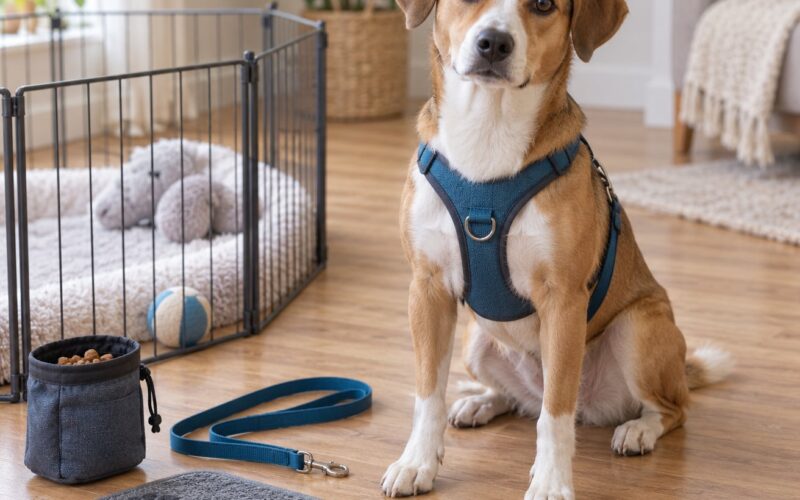
The decompression period for rescue dogs is the settling-in phase after adoption, when a dog’s nervous system comes down from shelter stress, transport and a completely unfamiliar home. It usually takes a few days to a few months, and its real job is to let your dog relax, eat and feel safe before you start training or socialising.
Most adopters underestimate it. They expect a happy, tired dog on day one, and then worry when they get a dog that hides under the bed, refuses dinner and startles at the vacuum. That behaviour is not stubbornness or a bad match. It is a nervous system doing what it was trained to do.
Quick summary before you read on:
- Decompression usually starts the moment the dog enters your home, not the day you bring them to a park.
- The widely used 3-3-3 framework is a rough guide: 3 days to feel safe enough, 3 weeks to settle, 3 months to feel like home.
- Your dog is not behind schedule. Many severely shut-down dogs need six months or more.
- Watch body language, not the calendar.
- Any symptom that worries you medically belongs with a veterinarian, not a calendar.
Table of Contents
- What Is the Decompression Period for Rescue Dogs?
- Why a rescue dog’s nervous system stays switched on
- What decompression is not
- How Long Does a Rescue Dog Need to Decompress?
- The 3-3-3 rule explained
- What each phase usually looks like
- Why some dogs need far longer than three months
- What Does a Decompressing Rescue Dog Look Like?
- How to Help a Rescue Dog During Decompression
- Set up the safe space before the dog arrives
- Keep the first 72 hours deliberately boring
- Introductions: resident pets, children and the outside world
- Escape risk during the first weeks
- Common mistakes during decompression
- Look after yourself too
- Decompression Period for Rescue Dogs vs. Training Progress
- When Should You Contact a Veterinarian or Behaviour Professional?
- Red flags for a veterinarian
- Red flags for a behaviour professional
- Frequently Asked Questions
- How long does decompression take for a rescue dog?
- What is the 7-7-7 rule for rescue dogs?
- My rescue dog is still scared after a month. Is this normal?
- Can I walk my rescue dog during decompression?
- Should I use a crate for a rescue dog?
- How do I stop my rescue dog escaping or fence scaling?
- Start Small and Let the Dog Set the Pace
What Is the Decompression Period for Rescue Dogs?
The decompression period is the time a newly adopted dog needs to come down from sustained stress and start feeling safe in a new environment. It is not a training phase and it is not a test of character. It is the quiet recovery window in which the nervous system recalibrates, appetite returns and normal behaviour starts to reappear.
Why a rescue dog’s nervous system stays switched on
Dogs read their surroundings constantly. Smells, floor surfaces, the sound of a different kettle, a stranger’s shoes left by the door: every one of those is information to process. In a shelter or a long-stay kennel, that information is relentless, and the dog adapts by staying alert and scanning.
Stress hormones run high for a long stretch in that environment. The result is a dog who can appear “fine” on adoption day because the relief of the new home briefly masks the accumulated tension. As the novelty of safety wears off, the pressure shows up as hiding, pacing or barking, sometimes days later.
Adopters often report the same pattern in forums: the dog looked settled at the shelter, then decompressed only once home. If your dog seems to get worse in week two instead of better, that is a widely recognised part of the process rather than evidence the adoption failed.
What decompression is not
It is not a period you have to earn your way through. It is not punishment for a sensitive dog, and it is not proof that the dog came damaged and cannot be helped. Treating the first weeks as a project to hurry along is the most common way adopters lose the trust they were building.
How Long Does a Rescue Dog Need to Decompress?
There is no fixed length. A straightforward foster-to-adoption move into a quiet home with no resident pets can settle in weeks. A dog from long-term kennels with an unknown history, or one that shuts down completely rather than acting out, may still be working through it after six months. Use the timelines below as reference points and your dog’s own behaviour as the real measure.

The 3-3-3 rule explained
The 3-3-3 rule comes from Second Chance Ranch Rescue and is the most widely repeated framework for new dog owners. It splits the adjustment into three phases:
- 3 days to decompress. In a shelter the dog was already handling noise and people. Arriving somewhere quieter feels enormous, and sleep, appetite and elimination can all fall apart.
- 3 weeks to settle. A predictable routine becomes familiar, the dog starts to anticipate meals and walks, and the first real bonds form.
- 3 months to feel at home. This is where behaviour and training become genuinely workable, for most dogs.
Use it as a planning tool, not a countdown. If your dog is still hiding at eight weeks, that is not a failure. Plenty of dogs with hard histories sit well outside the three-month line.
What each phase usually looks like
| Phase | What your dog is doing | What you should do |
|---|---|---|
| Before arrival | Waiting in a foster home or shelter | Prepare a quiet room, buy the same food they already eat, gather a blanket with a familiar scent |
| Days 1 to 3 | Hiding, startle, poor appetite, disrupted sleep | Keep the home calm, sit in the room and read aloud, keep visits short |
| Days 3 to 7 | Emerging to eat and toilet, cautious exploration | Hold the routine steady, start short identical walks, begin basic name and marker word |
| Weeks 2 to 3 | Longer walks, play, first interest in people | Widen the world gradually, start formal training in short sessions |
| Weeks 4 to 12 | Normal play, learning well, some regression around triggers | Continue classes and enrichment, protect the safe space the dog still has |
| Beyond 3 months | Long-term adjustment, occasional setbacks | Keep working on behaviour with professional support where needed |
Why some dogs need far longer than three months
Length depends mostly on what came before and how the dog copes. Dogs that freeze or shut down often take longer than dogs that bark and spin, because the outward behaviour is not the whole story. Kennel disease, an unresolved medical issue, or simply an environment that never allowed rest will all stretch the timeline.
There is also the 7-7-7 rule, a less common framework used mainly in multi-dog and predation-risk households. It suggests seven days, seven weeks and seven months. It shows up in a lot of search results and confuses a lot of people, so treat it as one variant among several rather than a competing truth.
What Does a Decompressing Rescue Dog Look Like?
Stress shows up in two very different ways, and knowing which one you are looking at changes how you respond. What matters in both cases is the same: reduced appetite, disrupted sleep and a dog who cannot settle are the most common physical signals.
| Sign | Shutdown presentation | Hyperactive presentation |
|---|---|---|
| Movement | Hiding under furniture, freezing, moving slowly | Pacing, spinning, jumping, unable to settle |
| Face | Avoiding eye contact, ears back, whale eye | Wide-eyed scanning, lip licking, repeated yawning |
| Noise | Very quiet, flinching at sudden sound | Barking, whining, reactivity to outside sounds |
| Appetite | Refusing food, eating only when alone | Eating fast and then vomiting from gulping |
| Social contact | Taking treats from your hand but turning away | Over-friendly at first, jumping and mouthing to cope |
| What helps | Distance, quiet, no eye contact pressure | Movement, sniffing, predictable low-key activity |
Signs of settling are quieter than you might expect. Eating at the same times each day, choosing to nap in the room you are in, a softer body when you reach for the harness, and a dog who notices you leave and comes back are all progress, even when nothing dramatic happens.
Expect the process to be uneven. Good days followed by a bad one is normal, and experienced adopters in rescue communities say repeatedly that one hard day does not undo a week of progress.
How to Help a Rescue Dog During Decompression
Set up the safe space before the dog arrives
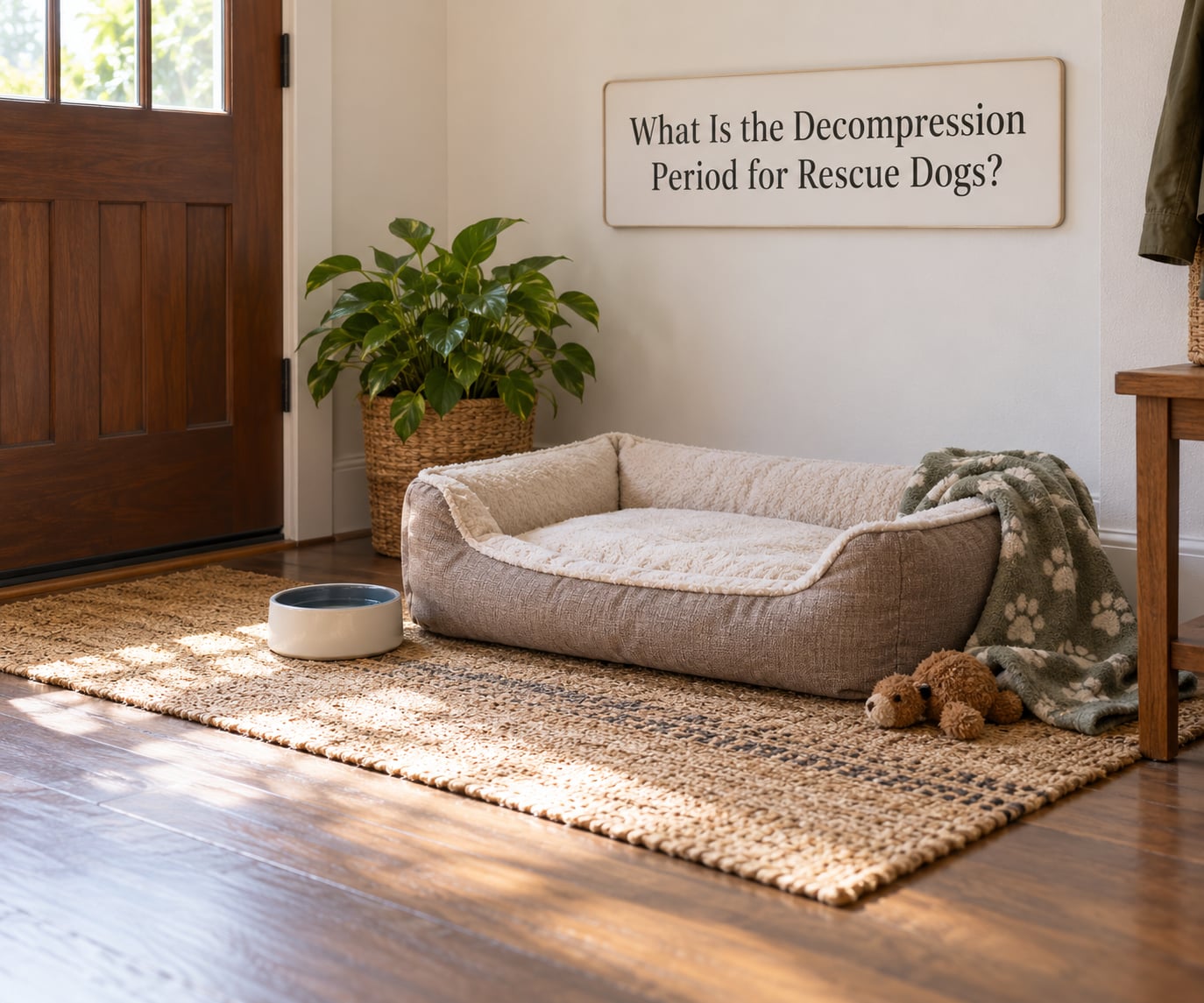
Pick one room in the house that will be the dog’s base camp and make it ready in advance. It should be away from the front door, contain water, a bed and a few safe chews, and have a gate or door you can close.
Leave that space open for the whole decompression period, not just week one. A dog who knows one predictable room is where they can escape to will use it, and that choice is what makes telling a worried dog “go to your bed” a useful cue later on.
Ask the shelter or current carer what food they are eating and buy the same brand. Change of diet plus change of home is a lot for one stomach at once. If you want to switch food, do it a couple of weeks later.
Keep the first 72 hours deliberately boring
Do less than feels productive. Sit in the room, read something out loud quietly, and let the dog decide whether to come closer. Talk to rescue dog decompressers, many of whom describe a “three day decompression” as sitting on the floor with a cup of coffee and ignoring the dog on purpose. It works because pressure to perform is the opposite of what the dog needs.
Hold a routine you can keep for weeks: same wake time, same meal times, same short walk at the same quiet time. Predictability is what actually lowers stress, not the content of the walk.
Physical and digestive symptoms deserve attention in their own right. Stress diarrhoea, vomiting and a poor appetite are common early on, and kennel cough can appear in the first few weeks. Never give human medication, and ask a veterinarian about anything that does not settle within a day or two.
Introductions: resident pets, children and the outside world
With a resident dog, work in stages and never rush straight to a face-to-face meeting. First swap bedding so each dog reads the other’s scent, then allow visual contact through a baby gate or cracked door, then take parallel walks a few metres apart, and only then consider a supervised meeting on lead. Some rescues keep dogs completely separated for the first two weeks, and that is a reasonable choice if either dog is reactive.
With children, write the rules down before the dog arrives and put them on the fridge: no hugging, no climbing over the dog, no disturbing a sleeping dog, no picking up, and the child who wants to interact goes through the adult. Toddlers and puppies and decompressing rescue dogs are a difficult combination and need close supervision in every room, including rooms you think the dog cannot reach.
With the outside world, keep walks short, on the same route, and away from other dogs and busy people at first. If someone asks to meet the new dog, ask them to wait. That request feels awkward once and saves a lot of trouble later.
Escape risk during the first weeks
Undersocialised dogs often attempt to escape or scale fences when left alone, particularly if they have spent time in kennels. Check gates, latches and fence lines before the first day alone, keep the first solo periods short and inside, and use a long line attached to a secure harness rather than a collar for anything outdoors. The safety gate is not a training failure. It prevents a dog escaping before it has learned that your home is where it stays.
Common mistakes during decompression
- Too many visitors. Enthusiasm is the most common cause of a bad first week. House rules beat good intentions.
- Starting real training too early. A dog that is still hiding cannot learn a cue. Let appetite and sleep return first.
- Reading behaviour as character. Hiding is not stubbornness and barking is not dominance.
- Chasing the calendar. Hitting day 21 does not change anything.
- Trying to fill every minute. Dogs decompressing in kennels rarely get real rest. Sleep and boredom are the treatment.
- Comparing timelines. Another adopter’s week-two dog tells you nothing about yours.
Look after yourself too
Adopter anxiety during the hiding phase is common and often louder than the dog’s behaviour. Talks to the rescue before you collect, keeping a short daily note of small changes, and reminding yourself that a dog who eats on day four is working hard, all help. If the uncertainty is affecting you badly, that is a reason to lean on the rescue’s staff or a behaviour professional, not a reason to feel you made the wrong choice.
Decompression Period for Rescue Dogs vs. Training Progress
Decompression and training are not opponents. Decompression is what makes training possible. The mistake is starting formal work while a dog is still in survival mode, because a nervous dog cannot hold attention and any session then reads as failure.
| Phase | Goal | Typical timing | Signs of readiness |
|---|---|---|---|
| Decompression | Feel safe, rest, eat, eliminate on a routine | Days 1 to 21 for most dogs | Eating regularly, some exploration, settling when you are near |
| Basic foundation training | Name response, marker word, loose lead, settle on a mat | From around week 2 to 3 | Taking treats, soft body, can focus for short bursts |
| Socialisation and public skills | Calm around people, dogs, handling and environments | From around week 8, in small doses | Recovering quickly after surprises, eating in public |
| Advanced behaviour work | Reactivity, fear, handling sensitivity | Any time, with professional guidance | Needs a plan; do it under an experienced trainer |
How long decompression should last before training starts comes down to readiness, not a date. Ask three questions: is the dog eating reliably, does the body soften when you approach, and can they take a treat without lunging? If the answers are yes, short positive reinforcement sessions will do more harm than waiting would.
When Should You Contact a Veterinarian or Behaviour Professional?
Some distress is expected during decompression. What matters is separating normal stress signals from signs that need a professional. Book the first vet appointment in the first week regardless, so you have a baseline and any anxiety is discussed early rather than in a crisis.
Red flags for a veterinarian
- Refusing all food and water for more than 24 hours
- Repeated vomiting or diarrhoea, or blood in either
- A persistent cough, sneezing or nasal discharge, which can be kennel cough
- Not urinating, or straining without producing urine
- Limping, lethargy, or any symptom that appears suddenly
- Skin irritation, hair loss or a wound
- A dog that seems disoriented or cannot settle in any position
Never give human medication to a dog. Several common pain and cold remedies are toxic to dogs, and a quick call to your vet or an emergency clinic is faster than searching online.
Red flags for a behaviour professional
- Bite history, or a dog that has gone from friendly to stiff without warning
- Hard guarding of food, toys or people that is escalating
- Reactivity that is not reducing with distance and low-pressure work
- Extreme fear that has not shifted after three months, when quality of life for the dog is suffering
- Escape attempts that risk injury to the dog
Ask for a certified behaviourist, an applied behaviourist or a qualified reward-based trainer, and be wary of anyone recommending dominance methods or alpha rolls. Get help early if the dog cannot eat, rest or stop hurting itself.
Frequently Asked Questions
How long does decompression take for a rescue dog?
Most dogs show the first signs of settling within three days, feel genuinely relaxed around the three-week mark and reach a stable adjustment by about three months. That is the 3-3-3 guide. Dogs from long-term kennels or with unknown histories often need six months or longer, and some shut-down dogs are still working through it after a year. Watch your dog’s behaviour rather than the calendar.
What is the 7-7-7 rule for rescue dogs?
The 7-7-7 rule is a variant of the 3-3-3 framework that uses seven days, seven weeks and seven months. It is used most often with dogs that need longer, particularly in multi-dog households or after a difficult history. It is not more accurate than 3-3-3, only slower. Use whichever fits your dog’s pace and treat both as reference points rather than deadlines.
My rescue dog is still scared after a month. Is this normal?
Yes, this is common, especially if the dog was in a shelter or kennel for a long time. Fear in a new home often surfaces in waves rather than fading on a smooth curve, and progress is not linear. Look for small changes like eating on a routine or resting near you. If the fear is extreme, escalating, or paired with not eating or not sleeping, contact a veterinarian or behaviourist.
Can I walk my rescue dog during decompression?
Short, predictable walks help more than long varied ones. Start with five minutes on the same quiet route at the same time each day, away from other dogs and busy places. A long line on a secure harness is safer than letting the dog off lead, since escape risk is higher before the dog is settled. Increase the duration only when the dog is relaxed at the start and end of each walk.
Should I use a crate for a rescue dog?
A crate can work as a den if the dog chooses to go in and stays relaxed there, but never use one to punish or to force the dog inside. Many decompressing dogs prefer a gated room with a bed, which gives the same option to retreat without confinement. If you are introducing a crate during a stressful period, wait until the dog is eating normally, and never leave a crated dog longer than it can hold its bladder.
How do I stop my rescue dog escaping or fence scaling?
Check every gate, latch and fence line before the dog arrives and again before the first time they are left alone. Supervise outdoors, use a long line attached to a secure harness, and keep the first periods alone short and indoors. Avoid tethering unattended or crating a dog that has a history of panicking, since both can make escape behaviour worse. Ask a behaviourist for a plan if attempts are increasing.
Start Small and Let the Dog Set the Pace
Prepare one quiet room, keep the first three days boring, and hold a routine you can sustain for weeks. That is the whole job at the start. Everything else, walks, visitors, resident pets and training, can wait until the dog is eating and sleeping on a normal pattern.
Read your dog’s body instead of the calendar, give it more time when it needs it, and call a veterinarian early about anything physical. Rescue dogs settle at the pace their nervous system allows, and the ones who decompress properly tend to be the easiest to live with for years afterwards.