Corgi exercise and weight management come down to two numbers you can actually track: how much daily activity your dog gets, and how many calories go into the bowl and into the treat jar. Most healthy adult corgis do well on roughly 45 to 60 minutes of walking spread across two or three outings, plus 10 to 20 minutes of sniffing or puzzle play, and they stay lean when treats stay under about 10% of their total intake.
Corgis are built low and long, which is charming and awkward at the same time. They are classified as chondrodystrophic breeds, meaning their spine is longer and more vulnerable than most dogs of their size, and extra weight presses on discs that have less room than they need. That is why weight control and back-safe movement belong in the same plan rather than two separate ones.
This guide covers both halves: what a normal day looks like at each life stage, how to adjust when your corgi is carrying extra weight or has a stiff back, and how to tell the difference between “lazy” and “unwell.” Nothing here replaces your veterinarian, and any corgi with breathing trouble, weakness in the back legs, or sudden pain needs to be seen by one today.
Table of Contents
- How much exercise does a corgi need?
- What is a safe daily corgi exercise routine?
- How can corgi weight management work without starving your dog?
- A six-week plan for an overweight corgi
- Use food as part of the exercise, not just the meal
- Which exercises should corgi owners avoid?
- How do I tell whether my corgi is at a healthy weight?
- Ten low-impact ways to add activity
- How do exercise and weight management change as a corgi ages?
- Puppies: build the pattern, protect the growth plates
- Adults: maintain, and correct early drift
- Senior corgis: shorter, more frequent, flatter
- When corgi exercise and weight management get more complicated
- How do I adjust the routine after too much or too little exercise?
- Frequently Asked Questions
- How much exercise does a corgi need per day?
- Are corgis prone to being overweight?
- Is 40 lbs overweight for a corgi?
- How long should I walk my dog each day for her to lose weight?
- What not to feed corgis?
- What are the early signs of IVDD in corgis?
- What to do first
How much exercise does a corgi need?
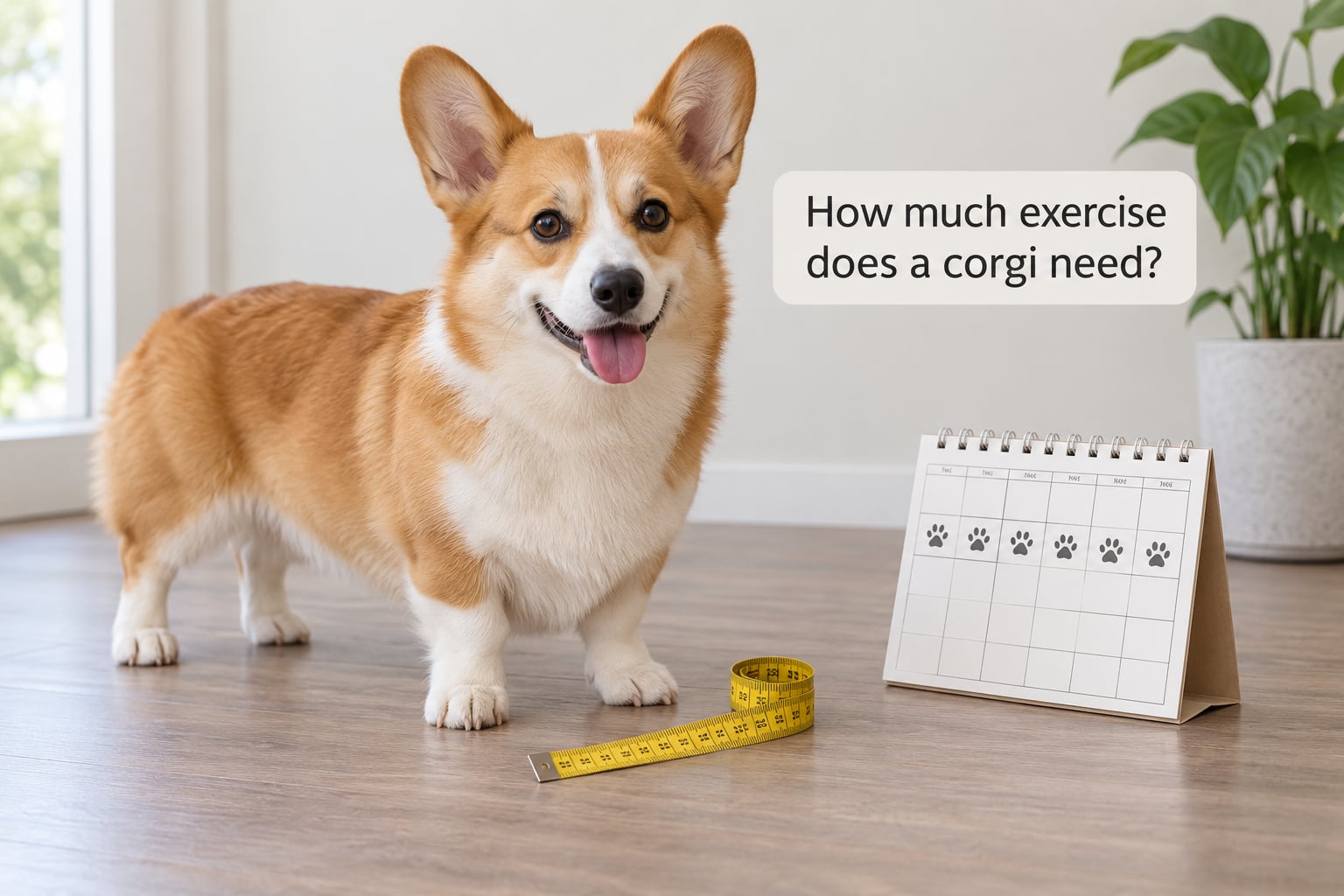
A healthy adult corgi needs about 60 to 90 minutes of activity spread over the day, most of it walking, plus mental work on top. Splitting that into two or three sessions suits the breed better than one long block, because corgis were bred to work in short bursts rather than to trot for hours.
That number is a starting point, not a target to force. A two-year-old in good shape on grass may comfortably handle more, while an overweight ten-year-old with stiff hips may manage 20 minutes and need rest. Age, body condition, weather, and any diagnosed joint or back problem all move the figure in one direction or the other.
| Life stage | Walking per day | How to split it | Enrichment focus |
|---|---|---|---|
| Puppy (8 weeks to 6 months) | About 5 minutes per month of age, several times a day | 3 to 5 short outings on soft ground | Short nose-work sessions, name games, gentle handling |
| Adolescent (6 to 12 months) | 30 to 60 minutes | Two walks plus a play session | Puzzle feeders, scent trails in the garden |
| Adult (1 to 7 years) | 60 to 90 minutes | Two or three walks across the day | Scatter feeding, hide and seek, trick training |
| Senior (8 years and older) | 30 to 60 minutes | Three or four short, gentle walks | Foraging games, lick mats, nose work at floor level |
| Overweight or stiff | Start at 15 to 30 minutes and build slowly | Several very short outings on flat, soft ground | Food puzzles that keep the dog busy without jumping |
Structured pavement walks should wait until a puppy is around four to six months old, because their growth plates are still open. Grass, sand, and carpet are kinder surfaces for young puppies and for any dog with joint trouble.
Weather is part of the number too, and owners of corgis tend to forget the coat. This is a dense double coat built for cold, wet Welsh weather, and it does not shed heat well in the other direction. In summer, walk before nine in the morning or after seven in the evening, keep sessions short on humid days, and carry water on every outing. A dark road surface in full sun can be hot enough for bare feet and much worse for a dog in a thick coat.
In winter, the risk is the opposite. Short legs plus a chest close to the ground means your corgi meets the underside of drifts, slush and ice with their chest and belly on every step, so keep walks shorter and check paws afterwards for grit or cracks.
What is a safe daily corgi exercise routine?

A corgi routine that holds up in real life has four parts: a morning walk to wake the body up, a midday block of sniffing or play that burns energy without impact, a second or third walk in the evening, and a short training or puzzle session that leaves the dog tired in the head rather than the legs.
- Morning walk, 20 to 30 minutes. Brisk but conversational pace. If your corgi can walk and bark at the same time, the pace is about right.
- Midday sniffing, 10 to 20 minutes. Let the lead drag on soft ground, scatter a handful of kibble in the grass, or hide a few treats in a snuffle mat. Slow, searching work tires a herding dog more than running does.
- Low-impact play, 10 minutes. Tug on a soft rope with two hands, or roll a ball along the floor. Both can be done sitting, which is why they suit arthritic dogs and wet weather.
- Evening walk, 30 to 40 minutes. Add a gentle hill or a longer sniff break here if the dog is moving well. This is the session to shorten in heat.
- Training or a puzzle, 10 to 15 minutes. Five minutes of shaping games or a lick mat at the end of the day settles a restless dog and keeps the household sane.
Take water on every outing, go early in the morning or last thing in the evening during warm weather, and stop while your corgi still wants to go. A dog that is still keen at the end of a walk usually walked the right distance.
How can corgi weight management work without starving your dog?
Weight management is not a diet. It is accurate bookkeeping about what goes in, plus exercise that spends it. Restricting a corgi to a token portion without changing anything else produces a hungry, noisy dog with the same weight, and over-restriction can trigger serious problems.
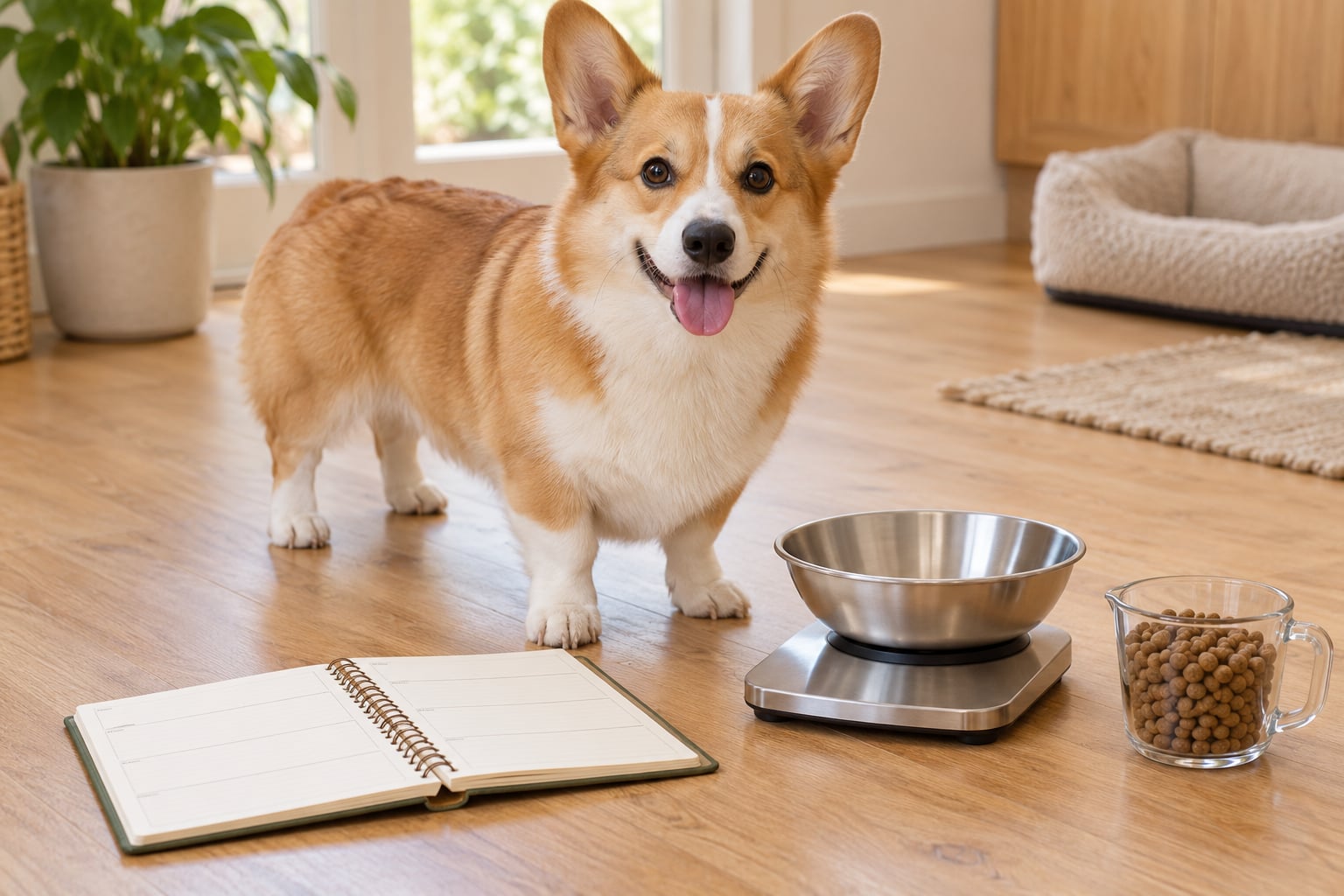
Measure meals instead of eyeballing them. Most owners who switch to a scale or a proper measuring cup report that this alone removes most of the slow drift. Read the label rather than the front of the bag: the calorie density per cup varies enormously between foods, so a cup of one food can be worth two cups of another.
Split the daily allowance into two or three measured meals. Corgis are grazing herding breeds and a large evening bowl on top of three treats from the family dinner often turns into a dog with no flat area left to lie down on.
Set a treat budget instead of a treat ban. A useful rule is that treats, training rewards, chews, and dental sticks together stay under roughly 10% of daily calories. Work the number out from your own food’s label and then weigh the treats for a week to learn what ten percent looks like in grams. One large biscuit can swallow the whole budget.
Deal with the household, not just the dog. The untracked calories that push a corgi over its target are usually nibbles from plates, dropped food during training, and the piece the children hand over. Some owners fix this by switching to a portioned feeder or a puzzle bowl so the dog eats alone; others simply tell everyone in the house what the daily limit is, in the same way they would talk about a toddler’s snacks.
And keep the diet complete. Food should be labelled as complete and balanced for the life stage, with the appropriate AAFCO or FEDIAF statement. Your veterinarian can calculate a maintenance or weight-reduction requirement for your individual dog; a chart on a bag is a starting point, not a prescription.
A six-week plan for an overweight corgi
Owners who succeed tend to change one or two things at a time and track them, rather than rewriting everything on Monday. This is the sequence that works for most dogs whose vet has cleared them for normal activity.
- Week one, measure everything. Weigh the dog, photograph them from above and from the side, and log every meal, treat and chew for seven days. Almost everyone finds 100 to 200 extra calories a day hiding in training rewards and nibbles.
- Week two, set the budget. Decide the daily total with your vet, then divide it: about 90% from measured meals, up to 10% for treats and training. Weigh the treats on a kitchen scale once so you know what that allowance looks like in your hand.
- Weeks three and four, add movement slowly. One extra 15-minute walk on flat ground, three or four days a week. Nothing high impact, nothing that leaves your dog limping or stiff the next morning.
- Week five, look at the picture, not the scale. Take the same two photographs. A visible waist and an easier rise off the floor count as progress even when the scale has barely moved.
- Week six, reweigh and reassess. Aim for slow, steady change. Losing more than about 1% of body weight per week is faster than you want and often ends in a dog who raids the bins, and steady loss takes a few months rather than a few weeks.
If two weeks of logged portions produce no change at all, do not simply cut more. Check the log first, then bring it to your veterinarian, because a dog that is not responding to a correct diet may have an underlying medical cause.
Use food as part of the exercise, not just the meal
A corgi’s working brain will happily accept food as payment, which makes food the most useful training tool you own. Scatter part of the meal across the garden, stuff a puzzle feeder, or hide small pieces around the room so the dog spends ten minutes foraging instead of eating in three seconds.
Owners report two clear benefits from this. The meal takes longer, so the dog is busy, and the day gains a chunk of mental exercise that walking alone does not provide. It also removes the boring “give me a treat” chatter, because the dog has already worked for part of its calories.
Watch the household, not just the bowl. Some of the biggest untracked gains happen in the seconds around dinner, so a feeding station in another room or a portioned bowl that empties slowly usually does more than any food change. If begging is the problem, the fix is physical distance and a full bowl in a room the family is not eating in.
Which exercises should corgi owners avoid?
The most common injuries in corgis come from jumping onto furniture, bouncing down steps, and leaping in and out of cars. These are short, sharp spinal compressions repeated hundreds of times over a dog’s life, and the risk climbs with every extra pound on the ribcage.
| Instead of this | Try this | Why it matters |
|---|---|---|
| Jumping off the sofa or bed | A sturdy ramp or steps leading down | Removes the impact that lands on the discs |
| Jumping into and out of the car | A ramp or a step, plus lifting for short, tall cars | Protects the back and the shoulders |
| Stairs and stairs down | Blocking the staircase, or a ramp over the top step | Repeated long-spine flexion is the classic trigger |
| Agility and high hurdles | Ground-level herding games, low weave poles on grass | Twisting and landing from height both load the spine |
| Long runs and steep hill repeats | Long flat walks at a steady pace | Builds fitness with far less compression and wear |
| Frisbee and high flying disc | A rolled ball on the ground, or a rope tug | Twisting mid-air is a common disc injury pattern |
Watch for the early signs of intervertebral disc disease: a hunched back when standing, reluctance to jump or climb, a lowered head while walking, yelping when the back is touched, dragging or weakness in the rear legs, or a sudden change in posture after minor handling. Collapse or complete loss of movement in the back legs is an emergency, not a wait-and-see, and needs a veterinary clinic the same day.
Most corgis can swim and many enjoy it, which makes water a good low-impact way to build fitness for a dog whose joints or back cannot handle long walks. Introduce it gradually, on a warm day, with a person at the dog’s level, and keep sessions short. A wet dog with a heavy double coat tires quickly, and corgis are not strong swimmers at long distances, so a pool with easy exit steps or shallow water suits best.
How do I tell whether my corgi is at a healthy weight?
Scales and breed charts mislead more often than they help, because two dogs of identical weight can look completely different. The tool veterinarians actually use is the body condition score, a nine-point scale where 4 or 5 out of 9 is ideal.
Run the check on a weekly rhythm, in the same room, before you have spent the day’s treats.
- Look from above. Standing over your corgi, you should be able to see a clear waist where the body narrows behind the last rib. At 5 out of 9 the waist is still visible from above; from 6 upward the back looks level and rounded.
- Run your hands over the ribs. You should feel the tips easily through a thin fat covering, without digging for them. Bones that feel sharp and prominent usually mean the dog is too thin.
- Look from the side. There should be an abdominal tuck that curves upward behind the ribs. A straight or bulging line from chest to hind leg points the wrong way.
- Weigh weekly, not daily. Put the dog on the same scales at the same time of day and write the number down. Day-to-day movement is water and bowel, not fat; weekly trends are what tell you something real.
Note what does not come from the number. A corgi that is technically a healthy weight but tires after ten minutes, struggles to rise, or is losing condition in the hindquarters has a problem that a weight chart cannot see.
Signs of excess weight beyond the ribs and waist include reluctance to climb, an obvious dip before the hind legs, difficulty rising after a nap, and sweating or panting unusually soon. Watch your dog from the side, not just the front: excess weight over the chest narrows the view from ahead while the waist still looks acceptable from the front.
Do not rely on what you can feel when you lift the dog or how much they beg. Corgis are extremely good at training people.
Ten low-impact ways to add activity
Not every day has to be a walk, and on a wet week the rest of the routine carries more weight. These all work on a floor, in a living room, or in a small flat.
- A snuffle mat. Scatter kibble in the folds and let the dog dig it out. Twenty minutes of slow searching.
- Scatter feeding. Throw part of the meal across a patch of grass and let the dog hunt it down.
- A lick mat. A smear of wet food keeps a dog settled for ten calm minutes.
- Tug, seated. Two hands, a soft rope, low height. No spinal twisting, high engagement.
- Roll a ball along the floor. No throws, no leaps. Nudge it with a nose or a paw.
- Scent hide and seek. Ten minutes of training, then hide a small piece of food somewhere in the room.
- Herding games on flat grass. Round pegs, a ball to circle, or chasing a leaf. Keep it on soft ground.
- Nose-work boxes. Cardboard with holes punched and treats at the bottom. Long, calm, low impact.
- A short training session. Five minutes of shaping or recall counts as work and uses real energy.
- Swimming or wading. The best low-impact cardio for a stiff or overweight corgi, introduced in shallow water with an easy exit.
Floor games beat fetch for this breed, and not just on the back. A corgi chasing a thrown object twists in the air several times a minute, and on a long body that is a lot of rotation through discs that were never built for it.
How do exercise and weight management change as a corgi ages?
Puppies: build the pattern, protect the growth plates
Under six months, keep structured walking to the five-minutes-per-month-of-age rule on soft ground, with several short outings instead of one. The goal at this age is coordination and a habit of walking calmly on a lead, not mileage. Food should be a complete growth diet, portioned for growth rather than for a slim adult target, and it should be reassessed after neutering.
Adults: maintain, and correct early drift
Between one and seven years, 60 to 90 minutes of daily activity holds a corgi at a healthy body condition score. Watch weight around neutering, because metabolism often slows in the months afterwards; owners regularly report a slow creep of 200 to 400 grams over a couple of months that nobody intended. Check the waist by touch once a week and adjust portions before the scale confirms anything.
Senior corgis: shorter, more frequent, flatter
From about eight years, three or four short gentle walks beat one long one, and owners of older corgis report much better results this way. Slope, stairs, and jumping come off the list. Watch for stiffness after resting, a slower rise, or a reluctance to continue that was not there last month, and treat those as a veterinary conversation rather than a training problem.
When corgi exercise and weight management get more complicated
An overweight dog, a dog recovering from a back episode, and a dog with hip or elbow problems each need their own plan, built with your veterinarian. In those cases the exercise ramp-up is slower, the calories are usually the first lever rather than extra kilometres, and pool work or long slow flat walks often carry more load than anything done on land.
How do I adjust the routine after too much or too little exercise?
Too little and too much look different from across the room, and the fix depends on which one you are seeing.
A corgi that is not getting enough activity typically lies down as soon as you get home, barks and herds constantly, chews furniture, and is hard to settle in the evening. A corgi that has had too much becomes reluctant to start, plants their feet, sits down mid-walk, lags behind, pants heavily for a long time, is stiff when you get back, or is unusually quiet afterwards. That second set is the one to take seriously.
Adjust gradually. For the under-exercised dog, add ten minutes a day to one walk for a week, then add a second block rather than lengthening the first. For the over-exercised dog, cut the last outing by a third, move to flat soft ground, keep water available, and give longer rest between outings for several days.
Stop and contact a veterinarian the same day if you see breathing difficulty that does not settle with rest, a repeated cough, collapse, a limp that lasts more than a few minutes, back pain, weakness or dragging in the hind legs, or an inability to rise. Exercise intolerance in a corgi, especially a younger one, deserves investigation rather than a training plan.
When it comes to feeding, a change in weight is also a signal. A corgi gaining steadily over several weeks without any change in food or activity deserves a vet visit, because medical causes including low thyroid hormone or Cushing’s disease are worth ruling out. A sudden loss of appetite, vomiting or increased thirst also needs a professional look, not a portion cut.
Frequently Asked Questions
How much exercise does a corgi need per day?
A healthy adult corgi needs roughly 60 to 90 minutes of activity a day, mostly walking, split into two or three outings. Add 10 to 20 minutes of sniffing or puzzle work. Puppies follow the five-minutes-per-month-of-age rule on soft ground, and seniors do better with three or four short gentle walks instead of one long one. Start low and build up over a couple of weeks.
Are corgis prone to being overweight?
Yes. Corgis have a strong drive to eat, a herding breed’s tendency to keep working even when they are tired, and a body shape that carries fat visibly around the middle. Weight matters more for this breed than most because corgis are chondrodystrophic, with long spines that suffer under extra load. Keeping them at a body condition score of 4 or 5 out of 9 is the practical target.
Is 40 lbs overweight for a corgi?
Breed standards for both Pembroke and Cardigan corgis sit well below 40 lbs, so it is worth discussing with your veterinarian rather than assuming it is normal. What matters more than any single number is how your individual dog looks and moves. Check for a visible waist from above and an abdominal tuck from the side, and feel the ribs easily. Ask your vet to set a target weight based on your dog’s frame.
How long should I walk my dog each day for her to lose weight?
Walking helps, but calorie intake is the main lever for weight loss; you cannot outrun a corgi’s ability to eat. Aim for 45 to 60 minutes of walking spread over two or three outings, on soft or flat ground, and pair it with measured meals and a treat budget under about 10% of daily calories. Steady progress takes weeks to months, not days. Your vet can set a realistic rate of loss for your dog.
What not to feed corgis?
Never feed chocolate, grapes, raisins, onions, garlic, leeks, raw dough, alcohol, or macadamia nuts. Xylitol in sugar-free gum and some peanut butters is dangerous too. Keep treats, chews and training rewards under roughly 10% of daily calories, and remember that table scraps from the family dinner are usually the biggest untracked source of calories. Complete and balanced everyday food should do the nutritional work.
What are the early signs of IVDD in corgis?
Early signs include a hunched back, reluctance to jump or climb, a lowered head while walking, yelping when the back is touched, stiffness that lingers, and dragging or weakness in the rear legs. Collapse or loss of movement in the back legs is an emergency needing a clinic the same day. Reducing jumps, using ramps to sofa and car, keeping weight lean and walking on soft ground all reduce the risk.
What to do first
This week, do three things: put the dog on the scales and write the number down, measure one week of food and treats instead of guessing, and add a ramp or steps to the sofa and the car. Then build two walks a day at a pace your corgi can still enjoy at the end.
Most of corgi exercise and weight management is ordinary consistency rather than anything dramatic. If your dog already has back pain, breathing trouble, or a sudden weight change, start with the veterinarian instead of the routine.