Most Chihuahua behavior problems come down to one thing the dog was never taught: what to do instead. Barking, lunging, snapping, guarding a toy, panicking when you grab your keys — these persist because they work, or because nothing else was ever offered. Chihuahua behavior problems and fixes are rarely about stubbornness; they are about what the dog has learned to expect. Here is how to identify the emotion driving the behavior and replace it, usually in four to twelve weeks of short daily sessions.
This guide covers the common Chihuahua behavior problems and fixes in the order owners actually need them: what to have ready, how to find the trigger, how to rule out pain, then a protocol per behavior. It is written for the person who just adopted an adult dog and has no idea what happened before them.
Updated for 2026. This is educational information, not veterinary advice. Any sudden, severe, or painful-seeming behavior change in your dog belongs with your veterinarian first.
Table of Contents
- What You Need
- Step-by-Step: How to Fix Chihuahua Behavior Problems
- 1. Identify the behavior and its trigger
- 2. Rule out pain or illness
- 3. Change the environment first
- 4. Teach an alternative behavior
- 5. Reduce excessive barking
- 6. Work on fear, reactivity, and aggression safely
- 7. Fix house-training, chewing, and separation issues
- How to Choose Between DIY Training, a Trainer, and a Behaviorist
- 8. Review progress and adjust
- Common Mistakes
- Frequently Asked Questions
- Are Chihuahua behavior problems caused by being small?
- How long does it take to fix excessive barking in a Chihuahua?
- Should I punish my Chihuahua for biting or barking?
- When should I take my Chihuahua to the vet for a behavior change?
- Can I use human medicine to calm my Chihuahua?
- How do I stop a Chihuahua from reacting to strangers and other dogs?
- Conclusion
What You Need
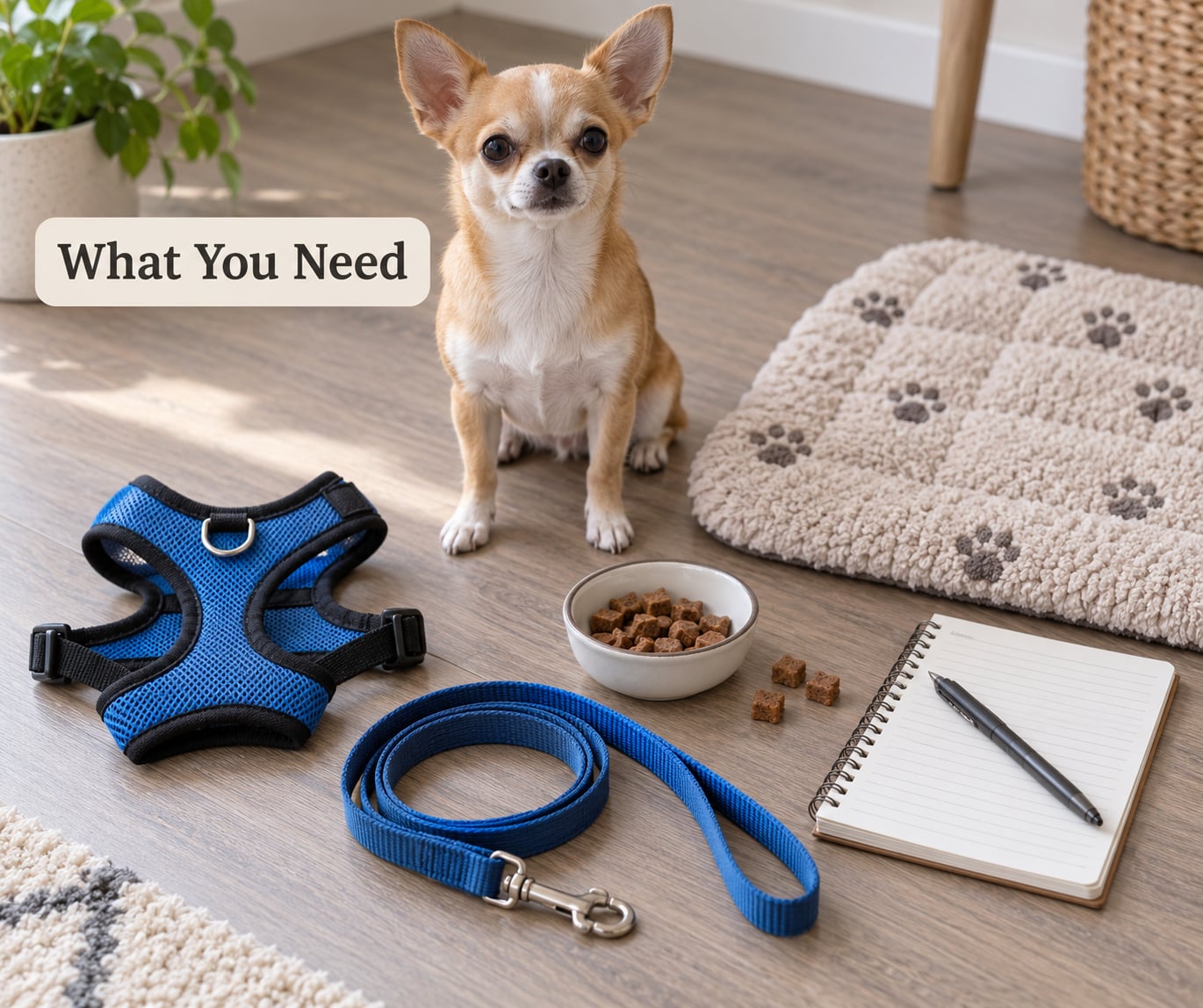
You need almost nothing to start. Here is the whole list, and the honest ranking of how much each one matters.
- A consistent reward system. Small, soft treats your dog eats in a second, plus a marker word you pair with the treat every time. This matters more than any gadget.
- A suitable harness or collar. A well-fitted harness gives you control over a small, slippery body without yanking the neck. A head halter helps with fast, reactive dogs.
- A leash you trust. A short, fixed-length leash for training. Retractable leashes lose you control at exactly the moment you need it.
- A quiet space for short sessions. Five minutes on a mat in a low-traffic room beats thirty minutes in a busy kitchen.
- A crate if separation is part of the problem. Only after your dog is relaxed around the closed door. Never as punishment.
- A way to record. A notebook or your phone. Write down what happened, when, and what you did. Memory is a poor record of a three-week pattern.
Patience sits above all of it. Chihuahuas are intelligent and strong-willed for their size, so a session that ends in frustration teaches you nothing and teaches your dog that you are unpredictable.
Step-by-Step: How to Fix Chihuahua Behavior Problems
1. Identify the behavior and its trigger
Write down four things every time the behavior happens: what it looked like, where it happened, what happened immediately before, and how long your dog took to settle afterward. That last detail — recovery time — is often the most useful number you will collect.
Then separate normal breed alertness from a real problem. Chihuahuas are alert by design; noticing a car is the job. A problem is a behavior that carries risk, distress, or damage: barking that will not stop, reactivity that ends in a lunge or growl, guarding food or a favorite person, chewing that ruins furniture, house-soiling after months of being clean, or any nipping that draws skin.
Here is the short version of chihuahua behavior problems and fixes most owners face, with the first move for each.
- Excessive barking. Answer the door once and ignore everything after, reward silence, and cut the rehearsal.
- Fear-based aggression toward strangers. Increase distance, add a visual barrier, and never punish the growl.
- Nipping and biting hands. Stop using hands as toys, reward four paws on the floor, and teach a release cue.
- Resource guarding. Drop the dropped item, teach an easy trade, and stop reaching into your dog’s space near valued objects.
- Separation anxiety. Build the alone duration up in tiny steps rather than testing for the limit.
- House-soiling. More trips out, more supervision, smaller gaps between breaks.
- Leash reactivity and pulling. Reward looking at you, stop walking the second tension appears, and change direction.
- Hiding, trembling, or shutting down. Treat as fear, reduce the trigger, and never corner or force handling.
- Barking when the owner works. A calm alone routine and a longer build-up than feels reasonable.
- Suddenly snapping at children. Supervise every interaction, give the dog an exit, and call a professional.
This table maps those problems to what is usually driving them and how long change realistically takes.
| Behavior | Usual root cause | First-line fix | Time to first change |
|---|---|---|---|
| Barking at the doorbell | Alerting gets rewarded by the door opening | One answer, then ignore; reward calm | 1 to 3 weeks |
| Leash lunging | Fear or arousal plus no distance | Reward head turns, walk the other way | 2 to 6 weeks |
| Mouth nipping | Teething plus hands as a toy | Trade to a toy, reward four paws down | 1 to 2 weeks |
| Guarding food or toys | Learned value, often from scarcity or theft | Trade and drop it; train swaps | 4 to 10 weeks |
| Separation distress | Hyper-attachment plus long absences rehearsed | Seconds-then-leave build-up | 6 weeks to 4 months |
| House-soiling after being clean | Bladder size, or pain or infection | Vet check first, then more breaks | Vet-dependent |
| Sudden aggression in an adult dog | Pain, sensory loss, illness, or aging | Stop training, book a vet visit | Diagnosis first |
2. Rule out pain or illness
A dog that changes behavior without warning deserves a vet visit before a training plan. Sudden aggression, new fear of surfaces he walked yesterday, vocal changes, appetite shifts, house-training collapse, or a dog who startles at sounds he has always ignored all point the same direction.
Chihuahuas can develop dental disease, patellar problems, joint pain, and neurological conditions that change how a dog handles being touched or approached. Vision and hearing loss in an older dog also cause startling and defensive reactions in dogs that were previously easy.
Rage syndrome — also called idiopathic aggression — is a rare condition where a dog shows sudden, intense, unprovoked aggression with no obvious trigger and no memory of the episode. It is a veterinary diagnosis, not an owner label, and it needs a veterinary behaviorist, not a training schedule.
On the age question: Chihuahuas do not become meaner as a rule. What changes with age is the body, and a dog in pain or losing sight is not a dog with a character problem. Get the senior check first, then reassess the behavior.
Two red flags mean stop and call someone who can physically examine your dog: a growl or snap with no identifiable trigger, and any behavior change that came on within days. Owners on r/Chihuahua and r/dogtraining raise the same two flags repeatedly, and both point the same direction.
3. Change the environment first
You cannot train a dog out of a situation that keeps happening. Management is not a cop-out; it is what stops your dog from practicing the behavior while you teach a better one.
Move further away. Put a visual barrier between your dog and the trigger. Give a quiet retreat space your dog can choose. Keep routines predictable so your dog can predict the day. Cap exposure: three brief, calm encounters beat one long, overwhelming one.
The rule of thumb is that your dog should never get to practice barking, lunging, or guarding on repeat until it works. Every successful attempt makes the next fix slower.
4. Teach an alternative behavior
Pick one behavior and train it for a week before adding another. The best replacement behaviors are the ones you can reward in half a second: look at me, go to your mat, four paws on the floor, or a leave-it turn.
The mechanics are simple and the timing is everything. Wait for the behavior, say your marker word the instant it happens, deliver the treat, and release. If your dog never offers the behavior, lower the difficulty: a bigger distance from the trigger, a busier location, a smaller step.
Sessions should be short. One to three minutes, a few reps, then stop while it is still going well. Owners who train a Chihuahua in twenty-minute blocks usually get a distracted, overloaded dog rather than a trained one.
5. Reduce excessive barking
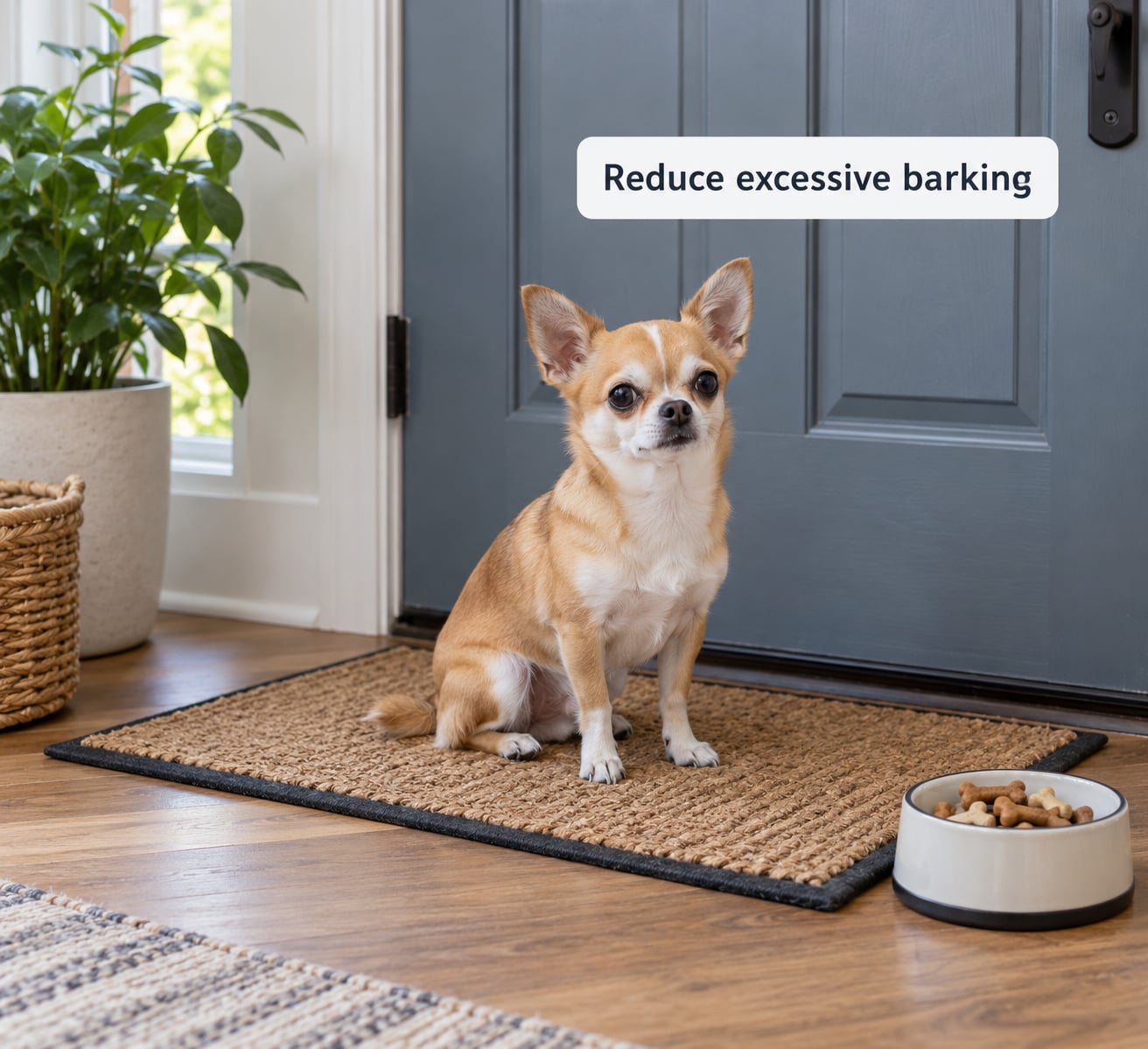
Excessive barking falls into two types, and confusing them is the most common training mistake. Alert barking is a short, sharp burst aimed at a trigger, ending the moment the trigger goes away. Frustrated barking is rhythmic, escalating, and continues after the thing has left.
For alert barking, teach a quiet cue. Wait until your dog is silent, mark, reward, and say your cue word at the same moment. Pair that cue with a greeting so the doorbell version exists somewhere other than a crisis.
For frustrated barking, the fix is interruption. Your dog is barking to reach you. Once the barking starts, the access ends: turn away, walk into another room, and step back only when quiet lasts ten seconds. Re-engage the second your dog settles.
For barking that happens when you are not home, the answer is rarely a quieter dog overnight. It is a shorter total time away, built up gradually, plus honest work with a qualified reward-based trainer if the distress is severe.
Suppressors and punishment collars are worth a sentence of their own: they do not change what your dog feels, and a dog who is punished for warning often learns to skip the warning.
6. Work on fear, reactivity, and aggression safely
Growling is communication. Punish a growl and you do not teach obedience; you remove the dog’s early warning system, which raises the odds the next signal is teeth. Owners who punish the growl often report the dog becoming unpredictable, because that is exactly what you trained.
For fear and reactivity you work with two tools. Desensitization means reducing the trigger to a level your dog can handle calmly. Counter-conditioning means pairing that level with something good until the dog’s emotional response changes. Stay below the reactive threshold: if your dog will not eat, will not take treats, or is pacing, you are too close.
A workable session looks like this: find a distance where your dog sees another dog and still eats, mark and reward the calm, and end while it is still easy. Repeat several times. Move one step closer. Repeat. Over weeks, not minutes.
Use barriers, avoid dog parks where size is unpredictable, and never flood the dog — forcing an encounter that ends in a lunge teaches panic, not confidence. For a real bite history, conflict with another dog in the home, or aggression toward children, get a qualified reward-based trainer or a veterinary behaviorist. Ask directly whether they use least intrusive, minimally invasive methods, which is the standard owners on Reddit forums say matters most.
If two Chihuahuas fight, interrupt during the build-up — the staring, the stiffening, the sudden silence — not after contact. Once a fight starts, separating them puts your hands in the middle of it.
7. Fix house-training, chewing, and separation issues
For house-soiling, more breaks beat more corrections. Tiny bladders mean frequent output, and holding urine can lead to urinary problems. Take your dog out on a fixed schedule, supervise closely between trips, and use scent management rather than harsh cleaner. A properly placed litter box can be a legitimate answer for a small dog, especially one with a small bladder and an owner with a long workday.
Never punish your dog after you find an accident. By the time you see it, the moment has passed and your dog has learned nothing except that you are unpredictable.
For chewing, give an appropriate safe alternative and keep the tempting object out of reach during the times your dog is unsupervised. Chewing often drops sharply once barking and separation stress come down, because one behavior is feeding the other.
For separation, hyper-attachment means a dog bonded so tightly to one person that their absence reads as real distress. Build the alone duration up in tiny steps: one second out of sight, then two, then ten, then a minute, returning before your dog panics each time. Add a camera so you can watch and return early. Crate desensitization follows the same ramp: door open and closed at the same time, then a short duration, then longer.
Home remedies like a pheromone diffuser, a consistent departure routine, and a chew that occupies can reduce mild distress. They do not fix panic, destroyed doors, or self-injury, and those are a professional call.
How to Choose Between DIY Training, a Trainer, and a Behaviorist
Owner forum threads keep circling the same question, so here is a straight answer. Do the work yourself when the behavior is barking, pulling, house-soiling, or mouthiness, and when there is no bite history and no conflict with another animal. These respond to consistency, and consistency is the part a professional cannot supply for you anyway.
Hire a reward-based trainer when fear or reactivity has a live trigger you cannot avoid — a neighbor’s dog, a busy street, a partner’s dog — or when you have tried three weeks of solo work with nothing to show. Ask whether they work below threshold, whether they use least intrusive minimally invasive methods, and whether they will work with a muzzle conditioning plan if bites are in the history.
Go to a veterinary behaviorist when aggression has no identifiable trigger, when a bite has drawn blood, when your dog is fearful of people, when there is a fight between dogs in the home, or when behavior changed suddenly with no medical explanation found. A behaviorist is the right call for rage syndrome or any episode your dog does not seem to remember.
One practical note from experienced owners: skip anyone who tells you to dominate the dog or who punishes a growl. That approach has cost Chihuahuas their homes, and you can hear the wrong answer in the first ten minutes.
8. Review progress and adjust
Review your notes every one to two weeks. Track four numbers: how often the behavior happens, how intense it gets, how long your dog takes to recover afterward, and how reliably the replacement behavior works.
Intensity and recovery time usually improve before frequency does, so a barking problem that drops from twenty barks to eight is real progress even if the count has not halved yet. If two weeks pass with no movement at all, lower the difficulty: more distance, smaller steps, shorter sessions, fewer repetitions.
If the situation worsens, or if new symptoms appear, stop and go back to the vet. Progress on a behavior problem should look like a slower, quieter, shorter version of the same thing — never a different problem entirely.
Common Mistakes
- Scolding or yelling. Adds an emotional charge to the trigger and teaches nothing. Replace it with silence plus a reward for calm.
- Punishing a growl. Removes the warning and raises bite risk. Replace it with distance and a reward for the next quiet moment.
- Flooding — forcing the trigger. Turns one bad exposure into many. Replace it with working under threshold, one step at a time.
- Inconsistent rules. “Drop it” meaning release in the kitchen and never on the carpet teaches a coin flip. Pick one rule for all rooms.
- Rewarding barking. Picking your dog up or going to them mid-bark pays the behavior every time. Replace it with turning away.
- Using human medication to calm a dog. Some human drugs are toxic to dogs and none should be given without a veterinarian’s instruction. Ask your vet directly.
- Calling every bark dominance. Most barking and most aggression in this breed is fear or arousal. Train for the emotion, not the label.
- Training during a crisis. Trying to teach while your dog is mid-lunging teaches you nothing. Rehearse away from the trigger first.
Two habits carry most of the rest. Keep sessions short and end them while your dog still wants more. And get a qualified reward-based trainer early if you are seeing a bite history, household conflict, or panic when you leave — weeks of solo work on a serious fear case is the most common wasted month.
Frequently Asked Questions
Are Chihuahua behavior problems caused by being small?
No. Small size makes some problems easier to create — dogs are picked up without warning, carried into strangers, and their barking is reinforced because everyone reacts — but it is not the cause. Fear, under-socialization, and handling that startle the dog are the causes. Treating a Chihuahua like any other dog requiring training, exercise, and space usually changes the behavior faster than any size-specific trick.
How long does it take to fix excessive barking in a Chihuahua?
Expect three to six weeks for a dog that gets a clear, consistent response, and longer if other issues such as fear or separation distress feed the barking. Alert barking at the door is often the quickest, since you control the trigger. Barking that happens when you are out is the slowest, because you cannot reward in the moment. Progress should show up as shorter bursts and faster settling.
Should I punish my Chihuahua for biting or barking?
No. Punishment teaches your dog to hide the warning, not to stop the feeling, and a dog that stops growling often bites instead. Barking is usually reinforced by attention, so scolding rewards it twice. Work on an alternative behavior such as going to a mat, reward silence, and interrupt access when barking starts. Never raise your voice or use physical correction on a dog this size.
When should I take my Chihuahua to the vet for a behavior change?
Take your dog in when the change came on suddenly, when you cannot identify a trigger, when there is vocal change or appetite change, or when a previously clean dog starts having accidents. New pain, a new fear of familiar surfaces, or startling also count. Dogs do not develop new character problems in a week, so a sudden change is a health question before it is a training question.
Can I use human medicine to calm my Chihuahua?
Do not give human medication without a veterinarian’s instruction. Several common human drugs, including ibuprofen and acetaminophen, are toxic to dogs, and sedatives meant for people can dangerously depress a small dog’s breathing or heart rate. Call your vet instead and describe the situation; there are approaches that do not involve drugs at all.
How do I stop a Chihuahua from reacting to strangers and other dogs?
Work below the threshold and reward calm at a distance. Find the point where your dog notices someone but still takes treats, mark the calm moment, reward, and leave before tension builds. Over several weeks, close the gap slightly each session. Skip dog parks while you build this, and never force an introduction, since flooding a fearful dog deepens the fear rather than removing it.
Conclusion
Start tomorrow by writing down one week of notes: what the behavior is, what happens right before it, and how long your dog takes to calm down. That record will tell you whether you are looking at a training problem or a vet problem, and almost everything else follows from those two answers.
Then fix one thing at a time, keep sessions under three minutes, reward the calm version of the behavior, and never punish a warning growl. If there is a bite history, household conflict, or panic when you leave, book a qualified reward-based trainer rather than spending another month guessing.