Taming a budgie takes patience, short daily sessions, and a bird that is free to walk away at any moment. Most budgies reach the finger-step stage somewhere between four and twelve weeks, and a hand-tame bird is the result of dozens of tiny wins, not one breakthrough moment.
The method below moves in eight stages, from a settled routine to voluntary contact. You never chase, never grab, and never hold a bird against its will. That rule sounds obvious, and it is the single reason most taming attempts stall.
At a glance: prepare the room and the routine, let the bird settle, reward curiosity with a target, teach a calm hand target, work around the open cage, offer finger contact, practice brief handling, then raise the difficulty slowly.
Table of Contents
- What You Need
- How to Tame a Budgie Step by Step
- 1. Prepare: How to Tame a Budgie Step by Step
- 2. Let the Budgie Settle in a Predictable Routine
- 3. Reward Curiosity With a Target
- 4. Teach a Calm Hand Target
- 5. Build Trust Around the Open Cage
- 6. Offer Finger or Palm Contact
- 7. Practice Brief, Positive Handling
- 8. Increase Trust Gradually
- Common Mistakes
- Chasing the Budgie or Trying to Catch It
- Grabbing the Bird or Restricting Movement
- Using Treats Too Heavily
- Reading Signs of Fear as Progress
- Rushing Every Training Stage
- Forgetting to Return the Budgie to Its Perch
- Frequently Asked Questions
- How long does it take to tame a budgie?
- Does a young budgie tame faster than an adult?
- What is the best treat to use when taming a budgie?
- What if my budgie will not step onto my finger?
- When should I stop and call an avian veterinarian?
- Is it normal for some budgies never to enjoy being handled?
- Conclusion
What You Need
You need very little. A calm room and a consistent schedule do most of the work, and most of the equipment below is already sitting in a normal budgie setup.
- A quiet routine. Same cage position, same wake and cover times, same session length each day. Predictability lowers stress faster than any single training trick.
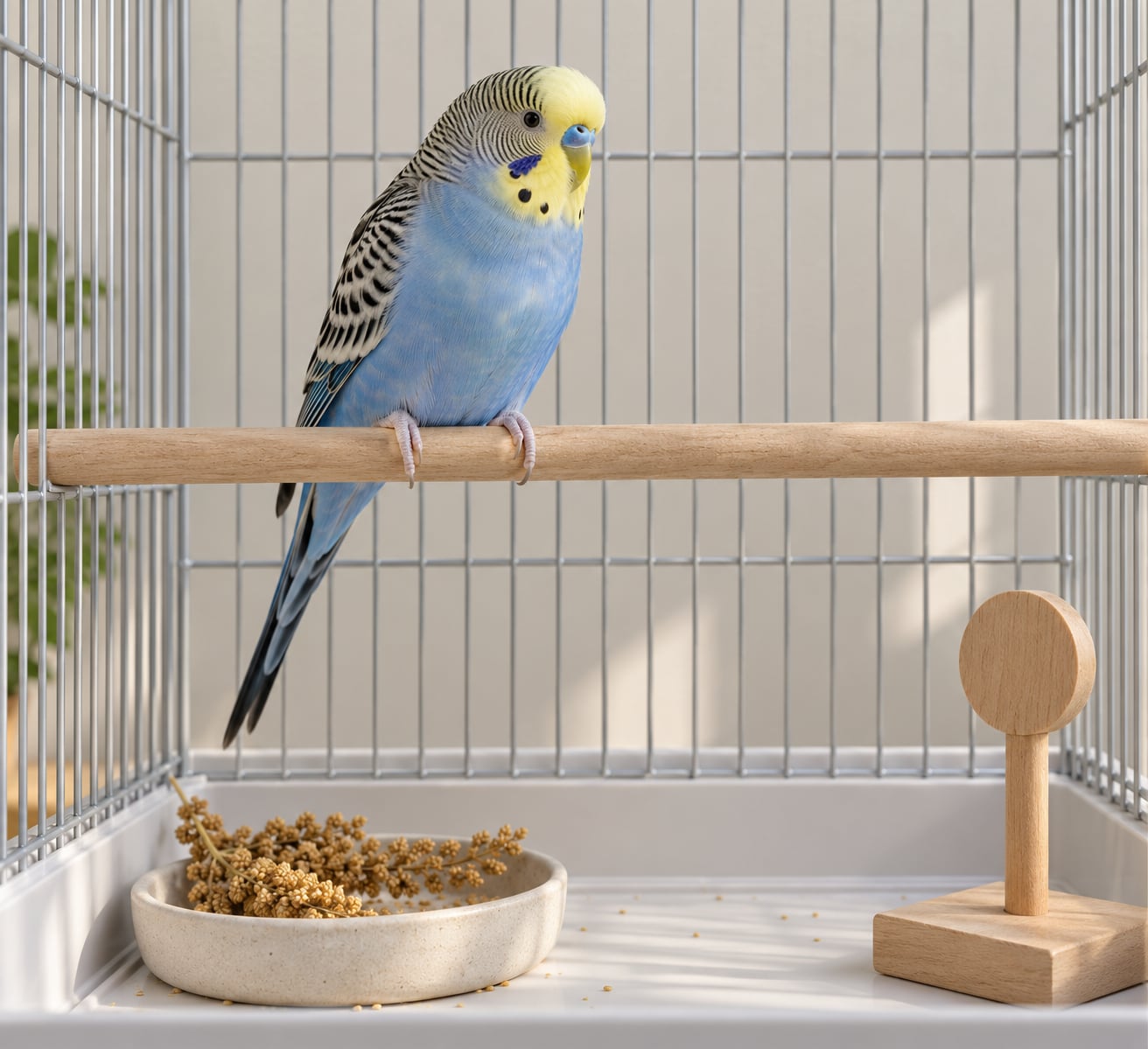
- A secure cage against a wall, at eye level. A bird with its back to a room feels exposed; a bird with a wall behind it feels secure. Keep the cage out of the kitchen, away from televisions, doorbells and constant foot traffic.
- A plain wooden perch and two or three toys. Nothing glued, nothing painted, nothing with loose fibres or small parts a beak can tear off.
- Spray millet and tiny seed pieces. Millet is the highest-value reward you can offer, which is why budgie owners reach for it constantly. A budgie will work for a piece of millet spray when it ignores ordinary seed, so use it deliberately and in small amounts.
- A training target. A clean wooden dowel, a chopstick, or the capped end of a pen works well. Nothing sharp, nothing that breaks.
- A small bird-proofed room for out-of-cage sessions. Start with a bathroom or spare room before using open space in the house.
- About 5 to 10 minutes of attention, twice a day. Short and frequent beats long and occasional. A tired budgie at minute eight has learned more than a bird forced through a twenty-minute session.
You do not need training gloves, restraint towels, special treats bought by the bucket, or any product marketed as an instant taming aid. Force is the expensive item, and it never works.
How to Tame a Budgie Step by Step
Each stage has a gate. Move forward only when the bird stays calm and returns to normal behaviour within a minute or two. If your budgie relaxes, eats or preens after a stage, that stage is complete.
1. Prepare: How to Tame a Budgie Step by Step
Start by making the environment boring and safe. Place the cage against a wall at eye level, keep the room calm, and spend the first few days near the cage without reaching for the bird.
- Sit within a metre or two of the cage for 10 to 15 minutes a day. Read, scroll, do nothing at all.
- Speak softly and use the same few calm phrases each time. A budgie learns that a particular voice means no danger.
- Keep normal care the same: fresh food, clean water, the same out-of-cage hours.
- Never grab, chase, or move quickly in front of the cage during these early days.
Watch for settled behaviour: preening, eating, sleeping with one foot tucked up, or hopping toward the cage front when you appear. Those are signs the bird is starting to file you under safe rather than dangerous.
2. Let the Budgie Settle in a Predictable Routine
Give your budgie one to two weeks of quiet routine before expecting any interaction. This is the stage people skip, and skipping it is why birds flatten against the cage back at month three.
- Keep the cage closed. The cage is a safe place, not a prison, and an anxious bird needs one predictable spot.
- Keep lights, noise levels, and the timing of daily care steady.
- Visit briefly and quietly rather than hovering. Ten calm minutes twice a day beats two hours of activity.
- Pause if the bird repeatedly retreats to the back of the cage, flutters away, freezes, or shows obvious distress.
If you have just brought the bird home, this is also when you sort out a separate space for any birds already in the home. A short quarantine period protects every bird in the room and costs nothing.
3. Reward Curiosity With a Target
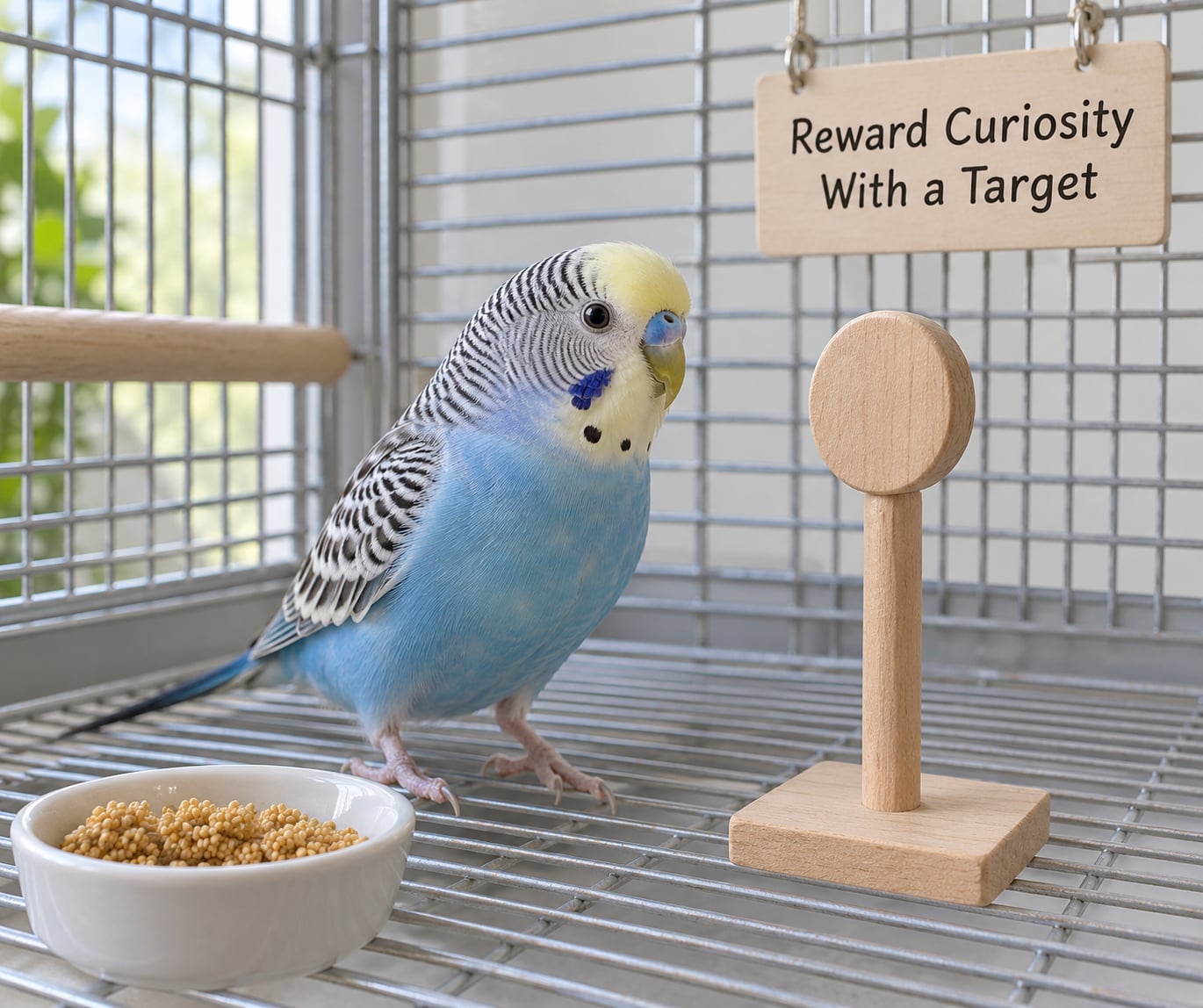
Target training gives your budgie something to do about being nervous. You present an object, the bird investigates it, and you pay for the curiosity. No hands involved, so nothing to fear.
- Hold the target a short distance from the perch and move it slowly. Do not touch the bird with it.
- When the budgie leans in, sniffs or taps it with the beak, deliver one tiny millet piece immediately.
- Keep sessions short and finish while the bird is still engaged. Ending early leaves a good taste.
- Once the bird investigates the target without hesitation, you can bring it closer to your hand.
This is the same method as clicker or trick training, and for budgies that resist handling it can be the whole relationship. A bird that will work for a target is a bird that trusts you.
4. Teach a Calm Hand Target
Now connect the target to your hand. The goal is that a stationary hand means something good is about to happen.
- Rest your hand still, palm down, near the perch and hold the target so the bird can tap it while staying in place.
- Reward the tap, then reward the tap when the target comes from your hand rather than from your other arm.
- Use one millet seed, not a spray. Budgies fill their crop fast, and a full bird has no motivation left for the next five minutes.
- Never push the target toward the bird. Resting it just outside reach and waiting does all the work.
Keep your hand still. Movement reads as a threat, so a finger that stays put looks like a perch and a finger that wiggles looks like something trying to catch it.
5. Build Trust Around the Open Cage
Once the bird taps a target from your hand calmly, open the cage door and work from the outside of it. The cage stays open in frame so the bird knows the exit exists.
- Keep hands low, still, and below shoulder height. A hand above the bird reads as a predator.
- Let the budgie approach at its own pace. Count the seconds instead of pushing.
- Reward any voluntary curiosity: a step closer, a look, a hop toward the door.
- Never use your hand to block the cage opening. A trapped bird is a frightened bird, and that undoes weeks of work.
Out-of-cage time is an offer, never an obligation. Experienced bird keepers are clear about this: if your budgie wants to stay inside, let it stay inside.
6. Offer Finger or Palm Contact
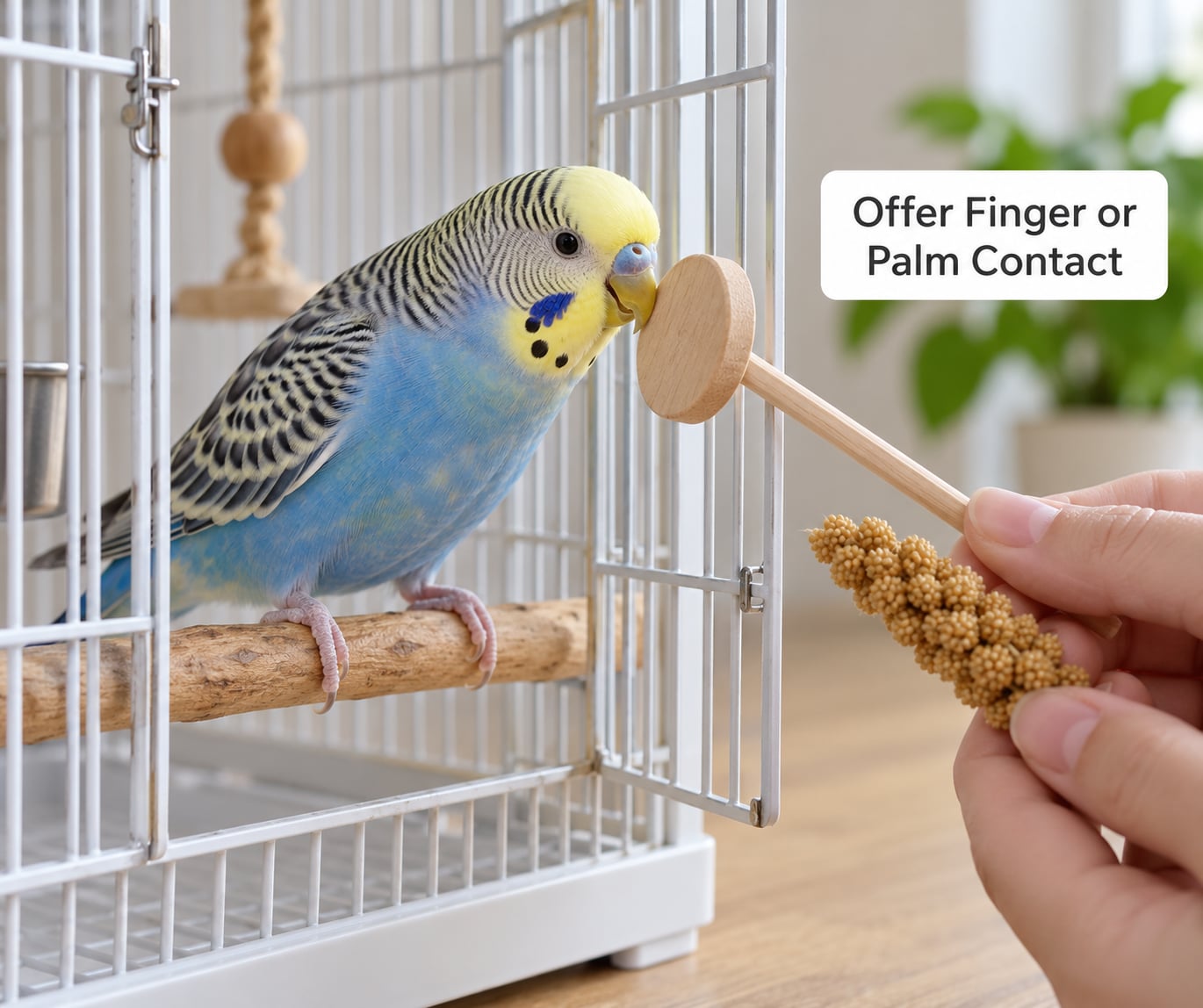
Move from the target to your hand in one small step at a time. Most budgies touch a finger first and step onto it a few sessions later.
- Hold a millet piece between finger and thumb at the end of your index finger, or flatten a finger and rest the reward on the top of it.
- Wait for the beak to touch the finger. Reward the touch straight away, before the step.
- For a step-up, press very gently on the lower chest or the top of the feet, about the pressure of a fingertip on the back of your hand. Slide the finger into the natural bend of the leg as the bird lifts.
- Move slowly and steadily to a perch. Pulling upward or carrying the bird away from a familiar perch sets the stage for falls.
If the bird eats and immediately flies back to its play stand, that is not a failure. It is a common problem, and the usual fix is to remove the competition: move the play stand out of the training room for a few days and work somewhere else entirely.
7. Practice Brief, Positive Handling
Short, gentle touch builds trust faster than long sessions. Ten calm seconds done twice a day beats five tense minutes.
- Stroke the head and neck with a flat finger or two fingers, in the direction the feathers grow. Many budgies lean into this.
- Support the body and both feet if you pick the bird up. Never restrain the wings.
- Keep the first sessions under a minute and end on a reward.
- Some budgies never enjoy being handled. A bird that stays calm near you, eats near you and steps up willingly has been tamed successfully, whatever the textbooks say.
Be clear-eyed about the outcome. A large share of adult budgies never become fully hand-tame, and a bird that is relaxed, active and unafraid of you is a better outcome than a bird that tolerates handling.
8. Increase Trust Gradually
Add difficulty only while the bird stays relaxed. If sessions start to feel like a negotiation, you have gone one stage too far.
- Keep the daily session, the same place and the same routine. Familiarity is what carries progress between sessions.
- Vary the reward: millet, a seed, a small piece of apple or carrot, then back to millet for the harder asks.
- Practice in a second quiet room, or in another part of the house, so the bird learns trust is not tied to one spot.
- Lengthen sessions by a minute or two at a time, never by doubling them.
- After a scare or a night fright, drop back to the last stage that worked and repeat it for several sessions.
Watch your budgie’s body language throughout. Relaxed birds sit smoothly, grip the perch lightly and preen. A flattened bird pressed into a corner, frantic wing flapping, beak clicking or lunging means you have gone too far.
How the timeline usually runs
| Period | What you do | What the bird does | Advance when |
|---|---|---|---|
| Weeks 1 to 2 | Quiet routine, cage closed, no handling | Settles, eats, preens, sleeps normally | The bird stops retreating when you approach |
| Weeks 2 to 4 | Target training, calm hand near the cage | Taps the target, tolerates your hand | It approaches your hand readily |
| Weeks 4 to 6 | Finger contact and step-up at the cage door | Takes food, touches and steps onto the finger | It steps up without a lunge or freeze |
| Weeks 6 to 8 | Out-of-cage work in a small room | Leaves the cage, perches near you | It comes out on its own and stays calm |
| Weeks 8 to 12 | Longer sessions, second room, more handling | Steps up, rides your hand, relaxes | Bonding continues for years |
Age changes these numbers. Budgies weaned after roughly three months are considerably harder to tame than young birds, and an adult rehomed bird can take longer still. The stages stay the same; only the pace changes.
Common Mistakes
Most stalled taming attempts come down to one of six habits. Each has a straightforward correction.
Chasing the Budgie or Trying to Catch It
Chasing triggers a flight response, and a bird that escapes to grab you learns that hands mean danger. Stop chasing, let the bird return to its cage or perch on its own, and go back to target work and rewards. Two calm sessions undo more than a week of chasing.
Grabbing the Bird or Restricting Movement
Grabbing damages trust and risks injury to the bird and to you, since a frightened budgie bites hard. The fix is voluntary targeting with a stationary hand and a clear exit the bird can use at any moment.
Using Treats Too Heavily
A budgie has a small crop. Large portions fill it in a couple of bites, and an over-fed bird has no reason to work. Use tiny millet pieces, one seed at a time, and remove uneaten food afterwards so the regular diet stays balanced. Millet is a useful training tool, not a staple.
Reading Signs of Fear as Progress
Frantic fluttering, repeated hiding, crouching, freezing, biting, puffed-up feathers and ragged breathing are stress signals, not breakthroughs. Pause, reduce distractions, wait a few days, then return to the last stage at which the bird felt safe.
Rushing Every Training Stage
Moving from cage presence to finger contact too quickly creates fear, and fear undoes earlier work. Advance only after the bird approaches voluntarily and stays calm, then repeat each successful stage across several sessions before pushing further.
Forgetting to Return the Budgie to Its Perch
Practicing finger steps away from a secure perch leaves the bird struggling or dropping to the floor. Keep early contact training beside a familiar perch and return the bird there gently between attempts, without pulling it upward.
Two more habits help more than anything else. Keep sessions short and consistent, and keep every interaction positive, so the last thing your budgie experiences each day is something good.
Frequently Asked Questions
How long does it take to tame a budgie?
Most budgies take four to twelve weeks of short daily sessions to step up willingly. Young birds weaned early are usually quickest, while adult or rehomed birds can take several months. Consistency matters more than length: ten calm minutes twice a day beats one long weekly session. Expect steady progress, and treat setbacks after a night fright or a scare as normal.
Does a young budgie tame faster than an adult?
Yes, usually. Budgies weaned at around six to eight weeks of age are usually curious and less set in their ways, while birds weaned after about three months take considerably longer. An adult bird that has never been handled can still become comfortable with you, it just moves at its own pace and may never enjoy full handling.
What is the best treat to use when taming a budgie?
Spray millet is the most effective training reward because budgies value it highly, followed by millet seed and small pieces of safe vegetables such as carrot or apple. Keep pieces tiny, since a full crop removes motivation, and remove leftovers so the everyday diet stays balanced. Millet is a training tool rather than a daily food.
What if my budgie will not step onto my finger?
Go back a stage rather than pushing forward. Spend several sessions on target tapping and food from your hand, then offer a finger with a reward resting on top and wait without moving. If the bird eats and flies away, remove play stands from the training room and work somewhere else. Pressure on the chest or feet should be very light, only enough to encourage a lift.
When should I stop and call an avian veterinarian?
Stop training and contact an avian or exotic-animal veterinarian if your budgie shows laboured or ragged breathing, feathers consistently fluffed up, weight loss, discharge around the eyes or nostrils, sitting on the cage floor, or any injury or bite wound. Sudden loss of interest in food, persistent hiding and marked lethargy are also reasons to book an appointment rather than push a taming schedule.
Is it normal for some budgies never to enjoy being handled?
Yes, and it is more common than the internet suggests. Plenty of budgies stay relaxed around their owners, take food and step up without ever liking head scratches or sitting on a hand. That is a successful outcome, not a failure. Chasing and forcing are the only things that reliably make a bird fearful, so skip them and let the relationship develop at the bird’s speed.
Conclusion
Start with a calm, predictable routine for one to two weeks, then reward voluntary curiosity with a target and tiny millet pieces before you ever ask for a finger step. Move one stage at a time and only when your budgie stays relaxed, because patience and force-free handling decide the outcome more than speed ever will. If anything in the list above sounds like what your bird already did, return to the earlier stage rather than pushing harder, and book an avian veterinarian for any sign of illness.