If you are asking why is my betta not eating, the short answer is that bettas are tropical fish and appetite usually drops when the water is cold, when toxic nitrogen waste builds up, or when something in the tank changes suddenly.
Overfeeding and bloat come next, followed by unfamiliar food, tank mates stealing meals, and illness. Before you panic, know this: a newly shipped betta often skips food for one to three days, and a female carrying eggs or building a bubble nest may refuse a meal for a day without anything being wrong.
The reason it matters is that appetite is the first thing to drop when a betta is stressed or becoming ill. A healthy betta can survive a couple of weeks without food, so starvation is rarely the urgent risk. Letting the underlying cause sit for days is the real danger, because bloat, swim bladder trouble and infections turn serious fast.
Table of Contents
- Why Is My Betta Fish Not Eating? (The Short Answer)
- How Long Can a Betta Go Without Food?
- Quick Diagnosis: Match the Symptom to the Cause
- Common Reasons Your Betta May Stop Eating
- Water quality: ammonia, nitrite and pH
- Water temperature too low
- Overfeeding, bloat and constipation
- The food itself: type, size and freshness
- New tank, shipping and general stress
- Tank mates competing for food
- Sickness and disease
- Not enough oxygen in the water
- External toxins
- Gravid female and bubble nest building
- Not Eating but Still Active? What That Means
- What to Do When Your Betta Stops Eating: A 72-Hour Triage Checklist
- How to Offer Food Safely
- Signs the Problem May Be More Serious
- How to Prevent a Refusal
- Frequently Asked Questions
- How long can a betta not eat before I should worry?
- Is it normal for a betta to skip a meal?
- How should I restart feeding after my betta stops eating?
- Can constipation cause a betta to stop eating?
- Should I force-feed a betta that is not eating?
- When does a betta not eating require a veterinarian?
- Conclusion: Start With Water, Then Temperature
Why Is My Betta Fish Not Eating? (The Short Answer)
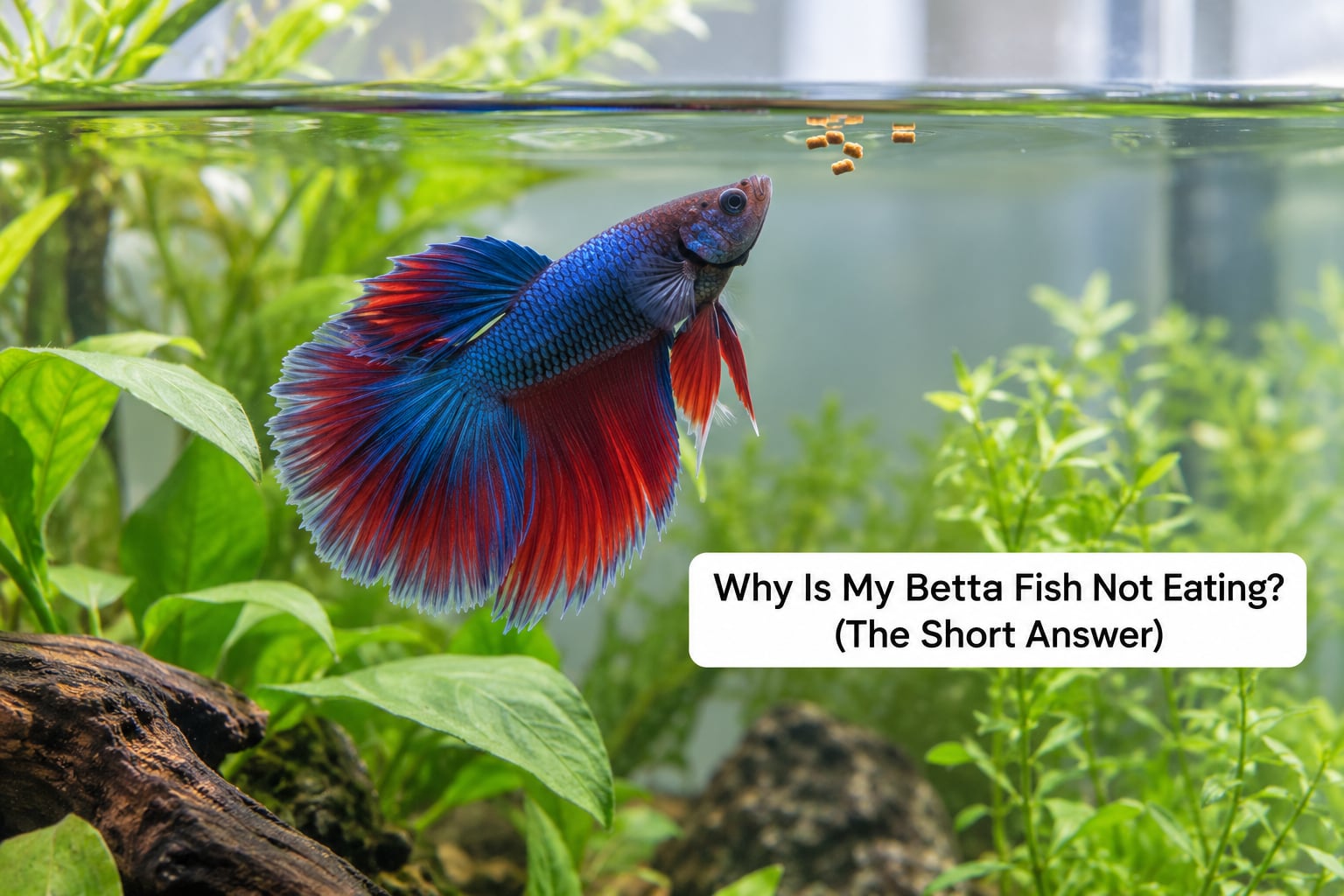
Here are the nine causes behind almost every case, roughly in the order worth checking them.
- Water quality problems. Ammonia or nitrite burns the gills and makes food unappealing, and bettas are especially sensitive to both compared with hardier fish.
- Water too cold. Below about 78°F a betta’s metabolism slows down, so it digests slowly and simply loses interest in food.
- Overfeeding and bloat. A betta stomach is about the size of its eye, so a few extra pellets can pack it full and back the whole system up.
- Food it does not recognise. Bettas are obligate carnivores and often ignore pellets that are the wrong size until they learn they are food.
- New tank or shipping stress. Moving a fish, even a short drive home, triggers a normal one to three day appetite pause while it settles.
- Tank mates stealing food. Fast, busy fish like neon tetras or guppies can clear a feeding before your betta reaches the food.
- Disease or parasites. Ich, velvet, fin rot and internal infections all suppress appetite, usually alongside other visible symptoms.
- Not enough oxygen. A betta can gulp surface air with its labyrinth organ, but still struggle in warm, still, badly filtered water.
- Toxins near the tank. Soap, lotion, cleaning spray and even air freshener fumes reach the water through the air and suppress appetite fast.
Bloated with stringy droppings points to constipation, while a round belly with scales that look like a pine cone points to something much more serious. The table below sorts that out in seconds.
How Long Can a Betta Go Without Food?
A healthy adult betta stored with plenty of fat can survive around two weeks without eating, and that is the number most online advice quotes. It is also the number that causes the most panic, because owners treat it as permission to wait. Duration alone tells you very little.
| Situation | Typical appetite pause | What to do |
|---|---|---|
| New betta, just shipped or moved | 1 to 3 days, sometimes up to 4 | Keep the tank quiet and stable, keep offering a small portion, do not change water repeatedly |
| Gravid female or bubble nest building | A day or two, sometimes longer | Leave her alone and skip meals if she spits food back out |
| Mild overfeeding, no swelling | 24 to 48 hours | Fast briefly, then offer a small portion of the usual food |
| Bloat or suspected constipation | 48 to 72 hours of fasting | Fast, then offer a single shelled pea, then reintroduce protein slowly |
| Refusal with lethargy, clamped fins or cloudy water | Not a fasting situation at all | Test water, look for disease, contact an aquatic veterinarian |
| Refusal past 5 to 7 days with no other symptoms | Unusual | Treat this as a real problem, not a fast, and get advice |
What matters more than the clock is the combination of symptoms. A betta that skips two pellets and then swims normally is a different situation from one that has not eaten for three days and is sitting on the bottom with clamped fins. Multiple symptoms together, or one severe symptom on its own, move the situation up the urgency scale immediately.
Quick Diagnosis: Match the Symptom to the Cause
Look at your betta before you touch the food jar. These are the tells owners use most often, and most of them take under a minute to check.
| What you see | Likely cause | First action |
|---|---|---|
| Round belly after the last few meals, stringy white or brown droppings | Bloat or constipation | Fast 48 to 72 hours, then one shelled pea |
| Belly looks round and scales stick out like a pine cone | Dropsy, a serious internal problem | Stop feeding, improve water quality, contact an aquatic veterinarian |
| Thin from the top view, head larger than body | Underfed or chronic internal disease | Check water parameters and offer high protein food |
| Sitting on the bottom, clamped fins, slow swimming | Cold water, poor water quality or illness | Test ammonia, nitrite and temperature first |
| Hiding constantly but still responsive | Stress, new tank, aggressive tank mate | Check for a fin-nipped tank mate, add cover, keep the tank quiet |
| Floating sideways or struggling to stay level | Swim bladder disorder or severe bloat | Fast and treat the constipation, avoid feeding dry pellets |
| Tiny white salt grain spots that spread over a few days | Ich | Raise temperature gradually, treat the whole tank, ask a vet about dosing |
| Fine gold or rusty dust, clamped fins, flashing at the gravel | Velvet | Darken the tank, treat promptly, get veterinary advice |
| Cloudy or smelly water after a water change | Uncycled tank or too large a change | Test the parameters before feeding again |
| Ignores pellets, takes bloodworms or daphnia instantly | Food unfamiliarity or wrong pellet size | Try live or frozen food, then re-teach pellets |
| Spits food out and chews it, then lets it go | Pellets too large, or old dry food | Buy pellets sized to the eye, replace food older than 6 months |
Two of these rows get confused more than any other, so it is worth being clear. Bloat means a rounded belly with smooth, flat-lying scales, and it is often fixable at home. Dropsy means the scales protrude and the fish looks like a pine cone, and that is an internal fluid problem needing a veterinarian. A fish can have bloat early and dropsy later, which is why the distinction matters.
Common Reasons Your Betta May Stop Eating
Water quality: ammonia, nitrite and pH
Ammonia and nitrite are the first things to rule out, because both burn the gills and a fish in burning water has no reason to eat. In a cycled tank both should read zero. Nitrate is the waste product that shows the filter is working, and reading under 20 ppm is comfortable; above 40 ppm is worth a water change no matter what the appetite is doing.
A betta prefers slightly acidic to neutral water, roughly pH 6.5 to 7.0, and more importantly it prefers water that does not swing. A pH that is high but perfectly stable is less stressful than a pH that bounces around after every water change. If your readings look fine but the betta still is not eating, look at what changed in the last week rather than only at the current numbers.
Water temperature too low
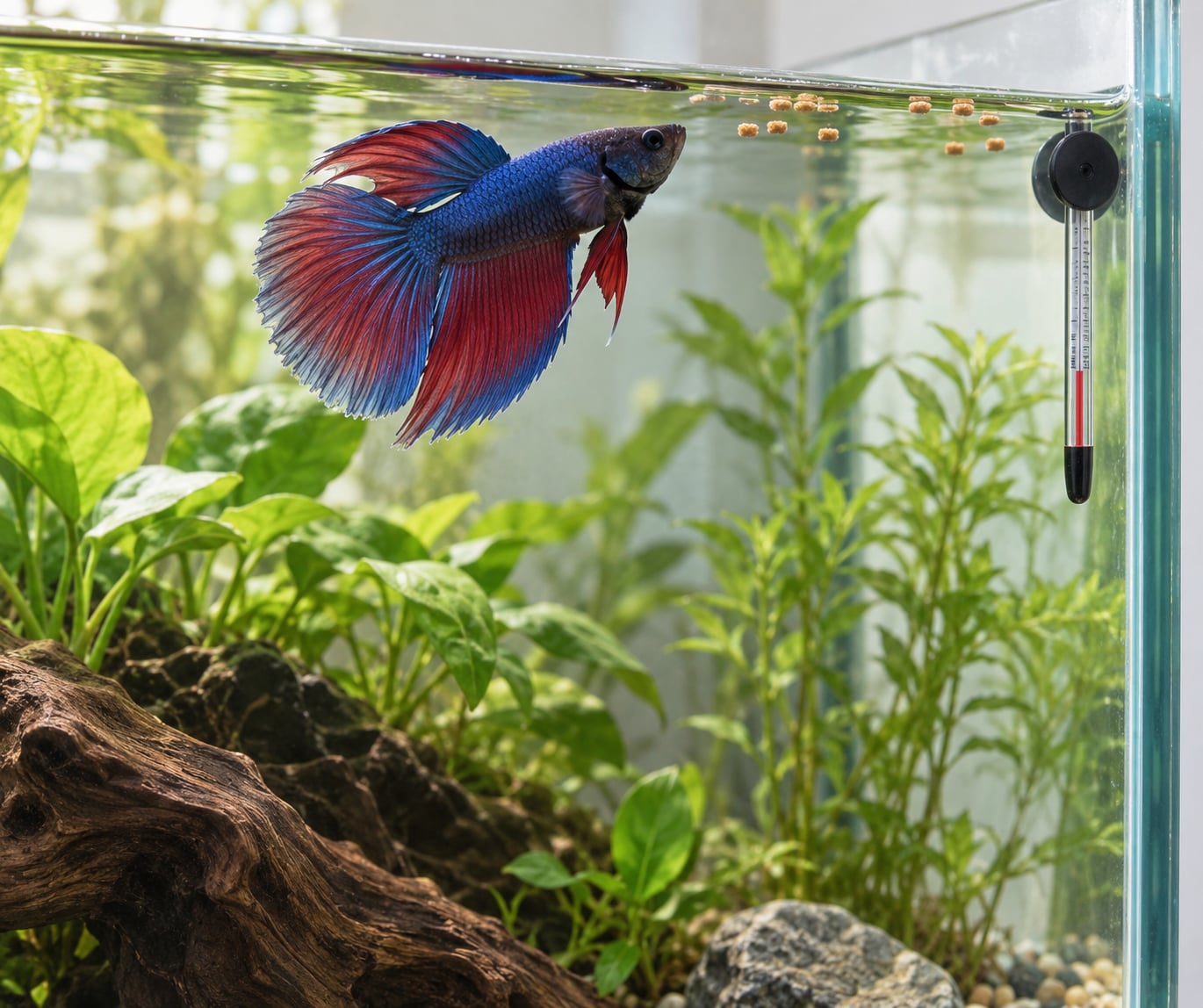
Bettas come from shallow tropical waters and cannot generate meaningful body heat, so their metabolism follows the tank. Aim for 78 to 80°F, and treat anything sitting near 72 to 75°F as too cold. In cold water digestion slows, activity drops and the immune response weakens, which is why a cold tank often progresses from refusing food to infection.
Check the actual temperature with a thermometer rather than trusting the heater dial. If the tank is cold, warm it gradually, and if the fish has been swinging between warm and cold, expect the appetite to be erratic until the temperature settles.
Overfeeding, bloat and constipation
This is the most common cause owners can fix themselves, and it is also the one they most often make worse. A betta stomach is roughly the size of its eye, so two or three small pellets twice a day is plenty. Feeding a pinch of five large pellets is closer to a full day of food at once.
Constipation signs are specific: a swollen round belly, thin stringy droppings that stay attached, and sometimes floating sideways because the gut presses on the swim bladder. Frozen food dropped into the tank still frozen expands inside the fish, which is another common route to the same problem.
On the Epsom salt question, it works as an osmotic laxative for fish, but it is a targeted tool, not a general fix. Owners on the forums report the pea fast helping far more often, and using salt in the main tank causes its own osmoregulation stress. If you are considering it, talk it through with an aquatic veterinarian first.
The food itself: type, size and freshness
Bettas are obligate carnivores. Pellets that sit uneaten while a betta ignores them and then snaps at bloodworms is not a fussy fish, it is a fish being offered the wrong thing. Small dithering feeders such as daphnia, brine shrimp and bloodworms are high value to a betta and work well for re-teaching appetite.
Buy pellets sized to the eye. If a pellet is wider than the eye, a betta will chew it and spit it out, which looks exactly like refusing food. Defrost frozen food in a small cup of tank water before offering it, and replace dry food once it is around six months old, because old pellets crumble and the oils in them go rancid.
Only feed for five to ten minutes. Anything left after that belongs in the net, because uneaten pellets are the start of both an ammonia spike and a bacterial bloom.
New tank, shipping and general stress
One to three days of refusal after shipping is normal and expected. During that window the smart move is to do almost nothing: keep lights low, keep the tank quiet, do not cycle water back and forth, and keep offering a small portion even if it is ignored.
Stress suppresses appetite directly and also weakens immune function, so a fish that is stressed for a week is a fish that gets sick. Keeping the tank stable matters more than making a dozen small adjustments in a day.
Tank mates competing for food
Bettas are slow eaters near the surface, and that puts them last in line for food in a community tank. Neon tetras, guppies, rasboras and most corydoras will clear a feeding faster than your betta can reach it, and owners often blame the fish for what is really theft.
Watch the tank during one full feeding before concluding anything. If you never see the betta reach the food, that is your answer. A few minutes of observation tells you more than a week of guessing.
Sickness and disease
Appetite loss is rarely the only symptom of illness. Look for the combination instead: clamped fins, faded colour, flashing at gravel, visible white or gold spots, frayed fin edges, stringy droppings or trouble swimming.
Ich shows up as tiny white salt-grain spots that spread across the fish over a few days. Velvet looks like fine gold or rust-coloured dust, usually with fins clamped and a fish flashing. Fin rot eats the edges of fins and leaves a ragged, receding margin. Swim bladder disorder shows as floating sideways, sinking hard or an inability to hold a level. Dropsy shows as protruding scales and a bloated body. Common triggers are poor water quality, cold water and stress, so the environment is always worth correcting at the same time.
Treat the whole tank rather than one fish, because these conditions spread through the water and through shared equipment. Ask an aquatic veterinarian about dosing rather than copying a number out of a forum thread, and never use human medication.
Not enough oxygen in the water
Bettas breathe atmospheric air at the surface thanks to a labyrinth organ, which is why they survive in still water that would suffocate other fish. That organ does not remove the need for dissolved oxygen, and warm water holds less of it. A small unfiltered bowl in a warm room is a genuinely dangerous setup for a tropical fish.
Signs of low oxygen include gasping at the surface, rapid gill movement and general listlessness. Surface agitation from a filter outflow or a light airstone helps, and a filter that actually turns the water over matters more than any single gadget.
External toxins
Soap, dish detergent, hand lotion, perfume, cleaning spray, air fresheners and even cigarette smoke can all reach your betta through the air. Ammonia burns and chlorinated water kill outright, and a bottle of cleaner sprayed in the room next to an open tank is enough to stop a fish eating within hours.
Ventilate the room, keep chemicals away from the tank, and always dechlorinate replacement water before it goes in. Never mix cleaning products in the same room as an open aquarium.
Gravid female and bubble nest building
A female carrying eggs or building a bubble nest often eats very little for a day or two, and spitting food out is not unusual during this period. This is one of the more common benign refusals and it usually resolves on its own. Do not fast a fish you think is gravid purely because she skipped a meal.
Not Eating but Still Active? What That Means
This is the single most common version of the question, and it is usually reassuring. A betta that swims normally, checks on you, reacts to movement and holds a normal body shape is not in an immediate crisis, even when it ignores food for a day.
It usually means one of four things. The fish is full and you are not seeing it eat, which happens often in planted tanks where leftover pellets sink out of sight behind wood. The fish is stressed but otherwise well, often the first days after a move. The food offered is not food to a carnivore, such as large dry pellets or old flakes. Or the fish is simply not hungry on a cool day.
Confirm intake rather than assuming. Watch for five minutes at a normal feeding time, and check the gravel for uneaten pellets. If the food is gone, your betta ate. Many owners have spent days worried about a fish that was full the whole time.
What to Do When Your Betta Stops Eating: A 72-Hour Triage Checklist
Work through these in order. Each step takes about a minute and rules out the most likely problems before you reach for something drastic. Do not skip ahead to medication.
- Test the water. Ammonia and nitrite should both read zero, nitrate under 20 ppm, pH around 6.5 to 7.0. Any reading of ammonia above zero explains the refusal on its own.
- Check the temperature. Aim for 78 to 80°F with an actual thermometer. Warm or cool the tank gradually rather than making a sudden change.
- Look at the belly and the droppings. A round belly with stringy droppings means bloat. A pine-cone texture means dropsy, which is a vet call.
- Check the equipment. Confirm the filter is running and the heater is not sitting in a cool tank. Restart anything that has stopped.
- Watch the fish for one full feeding. Look for clamped fins, flashing, white spots, distended belly or a fish that cannot hold its level. Also confirm whether a tank mate is clearing the food first.
- Fast for 24 to 48 hours if the belly is swollen. Withhold food entirely, keep the water clean, and do not treat a bloated fish with medication first.
- Change the food. Try a small portion of live or frozen daphnia, brine shrimp or bloodworms instead of the usual dry food.
- Feed for five to ten minutes only, then net out whatever is left so it does not break down in the water.
- Make one 20 to 30% water change with dechlorinated, temperature-matched water if any parameter has drifted.
- Give it a day and reassess. If nothing has changed after 72 hours, or if symptoms are worsening, contact an aquatic veterinarian with your test readings, temperature and timeline.
How to Offer Food Safely
Once the water is right, food stops being the problem. Offer a high quality betta pellet sized to the eye, plus a protein food your fish actually values such as daphnia, brine shrimp, bloodworms or freeze-dried options. Live and frozen foods have a strong aroma, which is why they often get a response when pellets get ignored.
Portion control is the whole game. Two or three pellets twice a day matches the size of the stomach, and overfeeding causes both bloat and an ammonia spike that then keeps the fish off food. Feed at the same times each day so the fish learns a rhythm.
Defrost frozen food in tank water before offering it, never drop a frozen cube straight into the tank. Remove leftovers after five to ten minutes. Never force-feed with a syringe, and never use human medication or human food unless a veterinarian specifically tells you to, because bettas cannot safely metabolise most of it.
After a fast, reintroduce food slowly rather than celebrating with a full meal.
- Day 1 after a bloat fast: one shelled pea, defrosted, or a single tiny portion of daphnia. Remove anything not taken within ten minutes.
- Day 2: two or three small pellets, or a few daphnia if the pea passed normally.
- Day 3 onward: return to the normal two pellet meals, and watch the belly and droppings for the next few days.
If a betta takes frozen or live food but still ignores pellets, that is not a health problem. Keep offering the food it will eat, and reintroduce pellets in a few very small pieces so the fish learns to associate them with a meal.
Signs the Problem May Be More Serious
Bettas can decline over hours rather than days, so certain combinations should end the home troubleshooting. Seek an aquatic veterinarian or a qualified aquatic specialist if you see any of the following.
- Scales that protrude and look like a pine cone, or a belly that is round with the scales standing out rather than lying flat.
- A cloudy or bulging eye, known as popeye.
- Stringy white or trailing droppings, especially with a swollen belly.
- Refusal to eat for 72 hours alongside lethargy, clamped fins or lying on the bottom.
- Gulping at the surface, red or inflamed gills, or rapid breathing.
- Visible weight loss, a noticeably thinner body, or a head that looks larger than the rest of the fish.
- Fin rot that is spreading, or white spots multiplying over days.
- Water parameters that will not come down, or a nitrogen cycle that has collapsed after a large water change.
A refusal to eat on its own is rarely an emergency. Refusal combined with any of the above is a different conversation, and waiting on it is where most preventable losses happen. An aquatic vet can see the fish in person, read the water, and dose treatments correctly, which is more than any forum thread can do.
How to Prevent a Refusal
Almost every case on this page traces back to a husbandry habit, and most are easy to prevent. Keep a stable temperature between 78 and 80°F with a real thermometer rather than trusting the dial. Keep ammonia and nitrite at zero, and stay on a water change routine that keeps nitrate under 20 to 40 ppm.
Feed two or three small pellets twice a day, defrost frozen food properly, and replace dry food every six months. Clean the filter media on a schedule instead of waiting for it to clog, and keep at least some surface movement in the tank so the water holds enough oxygen.
Finally, know your betta’s normal appetite. When you know how many pellets a healthy week looks like, a two-day change stands out immediately instead of becoming a slow worry. That baseline is the cheapest diagnostic tool you own.
Frequently Asked Questions
How long can a betta not eat before I should worry?
A healthy adult betta can survive roughly two weeks without food, so the total time is rarely the emergency. What matters is the combination. A skip of one or two meals in a betta that swims normally is usually nothing. Refusal past three days combined with lethargy, clamped fins, a swollen belly or cloudy water is a different situation and needs a vet. Newly shipped bettas often skip food for one to three days, and a gravid female may skip a day or two. Treat a refusal past five to seven days with no other symptoms as a real problem rather than a planned fast.
Is it normal for a betta to skip a meal?
Yes, occasionally. Bettas are tropical ectotherms and their appetite tracks temperature, activity and stress, so a quiet day can mean a quiet appetite. A single skipped meal in an otherwise normal fish is not a concern, and there is no benefit to offering extra food to compensate. Keep the routine the same, offer a small portion, and take leftovers out after five to ten minutes. What is not normal is a refusal that repeats for days or arrives alongside changes in posture, breathing, colour or droppings.
How should I restart feeding after my betta stops eating?
Go slowly, because a starving fish that eats a full meal can bloat again. On day one offer a single shelled pea or a very small portion of daphnia, and remove anything not eaten within ten minutes. On day two give two or three small pellets, and from day three return to two pellet meals a day. If your betta ignores pellets but takes bloodworms, brine shrimp or daphnia, keep feeding what it accepts and reintroduce pellets in tiny pieces later. Stop and go back a step if the belly starts to swell.
Can constipation cause a betta to stop eating?
It is one of the most common and most fixable causes. A betta stomach is about the size of its eye, so a few extra pellets or a frozen food cube dropped in still frozen can pack the gut full. The tells are a round swollen belly, thin stringy droppings and sometimes floating sideways as the gut presses on the swim bladder. The usual approach is a 24 to 72 hour fast, then one shelled pea, then a slow return to normal food. If the belly is round but the scales protrude like a pine cone, that is dropsy rather than constipation, and a vet call.
Should I force-feed a betta that is not eating?
No. Force-feeding with a syringe risks pushing food into the gills, damaging the mouth and adding stress to a fish that is already struggling. It also tends to make a fish more reluctant to eat. The safer route is to offer small portions of food the betta actually values, such as daphnia, brine shrimp or bloodworms, and remove leftovers after five to ten minutes. Never use human medication or human food, and if you are considering Epsom salt or any treatment, check with an aquatic veterinarian first, because the wrong dose in a small volume can be fatal.
When does a betta not eating require a veterinarian?
Get to an aquatic veterinarian when refusal is combined with any of these: scales standing out like a pine cone, a cloudy or bulging eye, stringy white droppings, red or inflamed gills, gasping at the surface, fin rot that is spreading, or weight loss. A refusal lasting 72 hours with lethargy or clamped fins also warrants a visit. Bring your water test readings, the temperature and a timeline of changes, because that information speeds up the diagnosis. A plain refusal to eat with normal behaviour and clean water is usually a husbandry problem you can solve at home.
Conclusion: Start With Water, Then Temperature
If you are asking why is my betta not eating, the answer is nearly always found in the first ten minutes of checking, not in a new supplement. Here is the short version of what to look for.
- Water quality: ammonia and nitrite at zero, nitrate under 20 ppm, pH around 6.5 to 7.0 and stable.
- Temperature: 78 to 80°F, verified with a real thermometer.
- Bloat: a round belly with stringy droppings, treated with a 24 to 72 hour fast and a shelled pea.
- Food: pellets sized to the eye, fresh, offered for five to ten minutes, two or three pellets twice a day.
- New tank stress: one to three days of refusal after shipping is normal, and the right move is to change nothing.
- Tank mates: check whether faster fish are clearing the food before the betta reaches it.
- Disease: look for clamped fins, spots, flashing, frayed fins or a fish that cannot hold its level.
- Oxygen and toxins: surface movement, a working filter, and no soap, spray or perfume near the tank.
Start with a water test and a thermometer reading, then look at the belly. Those two steps rule out the majority of cases, and they take less time than reading another forum thread. If the fish is still refusing food after 72 hours with no other symptoms, or if you see pine-cone scales, popeye or stringy droppings now, call an aquatic veterinarian rather than trying another home remedy.