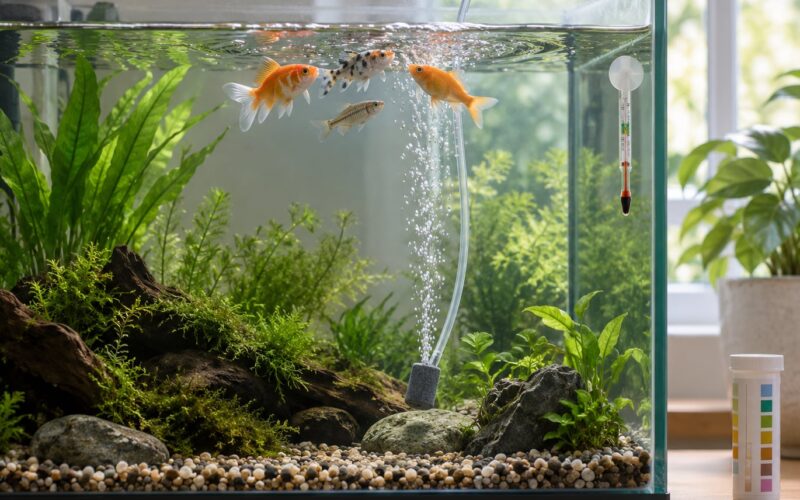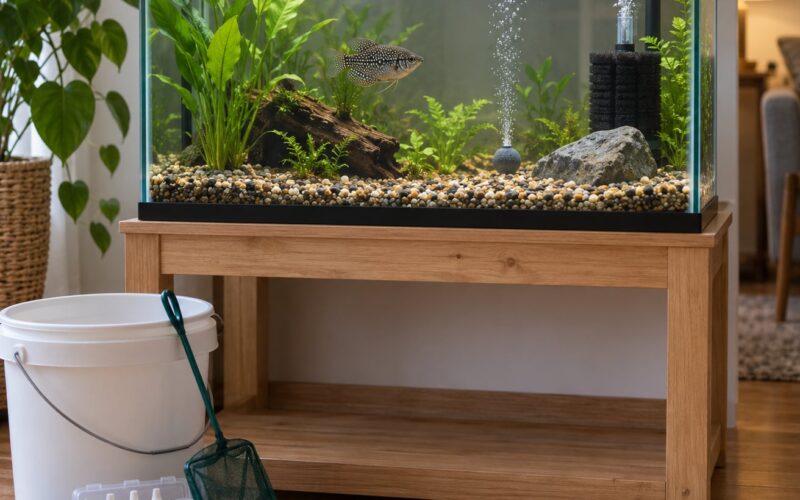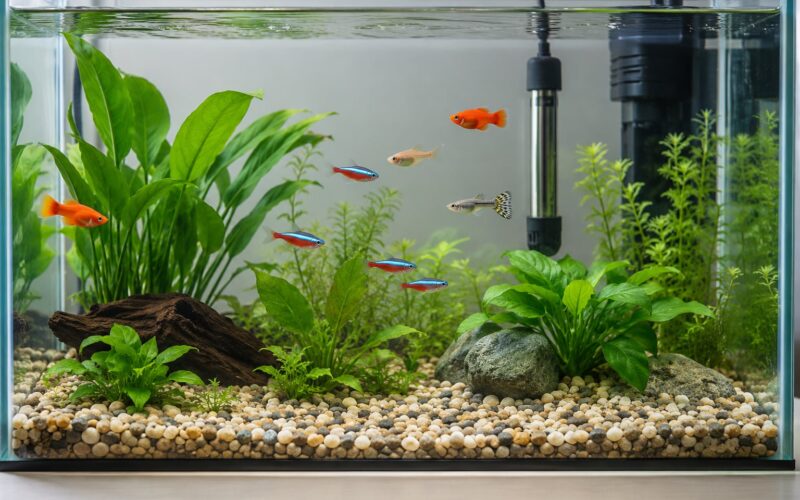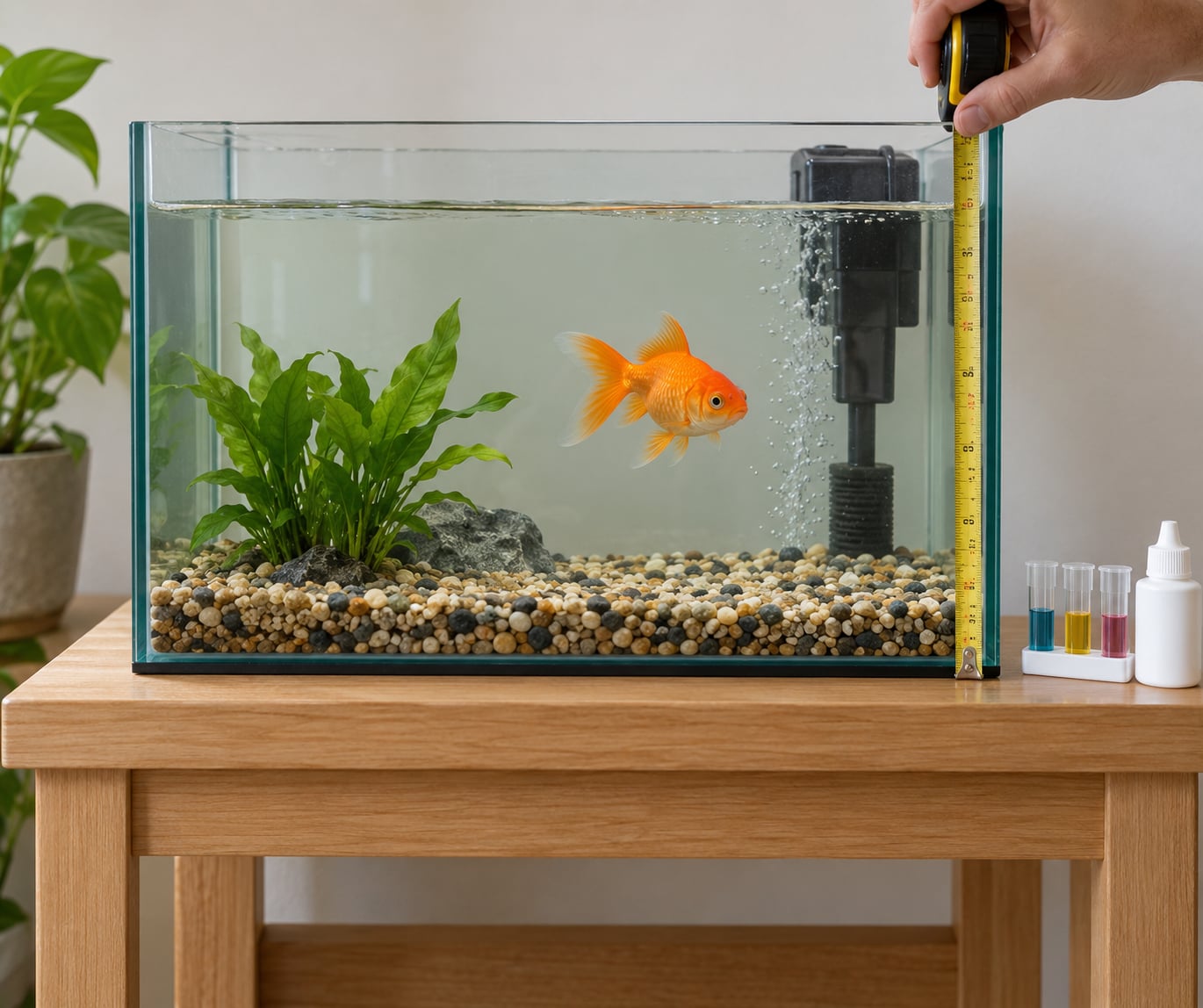
No, goldfish do not stop growing at whatever size their tank allows. A cramped aquarium slows skeletal growth through chronic stress, but the organs, eyes and swim bladder keep developing, so a small-looking fish is usually a damaged one. Getting goldfish tank size right is about usable water volume, filtration and stable water, not a single magic number.
The idea that a goldfish grows to fit its bowl is probably the most repeated piece of fishkeeping folklore out there. It shows up in cartoons, at market stalls and in the advice of people who love goldfish but have never kept one. It is also the reason so many goldfish live short, uncomfortable lives.
Here is the short version of what the myths actually get wrong:
| Myth | Reality | Why it matters |
|---|---|---|
| A goldfish grows to the size of its tank | Crowding inhibits growth hormones, it does not set a size limit | The fish looks small but suffers lasting organ and eye damage |
| A bowl is fine for one goldfish | Bowls have too little surface area and no room for a filter | Waste accumulates faster than it can be processed |
| One gallon per fish is enough | That rule ignores adult size, filtration and swimming room | It is the most common reason petstore goldfish stall at three inches |
| A bigger tank fixes everything | A large uncycled tank is just as harmful as a small one | Size without maintenance does not produce healthy fish |
| A running filter replaces water changes | Filters handle solids; they do not remove all dissolved nitrate | Nitrate keeps climbing until water changes bring it down |
| Goldfish live one or two years | Healthy goldfish in good setups reach 10 years and beyond | Short lives usually point to poor water, not to biology |
Table of Contents
- What Size Tank Does a Goldfish Actually Need?
- How Much Tank Space Does Each Goldfish Need?
- Why one gallon per fish does not work
- Do Goldfish Grow to the Size of Their Tank?
- Why Is Water Quality More Important Than Tank Size Alone?
- Does Tank Shape Matter as Much as Volume?
- How Much Space Do Fancy Goldfish Need?
- How to Choose the Right Tank for Your Goldfish
- Frequently Asked Questions
- Can one goldfish live in a 5 gallon tank?
- Do goldfish grow according to tank size?
- Why is my goldfish so large?
- How fast do goldfish grow?
- Is it a myth that goldfish have a three-second memory?
- How can I tell if my goldfish is happy?
- Conclusion: Start With the Right Space and Stable Water
What Size Tank Does a Goldfish Actually Need?
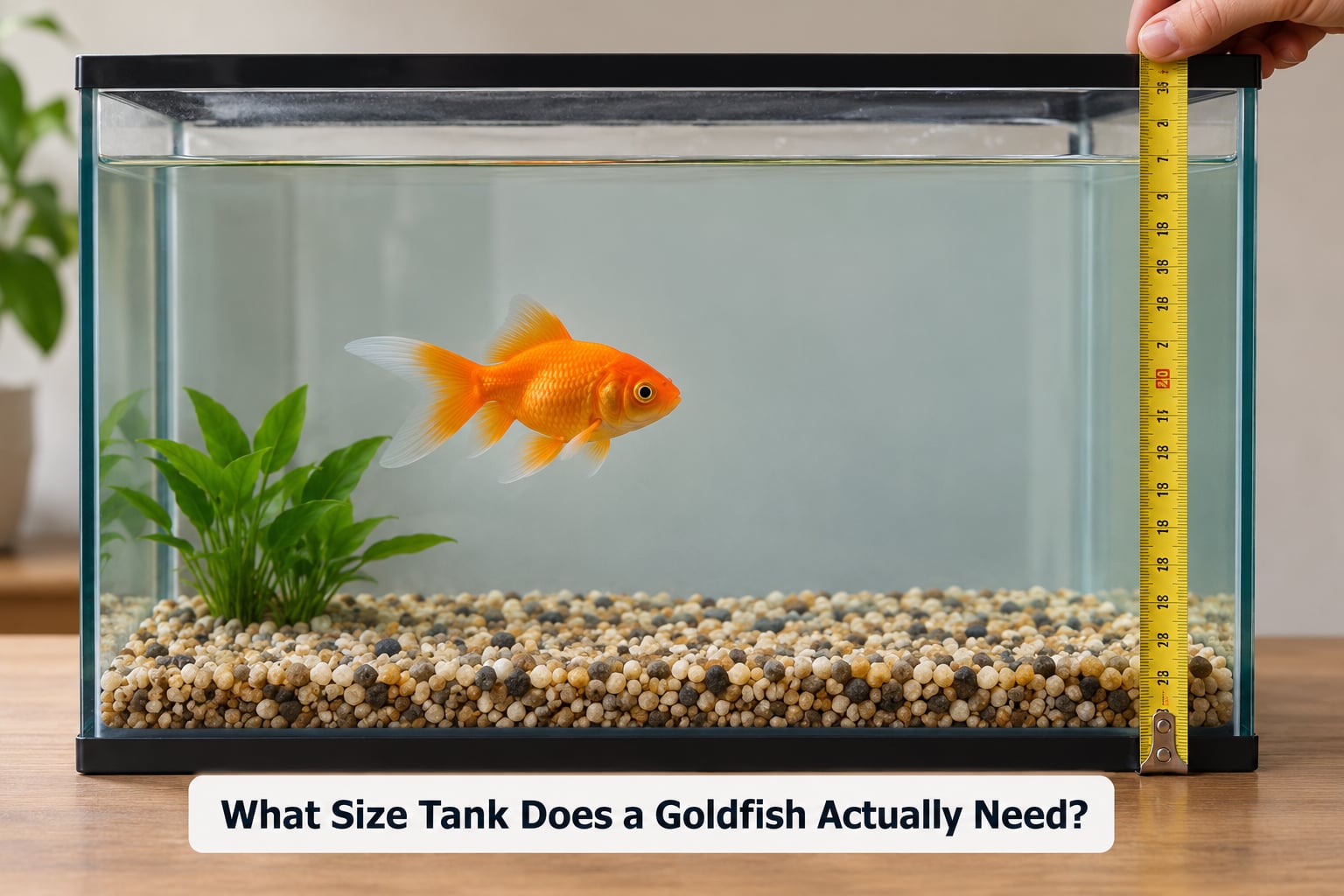
A single goldfish needs a rectangular tank holding at least 20 gallons of actual water for a fancy variety, or closer to 30 gallons for a comet or common goldfish. Add roughly 10 to 12 gallons for each additional fish, and judge the tank by the water volume measured at the substrate line, not the capacity printed on the box.
Three things decide whether a number is real: the water volume once gravel and decor are in, the footprint of the tank, and whether your filter can handle the bioload of the fish you plan to keep.
| Setup | True water volume | Suits | Honest limitation |
|---|---|---|---|
| Small desktop tank | 5 to 10 gallons | A temporary quarantine or fry setup | Too small for any adult goldfish long term |
| Standard rectangular tank | 20 to 29 gallons | One fancy goldfish, or two smaller ones at a push | Commits you to regular weekly water changes |
| Large rectangular tank | 40 gallons and up | Two comets or commons, or a small group of fancies | Water weighs about 8.3 pounds per gallon, so plan the stand and floor |
Goldfish are coldwater fish, so you do not need a heater. What you absolutely need is a filter rated for the tank’s real volume, a lid, and a flat surface for water changes. Everything else is preference.
How Much Tank Space Does Each Goldfish Need?
Why one gallon per fish does not work
The one-gallon-per-fish rule treats all fish as identical. A three-inch juvenile comet and a twelve-inch adult common goldfish have wildly different waste output, swimming demands and oxygen needs. The rule also says nothing about filtration, water changes or tank footprint, which is why it produces so many bad setups.
A better way to think about volume: how much waste must the water dilute, how far does the fish need to swim to feel normal, and how much water can you replace in a weekend without losing your cycle.
| True volume | Realistic stocking | What limits you here |
|---|---|---|
| Under 10 gallons | No adult goldfish | Waste builds up faster than a small biofilter can process it |
| 10 to 15 gallons | One young fancy, briefly | Rapid water quality swings stress the fish |
| 20 to 29 gallons | One fancy or one small comet | Limited swimming length and little room for error |
| 30 to 40 gallons | One comet or common, two smaller fish | Heavier water changes as the fish grows |
| 40 gallons plus | Two commons or comets, several fancies | Filled weight reaches 350 pounds or more |
Those conflicting numbers you have seen online, from five gallons to 75, are not all wrong. They come from different contexts: 5 gallons is a shipping or quarantine container, 20 to 30 is an indoor pet minimum, and 75 is closer to what a single wild fish occupies in a pond. Match the number to your situation.
Do Goldfish Grow to the Size of Their Tank?
They do not. A goldfish in a too-small tank releases growth-inhibiting hormones in response to chronic stress and poor water quality. Skeletal growth slows, but internal organs and eyes continue developing at their own pace. The result is a fish that looks compact and manageable while carrying damage that does not go away.
Keepers on r/Goldfish and long-timers on Aquariacentral describe this the same way: the fish that stays small in a tiny tank is malnourished and stressed, not conveniently sized. A stunted goldfish often shows a rounded head, a disproportionately large head relative to the body, ragged fins and a dark or patchy colour.
Growth itself is fast in the first year and then slows. A young comet commonly reaches eight to twelve inches in a healthy setup, and record-holding goldfish have measured well beyond eighteen inches. If your goldfish looks stuck at three inches in a small tank, that is your answer about why it is so small.
| Sign | What you are looking at | Likely meaning |
|---|---|---|
| Head noticeably wider than the body | Rounded, domed head shape | Growth inhibition from long-term crowding |
| Fins frayed or clamped against the body | Persistent fin damage | Chronic stress or poor water quality |
| Colour fading to pale or patchy | Loss of pigment over weeks | Poor nutrition or unstable conditions |
| Body elongating steadily month after month | Slow but consistent length gain | Normal growth in adequate space |
| Bobbing at the surface, trouble holding position | Swimming irregularity | Possible swim bladder problem, not tank size |
Why Is Water Quality More Important Than Tank Size Alone?
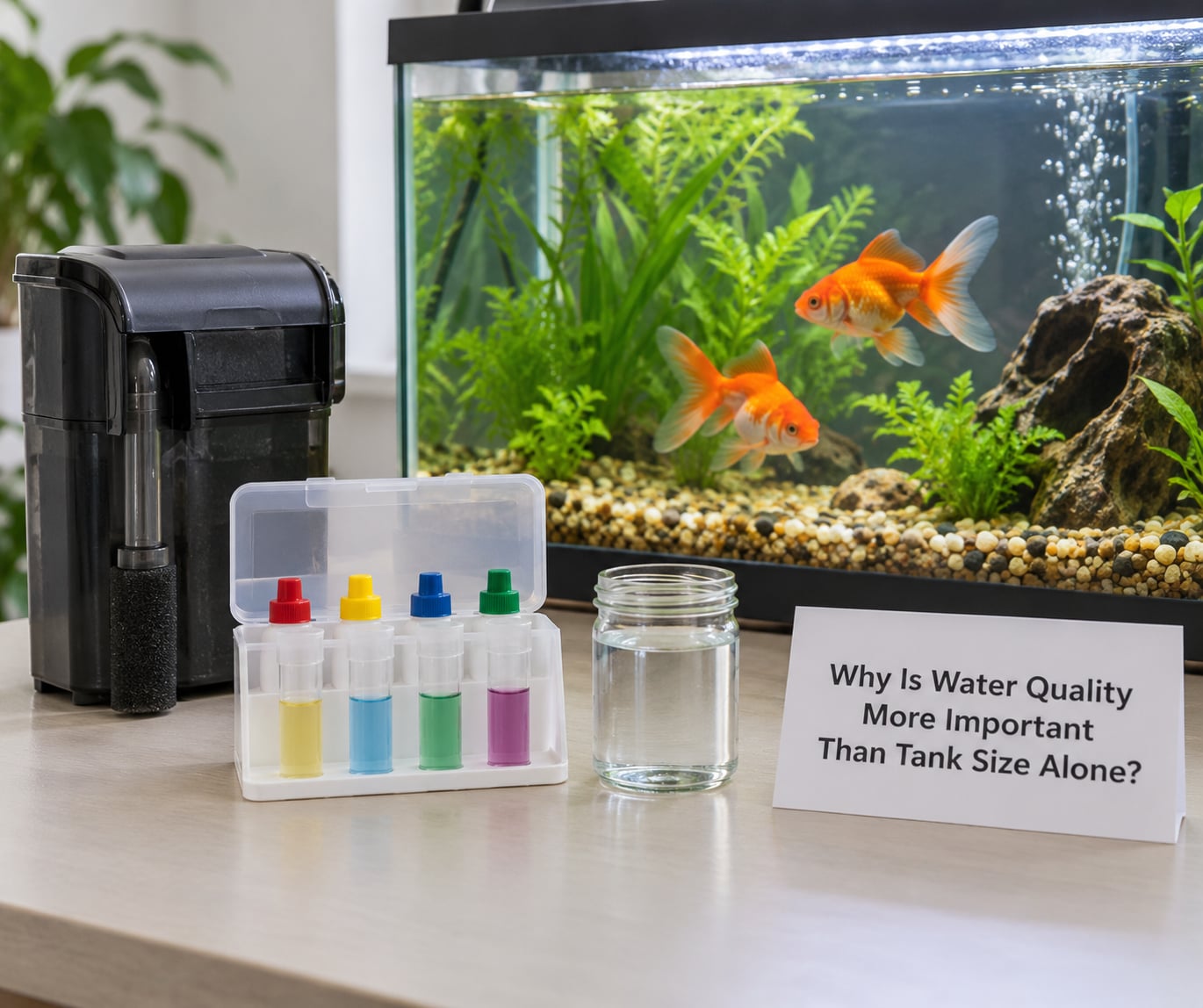
A 40-gallon tank that has never been cycled is more dangerous to a goldfish than a small tank that is cycled and maintained. Size dilutes waste, but it does not create the bacteria that convert ammonia into something harmless. Water quality decides whether a fish lives or merely survives.
Goldfish are heavy waste producers. They have no true stomach and a long intestine, so they produce a large volume of dilute waste, and much of it sinks straight to the substrate where it breaks down. Ammonia is the immediate problem, nitrite comes next, and nitrate is the end product your water changes remove.
| Water problem | Warning sign | Corrective action |
|---|---|---|
| Ammonia above 0 ppm | Red or inflamed gills, gasping at the surface, sudden fish death | Change 30 to 50 percent of the water now, add dechlorinated water, feed less |
| Nitrite above 0 ppm | Brown or chocolate coloured gills, listless fish | Water change and reduce feeding until readings clear |
| Nitrate climbing past 40 ppm | Cloudy water, algae growth, fading colour | Weekly partial water change on a regular schedule |
| Uncycled new tank | Ammonia spike in the first days after fish are added | Cycle the tank empty with fish food as an ammonia source before adding livestock |
| Unstable temperature | Slower activity, sitting on the bottom | Keep the room temperature steady and away from draughts |
Test your water weekly. That single habit catches ammonia and nitrate problems before they turn into an emergency, and it tells you whether your filter is doing its job.
Does Tank Shape Matter as Much as Volume?
Shape matters almost as much as the printed capacity. A tall, narrow tank with ten gallons holds the same water as a wide, short tank with ten gallons, but the wide one has far more surface area exposed to the air. Gas exchange happens at that surface, and goldfish need it.
Round bowls are the worst option. Their curved walls give no straight-line swimming distance, the surface area per gallon is low, and there is nowhere to hang a filter of any real capacity. Tanks shaped like letters, or with tall decorative hoods, are usually a marketing exercise rather than a design.
The rule I would give a beginner: buy the longest rectangular tank you can fit in the room. A 4-foot long, 1.5-foot wide tank gives far more usable swimming room than a cube with the same volume, and your fish will use every inch of that length.
How Much Space Do Fancy Goldfish Need?
Fancy varieties such as fantails, ryukins and orandas need slightly less volume than comets and commons, usually around 20 gallons for the first fish. The reason is their adult size, which is typically six to eight inches rather than ten to twelve.
That smaller size comes with trade-offs. Fancy goldfish have compact, rounded bodies and long flowing fins, and many of them swim poorly because of their body shape. Give them a tank with a long footprint and gentle flow so they can move without fighting the current.
They also produce plenty of waste for their size, and their long fins and rounded bodies make them more prone to swim bladder problems, so clean water matters more, not less. Some keepers keep fancy varieties in groups, and a group of small fish in a larger tank behaves better than one fish in a small one.
How to Choose the Right Tank for Your Goldfish
Work through this list before you buy anything, and you will avoid the most common beginner mistake, which is choosing a tank and then trying to fit a fish into it.
| Essential | What to check | Optional upgrade |
|---|---|---|
| True water volume | Measure at the substrate line, not the box label | Second tank for quarantine or fry |
| Footprint and length | The longest shape that fits the stand and the room | Background panel to reduce glare |
| Filter | Rated for the real volume, not the label capacity | Second filter or sponge on the sump side |
| Lid | Solid or mesh top, goldfish jump | Lid light for plant-free setups |
| Filled weight | About 8.3 pounds per gallon plus substrate and decor | Leveling mat under the tank |
| Water change access | Room for a bucket and a siphon hose beside the tank | Python-style siphon for easier draining |
| Temperature stability | Away from radiators, air conditioning vents and windows | Insulated mat for cold rooms |
If you already own a small tank and want to upgrade, set up the new tank and cycle it first. Then move the fish across in their existing water, adding tank water rather than tap water so the bacteria and temperature stay stable. Moving a fish into a brand new, uncycled tank is the fastest way to lose it.
Frequently Asked Questions
Can one goldfish live in a 5 gallon tank?
Only as a short-term quarantine or holding container. A 5-gallon tank lacks the water volume and filtration capacity to dilute a goldfish’s waste output, so ammonia and nitrate climb within days. For a permanent indoor home, aim for at least 20 gallons for a fancy goldfish and around 30 gallons for a comet or common goldfish, with a filter rated for that volume.
Do goldfish grow according to tank size?
No. Goldfish release growth-inhibiting hormones when chronic stress from crowding limits their growth, but organs, eyes and swim bladder keep developing normally. That produces a small-looking fish with lasting damage rather than a healthy small fish. Give the fish enough space and stable water and it will keep growing along its natural curve for the rest of its life.
Why is my goldfish so large?
Goldfish are fast growers, especially in their first year. A young comet commonly reaches eight to twelve inches in a healthy setup, and fancy varieties usually settle at six to eight inches. If your fish is filling the tank lengthwise, that is normal growth rather than a problem, provided the water quality is good and there is still room to turn around.
How fast do goldfish grow?
The fastest growth happens in the first six to twelve months, then slows steadily through the second year. Young goldfish can gain well over an inch a month while small. If a fish stops gaining length in a cramped or poorly filtered tank, growth has usually been inhibited rather than completed, which is one of the clearest signs to upgrade the setup.
Is it a myth that goldfish have a three-second memory?
Yes. Goldfish remember training cues, feeding locations and tank layout for weeks or months, and they recognise regular keepers by movement and timing. Keepers often describe fish that swim to the front glass when they know someone is about to feed. Any belief that a goldfish forgets everything in seconds came from cartoon writing, not from observing fish.
How can I tell if my goldfish is happy?
A healthy goldfish swims the full length of the tank, checks the surface for food, has clear clean eyes, and shows steady interest in what happens nearby. Fish that hang in a corner, gasp at the surface, clamp their fins or hide constantly are telling you something is wrong, usually water quality. Watch behaviour daily and test the water weekly.
Conclusion: Start With the Right Space and Stable Water
Goldfish tank size myths tend to make one variable look simple when it is not. A goldfish does not grow to fill a bowl, a bowl is never a home, and a big tank full of bad water is no better than a small one kept clean.
Measure your actual water volume, look up the adult size of the exact variety you are buying, and choose the longest rectangular tank your room will hold. Then pair it with a filter rated for that volume, cycle it before the fish arrive, and keep up with weekly partial water changes.
Keepers on r/fishkeeping point out that fish sold as beginner pets often need far more space than the label suggests. Trust your own numbers over that label, and your goldfish will have a good chance of reaching the long lifespan it was actually capable of.