If your fish are gasping at the surface, they are short of oxygen or unable to use the oxygen that is there. Low dissolved oxygen is the usual reason, but ammonia, nitrite, heat, chlorine from tap water and gill disease all produce the same behavior within hours. The difference between a solved problem and a dead tank is what you do in the first ten minutes.
Updated for 2026
Table of Contents
- What Does Fish Gasping at the Surface Mean?
- Quick Troubleshooting Checklist for Fish Gasping</
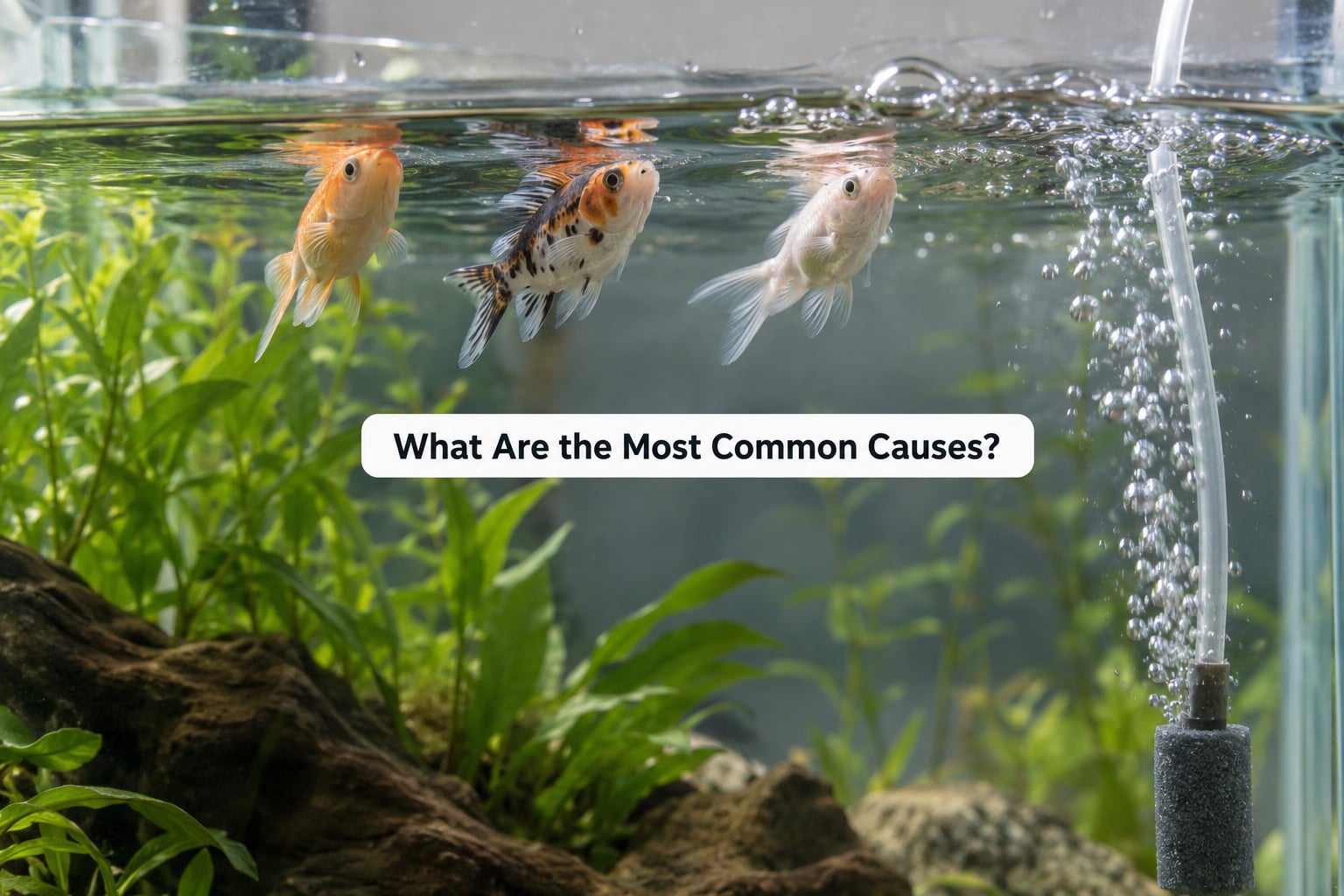
- What Are the Most Common Causes?
- Why Are My Fish Gasping at the Surface?
- Low dissolved oxygen
- Ammonia and nitrite poisoning
- Heat stress
- Filter and circulation failure
- Gill disease and parasites
- Labyrinth fish that gasp by design
- How to Check Dissolved Oxygen and Water Quality Safely
- What Should You Do Right Now?
- When Is Fish Gasping an Emergency?
- How to Prevent Surface Gasping in the Future
- Frequently Asked Questions
- Is it normal for fish to swim at the top of the tank?
- How much dissolved oxygen do aquarium fish need?
- Should I change the water if my fish is gasping?
- Can a clogged filter make fish gasp at the surface?
- Can I use human medicine to treat a gasping fish?
- How long does it take for a fish to recover after gasping?
- Conclusion
What Does Fish Gasping at the Surface Mean?
Fish gasp at the surface when they cannot pull enough dissolved oxygen through their gills, so they move to the top layer where oxygen is richest and pump water through their mouths in fast bursts. That is a distress signal in almost every species, the exception being labyrinth fish such as bettas and gouramis, which breathe air on purpose.
While you work out the cause, do three things. Add movement to the surface, stop feeding, and test the water. That sequence buys your fish time and takes about five minutes.
If you only remember one thing: surface gasping can go from a few fish to a dead tank overnight, because oxygen depletion and toxic ammonia both get worse the longer you wait.
Quick Troubleshooting Checklist for Fish Gasping</
Run down this list before changing anything. Each row is a check you can do in a couple of minutes, and the last column tells you whether the result means act now.
| Check | What to look for | Result that warrants urgent action |
|---|---|---|
| Dissolved oxygen | Test at tank temperature with a DO kit; cold water holds more oxygen than warm | Below roughly 5 mg/L, or below 4 mg/L in a heavily stocked tank |
| Temperature | Compare the reading against the range your species actually needs | Above that range, or climbing fast after a heater fault |
| Ammonia and nitrite | Liquid test kit, read at the correct time and against the right colour card | Any detectable ammonia or nitrite in a stocked tank |
| Circulation | Filter running, intake and outlet clear, ripple visible at the surface | Filter running but the surface is flat and still |
| Recent changes | Water change, new fish, new plants, medication, filter clean | A change in the last 48 hours with no dechlorinator or with a cold shock |
| Which fish | All fish at once, or one fish while the rest are normal | One fish gasping alone usually points at that fish, not the water |
| Gills | Colour and shape under the operculum, look for fraying, white film or redness | Pale, frayed, coated or raw-looking gills |
Read the whole table, not one row. An oxygen reading of 6 mg/L with zero ammonia is a very different situation from 6 mg/L with visible ammonia, and treating them the same way wastes hours.
What Are the Most Common Causes?
Why Are My Fish Gasping at the Surface?
Fish extract dissolved oxygen only from water passing over their gills, and the richest oxygen sits at the water surface where the gas exchange with air happens. When the water holds too little oxygen, when warm water has reduced its capacity to hold it, or when the gills are swollen and cannot exchange gas properly, the fish has no choice but to move upward and gulp faster.
That is why an airstone alone sometimes fixes nothing. Bubbles rising from the bottom may never break the surface, while a filter return or a small pump aimed at the surface creates the ripple that actually renews oxygen. Surface agitation is the part that matters.
Low dissolved oxygen
Oxygen shortage is the most common cause, and the pattern is unmistakable: gasping that is worse at night, worse in a heavily planted tank, and worse after several days of algae or uneaten food. Plants release oxygen by day and consume it at night, so a planted tank can quietly run out while you sleep.
Overstocking has the same effect because living tissue demands oxygen continuously. Dead fish in the morning usually mean oxygen depletion reached the level where the weakest fish could not keep up.
Ammonia and nitrite poisoning
Ammonia and nitrite burn gills and blood, and the affected fish often stays low in the tank or in a corner rather than at the surface, with clamped fins and dark or reddish gills. In an established tank this points to a filter crash, a mini-cycle after a rescape, or a dead fish breaking down.
Nitrite is the quieter one. It binds to haemoglobin and blocks oxygen transport, so a fish can be breathing hard in water that measures fine on an oxygen test while its blood carries almost nothing.
Heat stress
Warm water holds less oxygen, so a heater fault during a heat wave can push a comfortable tank into an oxygen crisis in a single afternoon. Watch the thermometer rather than the fish, since fish show heat stress in stages: gasping first, then clamped fins, then loss of balance near the surface.
Cool the tank gradually. Dropping cold water in raises the risk of a temperature shock that kills fish that were still recovering.
Filter and circulation failure
A filter that is running but not moving water is a common surprise. Look at the intake for debris, at the media for a smothering layer of fine sludge, and at the outlet for a stream that stirs the surface. A full water change that disturbs the gravel can also fill the filter with sediment and cut flow within hours.
Never rinse filter media under a tap. The chlorine kills the beneficial bacteria, and you can lose a working biofilter in a single rinse.
Gill disease and parasites
When ammonia, nitrite, temperature and oxygen all read acceptable and the fish still gasp, look at the gills. Bacterial gill disease and gill flukes show up as red, swollen, frayed or coated gills, usually with scratching, flashing and clamped fins.
This is the case where an aquatic veterinarian earns their fee. Salt, antibiotics and other remedies given blind often destroy the remaining gill function and finish what the infection started.
Labyrinth fish that gasp by design
Bettas, gouramis, ctenopoma and paradise fish carry a labyrinth organ that lets them breathe atmospheric air, so a slow trip to the surface every few minutes is normal. Distress looks different: they hang at the top, gulp frantically or stay there without moving away.
Do not use a calm betta to write off the rest of the tank. If the other species are gasping, something in the water still needs attention.
How to Check Dissolved Oxygen and Water Quality Safely
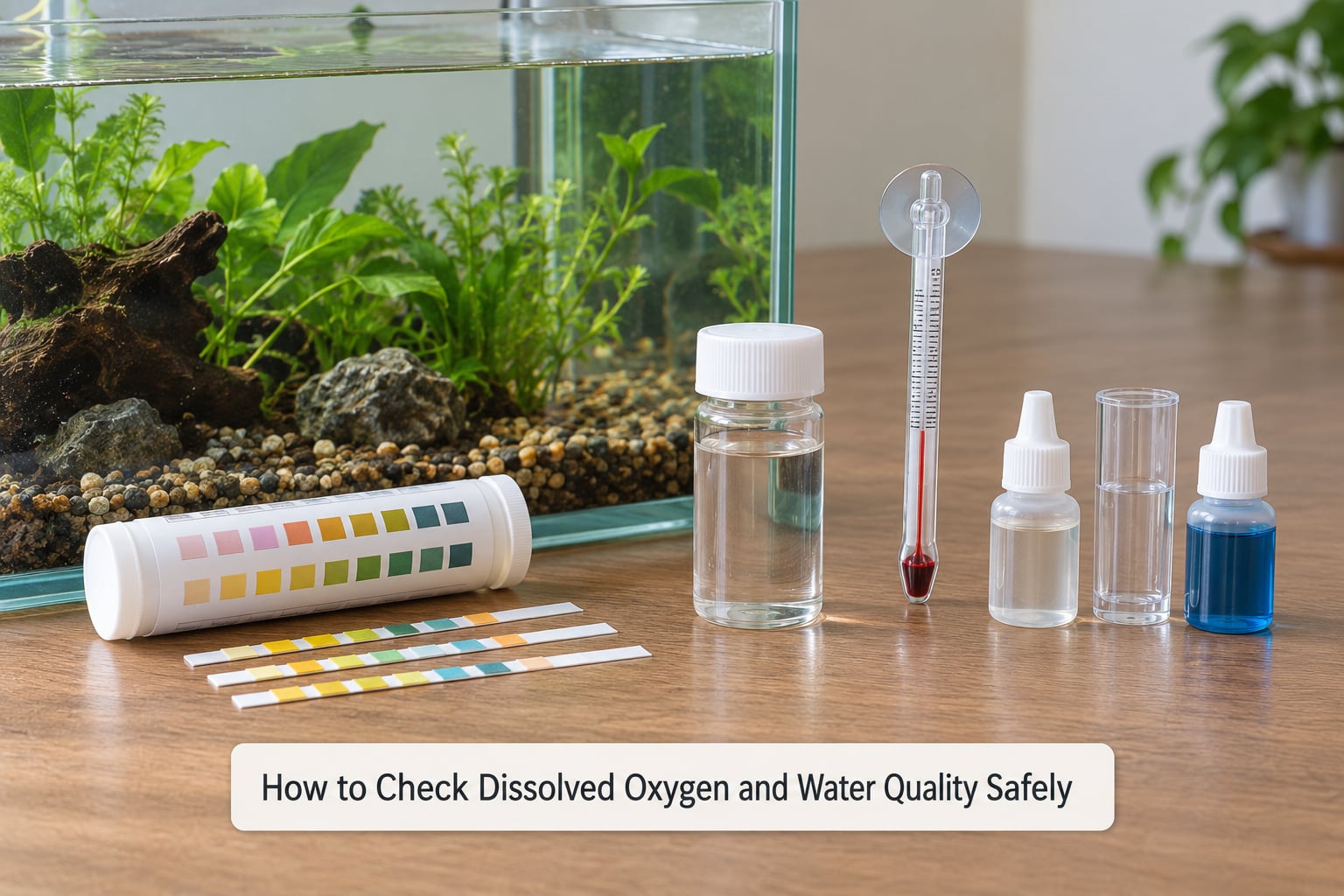
Test in this order and write the numbers down, because a single reading tells you very little on its own.
- Temperature. Check the tank and the tap water side by side. A tank several degrees above its range explains a lot of gasping on its own.
- Ammonia, nitrite and nitrate. Use a liquid kit where you can, since strips are good for spotting a problem and poor for reading a level. Test the tap water too, so you know what your conditioner has to deal with.
- pH and alkalinity. Relevant because it tells you how stable the water is, not because you should chase a number with chemicals. Large swings shock fish more than a slightly off reading.
- Dissolved oxygen. A DO test kit is worth owning. Without one, use your observations: a flat surface and fish at the top together are as good as a low reading.
Interpret the set together. Low oxygen with clean water points at stocking, temperature or circulation, while clean oxygen readings with ammonia present point at a filter or cycling problem. A chlorine or chloramine problem shows up as gasping that starts minutes after a water change and often affects every species at once.
Hold results next to your maintenance log. If you cannot remember the last reading, you cannot tell whether a number is new or normal for your tank.
What Should You Do Right Now?
Work in this order. Each step protects the fish while you look for the cause.
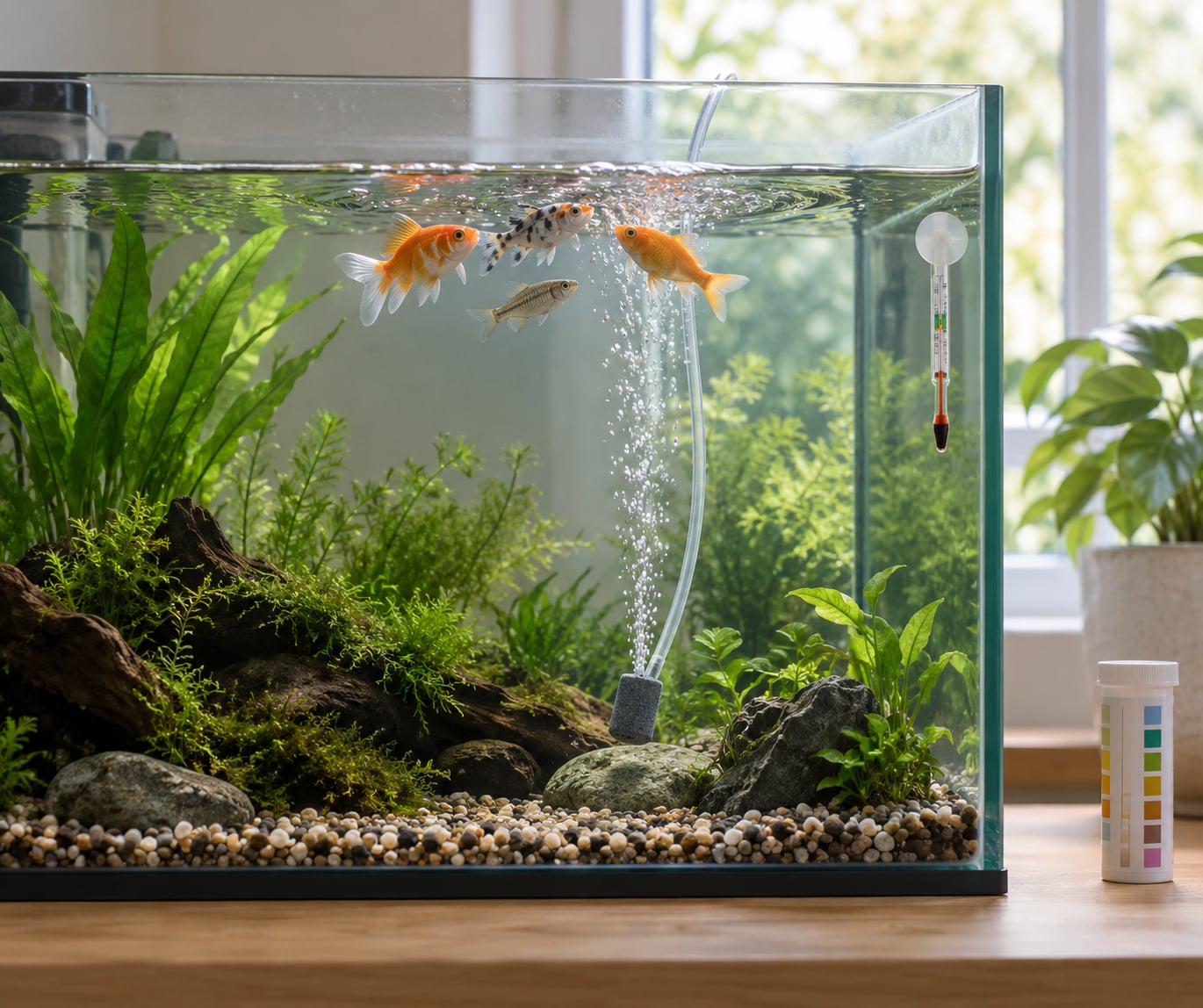
- Add surface movement. Aim a filter return, a small powerhead or an airstone with its outlet at the surface. Any of these buys time in minutes.
- Stop feeding. Uneaten food and fish waste are what produce ammonia and consume oxygen. A day of fasting costs a healthy fish nothing and cuts the load fast.
- Change water carefully. Do 30 to 50 percent with dechlorinated water at the same temperature as the tank. Cold shock and leftover chlorine turn a bad day into a worse one.
- Check the filter. Confirm the flow, clear the intake and rinse dirty media in water siphoned from the tank.
- Remove any dead fish. A dead body in warm water consumes oxygen and produces ammonia fast.
- Stop CO2 if you inject it. Turn off any carbon dioxide system and aerate hard instead. CO2 off-gasses at night and can leave fish gasping in a full, well-filtered tank.
You will know it is working when the fast gilling slows within 30 to 60 minutes and fish leave the top layer to spread out through the tank. If nothing changes after two hours of aeration and a large water change, the problem is probably not oxygen alone, so keep testing.
When Is Fish Gasping an Emergency?
Surface gasping that continues after an hour of aeration and a large water change is an emergency, especially when several signs appear together.
- Rapid opercular movement that never settles, even at rest
- Gasping at the filter outlet as well as the surface
- Loss of balance, floating at an angle, or upside down
- Pale, frayed, coated or bleeding gills
- Lethargy in fish that are normally active, or hiding and clamping fins
- Multiple species affected within the same hour
- Any fish dying
Contact an aquatic veterinarian or an experienced aquarium professional when gills look damaged, when only one fish is affected and it is getting worse, or when a water change and aeration produce no improvement. Bring photos of the fish, the gills and your test results.
Ignore dead fish at your own risk. A body in the tank tells you the cause is real and still active, and it removes oxygen while you work.
How to Prevent Surface Gasping in the Future
Every gasping emergency I have seen traced back to a short list of habits, and all of them are manageable.
- Stock realistically. Count the full-grown adult size of each species, not what the shop tank held.
- Keep the filter clean and the surface moving. A rinse in old tank water, done on a schedule, prevents most flow problems.
- Feed less. Smaller, less frequent meals cut both ammonia production and oxygen demand.
- Watch the thermometer. Keep a second thermometer in the tank so a heater fault does not go unnoticed until the fish are already in trouble.
- Acclimate new fish slowly and quarantine them before they go near the display tank.
- Service water changes on a schedule and test the tap water for chlorine or chloramine, especially after a utility change.
Keep a small emergency kit ready: a battery air pump, a bottle of dechlorinator, an air stone, and a spare heater. A battery pump is the one item that has rescued more tanks than any other during a power outage or a failed filter.
Routine maintenance is weekly and boring. Emergency intervention is today, in bigger volumes, with more air. Keeping the two separate is most of the battle.
Frequently Asked Questions
Is it normal for fish to swim at the top of the tank?
For most species, no. Steady swimming at the surface with fast gilling means the fish cannot get enough oxygen where it is. Betas, gouramis and other labyrinth fish are the exception and take air at the surface calmly and briefly. If your other fish are joining them up there, treat it as a problem and test the water.
How much dissolved oxygen do aquarium fish need?
Most aquarists aim for at least 5 mg/L in a community tank, and above 6 mg/L in warm water or a heavily stocked one. Cold water holds more oxygen than warm water, so a reading at one temperature means little at another. Below about 4 mg/L, distress is common and you should aerate and check stocking immediately.
Should I change the water if my fish is gasping?
Yes, but do it carefully. Change 30 to 50 percent with water that is dechlorinated and the same temperature as the tank, and aerate strongly during and after the change. A cold or chlorinated water change can trigger a fresh emergency in fish that were already struggling, so match the temperature and use conditioner every time.
Can a clogged filter make fish gasp at the surface?
It is one of the most common causes. A blocked intake or a thick layer of fine sludge on the media slows flow until the surface goes flat and still, and oxygen stops being renewed. Clear the intake, rinse dirty media in water taken from the tank itself, and never rinse media under a tap because chlorine kills the bacteria on it.
Can I use human medicine to treat a gasping fish?
Never. Human medicines are dosed for human body weight and can destroy a fish’s gills and liver, and several antibiotics reduce oxygen exchange further. Salt and broad remedies given without a diagnosis often kill more fish than the infection would. If the gills look damaged, ask an aquatic veterinarian for an actual diagnosis before adding anything to the tank.
How long does it take for a fish to recover after gasping?
With oxygen trouble, breathing usually slows within 30 to 60 minutes of good aeration, and fish often look normal within a day or two. Ammonia or nitrite damage takes longer, commonly several days of clean water and a stable biofilter. Gill disease is measured in weeks and needs veterinary treatment. If breathing has not improved within two hours, assume oxygen alone is not the cause.
Conclusion
The first action is free and takes a minute: move water at the surface so the fish can breathe, then stop feeding and change 30 to 50 percent of the water with dechlorinated, temperature-matched water. After that, test temperature, ammonia, nitrite and circulation, and check the gills if the numbers come back clean.
If breathing has not slowed within two hours, or the gills look damaged, call an aquatic veterinarian rather than adding another remedy. That is the point where a second lost fish stops being bad luck.