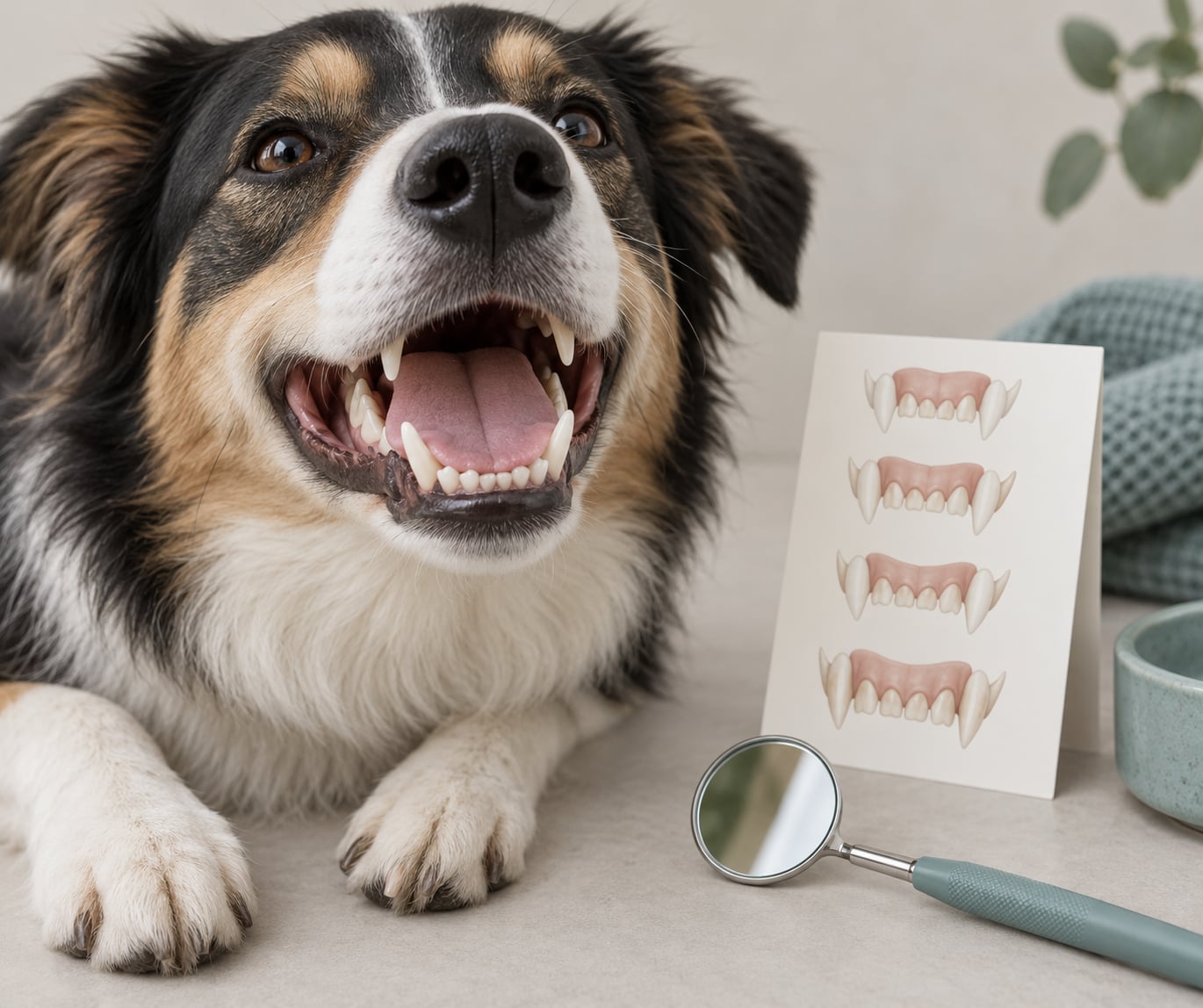
You estimate a dog’s age from their teeth by counting them, checking whether any baby teeth are still there, and looking at how much wear, staining and tartar have built up. Tooth eruption gives you a tight window up to about seven months. After that, teeth tell you a rough range, usually within one to two years, and never a birthday.
The whole check takes a minute or two with a calm dog and decent light. Most of the guesswork people get wrong comes from reading tartar as an age marker, so that gets its own section below.
Table of Contents
- What You Need
- Step-by-Step: How to Tell a Dog’s Age From Their Teeth
- 1. Check the Baby Teeth and Adult Teeth
- 2. Look at Tooth Eruption and the Number of Teeth
- 3. Assess Tooth Wear, Colour and Buildup
- 4. Compare the Findings With Typical Age Ranges
- Common Mistakes
- A Few Practical Tips
- Frequently Asked Questions
- How do I estimate my puppy’s age by its teeth?
- What are retained baby teeth, and does my dog need them removed?
- Do small dogs really get tartar faster than large dogs?
- At what age do dogs typically start getting tartar on their teeth?
- Can a vet tell me my dog’s exact age from its teeth?
- What is the 7 7 7 rule for dogs?
- Conclusion
What You Need
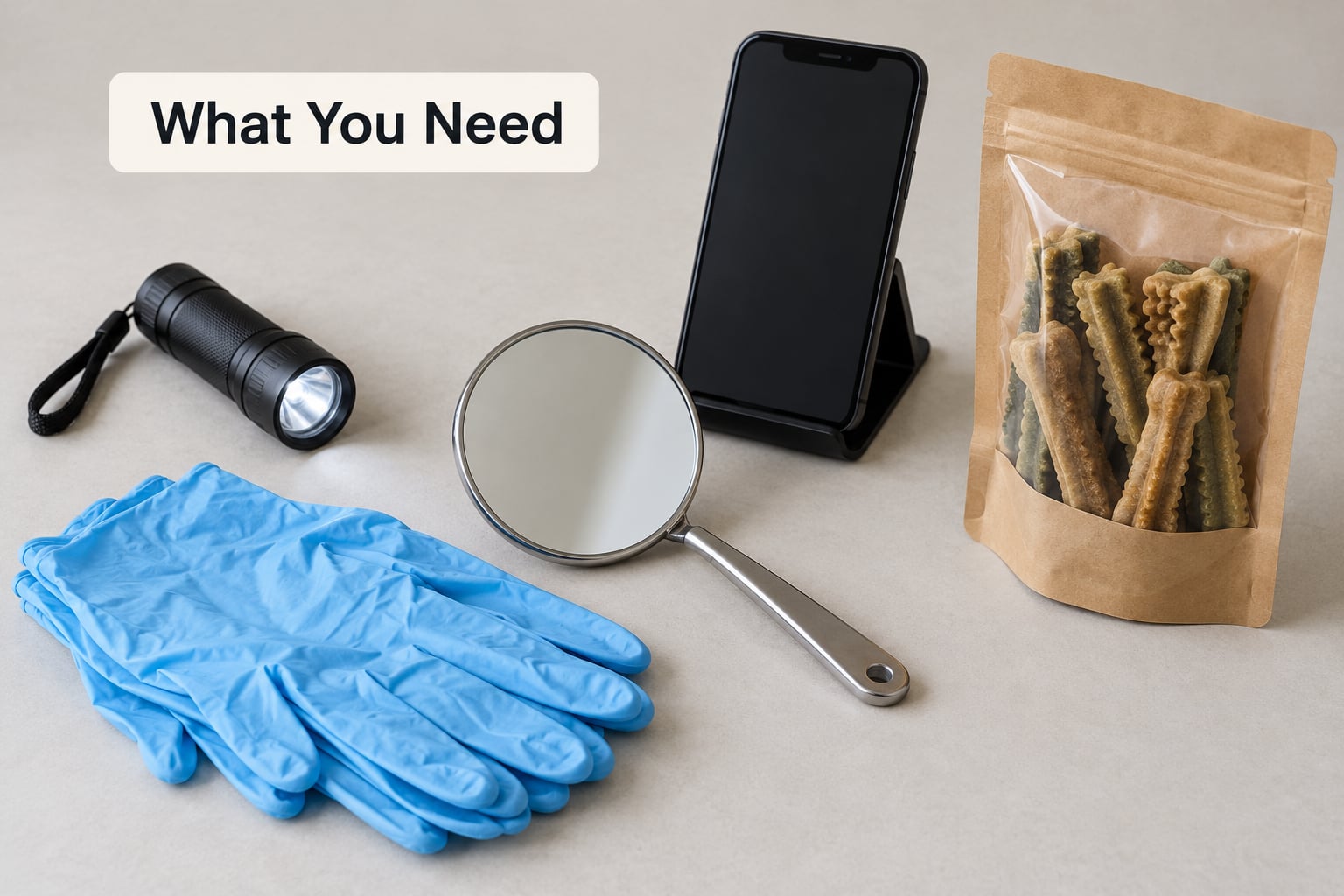
You need very little. Good light matters more than any tool, and a phone flashlight pointed from the side will show you gum colour and tartar better than an overhead lamp.
- Light — a window with daylight, a phone torch, or a bright lamp angled across the teeth.
- A dog who is not wound up — a relaxed dog tolerates the lip lift for longer than one who is being dragged to the vet.
- Clean hands or disposable gloves — especially if the gums look pink and puffy.
- A small hand mirror or your phone camera — the cheek-side premolars and molars are almost impossible to see from the front.
- Optional: dental chews or a dog toothbrush — useful afterwards, not needed for the estimate.
There is no special equipment. Do not muzzle a dog by force or wedge the jaw open to get a better look; a dog that fights the mouth lift will tell you nothing useful, and the struggle causes more harm than a rough estimate ever could.
Step-by-Step: How to Tell a Dog’s Age From Their Teeth
1. Check the Baby Teeth and Adult Teeth
First work out which set of teeth you are looking at. Puppies erupt 28 small, sharp deciduous teeth, often called milk teeth or baby teeth, between roughly three and eight weeks of age. Adults end up with 42 permanent teeth: 20 in the upper jaw and 22 in the lower.
Between about three and seven months the baby teeth loosen and fall out one by one as the permanent set pushes through. Most dogs start losing incisors around three to four months, canines around five to six months, and finish the changeover near seven months. By then the whole mouth is adult teeth and eruption tells you nothing more.
Retained baby teeth are the exception that throws the count out. A dog can be fully grown and still carry one or two baby teeth, usually the upper canines or incisors, which crowd the permanent set and trap plaque. How you tell them apart: baby teeth are much smaller, whiter and sharply pointed, and they sit slightly in front of the adult teeth.
You worked if you can name the set. Twenty-eight sharp little teeth means under about four months. A mix of small baby teeth and adult teeth means somewhere in the three-to-seven-month window. Forty-two adult teeth means at least seven months old.
2. Look at Tooth Eruption and the Number of Teeth
Which teeth are present is your broadest clue, and it works best early. Eruption order is fairly consistent across breeds: incisors first, then canines, then premolars, then molars, with the upper teeth usually arriving ahead of their lower partners.
Beyond seven months, expect 42 teeth and a full change to wear, colour and gums. Small dogs finish this on the early side and giant breeds on the late side, so a seven-month-old beagle and a seven-month-old Great Dane will not look identical. Individual dogs also vary by a month or two either way.
Here is the compact reference most people find useful:
| Age | Teeth present | What they look like |
|---|---|---|
| Under 3 weeks | None | Toothless, gums closed or just opening |
| 3-4 weeks | 28 deciduous | Incisors arrive first, small and needle-sharp |
| 4-6 weeks | 28 deciduous | Canines in, mouth fully stocked, puppy breath |
| 6-8 weeks | 28 deciduous | All baby teeth in, whites glaring, gums pale pink |
| 3-4 months | Mix | Front baby teeth starting to loosen and drop |
| 5-6 months | Mix | Canines and premolars changing over, gums maybe a little puffy |
| 7 months | 42 permanent | Full adult set, bright white, edges still sharp |
| 1-2 years | 42 permanent | Clean white teeth, slight rounding on the incisor edges, minimal tartar |
| 3-5 years | 42 permanent | Mild yellowing, tartar first on the back premolars and molars |
| 5-10 years | 42 permanent | Worn incisors, heavier tartar, gum recession, occasional missing tooth |
| 10+ years | Fewer than 42 | Heavy staining, worn or broken teeth, exposed roots, lost teeth |
Counting properly takes a moment. Lift the top lip and count along the visible arcade, then use your phone camera or a mirror for the cheek teeth on both sides of the upper jaw, and again underneath. You are looking for 42 in an adult. If you find far fewer and see gaps with smooth healed edges, teeth were lost rather than never erupted.
3. Assess Tooth Wear, Colour and Buildup
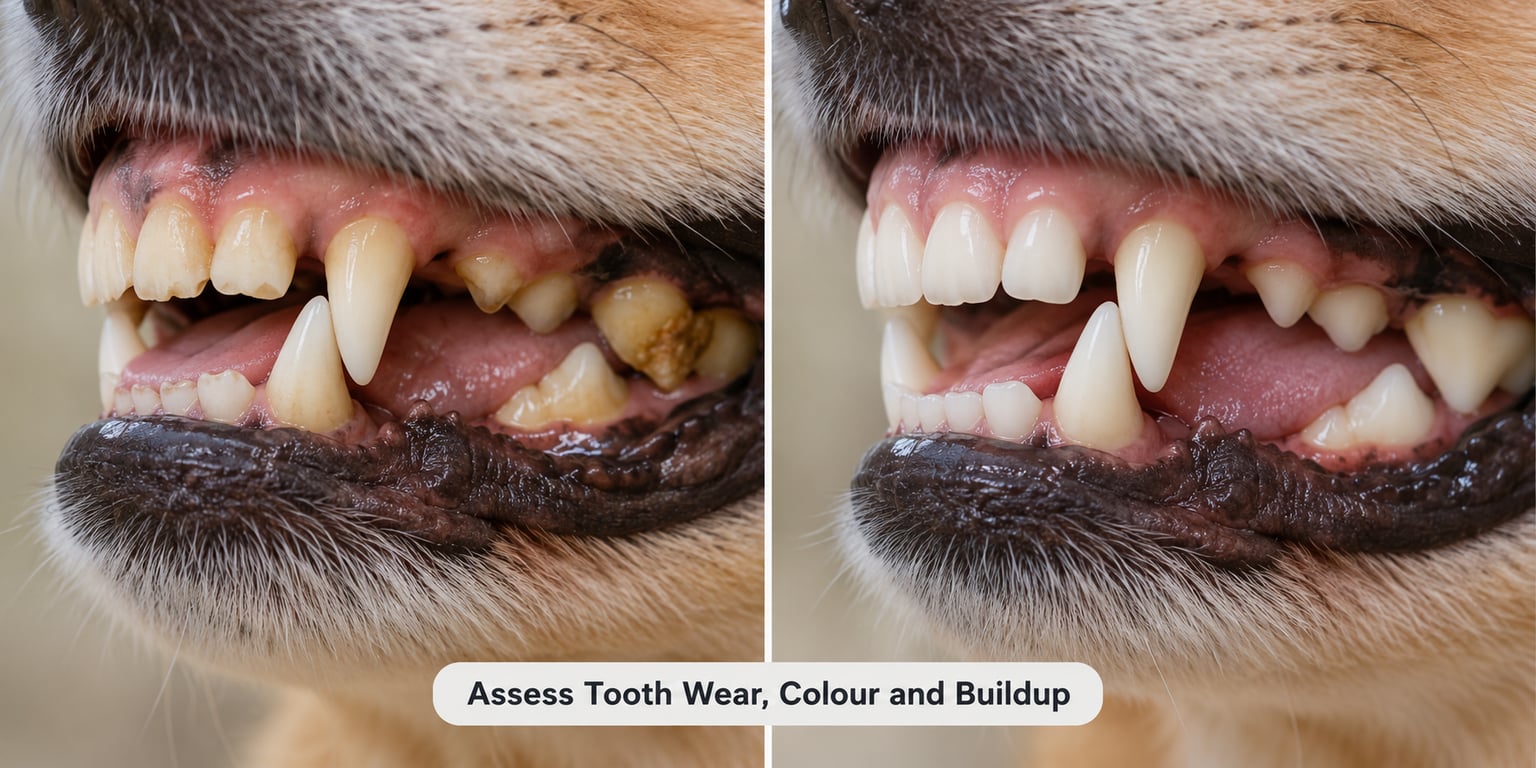
Wear is the second-best signal. A young adult’s incisors have crisp edges you can almost catch a fingernail on. By three to five years those edges have lost their sharpness, and by five to ten the corners are noticeably rounded and the incisor tips are shorter than the side edges.
Colour changes slowly. Bright white at first, then a dull off-white, then cream or yellow, and eventually brown patches on the back teeth. Staining can also be a single chipped or cracked tooth darkening long before the rest of the mouth changes.
Separate the two kinds of buildup. Plaque is a soft film you can often rub off the outside of the molars, and tartar is the hard yellow-brown or grey crust that does not budge. Tartar almost always shows up first on the cheek side of the lower premolars and the upper molars, where saliva sits.
None of that is an age clock. A small dog on wet food can show hard tartar at three, and a large dog that chews bones and has a professional clean every year may show very little at eight. Genetics, diet, chewing habits, gum disease and whether the dog ever saw a dental cleaning all rewrite the picture.
4. Compare the Findings With Typical Age Ranges
Put the pieces together and report a range rather than a number. Eruption narrows it tightly. After the full adult set is in, colour and wear give you a band, and tartar mostly tells you about dental care rather than age.
Small breeds mature sooner. Toy and small dogs typically reach their full adult dentition a bit earlier and build tartar much faster, because their teeth are crowded and their gum line is shallow. Medium and large breeds keep white teeth longer, and giants are the slowest of all. So a heavily tartar-covered Chihuahua should not be read as a senior, and a spotless Labrador at eight is not a miracle.
Owners working with an adopted dog get this wrong most often in both directions. People on forums describe rescues whose shelter estimate was years off from a DNA test, usually because the dog was a hard chewer with flattened teeth. Others describe young small breeds that looked ancient at four because of crowding. A stated range of one to two years keeps you on the right side of that.
You worked if you can say “roughly two to three years, give or take” and point to the clue that decided it. If your answer rests only on tartar, you have a dental conversation to have, not an age estimate.
Common Mistakes
Reading tartar as an age marker. Tartar is a record of oral hygiene, not birthdays. Owners in r/dogs and r/DoggyDNA describe heavy build-up on dogs who chew hard things constantly and worn, near-white teeth on dogs who do not, and the estimate inverts either way. Use eruption first and tartar only as a weak supporting note.
Counting only the front teeth. The incisors and canines show wear, but two thirds of the dentition sits behind the cheek. Always check the premolars and molars with a mirror or the phone camera before you settle on a number.
Assuming one timeline for every dog. Eruption order is consistent, but eruption timing and wear rate are not. Adjust mentally for breed size, and never transfer a chart stage from a giant-breed dog to a toy breed.
Forcing the mouth open. Restraining a nervous dog is the one genuinely harmful step in this process. Work on a calm moment, reward generously, and stop if the dog pulls away or whine. A partial look at a relaxed dog beats a complete look at a frightened one.
Treating heavy tartar as old age. Red, swollen or bleeding gums, bad breath, a broken tooth or a loose tooth are signs of periodontal disease, which is treatable at any age. Bring those to a vet instead of adding years to your dog’s age.
Forgetting the puppy-timeline myth. The old seven human years per dog year shortcut is still quoted everywhere. The first two dog years work out to roughly 10.5 human years each, and each year after that adds about four, so a six-year-old dog is closer to 45 in human terms than 42. It matters here because people convert the tooth estimate straight after finding it.
A Few Practical Tips
- Start when the dog is tired and settled, ideally after a walk or a meal.
- Lift the lip on one side at a time and take photographs straight away; comparing photos over weeks shows change that a single look misses.
- Score each category separately — count, colour, wear, tartar, gums — before combining them. Two strong clues beat five weak ones.
- Photograph the whole open mouth from the front and both sides at the same light each time.
- For an adopted dog of unknown age, DNA breed tests are the practical confirmation step, and a vet dental exam with radiographs gives a professional grade estimate.
Frequently Asked Questions
How do I estimate my puppy’s age by its teeth?
Puppies erupt their 28 baby teeth between about three and eight weeks, and lose them one at a time between roughly three and seven months. Incisors go first around three to four months, canines around five to six, and premolars last. Count what is present and how sharp it is: a needle-sharp mouth points to under four months, a mix of small and adult teeth to the middle window, and a full set of 42 with clean edges to about seven months. It takes a minute and it is the most accurate part of the whole method.
What are retained baby teeth, and does my dog need them removed?
Retained baby teeth are deciduous teeth that never fell out when the permanent teeth arrived. They are usually the upper canines or incisors, and you can spot them because they are smaller, whiter and sharply pointed, sitting slightly ahead of the adult set. They matter because they crowd the permanent teeth and trap plaque, which raises the risk of gum disease and can shift the adult teeth out of line. Ask your vet about them, and note that adult dogs carrying baby teeth can skew any tooth-based age count.
Do small dogs really get tartar faster than large dogs?
Yes, and it is the biggest reason generic age charts mislead people. Toy and small breeds have crowded teeth and a shallow gum line, so plaque hardens into tartar much earlier. Owners of Chihuahuas, Shih Tzus and Yorkshire Terriers regularly describe heavy build-up in dogs still fairly young, which reads as old age if you judge by tartar alone. Large and giant breeds keep whiter teeth longer, so the same appearance means something different at each size. Adjust your read for the breed in front of you.
At what age do dogs typically start getting tartar on their teeth?
For most medium and large dogs, visible tartar shows up between one and three years, starting on the cheek side of the lower premolars and the upper molars where saliva collects. Small breeds get there much sooner, sometimes under two. Hard-chewing dogs are the opposite case: wear can keep the teeth looking clean, which also makes them look younger than they are. Tartar is a better signal of dental care than of age, so treat it as supporting evidence only.
Can a vet tell me my dog’s exact age from its teeth?
No one can give an exact age, including your vet. Tooth eruption narrows the estimate tightly in puppies, and after the full adult set is in, a professional exam plus dental radiographs usually lands within about one to two years. Teeth alone are not proof of anything in adult dogs because chewing habits, diet, genetics and dental care all skew the wear. For an adopted dog whose age matters for medication, anaesthesia or insurance, records or a DNA test give a better answer.
What is the 7 7 7 rule for dogs?
The seven times rule is outdated. Small breeds age faster than large ones early on and slower later, so a single multiplier flattens a very different process. A better working version is that the first two dog years count for roughly 10.5 human years each, and every year after that adds about four. That puts a three-year-old near 28 in human terms and a ten-year-old near 66. The rule matters for tooth estimates because people convert the number the moment they find it.
If you want a second opinion on your own dog, note down the tooth count, the colour, how worn the incisor edges look and the state of the gums, then compare them against the table above. A photo of the open mouth from the front and both sides is far more useful than a description, and it gives anyone helping you a second set of eyes.
Conclusion
Start with the count. Twenty-eight sharp baby teeth put a puppy under four months, a mix of sets puts it between three and seven months, and a full set of 42 with clean, sharp-edged teeth means at least seven months old.
Past that, treat colour and wear as your clues and ignore tartar as an age marker. Report a range of one to two years, adjust for small or giant breeds, and get a veterinarian to confirm whenever the age matters or the gums look red, swollen or bleeding.