To grow live aquarium plants as a beginner, you need three things: light, an anchor for the roots or rhizome, and nutrients from the substrate or a liquid fertilizer. Pick low-maintenance species like Java fern and Anubias, plant each one according to its growth habit, and give it a steady 6 to 8 hour photoperiod.
Most beginners lose their first plants to two mistakes: burying a rhizome in the substrate, and reading normal plant melt as death. Both are avoidable, and I explain both below.
Table of Contents
- What You Need
- Step-by-Step
- Choose plants suited to your aquarium
- Prepare the tank and water
- Plant rooted plants correctly
- Place floating and free-rooted plants
- Set the lighting routine
- Fertilize without overfeeding
- Prune, clean, and watch for growth
- Common Mistakes
- Frequently Asked Questions
- Do aquarium plants need fertilizer to grow?
- Why are my aquarium plant leaves melting after I plant them?
- What are the easiest live aquarium plants for beginners?
- Does algae mean my aquarium plants are not growing properly?
- How often should I change the water and trim live aquarium plants?
- Can aquarium plants grow in a tank without a filter?
- Conclusion
What You Need
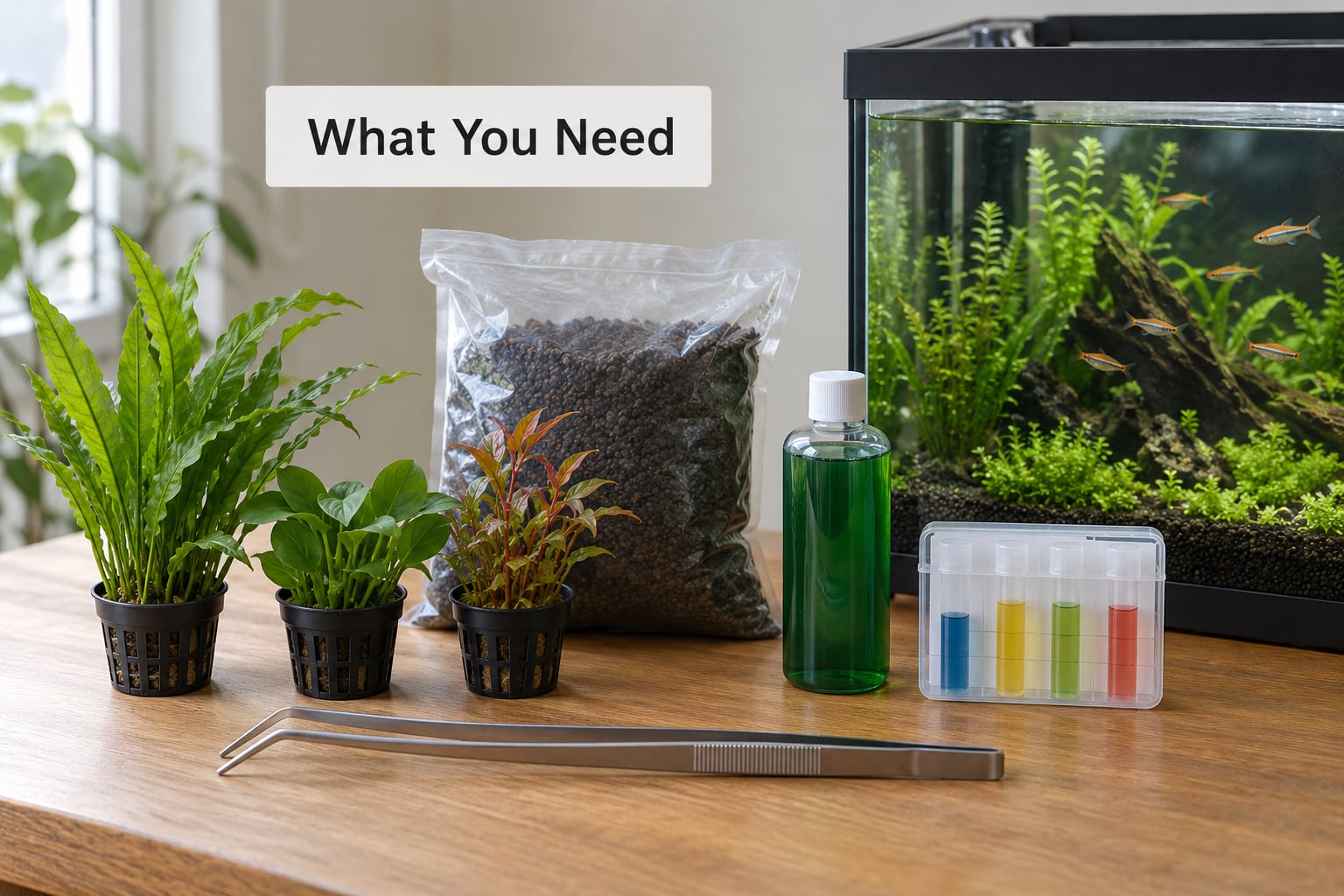
Start with the tank you already own. A 10 to 20 gallon aquarium is plenty for a first attempt, and the plant choices below work in that range. If you are still choosing hardware, work through this list before you buy anything live.
- A tank with a lid and a filter — a full-spectrum LED light is enough for beginners. Brightness matters less than consistency.
- Aquarium substrate, 1.5 to 3 inches deep — fine gravel, sand, or a nutrient-rich aquarium soil. Plain gravel works if you add root tabs or liquid fertilizer.
- Live aquatic plants — buy from a shop or nursery that labels species, not a marketplace listing that just says “aquarium plant seeds.”
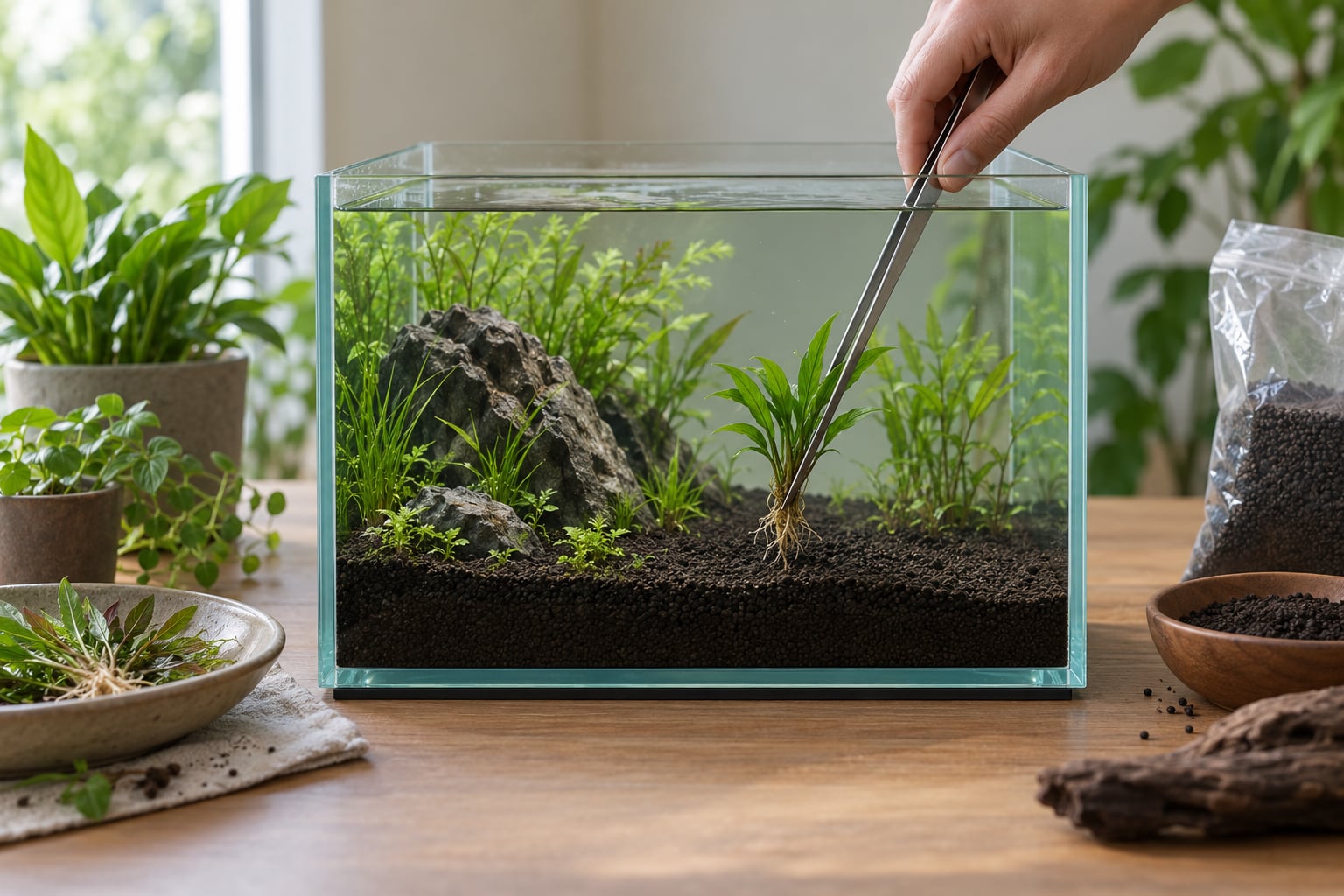
- Long aquascaping tweezers or a planting tool — this single tool makes deep planting possible instead of squinting into the tank.
- A water-testing kit — ammonia, nitrite, nitrate, temperature, and pH.
- A dechlorinator — tap water must be treated before it goes in.
- Optional: root tabs and an all-in-one liquid fertilizer.
Tank size drives plant size. A sword plant that looks generous in a 40 gallon tank will fill a 10 gallon tank in a month and shade everything else out.
Fish population matters too. Bettas, corydoras and shrimp tolerate nearly any plant; large cichlids and some gouramis chew or uproot tender leaves, so pick tougher species if that is your stock.
Step-by-Step
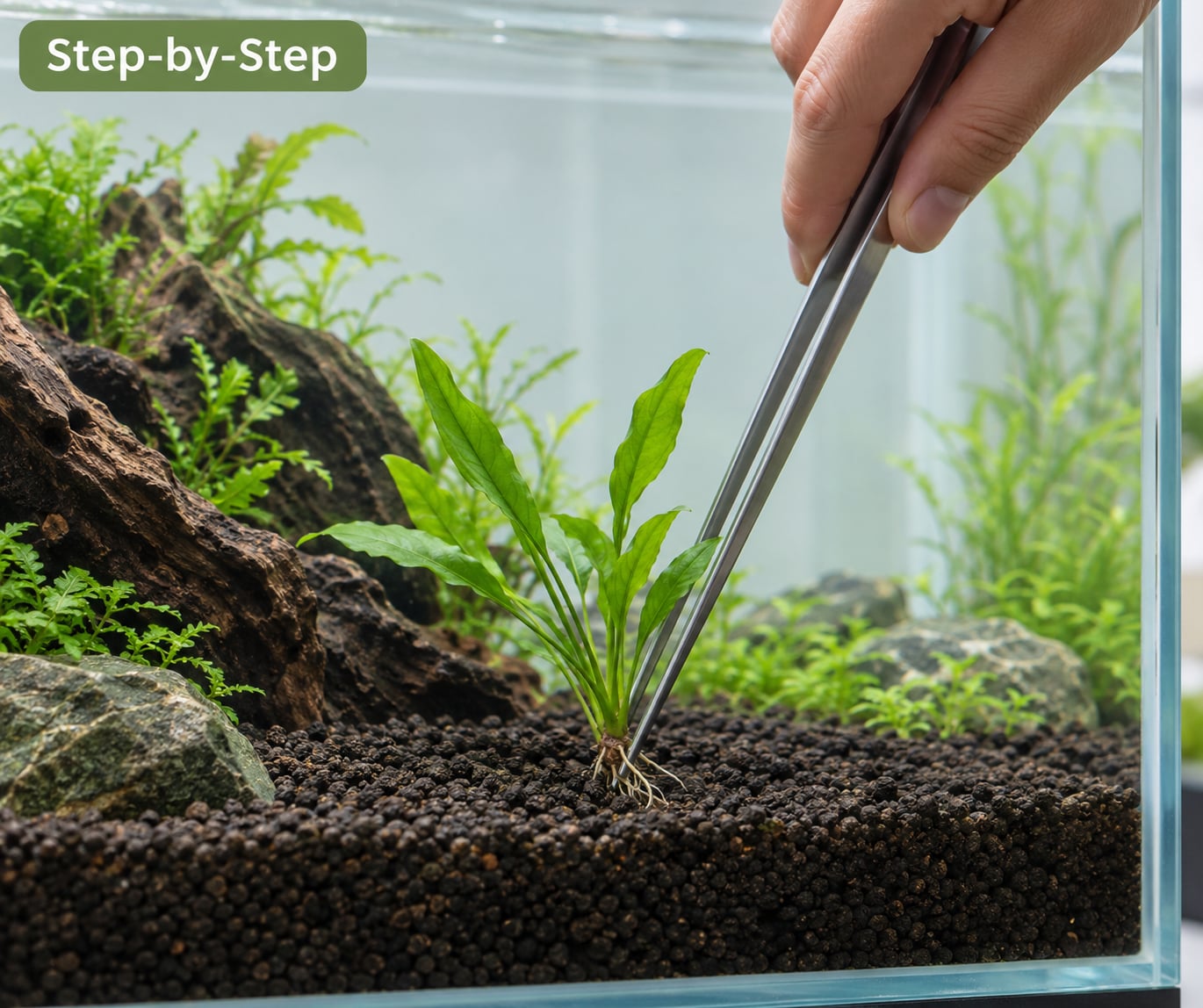
Working through how to grow live aquarium plants for beginners takes about a month of steady, boring consistency. Follow these seven steps in order and check the small signs after each one before moving to the next.
Choose plants suited to your aquarium
Match the plant to your temperature, light, tank size and fish before you match it to your taste. Tropical species generally want 74 to 79°F; cold-water species like Vallisneria tolerate more.
Easy foreground and midground choices for a beginner tank:
- Java fern (Microsorum pteropus) — a rhizome epiphyte that grows in almost any light and can be tied to driftwood.
- Anubias barteri nana — slow, thick leaves, hates its rhizome buried.
- Cryptocoryne — a rosette plant that settles in after a short melt period.
- Amazon sword (Echinodorus bleheri) — a big midground rosette that needs a real root zone.
- Water sprite (Ceratopteris) — a fast stem or floating plant, forgiving in almost anything.
- Bacopa and Hygrophila — fast stem plants that outcompete algae early on.
- Java moss — a moss you tie to decor, needing no substrate at all.
Beginners on fishlore and aquariumadvice repeatedly name Hygrophila and water sprite as the fastest, most forgiving starts. Avoid carpeting species like hair grass or pearl weed for your first tank; they are the slowest to establish without added CO2.
Prepare the tank and water
Do not plant into an uncycled tank and expect it to hold. Live plants help a cycle by consuming ammonia, and plenty of hobbyists add them during cycling deliberately, but they will not finish the job for you.
Rinse substrate in a bucket until the water runs mostly clear, then spread it to a depth of 1.5 to 3 inches — deeper on the back side, shallower at the front. If you already own colored gravel, forum advice is to keep it and mix in sand until you reach workable depth rather than replacing everything.
Fill slowly by pouring water onto a plate or saucer so the substrate stays put. Treat tap water with a dechlorinator, check temperature and pH against what your fish need, and test ammonia and nitrite before adding livestock.
Plant rooted plants correctly
This is where most first tanks go wrong, so work slowly with tweezers and shallow water if you can.
- Squeeze the plant out of its plastic pot.
- Peel away all mineral wool or gel from the roots. Leftover wool blocks nutrient uptake and floats back to the surface later.
- Trim brown roots back to roughly 4 cm with clean scissors.
- Make a hole in the substrate with your fingers or tweezers.
- Lower the plant in, keeping the crown at substrate level.
- Press the substrate gently around the roots. Do not compact it.
For a rosette like Amazon sword or Cryptocoryne, the leaves stay above the substrate while the roots go down. For stem plants such as Bacopa, bury the bare lower stem and leave the upper leaves exposed.
Rhizome plants are the exception. Anubias and Java fern grow from a thick horizontal rhizome that must sit above the substrate. Tie it to driftwood or a rock, or wedge it in gravel so only the roots are covered. Bury the rhizome and the plant rots within weeks — beginners on aquariumadvice call this the single most common plant-killer.
Place floating and free-rooted plants
Not every plant belongs in the substrate. Epiphytes and mosses attach to hardscape with aquarium-safe glue or a loose tie. Floaters such as duckweed, water lettuce, salvinia or hornwort stay at the surface.
Floating plants are the fastest win for a nervous beginner, because they need no planting at all. Keep them to one side of the tank, though. A dense mat shades the substrate and starves rooted plants underneath.
Set the lighting routine
Run the light 6 to 8 hours a day, on a timer, and change very little after that. Duration matters more than intensity for a beginner.
Too much light on an immature tank brings diatoms and green algae. Too little gives leggy, stretching stems and pale leaves. Anubias, Java fern and Cryptocoryne tolerate low light, while stem plants and carpets want more. If your tank is deeper than about 12 inches, raise the light or choose low-light species.
Fertilize without overfeeding
Nutrient-rich soil supplies most stem plants on its own. If you are using plain gravel or sand, add root tabs under root feeders or dose an all-in-one liquid fertilizer on the schedule the label gives.
Skip fertilizing a sparse tank. Extra nutrients plus strong light is the classic algae recipe. Yellowing older leaves with soft growth often signals a genuine nitrogen shortage, not a light problem.
Prune, clean, and watch for growth
Once a week, trim damaged or melting leaves and remove anything decaying from the substrate. Cut stem plants above a leaf node and replant the top; that piece roots into a second plant, so a small clump fills out fast.
The signs of success are simple: new leaves at the tips, white roots appearing, and steady height gain. Rhizome plants put out a single new leaf roughly every few weeks, which is normal, not stalled.
Here is the whole thing in one place, matched to each plant’s growth habit. Most beginners only need the first four rows:
- Rhizome epiphyte — Anubias, Java fern. Tie or glue the rhizome above the substrate. Easy.
- Rosette — Amazon sword, Cryptocoryne. Bury the roots only, keep the crown at substrate level. Easy.
- Stem plant — Bacopa, Hygrophila, Rotala. Bury the bare stem, leave the tops exposed. Easy.
- Stolon plant — Vallisneria, Sagittaria. Bury the base and let runners spread. Easy.
- Carpeting — hair grass, pearl weed. Plant in shallow substrate under high light. Hard without CO2.
- Moss — Java moss, Christmas moss. Tie to wood or rock, no substrate needed. Easy.
- Floating — hornwort, duckweed, salvinia. Drop them on the surface, keep them to one side. Easy.
- Bulb or tuber — Aponogeton, Crinum. Bury the bulb partway and leave the tip up. Moderate.
Common Mistakes
Burying a rhizome. The fix: Anubias and Java fern go on hardscape, rhizome exposed. If yours is already planted in gravel, gently lift it and re-seat the rhizome above the surface before it softens.
Choosing a plant the tank cannot support. Hair grass in a dim tank with a weak filter will grow slowly no matter what you do. Match species to light and tank size first.
Changing water parameters too quickly. Moving temperature or pH fast shocks plants and fish together. Match the tank to the water you have rather than chasing an ideal number.
Using untreated tap water. Chlorine and chloramine burn leaves and kill the beneficial bacteria in your filter. Always dechlorinate.
Overfertilizing. Dosing by instinct rather than by the label, especially in a low-demand tank, feeds algae more than plants. Cut the dose or stop entirely.
Overlighting a new tank. Heavy light before the cycle matures triggers a diatom bloom in weeks two and three. Start with 6 hours and stay there.
Overcrowding. Plants compete for light and nutrients. Six healthy plants in a 10 gallon tank look better and grow faster than twenty struggling ones.
Removing too many leaves at once. Every trimmed leaf is lost photosynthesis. Cut only what is damaged or sprawling.
Buying terrestrial plants. Lucky bamboo, lotus, and most listings sold as “aquarium plant seeds” are land plants that die in a week or two. Look for species names you recognise from planted tanks.
A maintenance tip that matters more than any of these: keep a routine. A ten-minute weekly trim and a regular partial water change will keep a low-tech planted tank stable for years. If your existing gravel is clean and deep enough, it is fine to build on it instead of replacing it.
Frequently Asked Questions
Do aquarium plants need fertilizer to grow?
Only when the substrate cannot supply nutrients. Nutrient-rich aquarium soil feeds most stem plants for the first year or more on its own. Plain gravel, sand or a bare bottom give the plants nothing, so use root tabs beneath root feeders or dose an all-in-one liquid fertilizer on the label schedule. Low-demand tanks like a 10 gallon with Anubias and Java fern need very little, and extra fertilizer often feeds algae instead of plants.
Why are my aquarium plant leaves melting after I plant them?
Melting is adjustment, not death. Submerged plants grown in nurseries feel out their roots, and replanting changes the water chemistry, temperature and light they experience, so older leaves often yellow and drop within the first two to four weeks. Healthy new growth at the tips during that window means the plant is recovering. Melting that continues past a month with no new leaves usually points to a buried rhizome or unstable water instead.
What are the easiest live aquarium plants for beginners?
Java fern, Anubias nana, Java moss, Cryptocoryne, water sprite and Vallisneria are the usual shortlist because they tolerate low light, wide temperature ranges and imperfect water. Hygrophila and Bacopa go further as fast stem plants that outcompete algae early in a new tank. Epiphytes and mosses are the safest first choices, since they attach to decor and never touch the substrate at all.
Does algae mean my aquarium plants are not growing properly?
Often the opposite. Algae bloom when light, nutrients and time are out of balance, while healthy plants are actively consuming the ammonia and nitrate algae feeds on. A green film or brown diatom coating in weeks two and three usually means the tank is immature or the photoperiod is too long, not that your plants have failed. Trim affected leaves, keep the light at 6 to 8 hours, and let the plants fill in.
How often should I change the water and trim live aquarium plants?
Change 20 to 30 percent of the water weekly with a gravel vacuum, using dechlorinated replacement water at the same temperature. Trim when plants reach two or three times their intended height: cut stem plants above a leaf node and replant the top, remove yellow leaves at the base, and thin runners that spread across the substrate. Do not replace more than a third of the water at once, since plants absorb nutrients from what is left behind.
Can aquarium plants grow in a tank without a filter?
They can survive, but you will be doing the filter’s job by hand. Without mechanical filtration, debris settles and ammonia builds up with no bacteria colony to process it, which kills plants and fish faster than any lighting mistake. A sponge filter in a small tank is inexpensive and gives you biological filtration, cycling and surface agitation in one. The beginner-friendly path is a filter plus moderate light and simple species.
Conclusion
Pick two or three easy species first — Anubias or Java fern tied to wood, plus one stem plant in substrate. Set your substrate 1.5 to 3 inches deep, treat the water, and keep every rhizome above the surface. Run the light 6 to 8 hours on a timer, add fertilizer only if your substrate cannot feed the plants, and give it a month.
Watch for new leaves rather than judging the tank by the ones on the floor. When you know how to grow live aquarium plants for beginners, the hard part is really just patience through the melt.