How to set up a betta tank properly is mostly waiting, not shopping. You need a filtered, heated, fully cycled aquarium of at least 5 gallons with a secure lid and a gentle low-flow filter, then you let that tank mature for two to six weeks before the fish goes in.
Here are the numbers that matter: 5 US gallons as an absolute floor, 8 to 10 gallons if you are new to this, water held between 76 and 82°F, ammonia and nitrite both reading zero, and nitrate under 20 to 40 ppm. Get those right and the rest is routine. Skip them and the betta will usually not die dramatically on day one; it will fade slowly over a few weeks, which is far harder to catch.
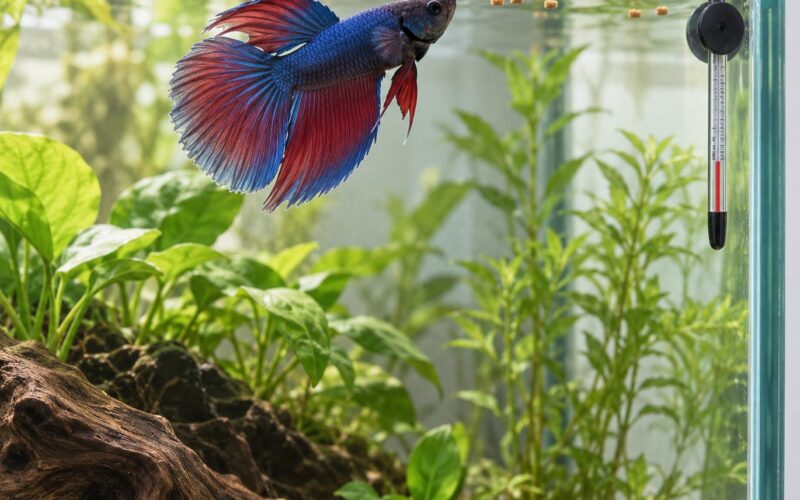
One note before you start. Bettas are tropical fish from warm, slow, heavily planted water, and they breathe surface air through a special organ called a labyrinth organ. That is why they tolerate a neglected bowl far longer than is good for them, and why so many pet store bettas arrive already damaged from ammonia in a tiny cup.
Table of Contents
- What You Need
- Step-by-Step: How to Set Up a Betta Tank Properly
- 1. Choose and Clean the Aquarium
- 2. Add Substrate, Décor, and a Hiding Place
- 3. Fill and Condition the Water
- 4. Install the Heater and Filter Correctly
- 5. Cycle the Tank Before Adding a Betta
- 6. Test the Final Water Conditions
- 7. Introduce the Betta Carefully
- Common Mistakes
- Frequently Asked Questions
- Can I put a betta in an uncycled tank?
- How long does it take to cycle a betta tank?
- What temperature should a betta tank be?
- Do betta fish really need a filter?
- How often should I change the water in a betta aquarium?
- How much food should I give a betta fish?
What You Need
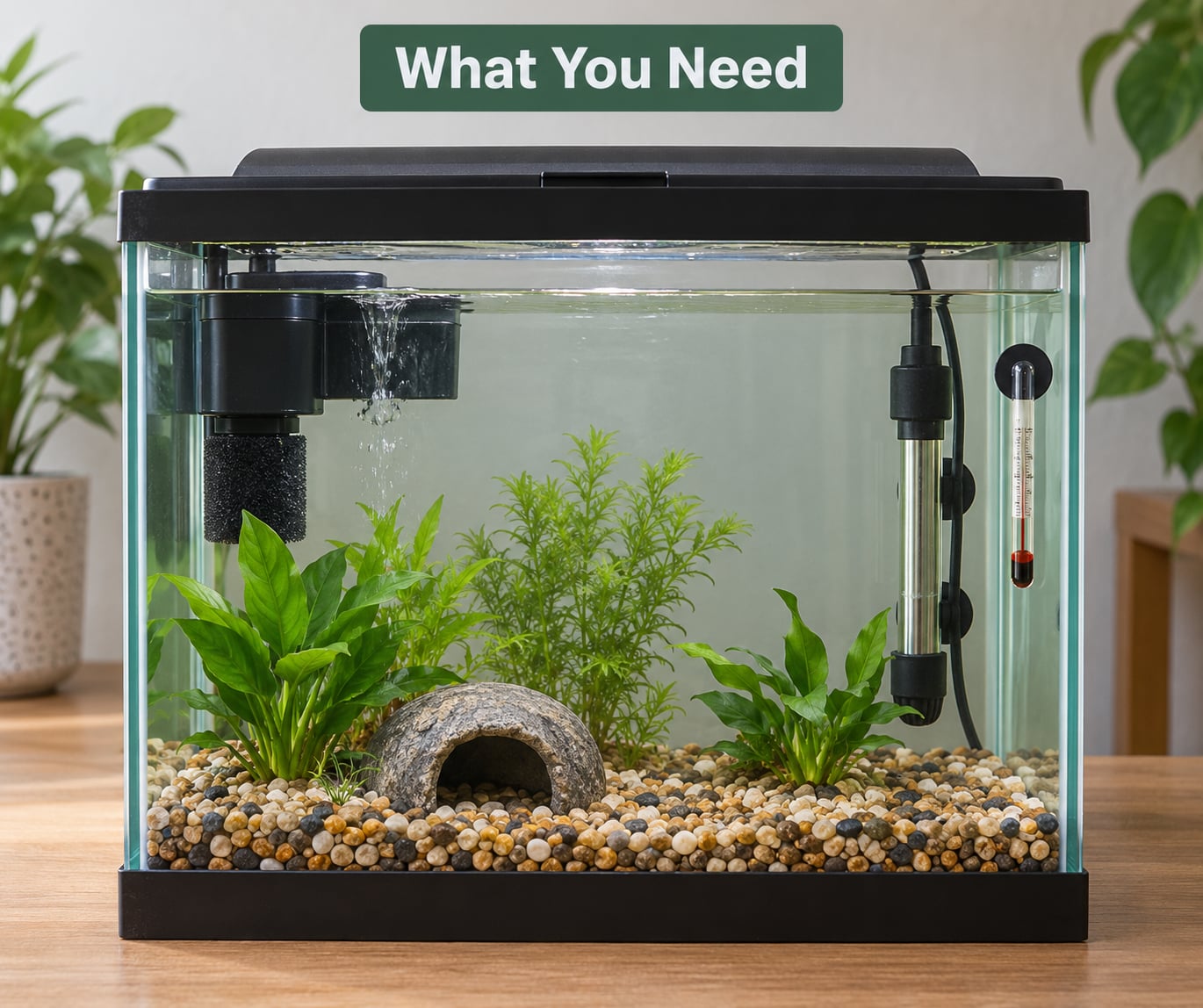
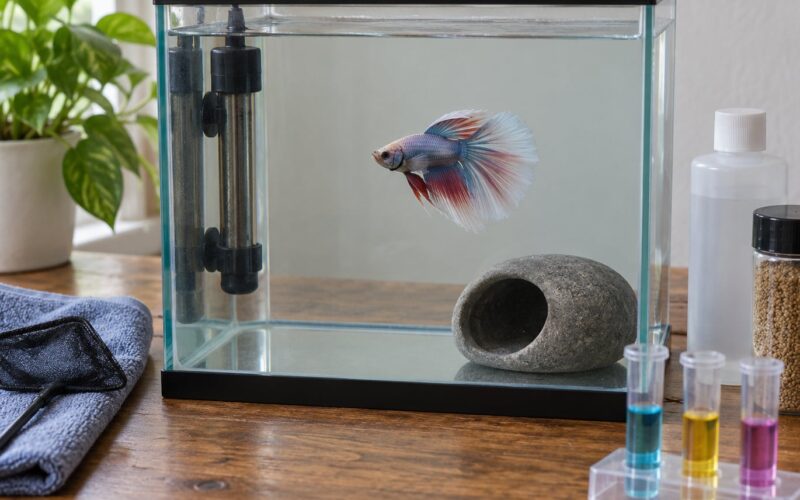
Everything on this list is a category, not a brand. Names like Seachem Prime or an API freshwater master kit come to mind as familiar examples, but any conditioner that neutralizes chlorine and chloramine and any liquid test kit you can read will do the job.
- Tank size: 5 US gallons is the floor and 8 to 10 gallons is what I would tell a beginner to buy. A longer, wider tank holds more water in a thinner column, and a bigger volume of water buffers temperature and water chemistry swings.
- Lid or hood: non-negotiable. Bettas are strong jumpers and a betta that clears the rim is a betta that lands on the floor.
- Adjustable heater: a submersible model with a dial, sized by tank volume and by how cold your room gets at night.
- Thermometer: a cheap stick-on or digital unit. A heater’s dial is a setting, not a reading.
- Low-flow filter: a sponge filter or a small internal filter with an adjustable outflow you can turn down. Betta fins are not built for a current.
- Water conditioner: a complete dechlorinator, not aquarium salt. Tap water is treated with chlorine or chloramine, both of which burn gills.
- Liquid test kit: strips are not good enough for cycling. You need ammonia, nitrite, and nitrate readings you can trust.
- Substrate: 1 to 2 inches of smooth gravel, fine sand, or aquarium soil. Nothing with sharp edges.
- Hiding place and cover: a cave, a plant clump, a leaf, or a betta hammock near the surface.
- Siphon and light timer: a gravel vacuum for water changes, and a timer so the light runs 6 to 8 hours a day on the same schedule.
- Optional: a food dish and extra decorations, as long as they are sold for aquarium use and carry no soap or paint residue.
Skip the sealed betta kits sold as beginner bundles. Keepers on r/bettafish and the FishLore betta forum point out the same thing again and again: the bundles aimed at betta keepers are frequently under 2 gallons, or they ship with a filter that is far too strong for a betta and no heater at all. Buy the tank, then buy the equipment for that tank.
| Tank size | Heater wattage | What that means for you |
|---|---|---|
| Up to 5 gallons | 25W | Fine in a room that stays reasonably warm |
| 6 to 10 gallons | 50W | The usual pick for a beginner 10-gallon |
| 10 gallons in a cool room | 75W to 100W | Rated larger so it can still hold heat overnight |
Step-by-Step: How to Set Up a Betta Tank Properly
1. Choose and Clean the Aquarium
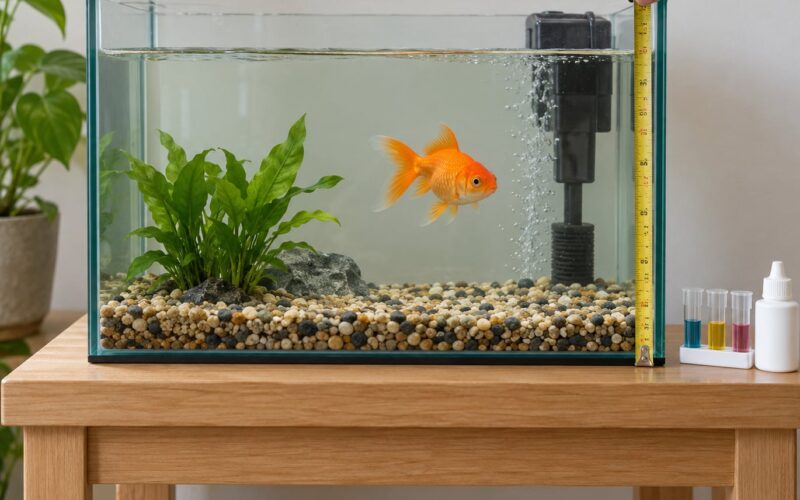
Choose a tank that is longer than it is tall. A tall narrow column of water is harder to keep stable than a wide shallow one, and your betta will use horizontal space more than vertical space anyway.
Set the empty tank on a level surface that can hold its full weight, close to an outlet but not in a draft or a window with direct sun. Fill it with water and leave it for 24 hours. If you see dampness on the stand or a puddle, you have found a problem now, not after the gravel goes in.
Rinse the empty tank and the substrate with plain water. No soap, no dish detergent, no vinegar rinse that you have not rinsed many times over. Household cleaners leave a residue that no amount of water conditioning removes.
2. Add Substrate, Décor, and a Hiding Place
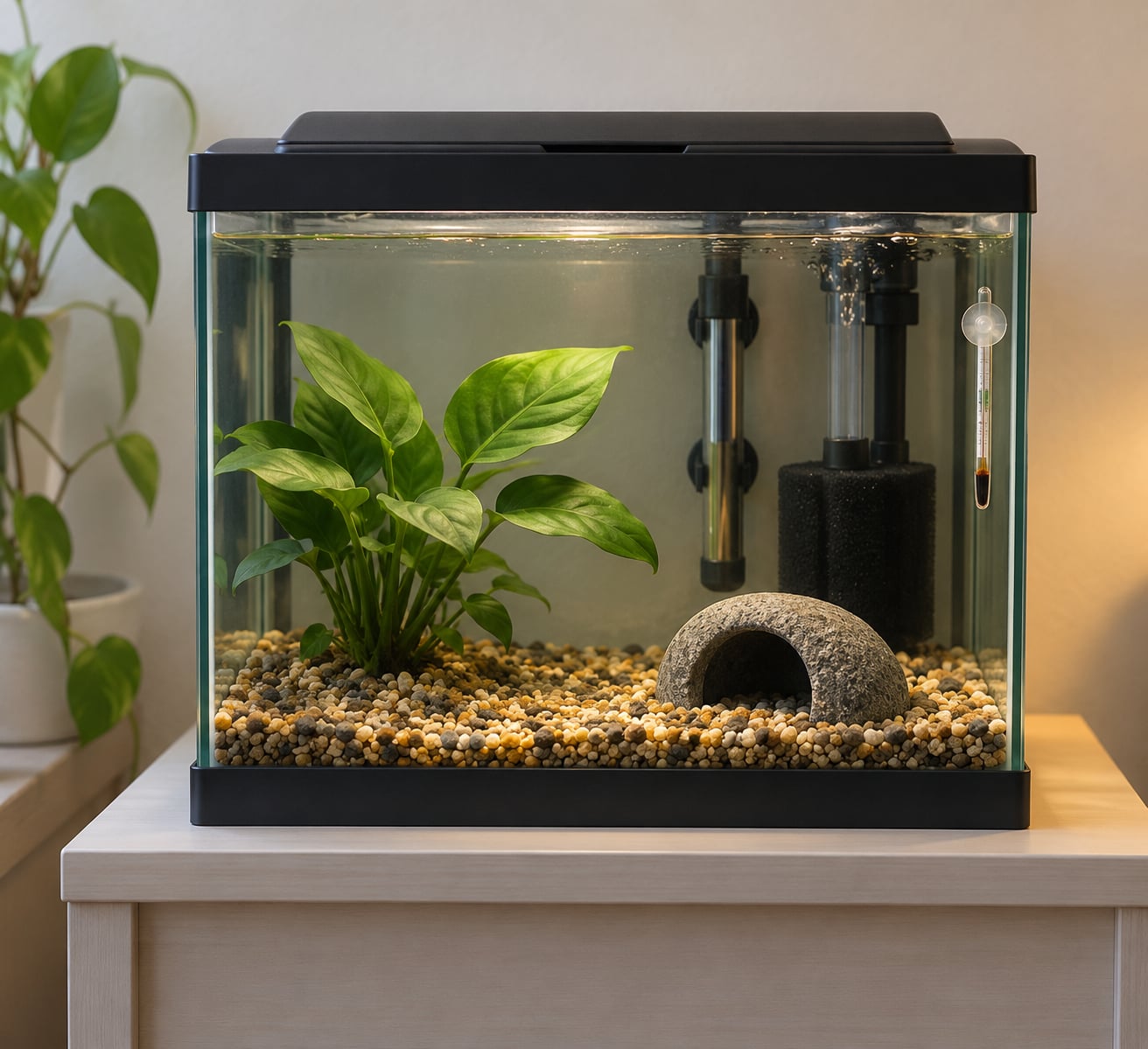
Add 1 to 2 inches of substrate, sloping it gently toward the front so you can see debris and clean the bottom. Rinse the gravel until the water runs clear.
Place decorations with an eye on two things: no sharp edges, and no tight gaps. Run a piece of pantyhose over any hard decoration. If the fabric snags, the decoration will snag fins too. This is a two-minute test and it settles the question every beginner argues about online.
Keep open swimming space in the middle. A betta that is forced to weave through clutter all day is a stressed betta, and long-finned varieties need room to turn without catching anything.
Then give it a retreat. A cave, a broad-leaf plant, or a leaf hammock near the surface all work, because a betta that feels cornered will wedge itself into a filter intake. Beginner-safe, low-light plants include Anubias, java fern, cryptocoryne, and java moss, with floating plants on top for shade.
If you want live plants, that is a bonus for water quality and for the fish, not a requirement. If you use silk, make sure the leaves and bases are smooth, because plastic leaves with rough stems are a common source of fin tears.
3. Fill and Condition the Water
Add tap water that already matches your target temperature. Fill a pitcher, let it sit until it feels the same as your heater set point, and use that. Pouring cold or hot water straight into a cycled or planted tank is a pH shock you can avoid entirely.
Then condition it, and follow the dose on your bottle for the actual volume of your tank. A conditioner neutralizes the chlorine or chloramine that municipal water carries. Untreated tap water will burn a betta’s gills, and it will also give you false ammonia readings once you start cycling, because the test cannot tell chlorine-damaged water from ammonia.
Fill to just under the filter intake and leave room to top the tank up as it evaporates over the coming weeks.
4. Install the Heater and Filter Correctly
Install the equipment before the tank is full, or at least before you move anything heavy. The heater goes near one end of the tank, fully submerged, with a small suction cup or bracket, and never pressed directly against the glass or resting on gravel. Glass-to-heater contact cracks glass, and a heater lying on the substrate will read warmer than the water and cook whatever is near it.
Set the heater a degree or two above your target and let it cycle on and off. Check the thermometer in a few hours rather than trusting the dial.
The filter is the piece beginners rush, and it causes the most grief. A sponge filter or a small internal power filter is the right size. Throttle the flow to the gentlest setting, aim the outflow along the glass rather than across the middle of the tank, and fit a prefilter sponge or a clean piece of pantyhose over the intake so no betta gets pulled against it.
Run the filter and heater together for an hour or two and confirm both are actually running before you go any further.
5. Cycle the Tank Before Adding a Betta
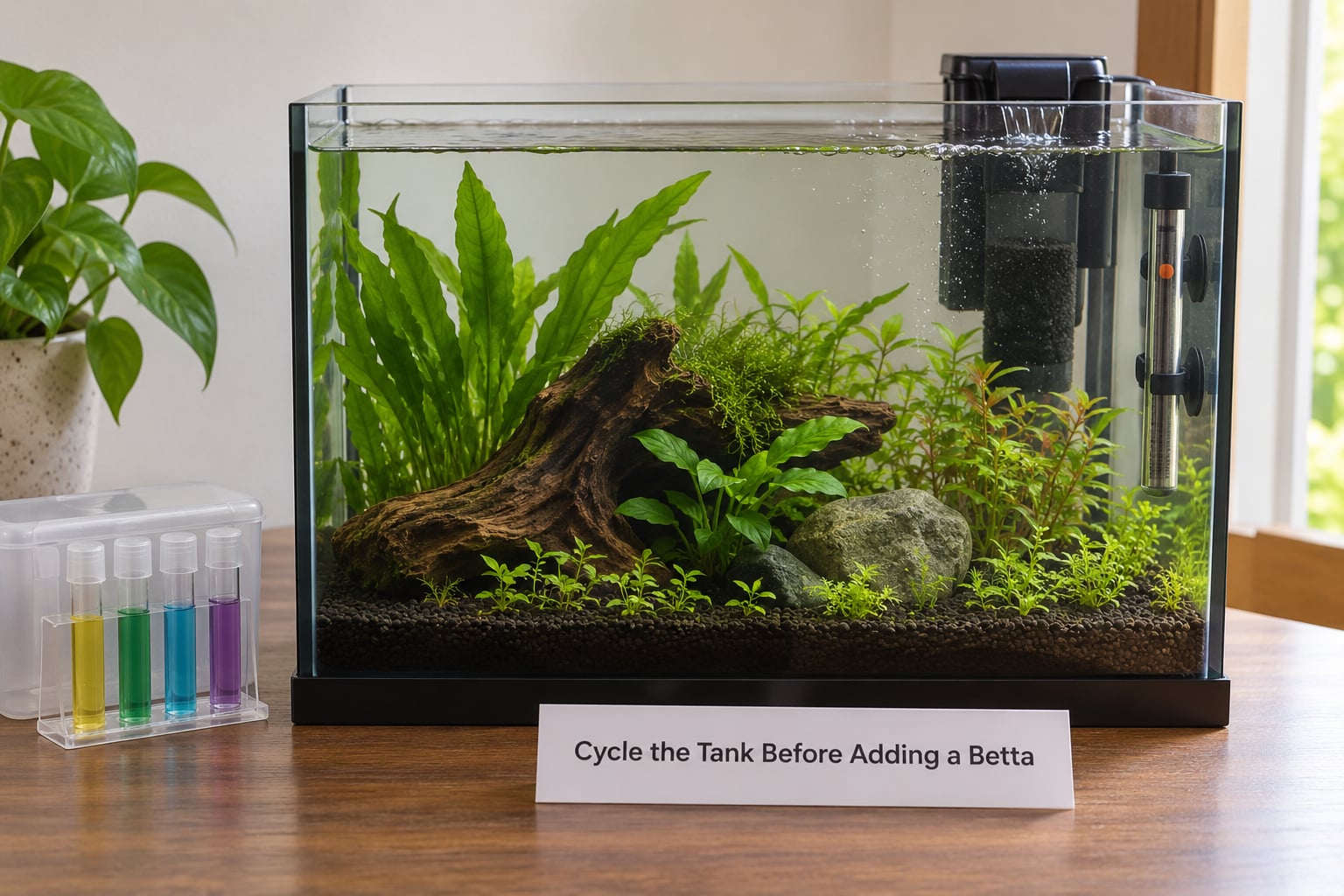
Wait two to six weeks. There is no shortcut, and any source promising you a fishless cycle in three days is selling you something.
Cycling means building a colony of beneficial bacteria that convert the ammonia your betta produces into nitrite, and then convert the nitrite into nitrate. Until that colony exists, the tank is a slowly filling poison bottle and your fish is breathing it.
Start a fishless cycle. Dose pure aquarium ammonia to about 2 ppm, or add a small pinch of ordinary fish food, which decomposes into ammonia over a few days. Then run the filter and heater, and test every other day. Do not skip the water changes during this period; partial changes keep the ammonia level in a range the bacteria can actually process, and topping up with conditioned water re-doses the ammonia a little each time.
What you will likely see: ammonia drops while nitrite climbs, then both fall and nitrate appears. That second stage is where people lose patience. Ammononia reading zero while nitrite is still climbing means you are only halfway through.
The tank is cycled when ammonia reads zero, nitrite reads zero, and nitrate shows a low but present reading, and it stays that way across two consecutive tests. A heavily planted tank may never show a visible spike, which is why experienced keepers wait two full weeks anyway.
You can shorten the wait by seeding the tank with filter media, driftwood, or a cup of gravel from an established, healthy aquarium. It genuinely helps. It does not eliminate the wait, and because the colony is incomplete, keep testing daily for the first two weeks after the fish is added.
6. Test the Final Water Conditions
Safe-looking water is not the same as safe water. Cloudiness is a bacterial bloom, not proof of a finished cycle, and still, clear, motionless water can be a brand-new tank with no bacteria in it at all. The test kit is the only evidence that counts.
| Parameter | Target | Red flag |
|---|---|---|
| Ammonia | 0 ppm | Anything above 0 after the cycle |
| Nitrite | 0 ppm | Anything detectable |
| Nitrate | Under 20 to 40 ppm | Rising past 40 ppm weekly |
| pH | 6.8 to 7.5, and stable | A swing of more than 0.5 in a day |
| Temperature | 76 to 82°F | Below 76°F or above 84°F |
Stability matters more than a perfect number. Fish adapt to the pH they were shipped in, so chasing a textbook 7.0 with pH-down chemicals can do more harm than leaving the tank alone. Test the same time of day, write the readings down, and change water gradually rather than all at once.
7. Introduce the Betta Carefully
Buy the fish only when the tank is ready, and ask the store to bag it in your own water if they can. If your betta is already in that paper cup from the shop, treat it as an emergency case, not a shortcut.
Float the sealed bag on the surface for 15 minutes so the temperature equalizes. This alone is where a lot of beginners stop, and it is where a lot of temperature shock happens.
Then transfer the betta with a small net or a clean cup, and add tank water to the bag rather than pouring store water into your aquarium. That store water carries ammonia, old food, and often a big pH difference, and you do not want any of it in a tank you just spent six weeks cycling.
If your betta came in a cup, you have no bag to drip from. Add tank water to the cup a little at a time over 20 to 30 minutes, then net the fish across. Dim the lights for the rest of the day, keep everything calm, and do not feed until tomorrow.
What you should expect in the first 48 hours: hiding, clamped fins, and little interest in food. That is normal adjustment. What is not normal is a betta lying flat on the gravel with rapid gill movement, which points to ammonia poisoning, or white cottony growth on the fins, which points to fungus. Both mean water changes with conditioned water today, and a call to a veterinarian who treats fish.
Never add a second fish in the same week, and never house two males together. Bettas will fight, and a divided tank with a solid divider and no gaps at all is the only setup that works if you are set on that.
Common Mistakes
Adding the betta before the cycle finishes. This is the number one way bettas die, and it happens constantly because the fish is already home. The fix is a separate container with conditioned, temperature-matched water and an air stone, plus 50% water changes every other day in the tank while it cycles. It is a lot of work for a few weeks, and it is still better than a dead fish. If you do it, test the tank daily and consider adding a dose of ammonia to feed the bacteria you are trying to grow.
Using a bowl, or an unfiltered container. Small unfiltered bowls are the worst possible home for a tropical fish. The volume is too small to buffer anything, there is no bacteria habitat, and waste builds up fast. If you must start with what you have, add a sponge filter and a heater, and change 30 to 40% of the water every three or four days rather than once a week.
Feeding too much. A betta with a full stomach often refuses food. A pinch twice a day, only what gets eaten in about a minute, is plenty. Uneaten protein is the fastest route to an ammonia spike in a young tank.
Using soap on anything that touches the tank. Rinse with water only. Detergent residue is not neutralised by conditioner and fish exposed to it burn.
Pressing the heater against the glass or laying it on the substrate. Stand it off the glass with a suction cup and keep it clear of gravel. Cracked glass and localized overheating are both avoidable.
Changing too much water at once, or too little too rarely. For one betta in a cycled tank, 25 to 30% weekly is plenty, matched in temperature and conditioned before it goes in. During cycling or after a mishap, 50% every other day. The debate you will find online between 20% and 50% is really about tank size and stocking: one betta in 10 gallons is not one betta in a 2-gallon bowl.
Trusting clear water. A tank can look finished and test like an empty glass bowl. Test, then trust the test.
Assuming a store betta is fine because it is swimming. Buyers regularly report gills labouring, lethargy, and red fin tips within days of purchase, all of it traceable to ammonia in the cup. If yours arrives with clamped fins, treat the first days gently and change water often.
Once your betta is settled, a simple routine carries you: feed a pinch twice a day, run the light 6 to 8 hours on a timer, test ammonia, nitrite, and nitrate once a week, change 25 to 30% of the water with conditioned water, and rinse your filter media in the old tank water you just siphoned out, never in tap water.
Frequently Asked Questions
Can I put a betta in an uncycled tank?
No. An uncycled tank has no beneficial bacteria colony to convert ammonia and nitrite, so waste builds up until it burns the fish’s gills. A betta can look fine for days while ammonia rises behind the scenes. If you already own the fish, keep it in a separate container with conditioned water and an air stone, and do 50% water changes every other day in the tank while it cycles.
How long does it take to cycle a betta tank?
Two to six weeks with a fishless cycle, and there is no shortcut. You are waiting for beneficial bacteria to colonize your filter media and substrate, which happens faster in warm, filtered, lightly planted water. Test every other day. The tank is ready when ammonia reads zero, nitrite reads zero, and a low nitrate reading appears, on two consecutive tests.
What temperature should a betta tank be?
Keep the water between 76 and 82 degrees F using an adjustable heater and a thermometer you check daily. Below 76 a betta becomes sluggish, stops eating, and is much more likely to develop infections, so 72 is too cold for keeping one as a pet. Set the heater a degree or two above target and let it hold, because unheated rooms swing hard at night.
Do betta fish really need a filter?
Yes. A filter keeps water moving, houses the bacteria that make the tank safe, and stops waste settling where it breaks down. Choose a sponge filter or a small internal filter turned to its gentlest setting, and cover the intake with a clean piece of pantyhose or a prefilter sponge so long fins never get pulled into it.
How often should I change the water in a betta aquarium?
In a cycled tank with one betta, change about 25 to 30 percent of the water once a week, using water matched to the tank temperature and conditioned before it goes in. Some keepers do 20 percent every two weeks instead. During cycling or after a mishap, do 50 percent every other day. One betta in 10 gallons is not one betta in a 2-gallon bowl.
How much food should I give a betta fish?
A pinch, twice a day at most. Offer only what the betta eats within about a minute and remove what stays on the bottom. Overfeeding is the most common beginner mistake, and leftover food is the fastest way to raise ammonia in a new tank. A useful check: a betta’s stomach is roughly the size of its eye.
Start with the boring part: finish the cycle and confirm safe readings before you buy the fish. Ammonia at zero, nitrite at zero, nitrate low, temperature steady between 76 and 82°F. Everything in 2026 still comes back to that same checklist, and a betta moved into a finished tank is a fish that never has to be worried about.