Indoor spraying is scent marking, not bad manners. Your cat backs up to a vertical surface, raises a stiff quivering tail and releases a small amount of urine so the room smells like home. To stop a cat from spraying indoors you have to do three things in the right order: clear the scent with an enzyme cleaner, remove whatever is making the cat feel unsafe, and have your vet rule out a urinary problem. Most households see the behaviour fade within a few weeks once the trigger is gone.
That last part surprises people. Owners often expect an instant fix and assume the cat is being defiant. It is not. Spraying is instinct, and a cat that marks the same wall twice has simply been told that wall still smells like itself. The loop breaks when the smell disappears completely and the reason for the marking is dealt with.
A few numbers to keep in mind while you work through this. Neutered male cats spray more than any other group, but female cats spray too, especially if they are intact and in heat. Unneutered males are the most likely to spray and the most likely to stop once desexed. And a meaningful share of cats that spray are doing it because of pain or urinary disease rather than territory, which is why the first call on the list is your vet.
If you are dealing with a specific situation right now — a new baby, a second cat, a move, cats outside your window — read the whole plan once, then jump to the step that matches your home.
Table of Contents
- What You Need
- Step-by-Step: How to Stop a Cat from Spraying Indoors
- 1. Identify Where and When Your Cat Is Spraying
- 2. Find the Trigger Without Interrupting Your Cat
- 3. Remove the Scent Completely
- 4. Reduce the Cat’s Need to Mark Territory
- 5. Review and Improve the Litter Box
- 6. Use Positive Reinforcement and Consistent Routines
- 7. Prevent the Behavior From Returning
- Common Mistakes
- When to Ask a Veterinarian
- Frequently Asked Questions
- How to stop a cat from spraying indoors with home remedies?
- Do cats mark their territory with pee?
- Does neutering stop spraying?
- Do female cats spray urine?
- Why does my cat keep spraying on walls?
- How long does it take to stop a cat from spraying indoors?
- Conclusión
What You Need

None of this is expensive and most of it you already own. Gathering it first means you are not improvising at 11pm with a wet cloth and a bottle of something harsh under the sink.
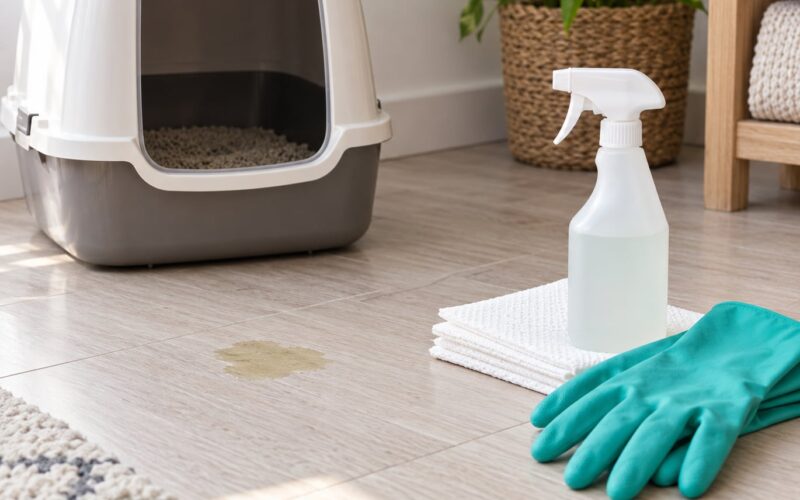
- Enzyme-based urine cleaner made for pets, not a general bathroom spray. This is the single item that matters most.
- Disposable gloves and a small scrub brush or toothbrush for texture.
- Open windows or a fan for ventilation while you work. Urine ammonia is unpleasant to breathe and the smell lingers in a closed room for days.
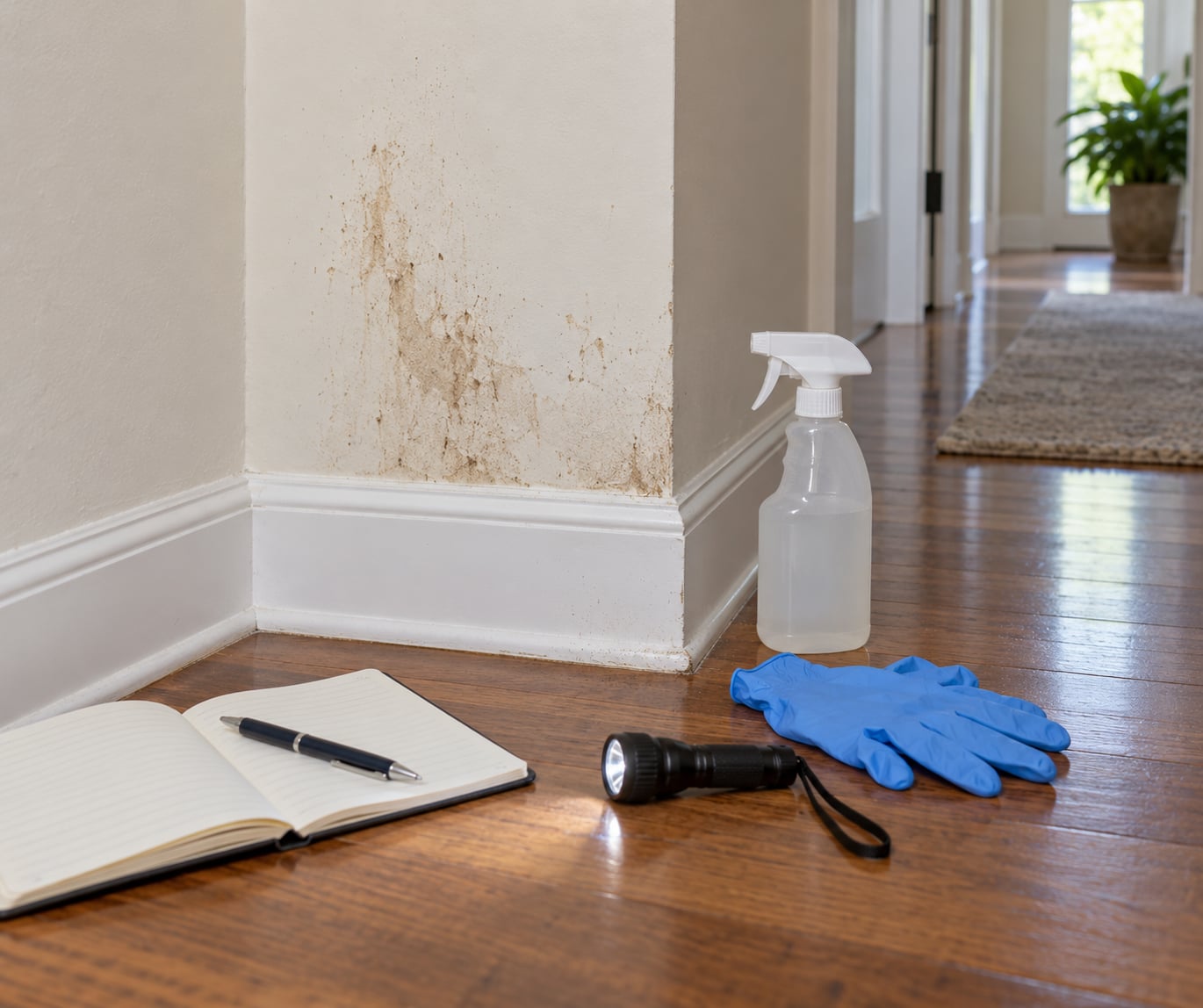
- A flashlight to find dried marks on skirting boards, curtains and carpet edges that you would otherwise miss.
- A notebook, or your phone’s notes app, for dates, locations and what changed that day.
- A way to watch without being seen — a chair in the room, a pet camera, or simply your own presence at the far end of the hall. You are looking for patterns, not catching your cat in the act.
Keep the cat out of the room while you clean. A closed door for a few hours is kinder than letting your cat stand over you and then wonder why the spot still pulls them back.
Step-by-Step: How to Stop a Cat from Spraying Indoors
Spraying stops when three conditions are met at once: you have removed the scent, you have removed the trigger, and you have kept the cat from being reminded about either one. Work through these seven steps in order. Skipping ahead to cleaning while the trigger is still there is why most attempts fail within a fortnight.
1. Identify Where and When Your Cat Is Spraying
Spraying and going outside the litter box are two different problems with two different fixes, so tell them apart before you change anything. Spraying leaves a small, deliberate deposit on a vertical surface. A litter-box accident leaves a larger pool on a horizontal one.
| What you see | Spraying | Outside the litter box |
|---|---|---|
| Posture | Stands, backs up to the surface, tail raised and stiff | Squatting, low to the ground |
| Tail | Vertical or twitching with a quiver | Low or loosely curled |
| Amount | A few millilitres | A normal full void |
| Where | Doorframes, windows, curtains, wardrobe doors, new furniture, your laundry | Floors, carpets, beds, sofas |
| Likely cause | Territory or reassurance marking | Litter problems, stress, or urinary disease |
Both need a clean, but they need different environments fixed behind them. Note the time of day too: spraying that happens right after you open the front door or come home from work points at something outside. Spraying in the middle of the night on a new piece of furniture points at household change.
2. Find the Trigger Without Interrupting Your Cat
You cannot fix a trigger you have not identified, and you will never identify one by scolding. Sit quietly, watch from a distance, and write down what happened in the hour before each incident.
The location of the mark is the best clue you will get, because cats mark boundaries and entry points rather than random walls.
| Where the spray lands | Most likely trigger |
|---|---|
| Window sill, glass, curtains by the window | Stray or neighbourhood cats seen from inside |
| Inside the front or back door, doorframe | Another cat in the house, an unfamiliar cat outdoors, or a delivery |
| Wardrobe doors, new furniture, boxes | Something moved or smells new and unfamiliar |
| Your bed, sofa, clothing, laundry basket | Separation anxiety, a new baby or partner, or conflict with another cat |
| Litter tray rim or wall beside the tray | The tray itself: wrong size, too dirty, or too close to something frightening |
Common triggers worth ruling in or out: new cats inside or outside, outdoor cats visible through glass, visitors staying over, a new baby, furniture rearranged, moving house, redecorating, a new litter box or a change of litter, and household tension between cats. Many owners report the behaviour starting suddenly in a clean, previously quiet adult cat with no household change at all. When that happens, look outward and inward at the same time: cats you have never seen through the window, and pain.
Give this step a week or two. Rushing to a fix without knowing the trigger usually means fixing the wrong thing for months.
3. Remove the Scent Completely
This is the step people skip, and it is the one that ends the cycle. Your cat re-marks a spot because the spot still smells like a toilet to a nose that is 100 times more sensitive than yours. Wipe it with water, dry it, and think the job is finished, and you have guaranteed a repeat.
- Check the label and test for colour-fastness on a hidden patch of fabric or wallpaper first.
- Apply the enzyme cleaner and leave it to sit for the time printed on the label. Enzymes need contact time to break the urine molecules down.
- Blot or scrub stubborn areas with a brush, then rinse with cool water where the surface allows it.
- Dry the area fully and ventilate the room.
- Block access until it is dry — close the door, tape over the spot with painter’s tape, or put a sheet of plastic or foil over it.
For carpets and upholstery, work the cleaner deep into the padding rather than just the surface. Urine wicks down into foam and bounces back up as it dries, which is why the smell returns weeks later. Covering the area with foil or plastic for a day after cleaning keeps the moisture trapped long enough to deal with what soaked in.
Spraying on clothing and laundry deserves its own paragraph. Wash those items immediately with a biological or enzyme laundry powder, ideally pre-soaked, and rinse with cool water. Never dry a marked garment in a tumble dryer before it has been through a proper wash; the heat sets whatever remains and makes the stain permanent. If the laundry smells musty even after a wash, a second dose of enzyme powder before drying usually clears it.
Now the home remedies question, ranked honestly.
Enzyme cleaner: worth it. This is the one remedy with a clear mechanism. It digests the urine rather than masking it, and it is the only option that reliably stops a cat returning to a spot.
Biological or enzymatic washing powder, diluted: genuinely useful, mainly for soft furnishings and laundry. A solution of roughly one part powder to nine parts water, applied, then rinsed with cool water, is a reasonable approach when you have a large stained area and no enzyme spray. It is not a substitute for enzyme cleaner on walls and hard surfaces.
White vinegar, diluted: low risk, limited result. It helps with fresh damp marks and light residue but does not break down the urea, so it is a step, not a fix.
Baking soda: absorbent and mildly deodorising, useful for soaking up fresh moisture on fabric. On its own it does nothing once urine has dried into a surface.
Essential oils, citrus sprays, menthol, ammonia: skip them. Essential oils are toxic to cats and can make marking worse by adding another unfamiliar scent. Ammonia is urine broken down, so it makes the area smell more like a litter tray. Anything ammonia-based, and household bleach, also damages some surfaces and never fully removes the cause.
Wallpaper or carpet replacement: sometimes the honest answer for a large saturated patch. Enzyme cleaning fixes most cases, but a soaked carpet pad under a wardrobe can re-mark for months.
4. Reduce the Cat’s Need to Mark Territory
A cat sprays to make an unfamiliar or shifting environment feel safe. Anything that raises its sense of control and reduces uncertainty makes marking less necessary.
- Give it vertical and hidden space. Shelves, a cat tree, a covered bed or an empty box give your cat somewhere that is off the ground and out of sight. You are not being indulgent; you are removing the reason for the marking.
- Block the sightlines to outdoor cats. Close blinds or curtains at the windows where cats appear, or move the perch away from that glass. This one change resolves a surprising share of window-sill spraying.
- Stop unwanted visitors getting in. A secure cat flap or door, no gaps under external doors, and no entry for cats that follow you or the postman.
- Give every cat an escape route. In multi-cat homes, two cats need two routes to food, water, resting spots and a high perch so nobody gets cornered. Most indoor conflict spraying is really about blocked access.
- Separate resources when conflict escalates. Feed in different rooms, place water bowls apart, and give each cat its own tray area.
- Familiarise new items instead of hiding them. Leave a new sofa or cardboard box out for days before the cat meets it, and rub a soft cloth on your cat’s cheek then wipe that cloth over the new surface so it carries your cat’s own scent.
- Consider pheromone products with realistic expectations. Diffusers go in a room and work best where the problem is concentrated; sprays are used on furniture and around the tray before a stressful moment; collars travel with the cat. Owners report helpful results for some cats and no change at all for others. Treat them as one supportive step, not a treatment.
Anything that makes the home feel unstable works against you, so keep changes gradual. Introducing furniture and pets slowly, and keeping feeding and play times predictable, all reduce the anxiety that sits underneath marking.
5. Review and Improve the Litter Box
Even when the behaviour is clearly marking rather than toileting, litter box problems often overlap. And if you are not sure which one you are dealing with, fix the tray first because it is cheap and it removes a common confounding factor.
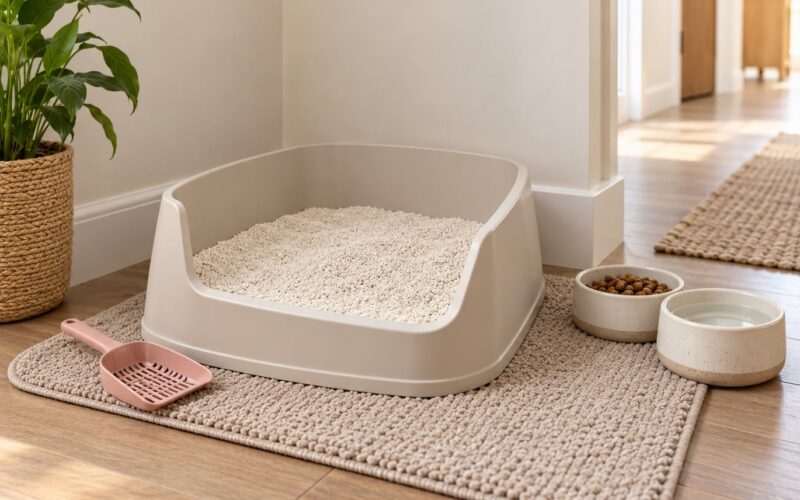
- Number: one tray per cat, plus one extra. In a single-cat home that means two. Two is not excessive.
- Size: at least 1.5 times your cat’s nose-to-tail-base length, in width and in depth, so the cat can stand fully and turn around.
- Type: open and uncovered if your cat uses a covered box reluctantly. Smell concentrates inside covered trays.
- Litter: unscented and fine-grained. Strong or clumping litter puts off some cats, and a scented tray next to an open one defeats the point.
- Cleanliness: scoop at least daily. A tray that goes a few days unscooped is the most common fixable trigger there is.
- Placement: quiet, low-traffic, away from noisy appliances, and never next to a door that opens onto a busy hallway. If the cat has to cross a loud path to reach it, that is a problem.
- Do not place the tray next to the food or in a spot where another cat can ambush it.
Once trays are right, block off the preferred tray location if it is somewhere unsuitable, such as next to an open front door. Put the cat’s new tray there so the alternative becomes the location that works.
6. Use Positive Reinforcement and Consistent Routines
Everything you do in the moment shapes whether your cat repeats the behaviour. Reward what you want and stay neutral about what you cannot prevent.
When you catch your cat calmly walking past the spot that used to attract spraying, mark it with a treat or a few seconds of chin scratches, then put the treat away so it is not a constant handout. Feed and play at fixed times, because predictable routines are a cheap anxiety treatment. After a stressful event, such as a visitor or a redecoration day, offer a session of play so the cat ends the period feeling safe and in control.
If you do catch your cat spraying, interrupt calmly and move them away, then clean later without the cat watching. No shouting, no clapping, no throwing. What you need is for spraying to be an unrewarding and entirely uneventful occurrence.
7. Prevent the Behavior From Returning
Spraying fades rather than stops overnight. Once you know the trigger, the useful measure is weeks, not days.
Week 1: still happening, sometimes because the scent is still there or the trigger is unresolved. Clean everything again and check every tray.
Weeks 2 to 3: new marks usually appear at the edges of the old area, which is a good sign. Your cat is losing interest in the old boundary.
Weeks 4 to 6: intervals lengthen. This is where most households get impatient. Do not increase cleaning products or add punishment; both slow things down.
From roughly 3 months: most cats whose trigger has been removed stop marking entirely. A few keep a token mark in one spot, which is a separate and much smaller problem.
Build the prevention habits now: clean promptly, keep several safe resources available per cat, monitor windows and doors for visitors, and keep the routine steady. Keep one spare enzyme cleaner in the cupboard and you will be ready within minutes of finding a fresh mark, which matters more than the product you use.
For the common awkward cases. If your cat is boarding, travelling or staying at the vet, send a worn T-shirt of yours in the carrier and ask the boarding staff to keep the routine familiar; this reduces stress marking on return home. If your cat is already neutered and starts suddenly, do not assume the desexing failed and do not assume it is spite: schedule a veterinary check, look hard at what changed outside the windows, and expect a slower, more careful fix.
Common Mistakes
Nearly every stalled attempt I can think of comes down to one of these six, and each has a straightforward correction.
Scolding or yelling. Punishment does not teach a cat to stop; it teaches your cat that you are unpredictable, and it frequently makes the marking worse because a stressed cat marks more. The correction is to interrupt calmly once, remove the cat, and address the environment instead.
Rubbing your cat’s face in the urine. It does not shame a cat, because a cat reads it as your scent, not a reprimand. It is unpleasant for your cat and adds your own scent to a spot you are trying to keep clear. The correction is nothing: no punishment at all, just cleaning.
Using ammonia or bleach. Ammonia is what urine breaks down into, so it reads as a litter tray to a cat nose, and bleach does not remove the cause either. The correction is a pet enzyme cleaner every time.
Cleaning late. Once urine has soaked into carpet and dried, the smell has set into the padding and ordinary surface cleaning will not reach it. The correction is to clean within hours and use plenty of product, working into the foam.
Forcing contact. Shoving a frightened cat toward another cat, or into a room after an incident, ends in more conflict and more marking. The correction is to give separate spaces and let the relationship rebuild at the cats’ pace.
Assuming it is only a litter box problem. Tray management fixes accidents. It does nothing about a cat marking the front door because a stray is sitting outside. The correction is to diagnose the behaviour properly first, then fix the environment it points to.
When to Ask a Veterinarian
Book an appointment if spraying starts suddenly in a cat that has never done it, and do not wait if you see any of these signs.
- Straining, pushing and crying in the litter tray, or frequent trips with little or no output. This can be a blockage, which is an emergency.
- Blood in the urine, or urine that is cloudy or very dark.
- Pain when the belly is touched, or licking at the genitals repeatedly.
- A sudden change in appetite, drinking, weight or litter box habits.
- Spraying that is suddenly far more frequent or voluminous.
Ask for a urinary workup covering feline lower urinary tract disease, crystals or struvite stones, and a bladder infection, plus blood tests for kidney disease, diabetes, hyperthyroidism and liver disease. Pain and illness change behaviour, and an adult cat that suddenly stops using its tray is a veterinary question before it is a behavioural one.
Never give a cat human medication. Painkillers, antihistamines and cold medicines that are harmless to people are dangerous to cats.
Ask about a certified behaviourist or your vet’s behaviour referral service when the marking continues despite a clean bill of health and a fixed environment. Behaviourists can build a desensitisation plan for windows and doors, which is usually where the hard cases sit. Your vet can also discuss prescribed anti-anxiety medication such as fluoxetine, which is sometimes used alongside environmental work for severe or chronic marking. That is a prescription conversation, not a supplement decision.
Frequently Asked Questions
How to stop a cat from spraying indoors with home remedies?
The only home remedy with a real mechanism is an enzyme-based cleaner, because it breaks urine down rather than masking it. Diluted biological washing powder works on soft furnishings and laundry, and diluted vinegar helps on fresh damp marks, but neither replaces enzyme cleaner on walls or carpets. Avoid ammonia, bleach and essential oils: ammonia is what urine breaks down into and reads as a litter tray to your cat, and essential oils are toxic to cats.
Do cats mark their territory with pee?
Yes. Spraying is urine marking, a scent-marking behaviour rather than a toilet accident. The cat stands, backs up to a vertical surface, holds its tail up and stiff, and releases a small amount of urine to leave scent information. It also marks with scent from its cheeks, which is why rubbing furniture leaves a normal, subtle mark that causes no problems. The spraying version is the one worth correcting.
Does neutering stop spraying?
Often, especially in young males, and it is the single most effective step for an intact cat. Desexing usually reduces the hormonal drive behind territorial marking within weeks to a few months. It does not fix everything: an adult cat that learned to spray before neutering, or one marking because of stress, pain, other cats or outdoor cats, may keep going. Neutering also reduces the risk of some urinary and reproductive conditions.
Do female cats spray urine?
Yes, and owners often assume otherwise. Intact females spray more often while in heat and when other females are around, especially in multi-cat households. Neutered females also spray, driven by stress, territory or medical causes rather than hormones. If the behaviour starts suddenly in a spayed cat, treat it as a trigger or a health question rather than a behaviour problem until your vet has ruled out urinary disease.
Why does my cat keep spraying on walls?
Location tells you the cause more often than not. Spraying on a window or curtain points to cats outside. Marks inside a doorframe point to another cat coming and going or a visitor at the door. Wardrobe doors and new furniture point to change in the environment, and marks on your bed or laundry point to separation anxiety or household tension. Cleaning alone will not hold if the trigger stays in place.
How long does it take to stop a cat from spraying indoors?
Expect weeks rather than days, and roughly three months for a full resolution once the trigger is gone. Weeks one to three usually still bring marks, often at the edge of the old area, which is progress rather than failure. If nothing is improving after a month with the environment fixed and the scent removed, go back and look for pain, urinary disease or a behaviourist.
Conclusión
Start with the pattern, not the product. Note where and when the marks appear, then use the location to work out the trigger: windows point outside, doorframes point at another cat, new furniture points at change. Clean every marked surface with an enzyme cleaner, deep enough for carpets and with a separate wash cycle for laundry, and keep the cat away until the area is fully dry. Then take the pressure off with more trays, more high places, blocked sightlines to outdoor cats, a steady routine and a few calm rewards.
Give it weeks rather than days, and expect most cases to settle over roughly three months once the cause is handled. If the spraying starts suddenly, comes with straining, blood or pain, or your cat has changed its appetite or drinking, contact your veterinarian first. Never give a cat human medication, and bring the whole picture with you, because the location of the marks usually explains more than the marks themselves.