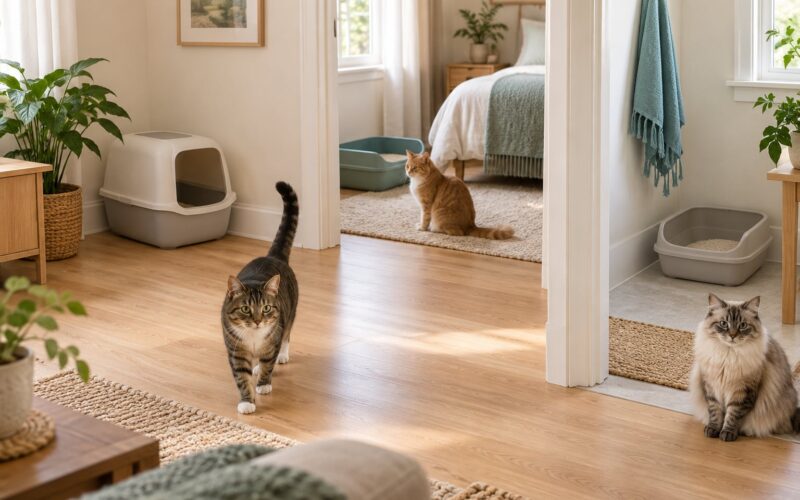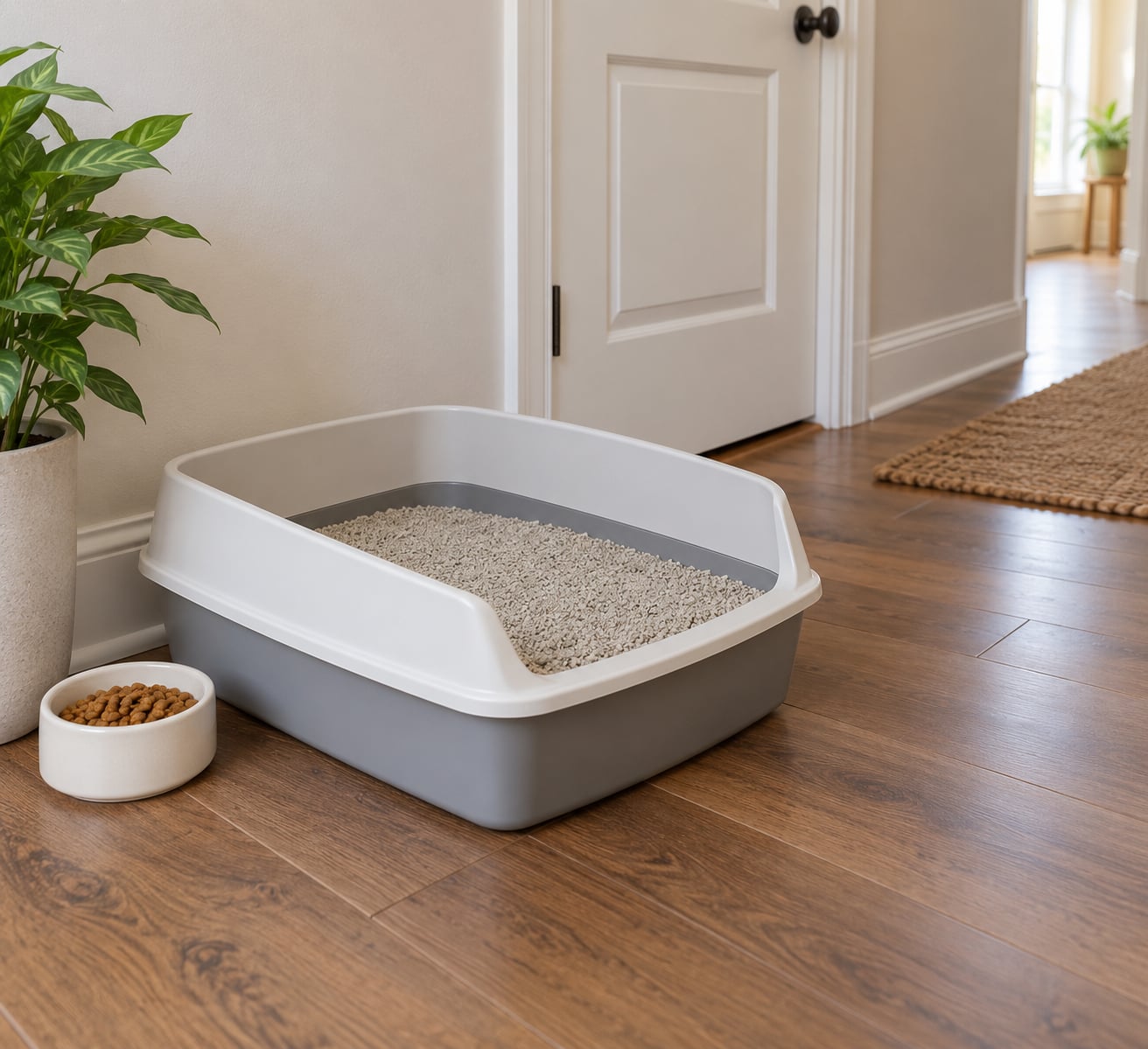
The short answer to why is my cat peeing outside the litter box comes down to four things: a medical condition that makes the box painful, a problem with the box itself, stress or a change in the home, and territorial marking. Sudden-onset house soiling needs a vet first. If your cat is otherwise bright, eating normally and acting like itself, the setup is the next thing to check.
This guide walks through the causes in the order your vet would approach them, the signs that separate a medical problem from an avoidable one, and the changes that fix most cases without any product at all.
Table of Contents
- What Does It Mean When a Cat Urinates Outside the Litter Box?
- Common Reasons Your Cat Is Peeing Outside the Box
- 1. A medical condition that makes the box painful
- 2. Litter box problems, the most common preventable cause
- 3. Stress and environmental change
- 4. Territorial marking
- Matching the pattern to the likely cause
- How to Tell If the Problem Is Behavioral or Medical
- How Litter, Trays, and Cleaning Affect Your Cat
- Cleaning accidents so the cat does not return to the same spot
- Why Is My Cat Peeing Outside the Litter Box Because of Stress?
- How to Help a Cat Re-Build Trust With the Litter Box
- When to See a Veterinarian About Cat Urination Problems
- Frequently Asked Questions
- My cat isn’t peeing but acting normally. What could be causing this and should I be concerned?
- What are some natural ways to prevent cats from urinating in the house?
- What is the best cat litter for cats who pee outside the litter box?
- How do I fix my cat from peeing outside the litter box?
- Should I punish my cat for peeing outside the litter box?
- Why is my cat peeing outside the litter box but pooping in it?
What Does It Mean When a Cat Urinates Outside the Litter Box?
Vets call this inappropriate elimination, or periuria. It is one of the most common reasons owners bring a cat in for an appointment, because owners notice it long before anything else changes.
There are two very different behaviors hiding under that one phrase, and telling them apart changes everything about what you do next.
- Accidental urination means the cat walked past the box, had no warning, and did not choose where the urine landed. The surface is usually horizontal, the volume is normal, and the posture is low and relaxed.
- Territorial marking is deliberate. The cat stands, raises its tail, and deposits a small amount of urine on a vertical or prominent surface such as a wall, a door frame, a sofa arm or your pillow.
Starting to record what, where and when it happens takes about a minute a day and pays for itself quickly. Cats on vet forums keep repeating the same advice: the diary is what finally reveals the trigger, because most owners misremember the timing.
| What you see | Accidental urination | Territorial marking |
|---|---|---|
| Posture | Crouched, low to the floor | Standing, tail raised and stiff |
| Amount | A normal full void | A small amount, often a dribble |
| Surface | Floor, rug, bedding, sofa seat | Wall, door, vertical furniture, doorway |
| When | After long gaps without a usable box | After a stress event or near other cats |
| Typical fix | Fix the box or the health problem | Reduce stress and widen territory |
Common Reasons Your Cat Is Peeing Outside the Box
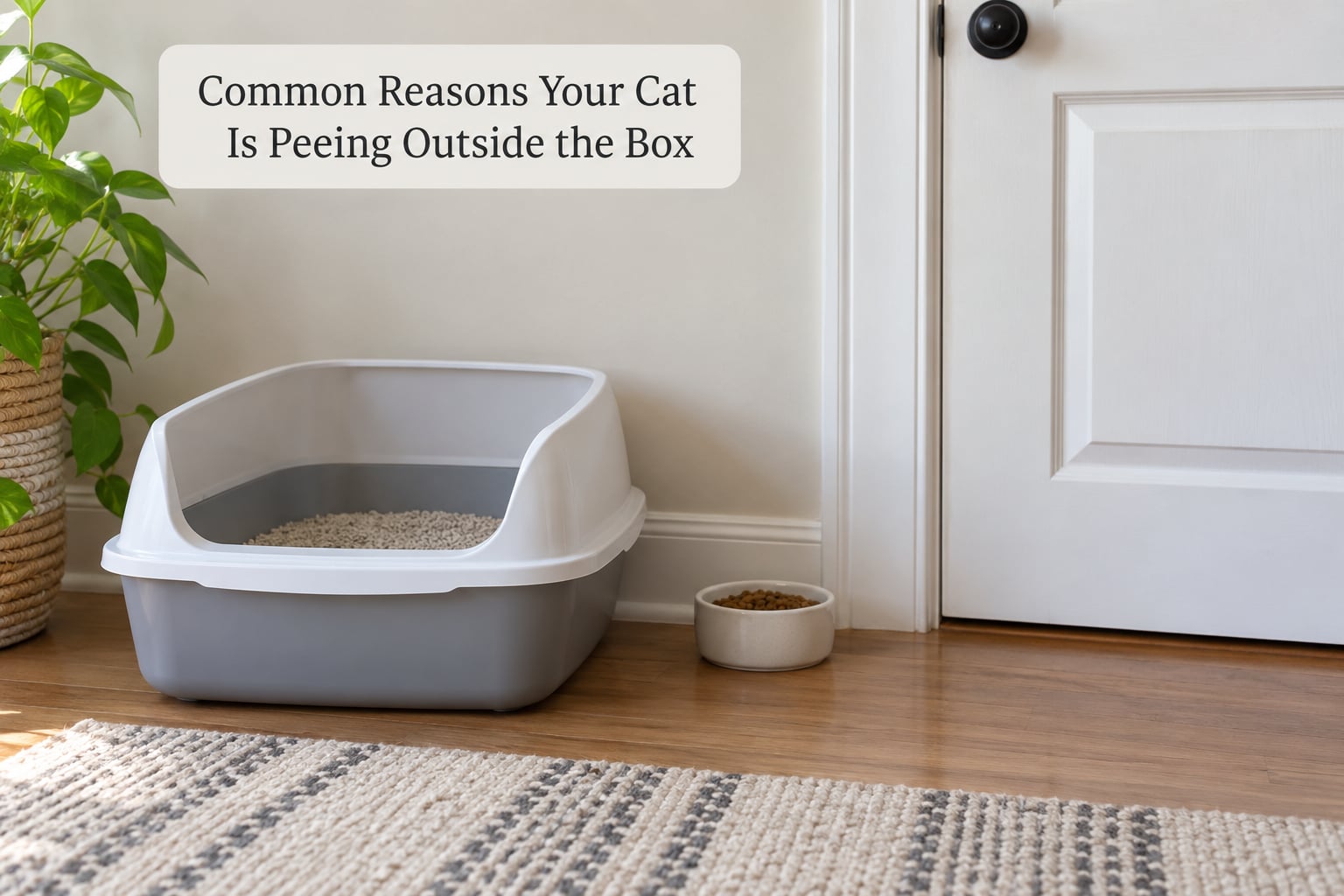
Four causes account for nearly all of these cases. Work through them in order rather than changing five things at once, because you will not know which one worked.
1. A medical condition that makes the box painful
A cat associates the box with pain and starts looking for relief somewhere else. Conditions behind this pattern include urinary tract infection, bladder stones and crystals, feline idiopathic cystitis (part of feline lower urinary tract disease, or FLUTD), kidney disease, diabetes, constipation, and arthritis that makes stepping into a high-sided box hurt.
Senior cats are the ones owners miss. A twelve-year-old cat with sore hips may not strain or vocalise at all; she simply avoids the box quietly, and the owner assumes she is being difficult.
2. Litter box problems, the most common preventable cause
Plenty of cats have never liked their box. They tolerate it until they do not. Too small, a lid they resent, scented litter, a slippery plastic base, a loud washing machine two feet away, or a box that sits next to the food bowl will all push a cat toward the floor.
A box that is clean when the owner looks at it is not necessarily clean. Cats use it every day, so a once-a-week scoop is a week of accumulation in their view.
3. Stress and environmental change
Moving house, a new partner, a baby, a new dog, an owner away for a week, a furniture shuffle or a renovation can all restart the behavior in a cat that never had a problem before. Sudden-onset cases in a healthy cat are usually environmental, as owners on cat advice forums almost always find once a vet clears their cat.
4. Territorial marking
Unneutered cats spray to advertise presence and status. Around ten percent of neutered males and five percent of spayed females still mark, so neutering reduces the behavior without removing it entirely. Multi-cat homes add pressure, particularly when one cat controls the path to the box.
Matching the pattern to the likely cause
| What the owner notices | Most likely cause |
|---|---|
| Peeing outside but still pooping in the box | Box aversion rather than illness, often from a recent deep clean or litter switch |
| Accidents only before breakfast or only at night | Routine, territory or a blocked box, not a urinary emergency |
| Started the day after a house move or a new arrival | Stress and environmental change |
| Visits the box, cries, leaves quickly | Pain on urination, needs a vet today |
| Wall and doorway spray in a multi-cat home | Territorial marking driven by conflict |
How to Tell If the Problem Is Behavioral or Medical
Watch your cat for a few days and write down what you see. If anything on the urgent list below shows up, stop troubleshooting and call a clinic.
Urgent signs that need a vet the same day:
- Repeated visits to the box with little or no urine produced.
- Crying, meowing or straining while trying to pass urine.
- Blood in the urine, or licking the genital area constantly.
- Lethargy, hiding, or vomiting alongside the behavior change.
- Complete absence of urine in the box for a cat that normally uses it daily.
Male cats are the highest risk group for a urethral obstruction, which is a blockage of the urine flow and a life-threatening emergency that can develop in hours. A female cat with the same warning signs still needs prompt attention.
Signs that point to the setup instead:
- Appetite, sleep and grooming are all normal.
- The cat uses the box some of the time and misses other times.
- Accidents appear on the same surface, usually near the box or in a quiet room.
- The cat checks the box, then walks away without straining.
One pattern owners raise often deserves a direct answer: if the cat still poops in the box but pees outside, the box is not being rejected entirely. That points toward urine-specific discomfort, scent marking, or a box the cat finds comfortable to sit in but not comfortable to wet in, such as a small covered tray.
How Litter, Trays, and Cleaning Affect Your Cat
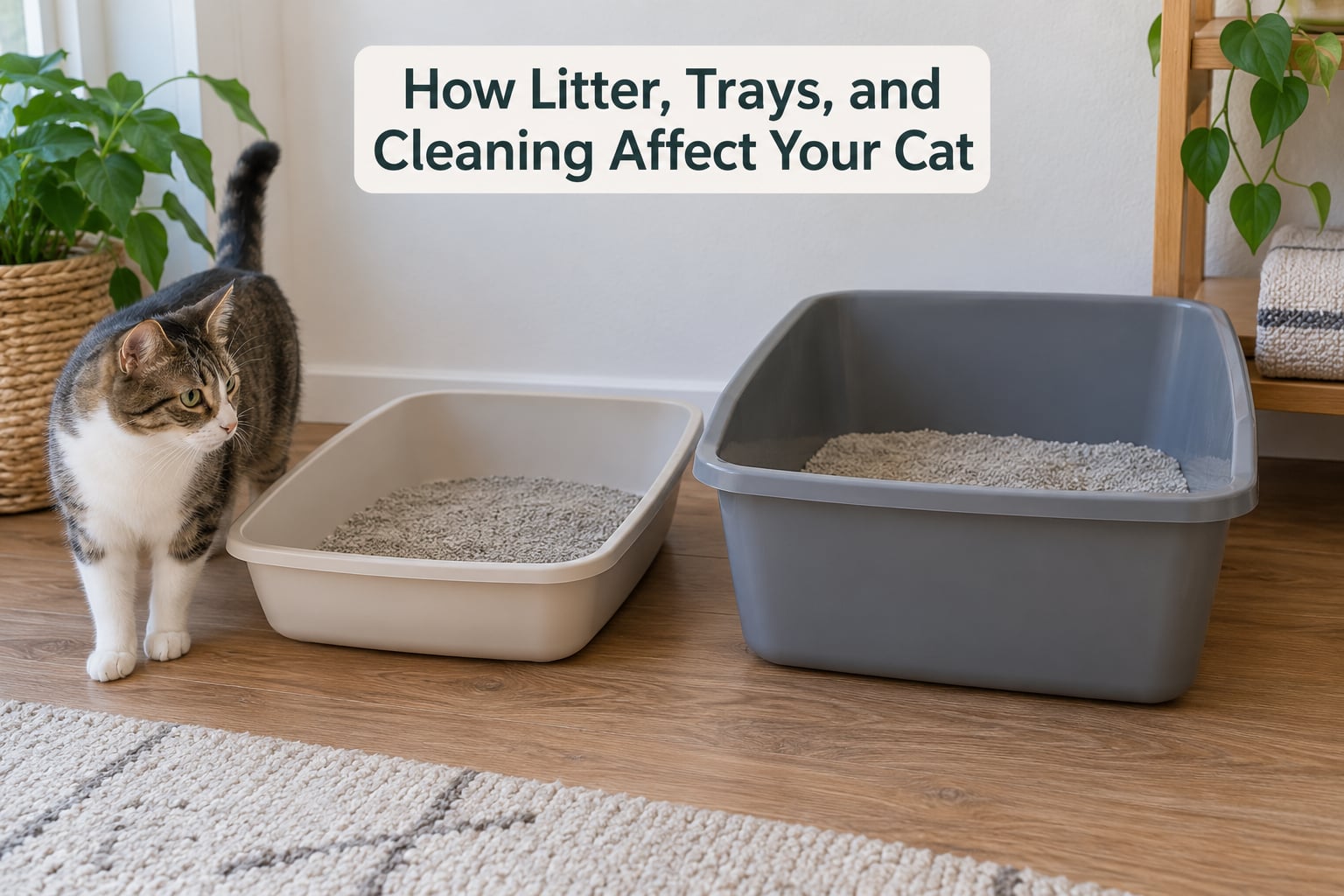
Most setup fixes are free or nearly free, and they start with the numbers. Cats are creatures of habit with a strong preference for open, roomy, quiet places to dig.
| Factor | What to aim for | Why it matters |
|---|---|---|
| Box size | About one and a half times your cat’s body length | A cramped tray makes turning around uncomfortable |
| Entry height | Low sides, roughly three or four inches | Helps kittens and senior cats with joint pain |
| Cover | Uncovered, or a lid only if your cat already prefers it | Cats value sight lines and escape routes |
| Litter | Unscented, fine-grain clumping litter | Strong perfume smells like an ammonia bathroom to a cat |
| Depth | Two to three inches | Too little or too much digging is discouraging |
| Scooping | At least once a day, more with two cats | Cats avoid a box they have to stand in |
| Full change | Every seven to ten days | Urine soaks into the base and never fully leaves |
| Placement | Quiet, accessible, away from food and noisy appliances | A trapped or exposed tray feels unsafe |
| Number of boxes | One per cat, plus one extra | Removes competition between cats in shared homes |
If money is tight, a large plastic storage bin with a cut-down entry hole does the same job as an oversized commercial tray. Removing the lid from a covered box costs nothing, and owners on cat forums report that switch alone fixes a surprising share of cases.
Cleaning accidents so the cat does not return to the same spot
Cat urine is not like ordinary spill. It contains uric acid crystals that stay in carpet, wood and fabric long after the smell has faded to human noses, and those leftovers are what pull your cat back to the same spot.
Use an enzymatic cleaner made for urine, follow the label dwell time before blotting, and get to it as quickly as possible. Blot first with old towels, then apply, then let it sit, then rinse or vacuum as directed.
Skip ammonia-based household cleaners. Ammonia is what urine breaks down into, so to a cat it reads as a fresh toilet cue rather than a removal. Skip essential oils around cats too, since several are toxic to them, and never use a phenol or bleach-based cleaner where a cat will walk afterward.
Why Is My Cat Peeing Outside the Litter Box Because of Stress?
Cats mark territory with urine because it is how they communicate, and a stressed cat marks more, not less. The point is to remove the reason for the message rather than punish the cat for sending it.
Common triggers, in the order cat owners report them:
- Moving house or rearranging furniture, including new flooring under a familiar box.
- A new partner, new baby, new roommate or a house full of visitors.
- A new dog or cat arriving, or another outdoor cat visible through a window.
- An owner away for several days, or a change in feeding times.
- Tension between cats over food bowls, resting spots or one slow litter box.
What helps: keep feeding and play times predictable, offer more than one hiding place and more than one elevated perch, separate resources so two cats never have to share a single bowl, and give the cat a way to observe outdoor cats without confronting them, such as a perch away from the window or a blocked view.
Pheromone products, whether a diffuser, spray or collar, are optional supports rather than guaranteed solutions. They tend to help in mild cases and do very little when the underlying stressor is still there, so treat them as one piece of a plan rather than the plan itself.
How to Help a Cat Re-Build Trust With the Litter Box
If the vet has cleared your cat, rebuild in stages and give it time. Owners who change everything on one day rarely learn which change worked.
Step 1: Identify the trigger. Keep the diary for at least a week. Note the time, the room, the surface, whether the cat was alone, and what happened in the two hours before.
Step 2: Fix the box first. Work through the table above. Litter changes take one variable at a time, so add the new litter alongside the old for a few days rather than swapping it completely.
Step 3: Add boxes, not fuss. If you have two cats, aim for three boxes and spread them across more than one floor. Boxes in separate rooms are worth more than three boxes stacked in one hallway.
Step 4: Keep the surroundings calm. Move the box away from a slamming door or a noisy appliance, and give the cat a private route to reach it.
Step 5: Never punish. Rubbing a cat’s nose in urine, shouting or removing the box entirely teaches nothing and can make the cat hide. Owners searching for how to discipline a cat for house soiling get a consistent answer from vets and behaviorists: there is no punishment that works.
Step 6: Track it. Most cats improve within days of the correct fix, and a full return to normal can take a few weeks of consistent habits. If nothing changes after a couple of weeks, or the pattern shifts, go back to the diary.
A useful reset for a cat that has abandoned a familiar tray: place a box in the room where the accidents happen, let the cat use it, then move it a few inches at a time toward the original spot.
When to See a Veterinarian About Cat Urination Problems
Book an appointment whenever the behavior is sudden, comes with any physical sign, or persists once the setup has been corrected. Early checks are cheaper than treating an obstruction, and a urinalysis answers most of the questions in one visit.
What to ask for at the visit:
- A urinalysis, and a urine culture if infection is suspected.
- Bloodwork for kidney and liver values, and blood glucose.
- Radiographs or ultrasound if stones, crystals or an obstruction are possible.
- A full physical exam, including a look at the joints if your cat is older.
Straining with little or no urine, blood in the urine, or vocalising while urinating means go today, not tomorrow. And never give human medication, including leftover pain relief or urinary remedies meant for people. What is safe for you can damage a cat’s kidneys or, in some cases, be fatal.
Frequently Asked Questions
My cat isn’t peeing but acting normally. What could be causing this and should I be concerned?
If your cat spends time in the box but produces little or nothing, treat it as urgent rather than odd. Straining with no urine, crying, blood or lethargy can signal a urethral obstruction, which is an emergency, especially in male cats. Call your vet the same day and do not wait to see whether it improves on its own.
What are some natural ways to prevent cats from urinating in the house?
Start with routine: predictable feeding times, daily play, several elevated perches and more than one hiding place, so the cat feels secure in its own space. Add litter boxes, one per cat plus one extra, spread across floors. Natural deterrents such as citrus or vinegar scents are unreliable and some essential oils are toxic to cats, so skip those.
What is the best cat litter for cats who pee outside the litter box?
Unscented, fine-grain clumping litter is the most widely recommended choice, with a depth of two to three inches. Skip perfumed and heavy clay or pellet litters, which some cats refuse. If the litter box is the real problem, changing litter will not fix it, so also check box size, lid and cleanliness before buying anything.
How do I fix my cat from peeing outside the litter box?
Rule out health problems with a vet first, then fix the setup: one box per cat plus one extra, uncovered, low-sided, in a quiet spot away from food and appliances, scooped daily and changed every seven to ten days. Then address stress with predictable routines and extra hiding and elevated spaces. Track progress in a simple diary.
Should I punish my cat for peeing outside the litter box?
No. Punishment does not teach a cat where to go; it teaches it to hide and to avoid you, and it can make a stress-related urination problem worse. Cats cannot connect the correction to the act that happened minutes or hours earlier. Clean the area with an enzymatic cleaner, then change the environment rather than reacting to the cat.
Why is my cat peeing outside the litter box but pooping in it?
That split usually means the cat is not rejecting the box itself. It points toward urine-specific discomfort, scent marking, or a box the cat will sit in but will not wet in, such as a small covered tray. A vet should still check for urinary disease, and at home try an uncovered, larger box with unscented clumping litter.
Do the first three things in this order. Get your cat checked by a vet, since a cat that is avoiding the box out of pain will not improve with any equipment change, and sudden straining with no urine needs attention today. If the vet finds nothing, fix one setup variable at a time, starting with box size, the lid and how clean it really is, and keep the diary going while you watch. Most cats are back to normal within a couple of weeks of the right fix.