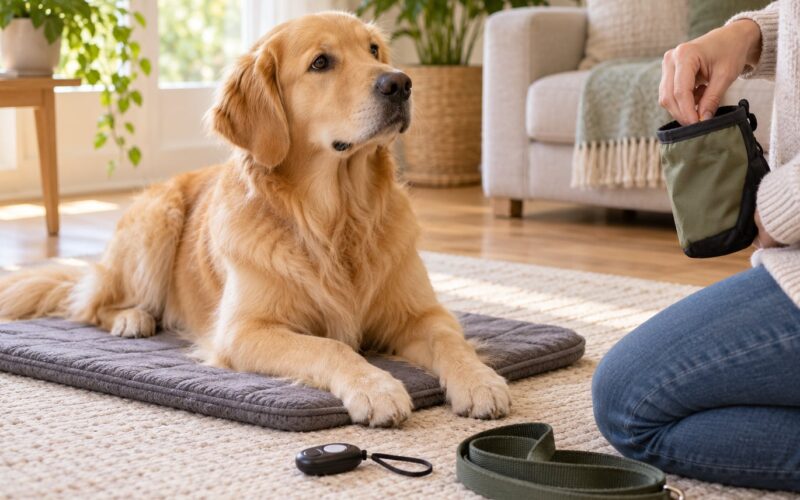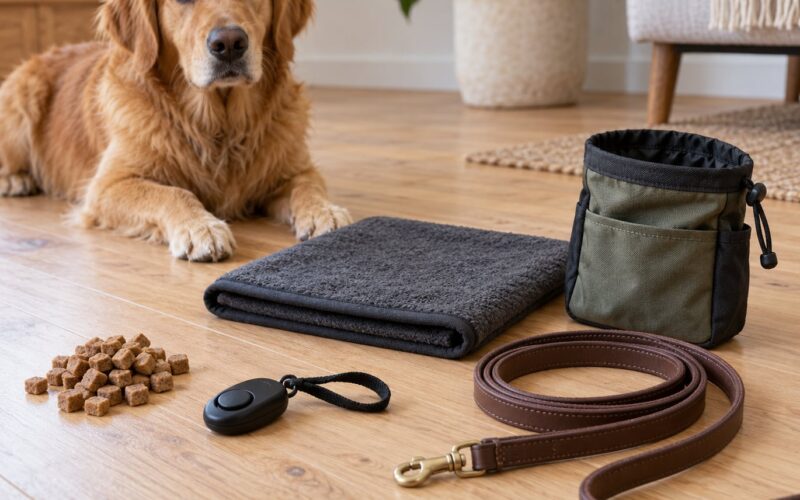
How to train a deaf dog comes down to one swap: you replace spoken commands with hand signals, touch cues and vibration, then back every cue with an instant food reward. Dogs read movement and body language faster than most people give them credit for, so a deaf dog given clear visual cues can learn everything a hearing dog learns. The whole process takes short daily sessions over a few weeks, not a free weekend.
The part that catches beginners off guard is you. A deaf dog cannot hear a marker sound, cannot hear its name called across a yard, and cannot hear a sharp no. Everything in training shifts toward what you can see and what you can deliver in the same second.
Table of Contents
- What You Need
- Step-by-Step: How to Train a Deaf Dog
- 1. Confirm the dog’s hearing status and training needs
- 2. Choose a small set of visual cues
- 3. Reward the dog for looking at you
- 4. Teach one hand signal at a time
- 5. Use a reliable recall cue
- 6. Train everyday behaviors without verbal commands
- 7. Practice short, consistent sessions over time
- Common Mistakes
- Frequently Asked Questions
- Are deaf dogs hard to train?
- How do you discipline a deaf dog without shouting?
- How do you get a deaf dog’s attention at a distance?
- How long does it take to train a deaf dog?
- Should I use a vibration collar for a deaf dog?
- Which dog breeds are most often deaf?
- Conclusion
What You Need
A quiet, boring room is the first thing. Not a busy living room, not the yard next to a busy street, not a spot where other dogs are barking. A calm dog with nothing else to do will hold your eyes on you long enough for you to mark something.
Then a treat pouch filled with something genuinely high value. This is not the everyday kibble, and it is not the dental stick your dog already ignores. Training treats should be soft, smelly and small, so you can deliver four or five in a row without breaking the rhythm of the exercise. Many owners keep a separate bag for training sessions specifically so they stay special.
You also need a visual marker. A clicker works for a hearing dog because the sound arrives a fraction before the treat. For a deaf dog, that fraction has to come from sight: an open palm flash, a thumbs-up held in clear view, or a bright hand held still above your head. Some owners use a small flashlight with an on-off pattern in the dark.
Safety gear is not optional here. A deaf dog cannot hear a whistle, cannot hear traffic and cannot hear you calling from another room. Get a long line, a sturdy collar or harness, identification tags that say the dog is deaf, and consider a location tracker so a dog that slips the collar is still findable.
Finally, ask your veterinarian for a hearing assessment before you build a whole curriculum around a guess. Some hearing loss in dogs is partial and some is temporary after an ear infection, and training a dog who is hard of hearing as if she were fully deaf wastes weeks. A basic hearing test in the consult room costs little, and a full BAER test, where available, gives you a clear answer.
Step-by-Step: How to Train a Deaf Dog
1. Confirm the dog’s hearing status and training needs
Have the hearing checked first, then watch for yourself. Call the dog’s name while she faces away, then again while she faces you, and stomp a floor beside her while she is turned away. A dog with partial hearing often responds to a close, high tone and misses the same tone from across the room, which tells you exactly where your signal has to be delivered.
Note when the loss started. A young deaf puppy and an eight-year-old rescue who went deaf in the last year are two different training projects. Puppies learn cues fastest, but older dogs can absolutely learn new cues with more repetitions, and senior deaf dogs still learn when the reward is worth it.
2. Choose a small set of visual cues

Pick five or six signals and stop there. Flat palm held still means stay. A wave of the open hand high overhead means come. A flat hand dropped toward the ground means down. A touch of your fingertips to your chest means watch me. Whatever you choose, write them on a single index card so the whole household uses the same version, because a second person inventing a different signal for come is the fastest way to make a dog look untrainable.
Make each shape distinct in silhouette. A flat palm, a raised thumb and a two-finger point should not look like the same gesture from across a lawn. Test your own clarity by giving the signal to another adult in the room before you ever give it to the dog.
Before giving any cue, check that the dog is actually watching. Say the name signal, wait a beat for her head to turn, and only then give the cue. Marking a response you never saw teaches you nothing and teaches the dog nothing.
3. Reward the dog for looking at you
Attention is the whole foundation. When the dog offers you her eyes for any reason at all, deliver the treat immediately. Do not wait for her to sit first or to give you a paw. Every spontaneous glance gets paid, which is slow work for two days and then pays off fast.
Raise the bar gradually. Start in a quiet room, then move to a slightly busier one, then outdoors. If you are marking her glances in three different environments by week two, the foundation is solid. Owners often skip this step, move straight to commands, and end up with a dog who performs perfectly at hand level and ignores you completely at ten paces.
4. Teach one hand signal at a time
Lure, mark, reward. Hold a treat just above and behind the dog’s nose, wait for the sit, flash your marker the instant her hips touch the floor, then give her the treat. Five repetitions is plenty for one signal in one session.
The critical detail is timing. A deaf dog has no click to orient her, so the visual marker and the treat must arrive within a fraction of a second of the correct behaviour. Then add the hand signal gradually. Hold a treat at your knee while she sits, and signal, and move the treat to reward. After she offers the sit unprompted three or four times, signal first and hold the treat empty for a moment.
Keep sessions under five minutes while you are teaching something new. A deaf dog cannot tell you with her ears that she is tired, so boredom shows up as drifting, licking, or sudden interest in the trash can instead. Two or three short sessions a day beats one long one.
5. Use a reliable recall cue
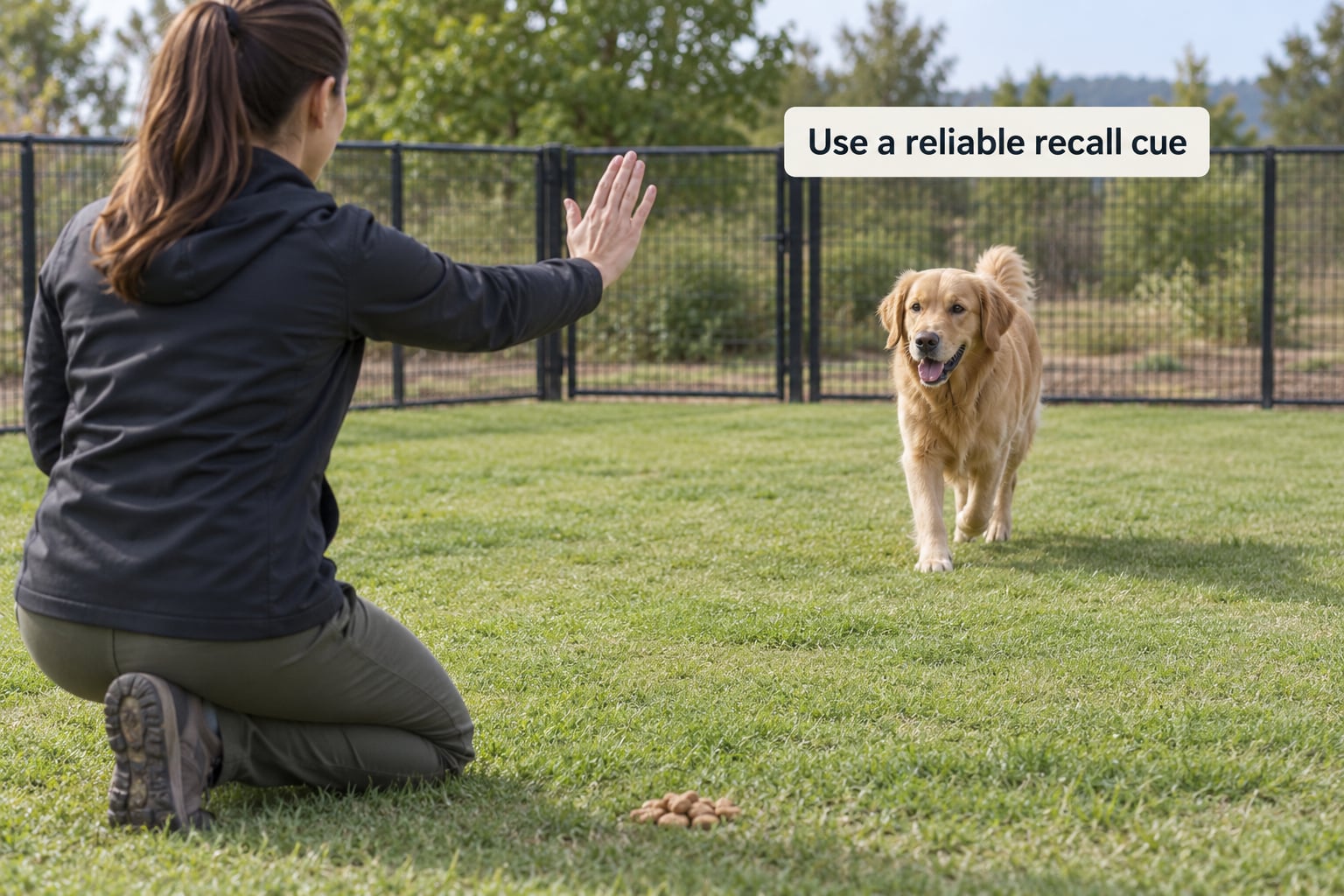
Recall is the cue that keeps a deaf dog alive, so build it on a long line first. Say the name signal, wait for the head turn, give the come wave, and when she arrives, mark and feed. Do it ten times in a boring room where she cannot fail.
Then move outdoors on the long line and do the same thing near distractions: a low fence, a parked car, another dog at a distance. Forum owners often recommend feeding roughly every fifteen seconds while walking, which builds check-ins and proximity so the come works by habit rather than by luck.
Add a light signal for the dark. A flashlight switched on and off twice, held where she can see it, gives you recall and attention cues after sunset. Many deaf dogs do well with a consistent on-off pattern because it is unmistakable.
Pick one recall cue and hold it to it. A high open-palm wave used consistently will outperform three half-remembered signals every time.
6. Train everyday behaviors without verbal commands
Most households need fewer than a dozen solid behaviours, and most of them are safety behaviours. Wait at a door: hold a flat palm up, mark the moment she stops, reward. Leave it: cue, and if she goes for something, calmly pick it up, guide her away, mark the neutral behaviour, reward the ignoring instead of the correction.
Settle on a mat is easier to teach than stay and pays off every single day. Cue, mark the down, reward, and add a release signal so she knows the repetition has ended. A released dog is a happy dog and a dog that gets asked for a release stops resenting the cue.
Never punish a missed response. Without sound, the dog has no idea whether you are correcting, celebrating, or about to leave. Interrupt by moving your body, redirect to the behaviour you want, and reward that. A stern look held for two seconds, then turned away, is a signal she can read.
7. Practice short, consistent sessions over time
Keep a simple log. Date, which signal you worked, and whether it happened first try. Most dogs take a few days for a new cue to click and a few weeks for it to hold under distraction. If a cue is failing consistently, the problem is usually the environment, not the dog. Move to somewhere quieter rather than repeating louder.
Work on touch tolerance early. Deaf dogs startle when reached for, and the fix that veteran foster volunteers use is simple: touch every part of the body daily, gently and without asking for anything, so your hands become a normal event rather than an ambush.
Ask for a qualified reward-based trainer if barking has become the main issue, if the dog shows fear around other dogs, or if you have no idea whether the progress you are seeing is real. Some owners also work with a force-free professional for the first few sessions to learn the timing properly, which is money well spent.
Common Mistakes
Using too many cues at once is the most frequent problem. A dog asked to learn six signals in a week has not learned six signals. Pick one, repeat until it is automatic, then add the next.
Rewarding late is the next one. If you mark and reward after the dog has already lost interest, you are rewarding the wrong moment, and you have no marker sound to correct the timing. Flash the marker at the exact instant of the behaviour.
Assuming the dog can feel vibration is a common and painful error. Some deaf dogs register a collar vibration perfectly well, and some do not notice it at all. A vibrating collar or remote can be a useful addition for attention at a distance, but it should never be the foundation of your training, and never punish with it. Owners on deaf-dog forums describe it as an easy-to-train tool, and also describe dogs that ignore it completely, so plan a fallback.
Letting the household invent its own signals undermines everything. If one person says come with a wave and another says it with a raised thumb, you get a dog that sits and stares when both appear. Agree on a card, post it on the fridge.
Punishing a missed response teaches confusion rather than correction. Shouting at a deaf dog does nothing except damage your relationship and, for some, build fear of your hands.
Training only in quiet rooms is how you get a brilliant indoor performer. Proof every cue somewhere harder: on a leash in a busy street, in a car park, at a dog park on a long line.
Frequently Asked Questions
Are deaf dogs hard to train?
No. Deaf dogs learn on the same reward-based principles as hearing dogs, with two substitutions: visual hand signals and touch cues instead of spoken words, and an instant physical reward instead of a click or verbal praise. Many owners report progress faster than expected, because the dog learns to read one clear signal rather than straining to hear one. Start with attention work, then add one cue at a time.
How do you discipline a deaf dog without shouting?
Interrupt, redirect, reward the alternative. Move toward the dog or gently guide her away from whatever she is doing, mark the behaviour you want instead, and pay for that. A two-second stern look followed by turning your back works as a clear time-out. Never shout and never reach for a vibration collar as punishment, because the dog cannot connect the sensation to the action without a sound to bridge it.
How do you get a deaf dog’s attention at a distance?
Close range works best with a shoulder tap or a touch under the chin. At longer range use a consistent floor stomp you can feel through the ground, a two-flash flashlight pattern after dark, or a high open-palm wave held still above your head. A vibrating collar or remote works for many dogs as a backup, but not all of them register the sensation, so always practise the visual signals too.
How long does it take to train a deaf dog?
Expect a few days for a new cue to click in a quiet room, and a few weeks for it to hold reliably with distractions. A basic reliable vocabulary of five or six behaviours usually takes four to eight weeks of short daily sessions. Older rescues and dogs with partial hearing take longer. Keep sessions under five minutes and log progress weekly rather than judging on a bad day.
Should I use a vibration collar for a deaf dog?
It can help, as long as it is introduced with rewards and used to get attention rather than to punish. Pair the vibration with a hand signal from day one so the dog links the sensation to a visual cue. Some deaf dogs ignore the vibration completely, which is why visual signals must come first. Never use it as a substitute for real training, and check with your veterinarian first.
Which dog breeds are most often deaf?
Inherited congenital deafness shows up most often in white or lightly marked coat dogs, including Australian Cattle Dogs, Dalmatians, Australian Shepherds, Border Collies, Bull Terriers, Boxers and several terrier breeds. Old age can also reduce hearing in any dog. Genetics matter more than breed size, so ask about hearing testing when you get a puppy from a breeder.
Conclusion
Start by booking the hearing check, because a week of training against the wrong assumption is a week wasted. Then spend three days on nothing but earning your dog’s attention, and write your five hand signals on a card everyone in the house can see. How to train a deaf dog comes down to one habit above all else: mark the behaviour the instant it happens, and pay for it while she is still looking at you.