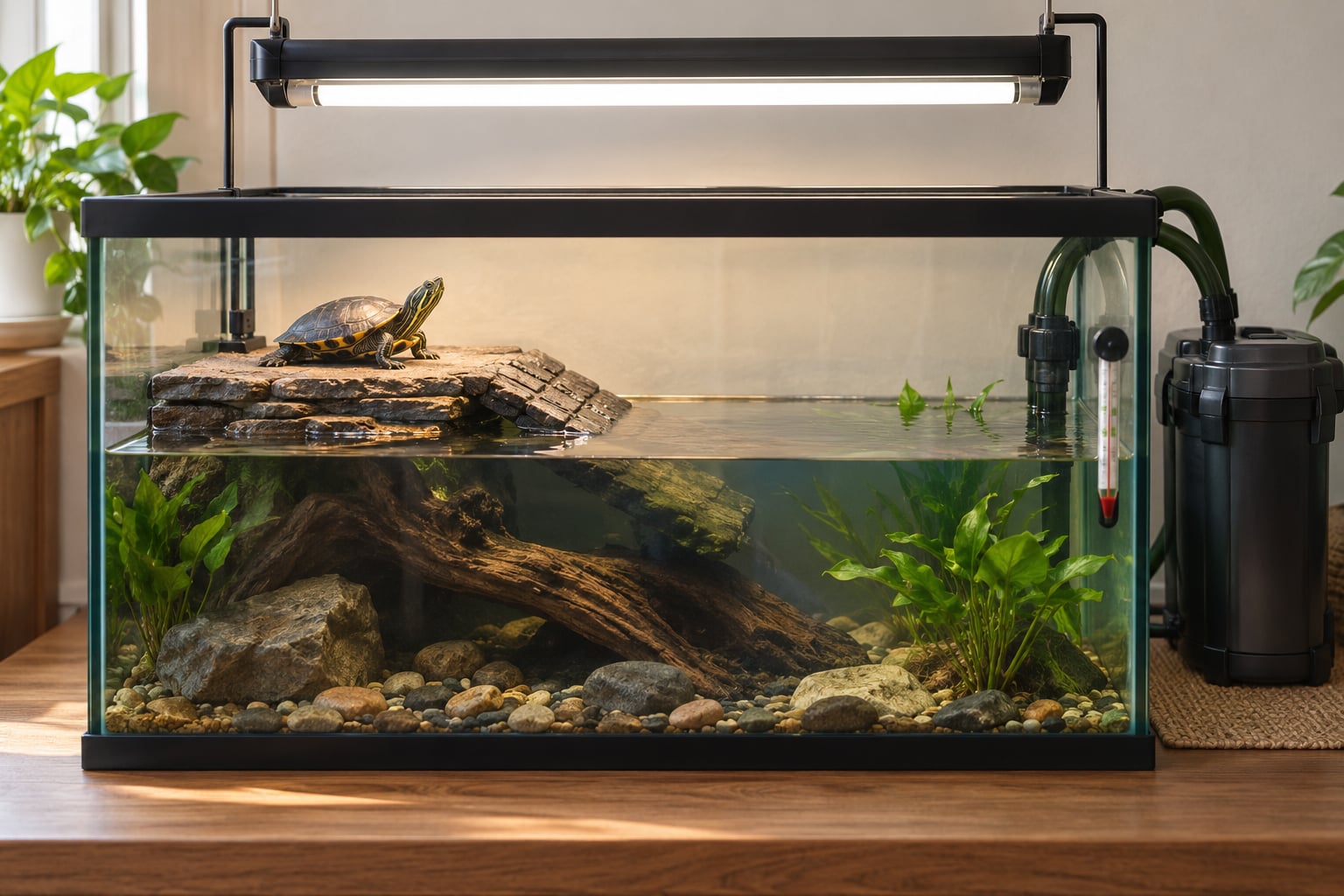
Learning how to care for a pet turtle indoors comes down to four things: a tank big enough for the adult animal, a dry basking platform under a UVB lamp, clean filtered water, and a diet matched to the species. Set those up before the turtle arrives and the daily routine is genuinely easy. Get them wrong and a turtle can hide serious problems for months.
Before you commit, know the lifespan. Aquatic turtles kept properly in captivity often live 20 to 40 years, and many states and countries ban the sale of turtles under 4 inches shell length. This is a long indoor commitment, not a classroom pet that grows into a nuisance.
Table of Contents
What You Need
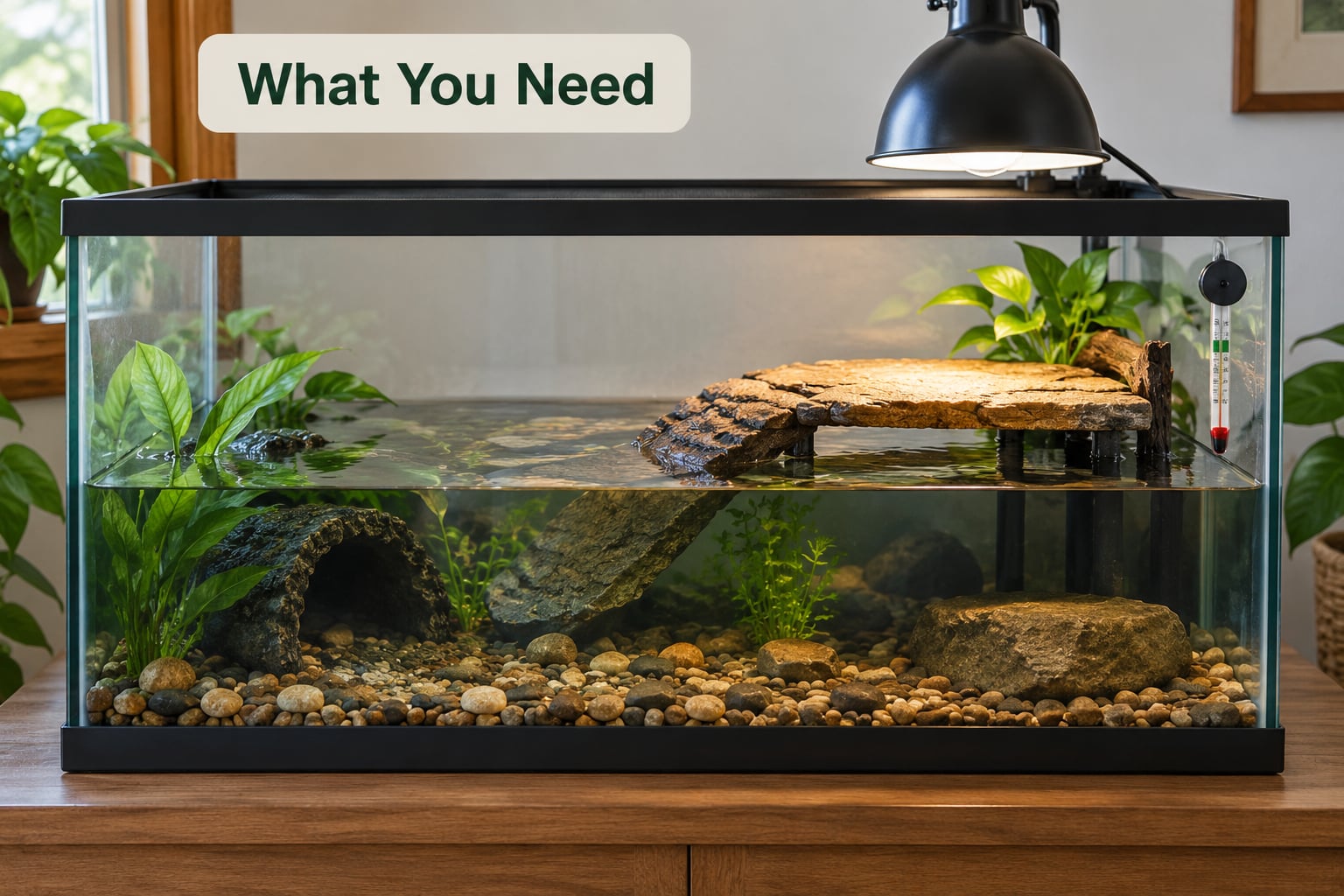
The list below covers an adult aquatic turtle such as a red-eared slider or painted turtle. Buy for the size the animal reaches, not the size it arrives at — sliders often need a 100-gallon-plus setup as adults, and moving up twice is more work than starting with room to grow.
Essentials
- Tank: a glass aquarium with a secure screened lid. Turtles climb surprisingly well, and an open top is an open door.
- Heat source: a basking bulb or ceramic heat emitter with a thermostat, plus a submersible heater for the water.
- UVB lamp: a T5 HO tube or compact fluorescent, mounted on a reflector roughly 8 to 12 inches above the basking platform.
- Two thermometers: one for the basking zone, one submersible for the water. Guessing at temperature is the most common beginner error.
- Canister filter: rated at four times the tank volume per hour. A 40-gallon tank needs a filter moving roughly 160 gallons per hour.
- Water conditioner and test kit: a dechlorinator plus liquid tests for ammonia, nitrite, nitrate and pH.
- Substrate and basking platform: washed river gravel or sand, a stable ramp or cork bark, and a cuttlebone for calcium.
- Food: species-appropriate turtle pellets as the base, plus greens, live or frozen invertebrates, and a cuttlebone or calcium supplement.
Nice to have
A second UVB bulb so the water gets some direct light, an automatic feeder for travel days, spare water test strips, and non-toxic aquatic plants such as anacharis or water lettuce for cover and enrichment. Owners of rescued turtles also need a separate quarantine tank, and it is worth finding an exotics or reptile veterinarian in your area before you need one.
Step-by-Step: Set Up the Turtle Habitat
Allow a full weekend to build the habitat and let it stabilize. Most of the frustration people report comes from adding a turtle to a tank that was filled with water an hour earlier.
Step 1: Choose the Right Tank
The sizing standard is 10 gallons of water space per inch of shell length, and most keepers treat 40 gallons as the practical floor for a single adult aquatic turtle. Bigger is better in one direction only: turtles do not get bored in a large clean tank, but they do get sick in a small dirty one.
| Adult shell length | Minimum water volume |
|---|---|
| 4 inches | 40 gallons |
| 6 inches | 60 gallons |
| 8 inches | 80 gallons |
| 10 inches | 100 gallons |
Longer tanks are more useful than taller ones, because swimming length matters more than climbing height. Fit the screened lid properly, keep the tank on a stand rated for the weight, and place it away from windows, radiators and doors that slam.
Step 2: Create Land and Water Areas
A turtle needs a dry, elevated basking platform and open water it can swim in. Fill the water to 1.5 to twice the turtle’s shell length — deep enough to swim freely, shallow enough that a weak or sick animal does not drown.
Build the land zone with a ramp or cork bark that is wide enough for the turtle to turn around on, and slope the transition so it can climb out without slipping. Semi-aquatic species and juveniles need a much larger land area than a fully grown adult slider does. Check the platform daily for a wobble, because a basking spot that tips sends a turtle straight back into the water.
Step 3: Install Heat and UVB Lighting
Turtles regulate body temperature by moving between warm and cool zones, so a single temperature for the whole tank is how overheating happens. Aim for the ranges below, then confirm them with your own thermometers rather than trusting the lamp’s label.
| Zone | Target range |
|---|---|
| Basking platform surface | 85-95 F |
| Warm side of the tank | 80-85 F |
| Water | 74-78 F |
| Nighttime (lights off) | 65-75 F |
Run the UVB lamp 10 to 12 hours a day on a timer, and switch it off at night so the animal gets a real dark period. UVB is not optional: it lets the turtle make vitamin D3 and absorb calcium, and without it the shell softens and warps. Replace UVB bulbs every 6 months, even when they still glow, because visible light outlasts the useful UV output.
If the basking spot reads cold, the usual causes are the lamp sitting too high, a bulb too small for the zone, or a cool room in winter. Fix the placement before adding a second heater.
Step 4: Add Safe Substrate and Decorations
Use washed river gravel, sand or a bare bottom. Skip aquarium gravel — small pebbles get swallowed and can cause impaction, and experienced keepers on reptile forums warn about it constantly. Anything with sharp edges, small openings a head can wedge into, or a water-based paint or sealant is unsafe.
Include a cuttlebone, a hide at the waterline so the turtle can rest out of sight, and a couple of large rocks or driftwood. Keep the layout simple enough that you can reach every corner during a clean.
Step 5: Stabilize the Habitat Before Introducing the Turtle
Run the filter and heater for several days with the tank full, condition the water, and test it. Aim for pH between 6.0 and 8.0, zero ammonia, nitrite below 0.5 ppm, and nitrate below 40 ppm. If your tap water is above pH 8, a pH-down product or a mix of treated water is worth adding to the routine.
Watch the cycle: ammonia and nitrite read high for the first days, then the nitrates settle as the filter colonizes. Only then does the turtle go in. Releasing it into an uncycled tank is the single most avoidable way to lose an animal in the first month.
Step-by-Step: Feed and Handle the Turtle
Once the habitat is stable, daily care takes about ten minutes. Most of it is observation, which is where you catch problems early — turtles hide illness well.
Step 6: Feed a Balanced Diet
Diet depends on species and age. Juveniles under about a year are mostly carnivorous and need protein — pellets, earthworms, crickets, mealworms, shrimp and feeder fish. Adults shift toward a vegetable-heavy diet: dark leafy greens, collard and dandelion greens, squash, carrots and a small portion of fruit, plus a smaller amount of pellets.
Feed juveniles daily and adults two to three times a week, in a portion roughly the size of the turtle’s head. Remove uneaten food within about fifteen minutes, because food left in warm water degrades the water fast. Never give human medication, vitamin supplements or calcium tablets designed for people without veterinary guidance — a turtle does not dose like a person, and excess calcium compounds cause shell and kidney problems.
A cuttlebone in the water covers routine calcium needs. Supplementing further is a conversation for a reptile veterinarian who has seen the animal and its bloodwork.
Step 7: Handle the Turtle Safely
Wash your hands with soap and water before and after any contact, and teach children the same rule. Turtles carry Salmonella in their mouth and droppings, which is a normal fact of life with reptiles rather than a sign of neglect, but it matters most for young kids, older adults and anyone pregnant.
When you lift a turtle, support it with both hands under the shell, keep it low over the tank, and limit the time out. A frightened turtle may struggle, scratch or bite, and a flip that sends it onto hard flooring injures the plastron. Handling is a treat used for a quick check, not interaction — most turtles prefer being watched rather than held.
Step 8: Clean the Habitat on a Routine
Consolidating the schedule is what makes indoor turtle care manageable. Put it on the calendar rather than waiting for the water to look bad.
| When | What to do |
|---|---|
| Daily | Remove uneaten food, scoop solid waste, check both thermometers and the water line, look the turtle over |
| 2-3 times a week | Change 25-50 percent of the water with conditioned, temperature-matched water |
| Weekly | Test the water, wipe algae from glass and the platform, rinse the filter media in tank water |
| Every 3-4 weeks | Deep clean: drain the tank, scrub with hot water and a reptile-safe cleaner, rinse substrate or replace it |
| Every 6 months | Replace the UVB bulb, and replace the heater and thermometer if either is failing a check |
Never clean the habitat with bleach, ammonia sprays or household disinfectants, and never use soap. If a smell is driving the clean, the filter is undersized or the water is being changed too rarely.
Common Mistakes
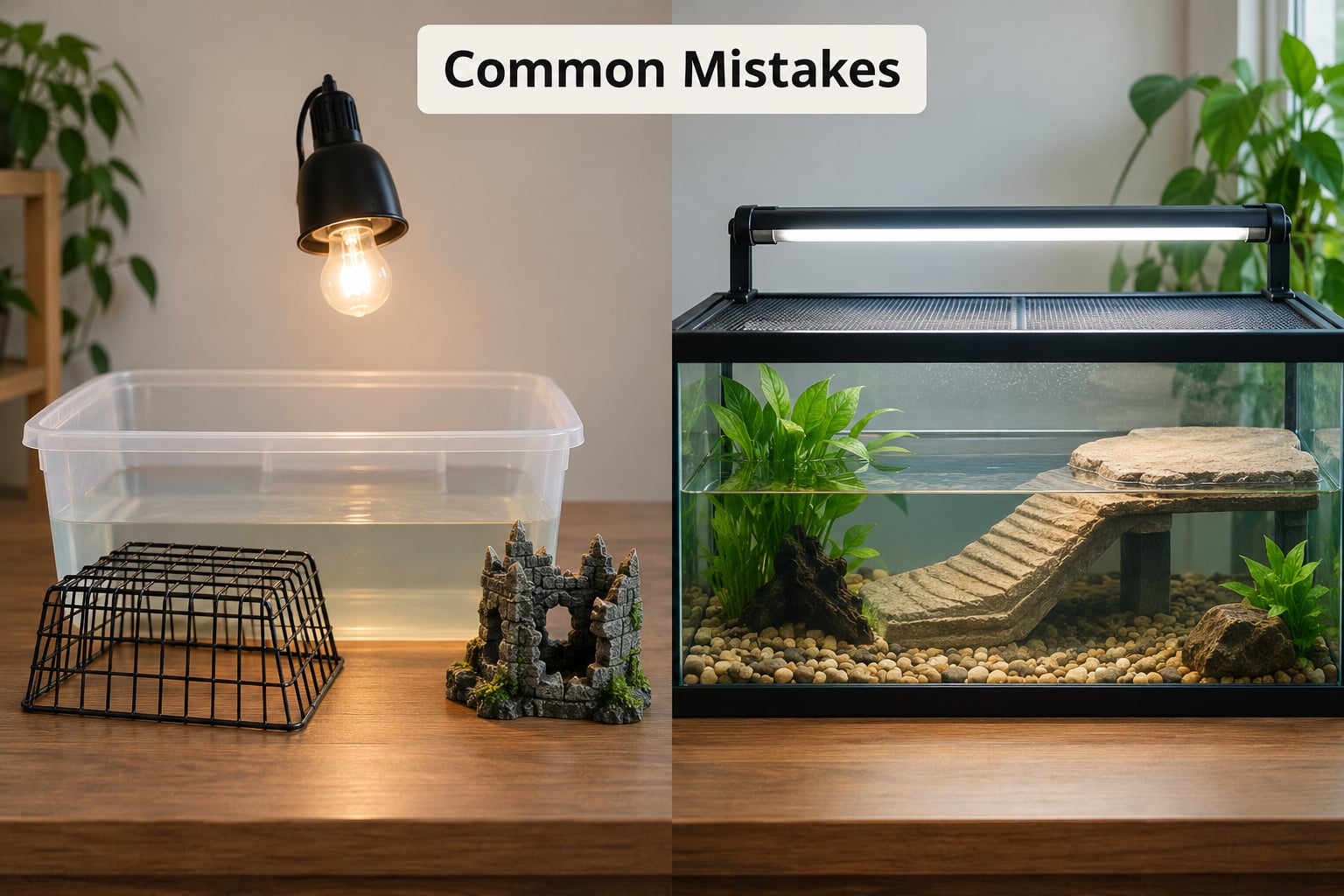
Nearly every sad setup I have seen traces back to one of these. Each has a straightforward fix.
Starting with a small tank. A plastic storage tub or laundry tub keeps a turtle alive and keeps it small. Size for the adult animal using the 10-gallons-per-inch rule.
Skipping UVB. A basking bulb is heat, not UV. Without UVB, calcium is not absorbed properly and the shell softens and deforms over time.
One temperature for the whole tank. Turtles need a gradient. A basking platform at 85-95 F and water at 74-78 F is the working combination.
Feeding in excess and leaving leftovers. Overfeeding dirties water fast and pushes nitrate up. Portion by head size and remove uneaten food promptly.
Sharp or painted decorations. Metal, untreated wood, aquarium gravel and anything coated with water-based paint can injure a turtle or be swallowed.
Using human medication. Never give a turtle over-the-counter pain relief, antibiotics or supplements meant for people. See a reptile veterinarian.
Ignoring early warning signs. Swollen eyes, a soft or patchy shell, discharge, refusal to eat, or sudden constant hiding all need a vet, not a week of observation.
Housing two turtles to avoid company. One turtle per enclosure is the community consensus among experienced keepers. Males can become aggressive, and mixed sexes lead to unwanted breeding and egg binding, which is dangerous for the female.
Letting the turtle roam the house. This is a regular question and the answer is no. Turtles track dirt and bacteria across floors, urinate where they walk, can carry Salmonella, and cannot be reliably house-trained or found once hidden. A dry play pen for ten supervised minutes is the safe version. Keep doors and stairs closed, and check any floor drain or vent they could reach.
Keeping a Pet Turtle Indoors Through Winter and Trips
Indoor-only turtles should not hibernate. A turtle that drops its temperature and slows down in winter can suffer organ and eye damage that never fully reverses, so keep the basking and water temperatures above the ranges in Step 3 all year and do not let the room temperature drop overnight. A rusted heater thermostat in a cold house is a common cause of sudden illness in January.
A healthy adult turtle can manage a few days alone but not a week of neglect. The realistic limit is about two or three days without a person in the house, and a sitter who understands turtles is the only safe option beyond that. Write the instructions down: how much to feed and how often, that uneaten food comes out after fifteen minutes, how to do a partial water change, what temperature the water should be, and that the lamp timer stays on the same schedule. Test the heater and filter the morning you leave, and remove anything the turtle could topple into the water.
Frequently Asked Questions
How often should I clean my indoor pet turtle’s tank?
Remove uneaten food and solid waste every day, change 25 to 50 percent of the water two or three times a week with conditioned water at the same temperature, and test the water weekly for ammonia, nitrite, nitrate and pH. Do a full deep clean every three to four weeks, and replace the UVB bulb every six months. A strong canister filter keeps the interval shorter, not longer.
Do pet turtles need UVB light indoors?
Yes. Indoor turtles get no useful UV through glass or window light, and UVB is what lets them make vitamin D3 and absorb calcium from food. Without it, shells soften and warp and metabolic bone disease develops. Run a T5 HO or compact UVB lamp 10 to 12 hours a day about 8 to 12 inches above the basking platform, and replace the bulb every six months even while it still glows.
How deep should the water be for a pet turtle?
Set the water depth to 1.5 to twice the turtle’s shell length, which lets an adult swim freely while a young or weak animal can still reach the surface to breathe. Provide an angled ramp or platform so the turtle can climb out easily, and a dry elevated basking area above the waterline. Check the depth again as the turtle grows, because a shallow adult tank is a common shortcut that ends in a drown or a climb-out failure.
What foods are safe for a pet turtle?
Use species-appropriate turtle pellets as the base, and pair them with dark leafy greens such as collard or dandelion, plus invertebrates like earthworms, crickets, mealworms and shrimp. Juveniles under a year need more protein; adults need more vegetables. Portion food roughly the size of the turtle’s head and remove leftovers within fifteen minutes. Never give human medication, chocolate, citrus, onions or prepared human snacks.
Why is my pet turtle suddenly hiding?
Hiding is often normal. Turtles rest under a hide, dig into substrate, or stay low when the room is busy, and many sleep for long stretches. Persistent hiding that comes with refusal to eat, swollen eyes, discharge or unusual stillness points to illness, cold water, a failed heater or a lamp that is too dim. Check both thermometers and the water chemistry first, and see a reptile veterinarian if nothing changes within a few days.
When should I take my turtle to a veterinarian?
Book a reptile or exotics veterinarian for swollen or closed eyes, nasal or eye discharge, a soft, pitted or oddly coloured shell, a plastron that lifts, persistent hiding with no appetite, weight loss, an empty-looking mouth, or any wound. Schedule a yearly check-up even for a healthy turtle, ideally with a blood test once a year. Never treat a turtle with human medication, and never wait past a few days on a refusal to eat.
Start with the tank and the numbers: 10 gallons per inch of adult shell, a dry basking platform at 85-95 F, water at 74-78 F, UVB for 10 to 12 hours, and a filter rated at four times the tank volume per hour. Let the water cycle before the turtle arrives, and find a reptile veterinarian now rather than in an emergency. Everything else on this page is weekly maintenance by comparison.
This article is general care information, not veterinary advice. A reptile or exotics veterinarian should make any diagnosis, and any turtle that stops eating or shows signs of illness needs to be seen promptly.