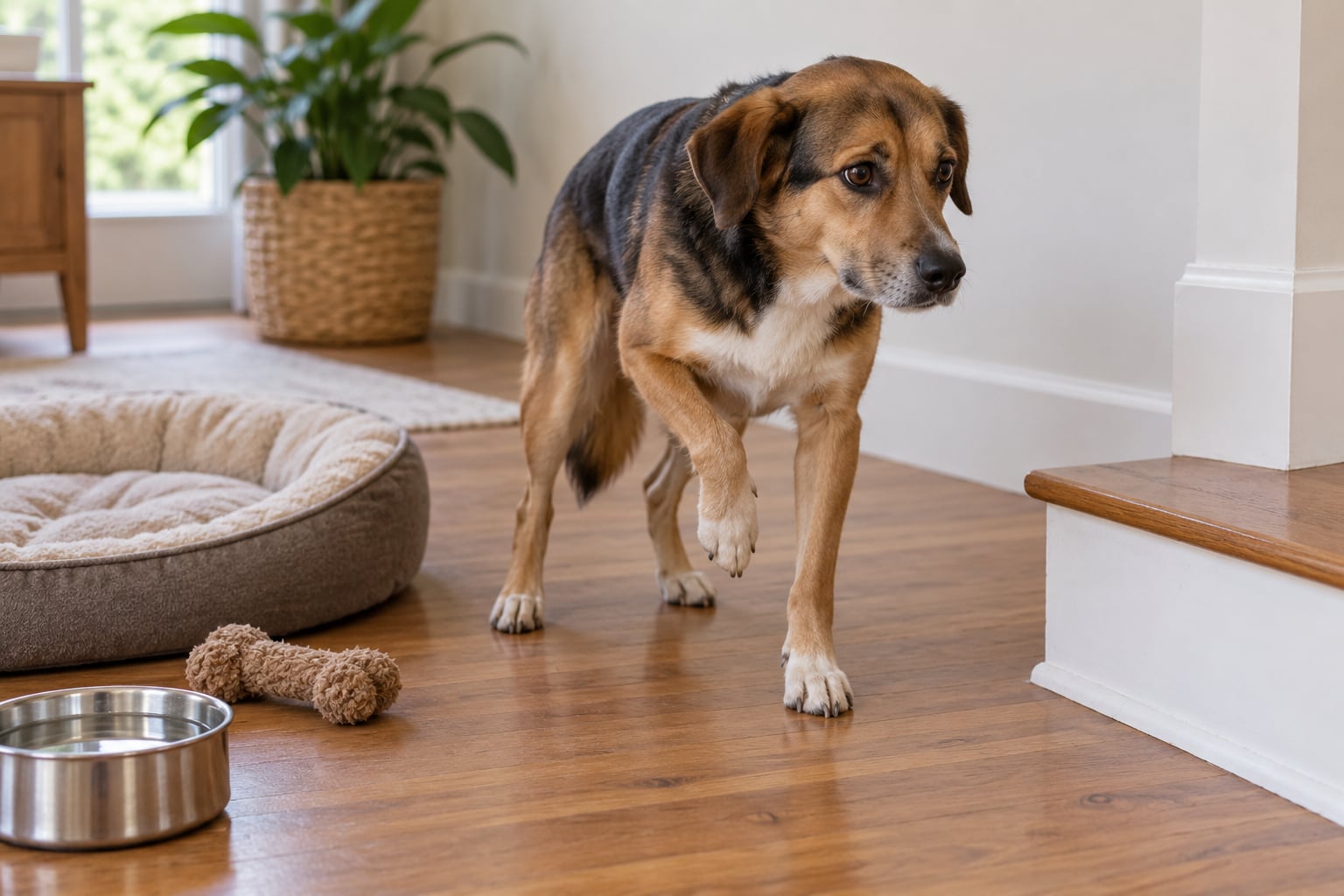
Most dogs do not cry out when they hurt. They slow down, withdraw, stop playing, or become unusually grumpy, and by the time a limp shows up the discomfort has usually been there for weeks. To know how to tell if your dog is in pain, stop listening for whining and start comparing your dog right now against how that same dog behaved a month ago. Ten quiet minutes is enough to spot most changes.
There is a reason dogs hide discomfort. Showing weakness in front of something bigger was a bad survival strategy for thousands of years, and that instinct is still switched on in a dog on a sofa eating biscuits. It means the absence of a dramatic reaction tells you very little.
That flips the problem around. Instead of hunting for one obvious symptom, you are looking for a pattern of small departures from normal, and a pattern is far easier to see than a single sign. This guide walks through what to watch for, how to check safely at home, and which changes mean you can monitor, which mean call today, and which mean go to the emergency room now.
A note before you start: this is general information for reading your own dog, not a diagnosis. Your veterinarian is the only person who can work out what is actually hurting, and every sign described below points in the same direction, which is a phone call.
Table of Contents
What You Need
Nothing to buy and nothing to set up. The whole check runs on observation, and doing it in the right conditions is most of the work.
- A quiet stretch of time. Ten to fifteen calm minutes when the dog is relaxed, ideally in a familiar room. A distracted dog limping around a busy kitchen is harder to read than one standing still in a hallway.
- The dog’s normal behavior as your baseline. Write down three things your dog normally does every day: walk length, favourite activity, sleep spots. If you do not have that written anywhere, this is the moment to start.
- A quiet place to watch from. Movement and posture read better from a few feet away than from directly in front of the face.
- A phone with your vet’s number already in it. You want to call, not to spend twenty minutes searching for a clinic at 9pm.
- A notepad or your phone’s notes app. A short pain diary: date, what changed, what the dog did or refused to do, and any recent activity. Dates turn a vague worry into something a vet can act on.
Two rules before you go further. Never give your dog human pain medication to see if it settles them, and never press, prod or repeatedly poke a spot that might hurt to find out whether it does. Both are covered properly below, because they are the two most common mistakes owners make.
Step-by-Step: How to Tell if Your Dog Is in Pain
Work through this in order, from the room changes down to the body itself. The first pass is easy and takes the longest, because you are simply watching a dog be a dog and noticing what is missing from the usual picture. Eleven signs are grouped below, split by behavior, movement, body systems, and face and voice. A dog rarely shows only one.
Notice changes in behavior and daily routines
Behavior is where owners most often notice something first, and most often talk themselves out of it. These five cover the routines you already know by heart.
1. Less interest in the things they love. The dog who pulls toward the door, drags you to the park, or checks in with you every five minutes now watches from the sofa. One skipped game is nothing. A week of shorter walks and no enthusiasm is a change worth writing down.
2. Hiding and withdrawal. A dog who starts sleeping in the laundry room instead of the bedroom, spends the day in a spot they never chose, or avoids eye contact is often doing the opposite of the “they just want to be alone” reading. Dogs also sleep more and groom less when they hurt, so a scruffy coat and long sleeps belong on this list.
3. New irritability or aggression. A normally sweet dog who snaps at the kids, growls when lifted, or turns on a housemate they used to adore has usually changed in some way. Sudden new aggression is pain far more often than it is a personality shift, and punishing it makes the situation worse on both sides.
4. Restlessness and difficulty settling. Pacing, circling, shifting position on the bed, getting up and lying down repeatedly, or staring at a wall are all signs on the list. Internal discomfort in particular makes a dog unable to get comfortable in any one position, which is different from a dog that is simply bored.
5. Changes in sleep and house-training habits. A dog who was clean for years starting to have accidents in the house at night is telling you something. Pain, particularly around the back, hips or abdomen, changes how a dog positions itself to relieve itself, and some dogs stop signalling in time because the posture itself hurts.
Check posture, movement, and sensitivity to touch
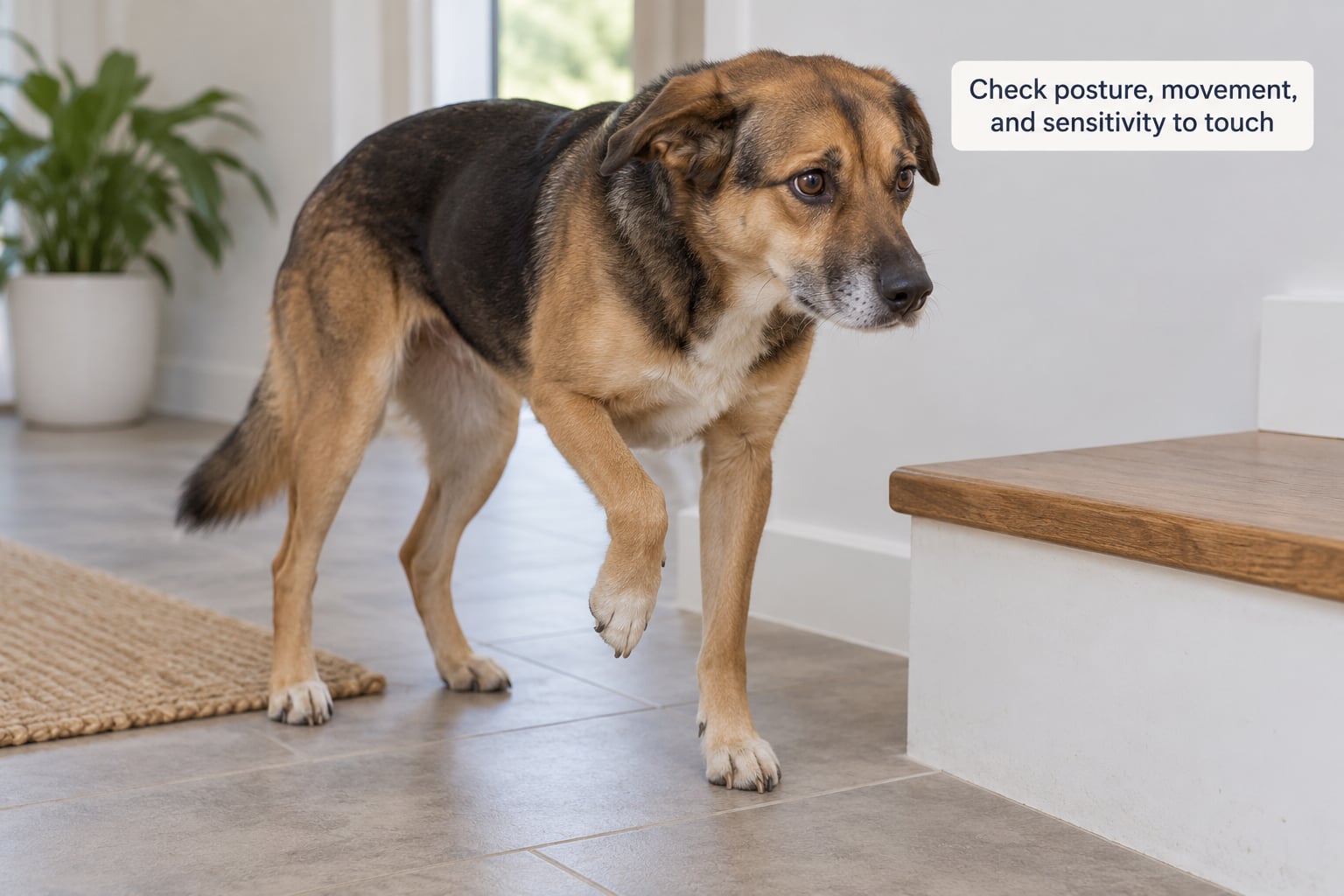
This is the group owners trust most, and it is the group that most often shows up late. Watch how the dog stands, how they get up, and how they move across an even floor. A dog that used to launch onto the sofa now stands beside it and thinks about it. A dog that used to take stairs two at a time now goes up one at a time, sideways, with the handrail in view.
6. Limping or favouring a leg. Note which leg, whether the dog touches it down at all, and whether the limp is worse at the start of a walk and eases off, or worse after resting. Weight shifting off one side, a head that bobs when the painful leg lands, and a hind leg that will not fully extend are all part of this sign.
7. Stiffness and reluctance to rise. The most-missed sign in older dogs. A stiff dog takes a long moment to get up from a nap, walks stiffly for the first few steps, then loosens up. Owners call that “getting old” or “lazy.” Your dog is not lazy, they are careful, and the slowing down is the sign.
8. Hunched back, tucked tail, lowered head. A curved back, a tail clamped low or held very still, a head carried below the shoulders, and a tucked-up belly all point to discomfort, and they are easier to read from across the room than from up close. A dog that kneels in a stretched-down position and comes straight back up, sometimes repeatedly, is stretching the front of the body and is worth noting as a description, not a diagnosis.
Panting when the room is cool, shaking or trembling with no obvious cause, and drooling more than usual sit in this group too. Panting that does not settle with rest and cooling is a breathing concern rather than a pain-only concern, and it is covered again in the next step.
Handling matters here. Let the dog come to you, move slowly, and watch for flinching, freezing, lip licking, or a move away as you touch the back, ribs, hips, neck or the base of the tail. Stop the moment you see one. You are gathering information for a vet, not running a test, and a dog who is guarding a spot is telling you it needs protecting.
Monitor eating, drinking, breathing, and elimination
9. Changes around food and water. Chewing on one side only, dropping kibble, swallowing hard, licking the bowl and walking away, or eating noticeably less or more than usual. Drinking much more or much less than usual shows up alongside many conditions your vet will want to know about, so record how much and how often.
10. Breathing, urination and stool changes. Labored or noisy breathing, breathing faster than usual at rest, or panting that never settles. Repeated attempts to urinate with little or nothing produced, straining, accidents in the house, diarrhoea, or a hard swollen-looking abdomen are not subtle signs, and several of them are time-critical.
Keep the distinction in your head: reduced appetite alone is worth a note, while refusal to eat or drink combined with repeated vomiting, a swollen abdomen or unproductive retching is a reason to stop reading and start driving. Those combinations appear in the table below.
Look for vocal and facial pain signals
11. Vocalising and facial changes. Whining, groaning, yelping, sighing, or grumbling when lying down, getting up, being touched or lifted. Alongside that: flattened or pinned-back ears, eyes that look squinted or half closed, whites showing, a tense face, panting with the mouth open when they are not hot, and repeated licking or biting at one specific patch of skin.
Two honest caveats. Some dogs barely vocalise at all, so an absence of sound is not reassurance. And vocalising on its own tells you very little about cause, because the same noise shows up in fear, excitement, frustration and pain. Treat it as one data point alongside the rest, not as a verdict.
Confirm the change and decide how urgently to act
You now have observations. Turning them into a decision is a short exercise: look at the pattern, the duration, the severity, and the context.
Pattern. One odd moment is noise. Three or more changes together, appearing across days, is a signal. Duration. Anything that started suddenly, and anything that has been sliding for more than a few days, both deserve a call. Severity. Mild and improving after rest is different from mild and getting worse. Context. What happened in the days before: a fall, a fight, a new walk route with rough ground, a long hike, surgery, a new medication, a change of food, or a suspected toxin or swallowed object.
Use this table to sort what you saw into how quickly to act. It is a guide to urgency, not a diagnosis of what is wrong.
| What you noticed | Where to look | How urgent |
|---|---|---|
| Firm painful abdomen, repeated retching with nothing produced, unproductive attempts to urinate | Belly, bathroom floor, behaviour | Emergency now |
| Laboured or noisy breathing, collapse, pale or blue gums, seizures, uncontrolled bleeding, major trauma | Breathing, gums, whole body | Emergency now |
| Suspected poisoning, a swallowed object or a string caught in the mouth, a swollen face after a sting or bite | Mouth, paws, surroundings | Emergency now |
| No weight bearing on a leg, yelping on movement, cannot lie down or get up comfortably | Legs, back, movement | Call your vet today or now |
| New aggression, repeated vomiting, refusing food and water, straining to urinate with accidents indoors | Behaviour, appetite, litter area | Call your vet today |
| Persistent licking of one patch, a limp that returns for days, difficulty using stairs or jumping | Paws, joints, back, floor | Book an appointment in the next day or two |
| Slower to rise, stiffness after rest, shorter walks, less enthusiasm for play | Rising, walking, daily routine | Book an appointment this week, and keep a pain diary |
| Occasional stiffness that eases within a few minutes of gentle movement, no other change | Rising, walking | Note it, watch it, update the diary monthly |
Owners on dog forums describe the same pattern repeatedly: the first thing they noticed was behavioral, not physical. Hiding, withdrawing, snapping, or losing interest in a favourite walk came before any limp, and in several threads the dog behaved completely normally right up until the vet found something. That is exactly why a written diary beats memory, and why an owner who can say “he stopped asking to go out on Saturday and started sleeping under the desk on Sunday” is far more useful to a vet than one who says “he seems off lately.”
Common Mistakes
Waiting for obvious pain. The myth that a dog in pain cries out is the single biggest reason problems get found late. Fix: judge the change, not the drama. Any new slowness, guarding, or habit change counts today.
Assuming every sign is behavioral. A dog who hides and sleeps more is easy to blame on a new job, a new baby, or a mood. Fix: hold the change to the same test as a limp. Has this dog always been like this, or is it new?
Giving human pain medicine. Ibuprofen, acetaminophen, naproxen and aspirin are all dangerous for dogs, and acetaminophen and ibuprofen in particular can cause serious liver and kidney damage. Fix: call a veterinarian or an animal poison line, and let the vet handle dosing. The same applies to any leftover human or pet medication lying around the house.
Repeatedly testing a sore spot. Pressing the hip again to see if the dog flinches, or asking it to jump to prove it is fine, turns a manageable ache into a bigger injury. Fix: observe naturally. Real movement tells you more than a poke, and your hands are not the diagnostic tool.
Relying on appetite alone. Many owners say the dog is eating, so it cannot be that bad. A dog with a painful back or a sore mouth will often keep eating, and many dogs in significant pain keep eating and playing. Fix: judge the whole pattern, not one behavior.
Forcing exercise to “work it off.” A limp that gets worse over the following days is not a warm-up, it is a soft tissue or joint problem getting worse. Fix: keep activity short and calm, on a soft surface, and let a veterinarian decide whether rest, controlled movement or neither is right.
Using a symptom list as a diagnosis. Internet checklists are good at spotting a change, which is what this page is for, and no good at naming the cause. Fix: use a list to decide whether to call, and let the clinic decide what is wrong.
Frequently Asked Questions
Can dogs hide that they are in pain?
Yes, and most of them do to some degree. Dogs evolved to avoid displaying weakness around predators, so many carry pain quietly and keep eating, playing and greeting people normally. That is why the practical answer to how to tell if your dog is in pain is to compare today’s behavior with that same dog’s normal over the past few weeks, rather than waiting for whining or a dramatic limp.
What are the most urgent signs that a dog needs a veterinarian?
Go to an emergency clinic for labored or noisy breathing, collapse, pale or blue gums, seizures, uncontrolled bleeding, major trauma, a firm swollen abdomen, repeated retching with nothing produced, repeated attempts to urinate with no result, or any suspected poisoning. A dog that cannot lie down comfortably, will not bear weight on a leg, or yelps with movement needs a call the same day.
Should I give my dog human pain medicine?
No. Ibuprofen, acetaminophen, naproxen and aspirin can cause serious liver, kidney and stomach damage in dogs, and some cause death. Do not give any leftover human or pet medication, and do not use doses found online. If your dog has already swallowed one, contact a veterinarian or an animal poison line straight away, even if the dog seems fine, because signs can take hours to appear.
How can I tell whether my dog is limping or just tired?
Tiredness improves within minutes of rest and the gait looks normal again. Pain tends to persist or come back on the next walk, the dog keeps the leg light or will not put it down at all, and stiffness often appears first thing after a night on a hard surface. Watch the first ten steps after rising and after resting, on a flat even floor, and film that short clip for your vet.
What should I do if my dog stops eating or drinking?
Treat it as a prompt call, not something to wait out, especially if the dog seems uncomfortable, has a swollen abdomen, retches without producing anything, or seems nauseated. A dog that drinks little and urinates very little can become dangerously dehydrated quickly. Note how long the refusal has lasted and when it started, and let the clinic guide what fluids or food to offer and when to come in.
Can pain come from a dog’s emotional stress?
A stressed dog is genuinely uncomfortable: they pace, pant, hide, vocalise, chew destructively and lose interest in normal activity, and those behaviors overlap with the signs of physical pain. That overlap is why stress alone should never be assumed, and why a change in behavior plus any sign of discomfort deserves an assessment. A veterinarian can separate the two and look for the physical cause you cannot see at home.
What to Do First if You Suspect Dog Pain
Stop strenuous activity, keep your dog comfortable and quiet, and call a veterinarian. Those four things in that order cover what happens in the first few hours, and they hold whether you are looking at a limp, a dog who will not eat, or a senior dog who has been slow to rise for a fortnight.
Keep activity short, calm and on a soft floor, and make the resting spot somewhere easy to get to rather than a sofa or a bed. Sit nearby rather than fussing; a dog watched too closely paces more. And write down what you saw, with dates, before the appointment, because the details fade fast.
Do not wait if you see labored or noisy breathing, collapse, a swollen abdomen, repeated retching with nothing produced, an inability to urinate, severe injury, or any suspicion your dog has swallowed something toxic. Those go straight to an emergency clinic, tonight, not to a wait-and-see morning.
Everything above is a way of noticing, not a way of diagnosing. Untreated pain changes how a dog moves, and the body compensates around it, which is why catching it early matters so much to mobility and mood. If something in this list sounds like your dog today, make the call.