How to introduce a new puppy to an older dog safely comes down to three things: swap scents first, meet on neutral ground with both dogs leashed, then let calm behaviour earn you longer sessions. Most introductions take seven to fourteen days, and the whole thing is easy on an afternoon of attention and fiddly over the following fortnight.
The mistake I see most often is rushing the calendar. People bring the puppy home, shut both dogs in the kitchen together, and hope affection sorts itself out. It rarely does. A puppy is a loud, fast, bouncy animal with no idea the living room belongs to somebody, and a resident dog reads that as an intruder on its sofa.
So think of the first three months as a slow handover rather than a single event. Many experienced breeders use what gets called the 3-3-3 rule: roughly three days to decompress, three weeks to build a routine, three months to feel like a bonded pair. Some pairs never become best friends, and that is a perfectly fine outcome. Polite tolerance counts as success.
One more note before we start. If your older dog has arthritis, a hearing loss, a failing heart, or any pain at all, get a veterinary check before the puppy arrives. Pain makes dogs snappy, and an older dog in pain cannot be asked to tolerate a puppy landing on its back.
Table of Contents
What You Need
Gather everything before collection day. Buying supplies in a panic on day two is how dogs end up sharing bowls on day three.
- A neutral meeting spot. A quiet room neither dog has claimed, a fenced garden you have not used for a week, or a friend’s driveway. Avoid the resident dog’s own territory if you can.
- Two leads and two harnesses. Harnesses give you control without neck pressure. A clip-on lead on a dog that pulls can hurt an older neck.
- A long line. Fifteen to twenty feet of lightweight line for walking work and for keeping a puppy from bolting mid-session.
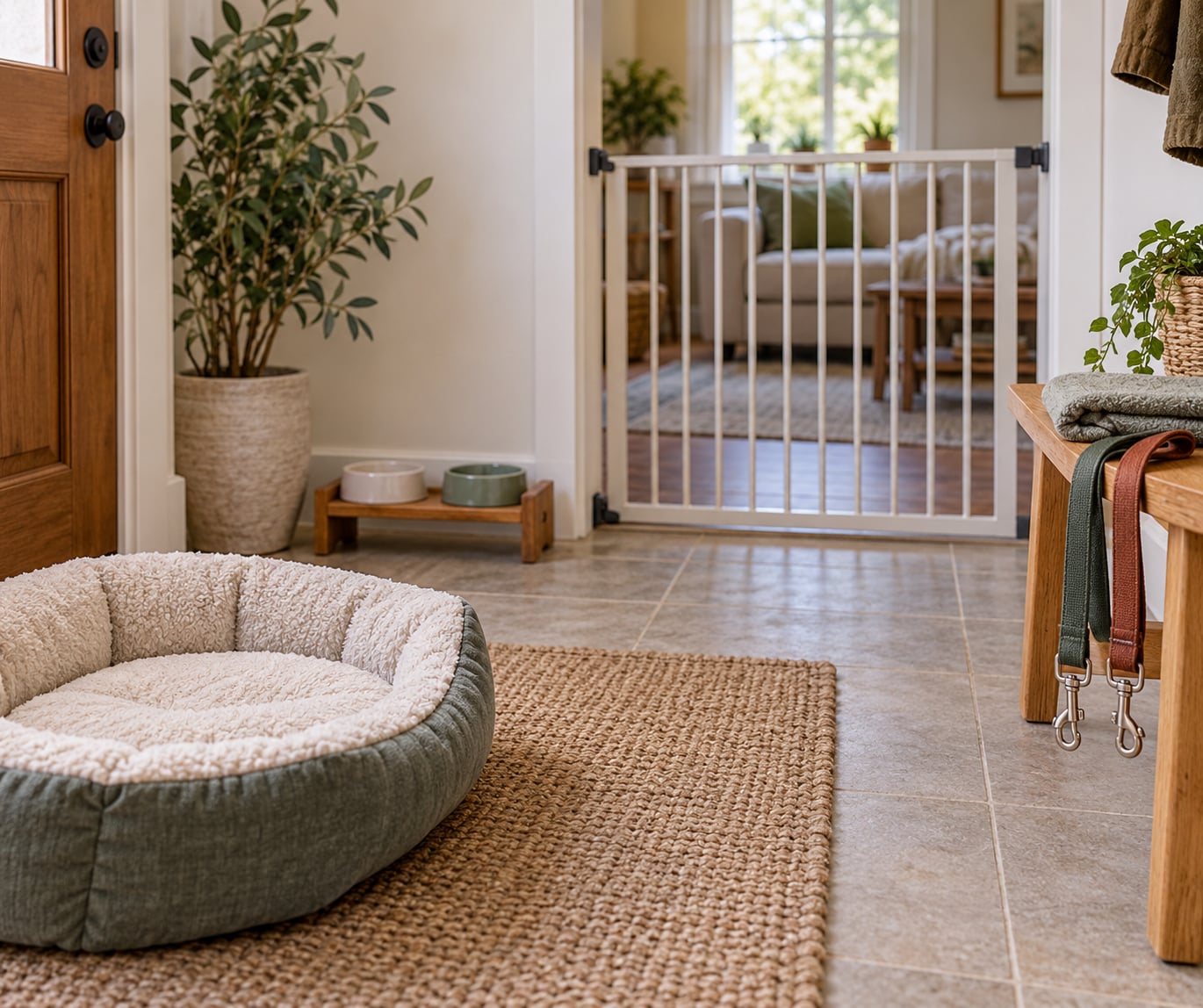
- A baby gate or exercise pen. The single most useful piece of equipment in the whole process. It lets you give the older dog a guaranteed break without moving furniture.
- A crate for the puppy. Only if you plan to crate train properly. Never as a punishment, and never where the resident dog can reach through the bars.
- High-value treats. Small, smelly, and boring enough to matter. You want something that pulls a dog’s attention off whatever just happened.
- Separate bowls, beds and feeding areas. Different rooms, not just different corners of the same kitchen.
- Two soft items for a scent swap. A towel, a blanket, a worn T-shirt. Cheap and it works better than most expensive things.
- A second adult if you have one. One handler per dog makes all the difference during the first walks.
- A notebook or your phone. Write down each session: how long, what happened, what the tension looked like. You will not remember it accurately a week later.
None of this replaces your attention. A gate buys you thirty minutes; it does not tell you whether the older dog has quietly stopped eating.
How to Introduce a New Puppy to an Older Dog Step by Step
The sequence below assumes the first meeting is neutral and the dogs stay leashed. If either dog is already growling hard, freezing or charging, drop back one stage and stay there. Going back is normal, not failure.
Set Up a Neutral Space
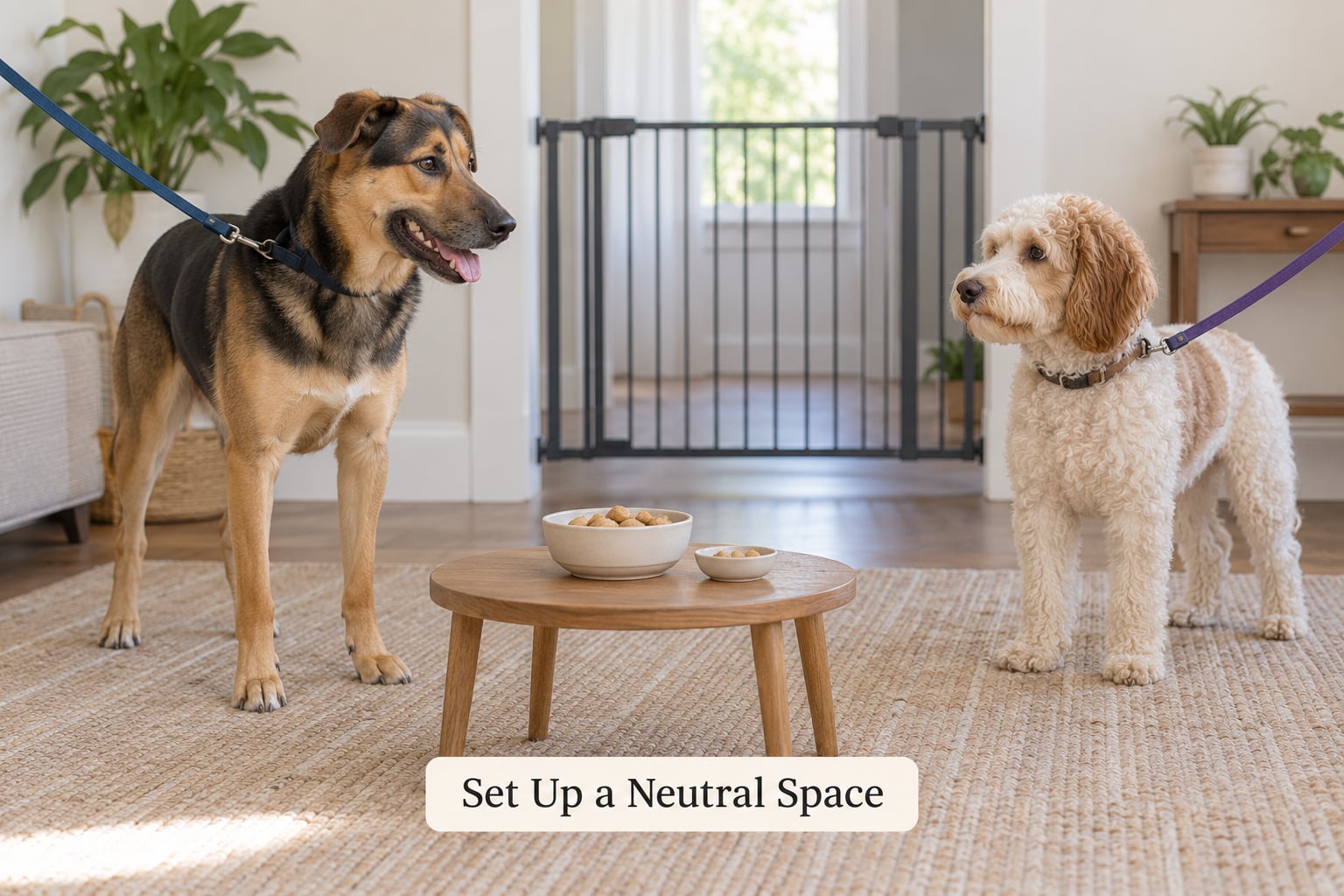
Neutral ground matters because dogs read location as permission. In the older dog’s house, that puppy is an intruder and the resident dog is defending its own sofa. Somewhere boring and shared, neither dog has a territorial claim and both can take in the situation without a fight to fight.
Pick a room with space to move and no narrow doorways. Put the puppy down first, on lead, and let it relieve itself, then bring the older dog in on the other side of the room. Two adults, two dogs, one small table of treats between you.
Let them look at each other for a few seconds. Then, quietly, walk each dog roughly parallel to the other and away again, like you are both heading to the fridge. You are not aiming for contact. You are aiming for the picture they build in their heads: another animal nearby is boring, and boring is survivable.
End the session while everything still feels easy. Thirty seconds of dull is worth more than five minutes of wrestling.
Swap Scent Before Meeting
Scent comes before sight. It is the first introduction most dogs actually get, and skipping it is why so many first meetings go sideways.
Take a soft item the older dog has slept on and place it near the puppy’s sleeping spot. It might whine, chew it, or stare at it. All normal. Do the same with a puppy item near the older dog’s bed or resting area.
Keep those items away from food bowls. You do not want a scent-soaked blanket lying next to dinner at the same time you are trying to keep mealtimes conflict-free.
Repeat the exchange on different days, alternating which animal gets whose scent. Owners often tell me the puppy is the easier half of this, and it usually is. The resident dog is the one processing something entirely new.
Use Short, Positive Sessions
Once scent exchange has run a day or two, move to short supervised meetings of one to five minutes in the neutral space. Reward calm approaches, and reward disengagement even more heavily, because a dog who learns to walk away gets rewarded is a dog who learns that walking away works.
Reading the room matters more than any equipment. Here is the split I watch for:
| What you see | What it means | What to do |
|---|---|---|
| Loose body, soft mouth, normal sniffing, a tail that wags loosely at the middle height | Comfortable and processing | Let it happen, reward calm interest |
| Looking away, licking lips, yawning, turning the body sideways, pawing at the floor | Getting uncomfortable, managing stress | Add distance, reward the dog who is handling it well |
| Stiff, frozen posture, a stiff high wag, hard stare, one dog stops moving | Serious tension building | Calm separation immediately, no eye contact, no reaching between them |
| Lip curling, raised hackles, repeated low growl, charging | Warning escalating to a fight | Full separation behind a barrier, end the session |
A wagging tail alone means nothing. A stiff, high, vibrating wag is a dog that is wound tight, not friendly.
Growls deserve a special mention. A low, brief growl from a senior dog telling a puppy to back off is communication, not disobedience. Punish it and you teach the dog to hide warning signs and go straight to biting, and you teach the puppy that growling works.
Manage Walks, Food, and Rest
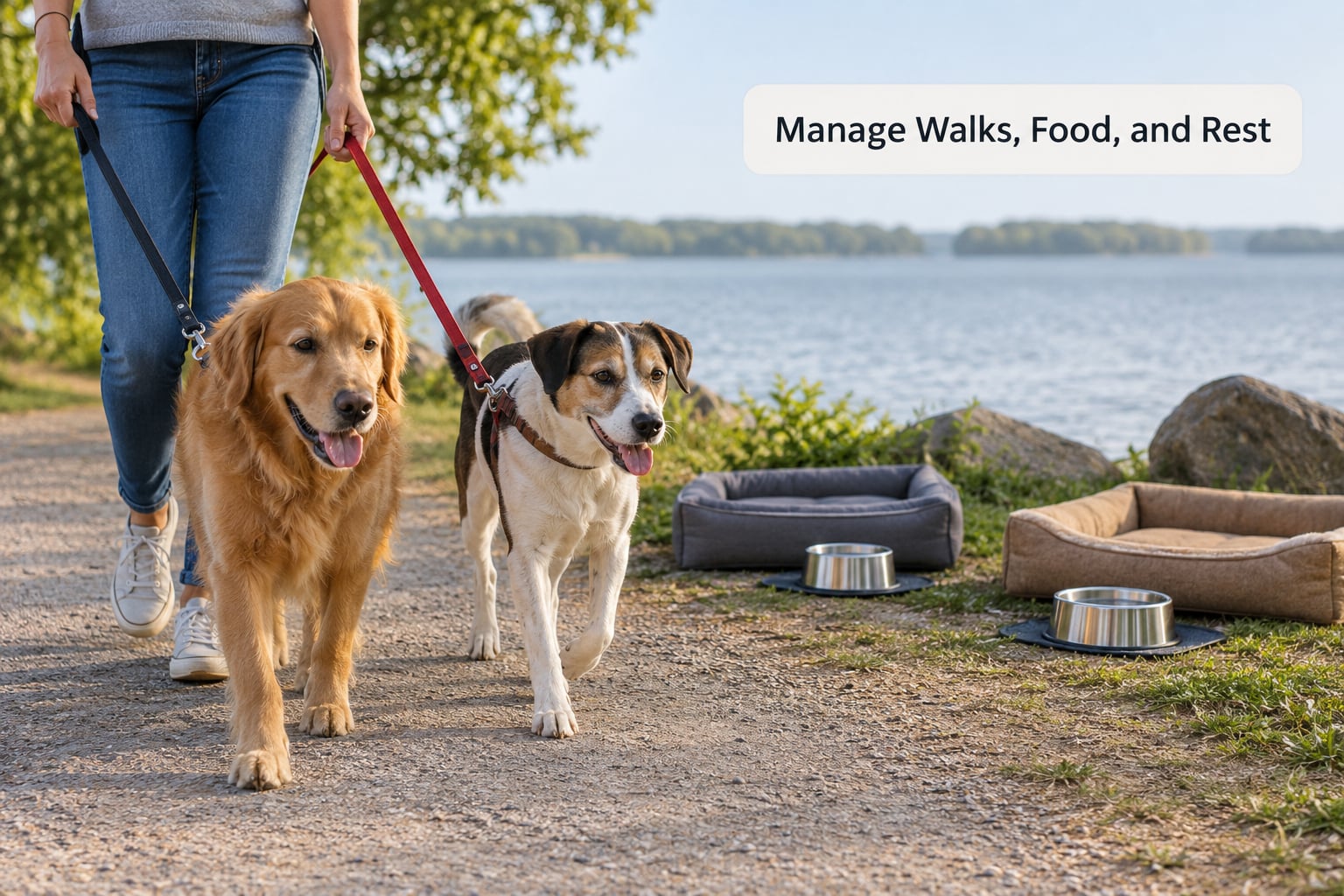
Parallel walking is the single technique experienced trainers reach for first. Two dogs, separate handlers, walking in the same direction a few metres apart, ignoring each other. Movement and shared purpose settle dogs faster than standing still and staring at each other.
Start with two or three minutes and a wide gap. The puppy will want to charge over and play. You walk it past instead and reward it for staying with you. The older dog gets to notice that this new animal is not charging at its face.
Feed separately for at least several weeks, in different rooms, with the doors shut. Food is the most common trigger for resource guarding, and separate feeding removes nearly all of it. Pick up bowls after five minutes so nothing is left to guard.
Toys are more complicated. For now, remove shared toys entirely and give the puppy its own, while the older dog keeps access to the favourites it has always had. A senior dog that loses its own toys at the same time it loses its sofa, its routine and its owner is a lot to lose in one week.
Give each dog a bed in a spot the other cannot reach. That retreat is where the older dog goes to recover, and it must be respected without exception. If the puppy follows it there, the puppy needs its own bed, not a bigger correction.
Watch the senior dog’s rest. Persistent nuzzling, climbing or mounting from a puppy is harassment, not play, and it is hard on joints and on nerves.
Build Up to Unsupervised Time
Once both dogs can eat, walk and settle near each other without a hard stare, open up the distance gradually rather than all at once. Put a baby gate across a doorway so they can see and hear each other without contact. This is low-stress time that still counts as contact.
Then test short periods of monitored togetherness. Two minutes in the same room with you watching is a full stage. Notice how they recover afterwards, because recovery speed is a better signal than the play itself. A dog that bounces back within seconds is having fun. A dog that sits in a corner afterwards and shakes for ten minutes has been managing tension, not playing.
If a session goes badly, drop back to the stage where things were calm. Not to the beginning, just one notch. Repeating a stage is cheap; pushing through a fight risk is not.
Move in stages you are not certain you can supervise. A puppy that has just eaten, is sleep-deprived, or is mid-teething will play far rougher than one that has had a walk and a nap, and those are the afternoons people forget.
Ask a veterinarian or a qualified reward-based trainer if the tension escalates over days despite the steps, if either dog stops eating or stops engaging with anything, if one dog hides constantly, or if you cannot interrupt a fight without your hands going into the middle of it. A senior dog with pain needs a medical conversation first; behaviour has a physical cause more often than people expect.
Common Mistakes
Putting both dogs together on day one because it seems efficient. Correct it by going back to scent exchange and neutral meetings. Efficient and fast usually means you will be rehoming one of them by month three.
Feeding near each other to see what happens. You already know what happens: a conflict you created on purpose. Feed in separate rooms and let high-value treats be the only food either dog sees near the other.
Holding the puppy up to the older dog for a sniff. Lifting a puppy puts it at eye level and removes its escape route, which reads as challenge. Let dogs choose to approach.
Forcing interaction because they are both tired. A tired dog is a less reactive dog, but a forced meeting still teaches that the other animal is something to endure. Tiredness helps once the process has already started calmly.
Punishing growling or barking. This silences the warning and removes the dog’s best option short of a bite. Respond by adding distance instead.
Reading every withdrawal as jealousy. Turning away is often a dog managing stress. Labeling it jealousy leads you to remove the older dog’s retreat, which removes the very thing keeping everyone calm.
Letting children hold the puppy over the older dog. Kids get excited, excited puppies bite at hands, and the senior dog gets blamed. Children and puppy time should be supervised, and children should learn that the older dog’s bed is off limits.
How Long Should the Introduction Take?
A careful introduction of a new puppy to an older dog usually takes seven to fourteen days to reach calm, supervised togetherness, and considerably longer to reach genuine friendship. Plan for the longer number if the resident dog is eight or older, has never lived with another dog, or is reactive to movement.
What stretches the timeline: the older dog’s health and pain level, how socialized it was as a pup, whether it has lived with puppies before, and how much routine the household can keep. A large-breed puppy arriving into a home with a small senior dog usually needs slower progress, because play that feels mild to the puppy is heavy on the other dog.
Progress should follow behaviour, not the calendar. Track it in the notebook: session length, what happened, how quickly each dog relaxed afterwards. If week one still feels tense, that is data, not failure. Most problems I have seen were solved by slowing down, not by trying harder.
Frequently Asked Questions
Can an older dog get along with a new puppy?
Yes, most do, though not always in the way people picture. A common good outcome is a polite, tolerant household where each dog has its own space, rather than a close friendship. Older dogs that grew up with dogs, or that have lived with a puppy before, usually settle within a few weeks. Senior dogs, reactive dogs and dogs in pain take longer and need more careful pacing.
How long should I keep my new puppy separate from my older dog?
Keep them physically separated with a gate or crate whenever you cannot supervise, and keep feeding separate for several weeks at minimum. Full separation is only necessary during the earliest days, or if either dog freezes, hides or escalates. Many owners manage a household with a gate in place for the first month or two rather than fully separating the dogs.
Should I let the puppy and older dog play with toys together?
Not at first. Toys are the most common trigger for resource guarding, and a puppy grabbing a senior dog’s favourite toy is a fast route to conflict. Give each dog their own toys in their own areas, and supervise closely for a few weeks before allowing any shared toy play. If the older dog already guards toys, skip shared toys entirely and ask a trainer for help.
What does it mean if my older dog walks away from the puppy?
It usually means the dog needs more space, not that it dislikes the puppy. Turning away, licking lips, yawning or looking off to the side are stress signals, and treating them as rejection leads owners to remove the older dog’s retreat, which makes everything harder. Let the dog leave, reward the calm exit, and re-introduce at a shorter duration with more distance next time.
When should I ask a veterinarian or dog trainer for help?
Call a veterinarian if the older dog stops eating, seems to limp, is in visible pain, or becomes unusually withdrawn, since pain is a common trigger for aggression. Call a qualified reward-based trainer if tension escalates despite the steps, if one dog hides constantly, if you cannot separate them safely, or if you feel overwhelmed. Early help is cheaper than a long fight risk.
Conclusion
Start with three actions and nothing else: set up a neutral space, run a scent swap over a couple of days, then hold one short leashed meeting that you end while it still feels easy. Everything after that follows the dogs’ behaviour, not your diary.
Feed separately, keep toys separate, and give the older dog a retreat the puppy cannot follow. Watch the early body language more closely than the play, and treat a growl as information rather than disobedience. Slow, boring and calm beats fast, exciting and hopeful every time.