If you are searching for how much should a puppy eat by weight and age, the short answer is: puppies need roughly 2 to 2.5% of their body weight in food per day, split into 3 to 4 measured meals, and the number stays surprisingly steady between 4 and 12 months even as your puppy gets much bigger. Weight and age together give you a starting point, not a final answer.
Every puppy is different, so treat any chart as a starting number and adjust with weekly weigh-ins and a hands-on body condition check. Owners who get this wrong usually land on one of two errors: underfeeding because they misread the table on the food bag, or overfeeding because a pleading face convinced them the bowl should always be empty.
Table of Contents
How Much Should a Puppy Eat by Weight and Age?
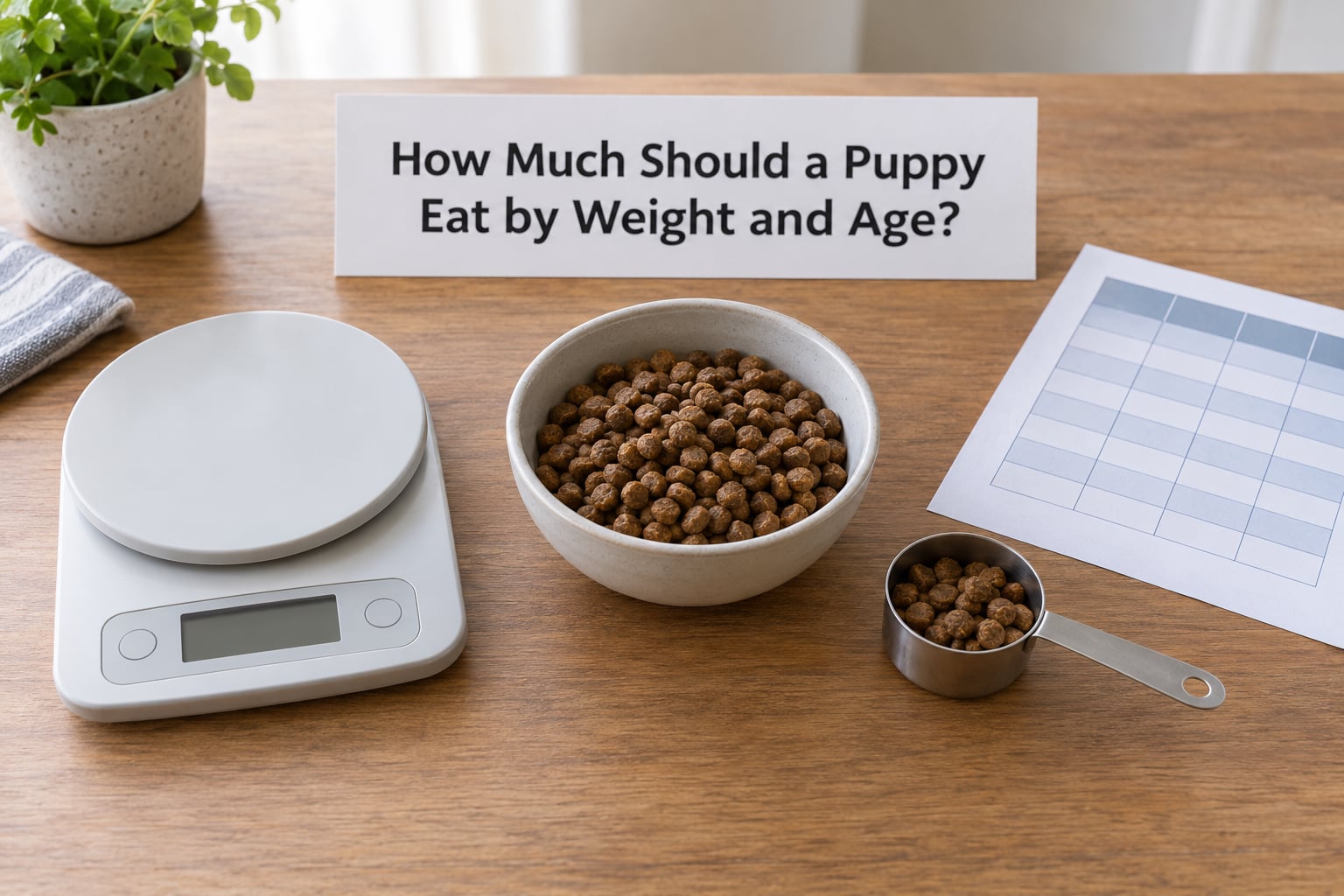
The chart below crosses five weight bands with three age bands and gives cups, gram equivalents and meals per day. Cup figures assume a standard dry kibble; wet and fresh foods need their own conversion because the calorie density is much higher.
| Current weight | 6-12 weeks | 3-6 months | 6-12 months |
|---|---|---|---|
| Under 5 lb (2.3 kg) | 1/3 to 1/2 cup (40-60 g), 4 meals | 1/2 to 3/4 cup (60-90 g), 3 meals | 3/4 to 1 cup (90-120 g), 2 meals |
| 5-10 lb (2.3-4.5 kg) | 1/2 to 3/4 cup (60-90 g), 4 meals | 3/4 to 1 1/4 cups (90-150 g), 3 meals | 1 to 1 1/2 cups (120-180 g), 2 meals |
| 10-20 lb (4.5-9 kg) | 3/4 to 1 cup (90-120 g), 3 meals | 1 to 1 1/2 cups (120-180 g), 3 meals | 1 1/2 to 2 cups (180-240 g), 2 meals |
| 20-50 lb (9-23 kg) | 1 to 1 1/4 cups (120-150 g), 3 meals | 1 1/2 to 2 cups (180-240 g), 3 meals | 2 to 2 1/2 cups (240-300 g), 2 meals |
| 50 lb and up (23 kg and up) | 1 1/4 to 1 1/2 cups (150-180 g), 3 meals | 2 to 2 1/2 cups (240-300 g), 3 meals | 2 1/2 to 3 1/2 cups (300-420 g), 2 meals |
Start at the low end of the range and add more if the puppy still finishes every meal and looks lean. A quick way in: feed about 2 to 2.5% of body weight in grams of food per day, or take the resting energy requirement and multiply it by 2.2, then by 1.5 once your puppy passes half its adult weight.
Grams matter more than cups for accuracy. A standard cup of dry kibble varies by a few grams between brands, and for a 2 kg puppy a 20 g error is a whole meal.
Puppy Feeding Amounts by Age
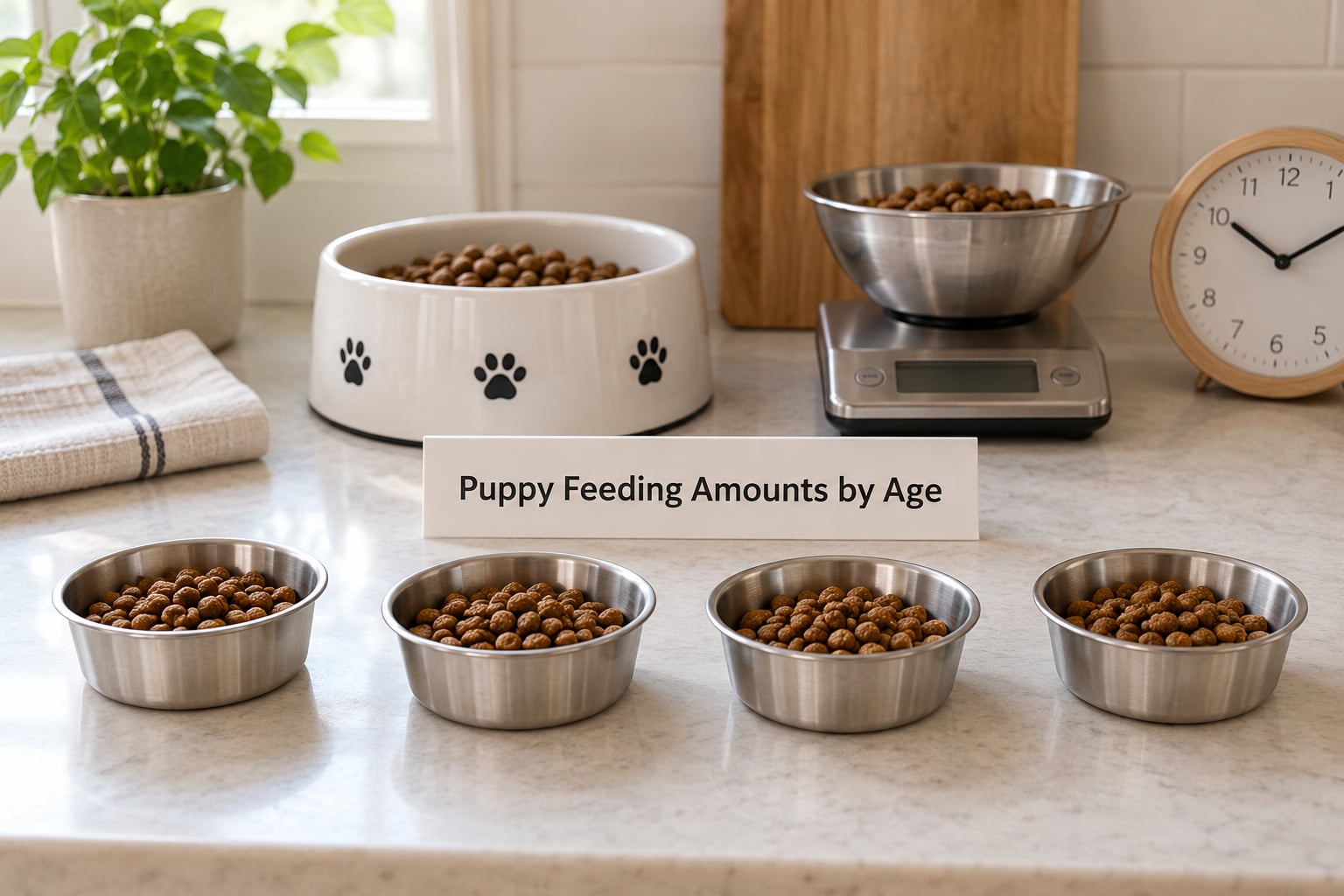
Younger puppies need more frequent meals because their stomachs are small and their blood sugar dips quickly. Four meals before 12 weeks keeps them steady; two meals after six months matches how most adult dogs eat.
| Age | Meals per day | What changes |
|---|---|---|
| First 8 weeks | 4 or more, or continue nursing | The dam’s milk or a milk replacer still covers most intake; weaning onto solid food happens over a couple of weeks |
| 8-12 weeks | 4 | Food-only diet, portion split into four equal bowls, same times each day |
| 3-4 months | 3 to 4 | Total daily amount keeps climbing; start offering a midday topper if the puppy is restless |
| 4-6 months | 3 | Growth energy use starts to level off even though weight keeps rising |
| 6-9 months | 2 | Many puppies hold a steady daily total from here until they reach adult size |
| 9 months and up | 2 | Portions shift toward the adult formula for small and medium breeds |
Owners on puppy forums ask almost the same question daily with only two variables: weight and age. That is exactly why a chart like this works better than a bag label, which indexes by something else entirely.
How to Calculate Food by Weight
To get past the cup guessing game, work through four steps. The result is a daily number in calories, which you then convert into whatever unit your food is measured in.
1. Check the calorie density
Every bag lists kilocalories per cup, per kilogram or per 100 g. Typical dry puppy kibble runs about 3,500 kcal per kilogram and roughly 350 to 400 kcal per cup. Wet puppy food is much denser, often around 800 kcal per cup, which is why a cup of wet cannot be swapped for a cup of kibble.
2. Work out the resting energy requirement
The standard formula is RER = 70 multiplied by body weight in kilograms raised to the power of 0.75. A 5 kg puppy works out to 70 x 5^0.75, which is about 234 kcal just to stay still and breathe.
3. Apply the life stage multiplier
Multiply RER by 2.0 to 2.2 for a puppy under half of its adult weight, and by 1.5 once your puppy is past half its expected adult weight and growth slows. That same 5 kg puppy needs roughly 500 to 600 kcal a day, which is the number most owners can sanity-check against the label.
4. Convert calories into food and adjust by body condition
Divide daily calories by the food’s kcal per cup, then split that total across the meals for your puppy’s age. After two weeks, feel the ribs from above, look for a visible waist from above, and adjust by 10% at a time. Growth charts from your vet are a better check than the bag.
Puppy Food Types and Portion Differences
Food type changes your numbers more than breed does. A complete and balanced puppy food is formulated for growth, while adult maintenance food is not, no matter how good the ingredients look.
- Complete puppy kibble. Easiest to measure and the most efficient way to hit a calorie target. A standard cup gives a repeatable number, so weigh the first few portions on a kitchen scale to learn what one cup looks like in your dog bowl.
- Wet puppy food. Roughly twice the calories per volume of kibble, and much softer. Small-breed owners use it as a topper on kibble; full wet diets need portions calculated in grams, not cups.
- Mixed feeding. The hardest to do by eye. Calculate the calories in each part separately, add them to the daily total, and then convert back into kibble cups plus wet grams.
- Fresh or raw food. Highly digestible, so the gram weight you feed delivers more usable calories than the same gram of kibble. Use the food’s own calorie figure, not a generic rule of thumb.
- Treats and toppers. Keep them under 10% of the daily calorie total. That sounds small, and it is: a training session that uses 15% of the day’s calories quietly inflates the whole week’s growth curve.
- Table scraps. Calorie-dense, unbalanced and unpredictable. If your puppy gets a piece of cheese, subtract roughly the same calories from the meal rather than adding them on top.
How to Adjust Portions as Your Puppy Grows
Weigh your puppy at the same time on the same day each week and write the number down. A single week tells you little; the trend over four weeks tells you almost everything.
| Size class (adult weight) | Expected weekly gain |
|---|---|
| Toy (under 10 lb / 4.5 kg) | 2 to 4 oz (55-115 g) per week |
| Small (10-25 lb / 4.5-11 kg) | 4 to 8 oz (115-225 g) per week |
| Medium (25-50 lb / 11-23 kg) | 6 to 12 oz (170-340 g) per week |
| Large (50-90 lb / 23-41 kg) | 1 to 2 lb (450-900 g) per week |
| Giant (over 90 lb / 41 kg) | 1 1/2 to 2 1/2 lb (680-1130 g) per week |
Two things surprise new owners. First, daily calories often stay flat from 4 to 12 months even while weight climbs fast, because growth energy use per pound drops as the puppy gets bigger. Second, the feeding table printed on a dog food bag is indexed by expected adult weight, not current weight. Owners misread this constantly and end up underfeeding. The food itself is fine; the column you pick is the problem.
| Size class | When to switch to adult food |
|---|---|
| Toy and small breeds | Around 9 to 12 months |
| Medium breeds | Around 12 months |
| Large breeds | 12 to 18 months, or when the growth plates close on your vet’s X-ray |
| Giant breeds | 18 to 24 months |
Change food over about seven days, mixing a quarter of the new food in for two days, then half, then three quarters. Never restrict food deliberately to slow a large-breed puppy. Slower, even growth is what protects the joints, and a restricted diet on a growing dog can cause lasting developmental problems.
Safe Feeding Practices and Common Mistakes
Feeding a puppy is mostly repetition, and most mistakes come from skipping it. Keep meal times fixed, weigh portions rather than eyeballing them, and refill the water bowl whenever you refill theirs.
- Constant schedule. Four predictable bowls teach a puppy that barking at the counter does nothing. It also makes a refusal to eat obvious, because you know exactly when the last meal was.
- Weigh, do not scoop. A kitchen scale with one gram resolution removes the guesswork for small breeds and costs very little.
- Match chew size to mouth. Small puppies need small pieces. A kibble meant for a large-breed puppy is fine as a teething chew for a 10-week-old, but a hard oversized piece can crack a tooth.
- Keep human food out of the equation. Chocolate, grapes, raisins, onions, garlic, macadamia nuts and anything with xylitol are all dangerous for dogs. Cooked bones and fatty scraps cause their own problems.
- Do not fill the allowance with treats. Training rewards are useful because they are tiny. The moment they turn into half the bowl, the meal plan has quietly stopped working.
When to Ask a Veterinarian About Eating
A puppy skipping one meal is usually nothing. A puppy that has stopped eating needs a phone call, because the list of possible causes runs from a foreign object to a parasite to something more serious, and only an exam separates them.
Call your vet the same day you notice vomiting or diarrhoea that does not settle, blood in the stool, a swollen or hard belly, pain when you pick your puppy up, lethargy, sudden thirst, or weight loss or stunted growth across several weigh-ins. A bloated-looking large-breed puppy is an emergency rather than a same-day appointment, since the condition can worsen fast.
Your vet can also set an individualized calorie target, check body condition properly, and adjust portions for a puppy with medical or growth needs. Do not start a restricted diet on your own to slow growth down.
Frequently Asked Questions
Is 2 cups of food a day enough for a puppy?
It depends entirely on the puppy. Two cups of dry kibble is roughly 700 to 800 kcal, which suits a puppy in the 10 to 20 lb range eating two or three meals a day. It is far too much for a 5 lb toy breed and not nearly enough for a 40 lb Labrador puppy. Use your puppy’s weight, age and body condition rather than a fixed cup count.
Can a puppy go 12 hours without food at night?
After about four months most puppies manage an overnight gap comfortably, and two meals a day naturally leaves roughly 10 to 12 hours between them. Very young puppies cannot, which is why feeding schedules drop from four meals to three and then two. If your puppy is under three months, vomiting, or a small breed prone to low blood sugar, keep a night meal in place and ask your vet.
How many calories does a puppy need per day?
Calculate the resting energy requirement with 70 multiplied by body weight in kilograms raised to 0.75, then multiply by 2.0 to 2.2 while your puppy is under half its adult weight and by 1.5 after that. A 5 kg puppy needs roughly 500 to 600 kcal a day. Treats and toppers count toward that total, with under 10% going to training rewards.
Should I free feed my puppy?
Free feeding works for some adult dogs, but puppies eat differently. Most puppies do not self-regulate well, and a bowl left full all day makes weight gain hard to track and growth harder to adjust. Measured meals let you notice a puppy that stops eating, and they make training schedules easier because you control when the food arrives.
When can puppies switch to adult food?
Small and toy breeds are usually ready around 9 to 12 months, medium breeds around 12 months, and large breeds between 12 and 18 months. Giant breeds can need adult food at 18 to 24 months. Switching too early raises the risk of joint problems, so confirm the timing with your vet and change food gradually over about seven days.
How much should a puppy gain per week?
It depends on the adult size your puppy is heading toward. Toy breeds typically gain 2 to 4 oz per week, medium breeds 6 to 12 oz, and large breeds 1 to 2 lb. Weigh weekly on the same day and compare the trend rather than a single week, and bring your numbers to your vet if growth stalls or climbs sharply.
Start tonight: weigh your puppy, find the weight band and age band in the chart above, measure that amount in grams, and schedule the meals. Then weigh again next Sunday and adjust by 10% if the waist says so. When the numbers and your vet disagree, follow the vet.