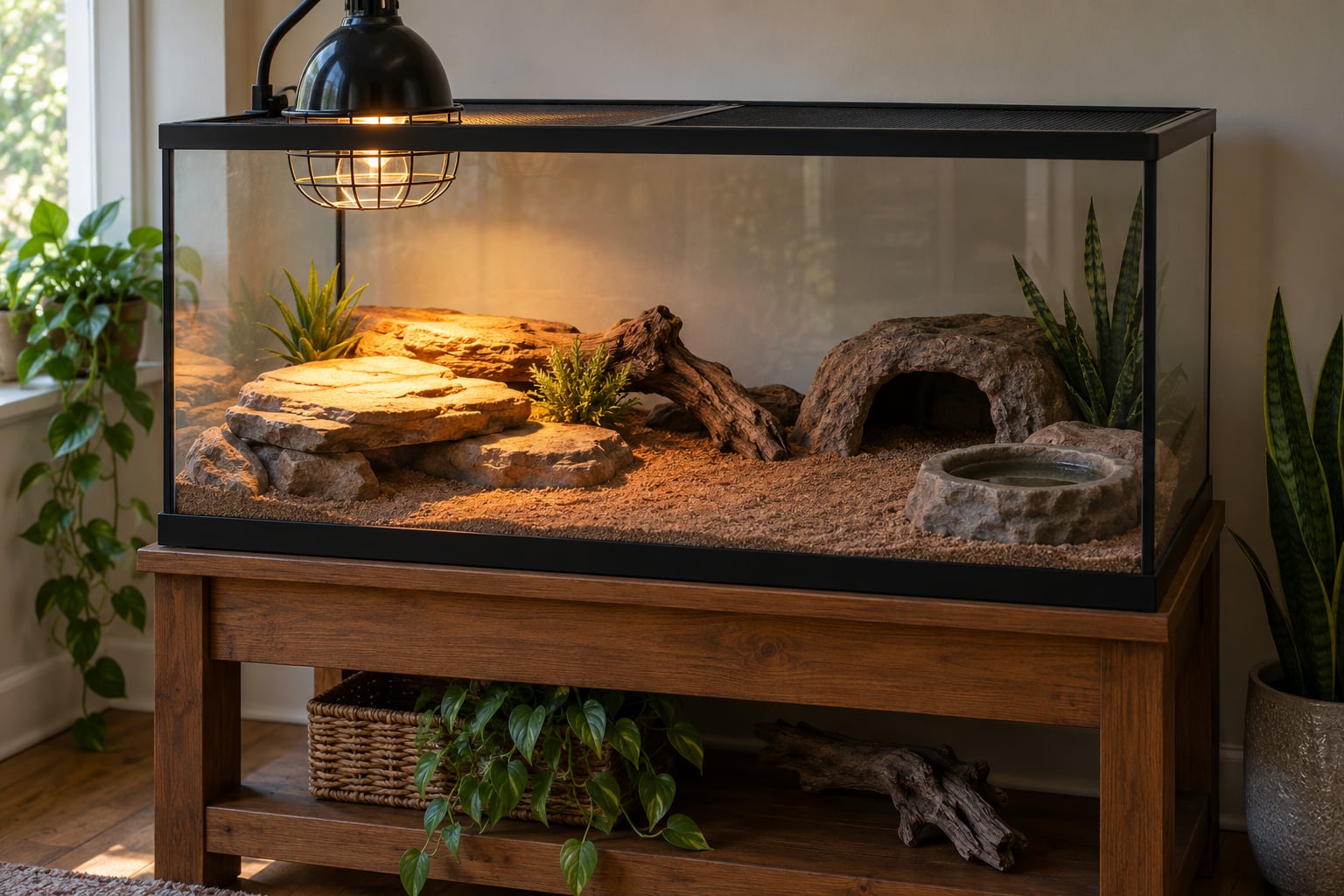
To set up a leopard gecko tank, you need a front-opening enclosure around 36 x 18 x 18 inches (91 x 46 x 46 cm), one guarded overhead heat source on a dimmable thermostat, at least three hides including a humid one, and a safe substrate. Most first-time keepers get it right in an afternoon plus a week of running the empty tank before the gecko arrives.
That last week is the part people skip, and it is the part that saves you. Heating equipment fails, a lamp burns out, a thermostat probe sits in the wrong spot, and you want to find out in an empty tank rather than with a stressed animal hiding under a hide you can’t reach.
Table of Contents
What You Need
Buy everything before the gecko comes home. Here is the working list, with one line on why each piece matters.
- Enclosure. A 40-gallon breeder (36 x 18 x 18 in) is the right target for an adult. A 20-gallon long (30 x 12 x 12 in) works as a temporary quarantine setup.
- Secure lid. Screen top with two clips, or a front-opening terrarium with doors that latch. Leopard geckos are escape artists.
- Heat source. A halogen basking lamp or a deep heat projector, both mounted overhead and guarded.
- Dimmable thermostat. Not an on/off timer, not a dial. This is the piece that prevents burns and overheating.
- Two digital thermometers. One for the warm side, one for the cool side, so you are reading the gradient instead of guessing.
- Hygrometer. For the cool side. The ambient number is less critical than the humid hide, but you still want to see it.
- Infrared temperature gun. Cheap, and it is how you check the actual surface temperature under the lamp.
- Three hides. One warm, one cool, one humid. Two is the most common beginner mistake.
- Substrate. Paper towel, slate or ceramic tile, or a screened soil-and-sand mix.
- Water dish. Shallow, stable, placed on the cool side.
- Linear UVB fixture. A T5 or T8 tube across the top, with a shaded area next to it.
- Clutter. Fake plants, cork bark, hides, a feeding tong. A gecko that feels exposed will not eat.
Two leopard geckos never share an enclosure. Adults are solitary and will fight over territory and food, and no tank is large enough to prevent it.
How to Set Up a Leopard Gecko Tank Step by Step
Build the tank from the bottom up. The order below matters, because adding substrate after the lamps are installed means moving hot fixtures over a wet floor.
Choose the Right Tank
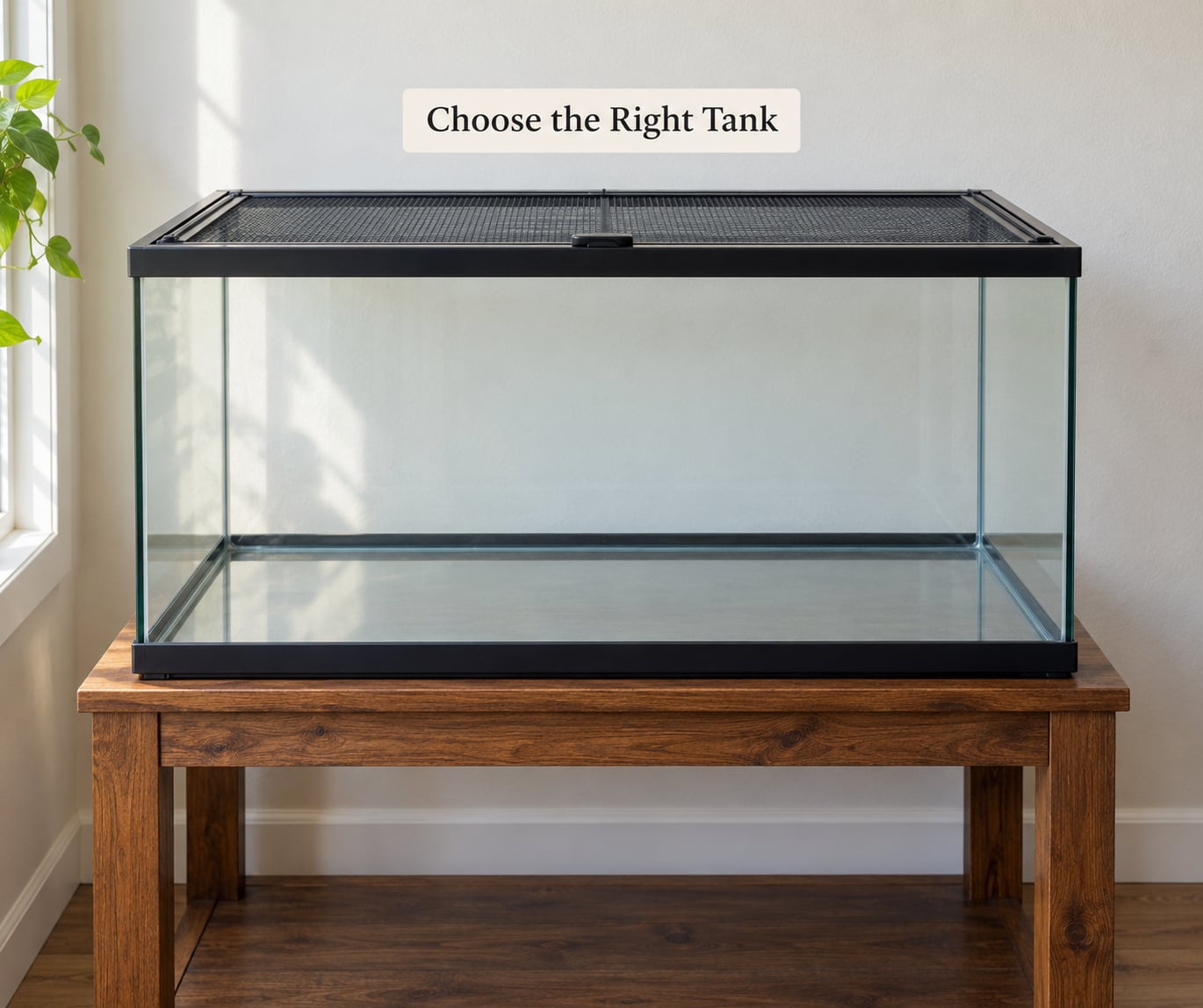
Buy the tank you want to keep for the next fifteen years, not the one that fits the gecko you have now. An adult leopard gecko needs floor space to move across a temperature gradient, so a horizontal enclosure beats a tall one every time. A 40-gallon breeder is the community standard for a full-grown animal, and starting there means one purchase instead of two.
| Enclosure | Dimensions | Best for |
|---|---|---|
| 10 to 15 gallon | 20 x 10 x 12 in | Quarantine, hatchlings, temporary hospital tank |
| 20 gallon long | 30 x 12 x 12 in | Juvenile or small adult; still a step up later |
| 40 gallon breeder | 36 x 18 x 18 in | Adults, and where most keepers should start |
Check three things when the tank arrives. The lid has to latch, not just rest there. There has to be some ventilation, whether that is a screen top or drilled holes. And the enclosure has to sit on a flat, solid surface that can hold 60 to 100 pounds once it is full of substrate and rock.
Placement in the room gets almost no attention in guides, and it matters. Keep the tank out of direct sunlight, away from heating vents and air conditioning units, and away from a window where afternoon sun turns the whole enclosure into an oven. In a home with cats, put it up high and against a wall. Vibration from a washing machine or stereo resets a gecko that has finally stopped pacing.
Add the Substrate
What you put in the bottom of the tank is a health decision, not a decorating one. Loose substrate swallowed in quantity can cause impaction, an intestinal blockage that needs surgery.
| Substrate | Choose it if | Watch out for |
|---|---|---|
| Paper towel | You want a cheap, obvious way to spot blood in the droppings | Tearing and soaking; replace daily |
| Slate or ceramic tile | You want something permanent and washable | Cold underfoot; add a thin paper layer over part of it |
| 70/30 topsoil and playsand mix | You want natural digging behaviour for a healthy adult | Sieve out every pebble and hard chunk; feed away from the bowl |
| Bioactive mix with drainage layer | You want a planted, self-cleaning system and will keep it moist | Needs springtails or isopods to work; slow to set up |
Never use calcium sand, walnut shell, cat litter, pine or cedar bedding, or astroturf. Calcium sand clumps and is the single most dangerous substrate on the shelf. Mix your own soil at a 70 percent soil to 30 percent washed play sand ratio if you go that route, and store it airtight so it stays dry.
Spread it two to three inches deep on the cool side and a little less near the heat source, where it dries out faster. Slope it gently so a dig has somewhere to go, and press it down around the corners so there are no gaps a foot can disappear into.
How to Set Up a Leopard Gecko Tank Without Overheating It
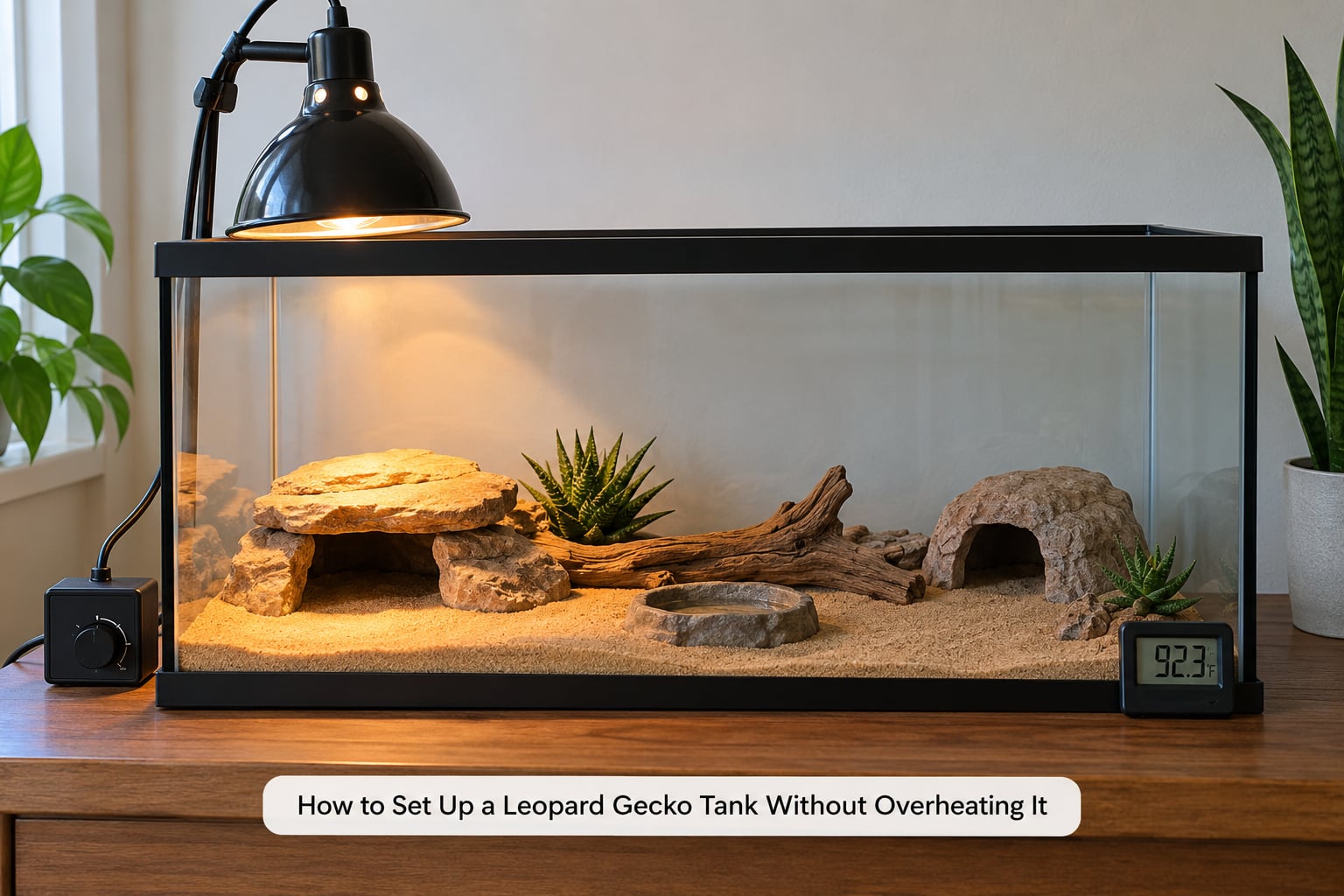
Leopard geckos absorb heat through their bellies and move between a warm end and a cool end to regulate their own body temperature. A tank with one even temperature is not correct. You are building a gradient, and every number below is a surface or air reading you verify with a tool rather than a guess.
| Zone | Fahrenheit | Celsius | How to measure |
|---|---|---|---|
| Basking surface | 94 to 97 F | 34 to 36 C | Infrared gun, on the rock under the lamp |
| Warm side air | 90 to 93 F | 32 to 34 C | Digital thermometer on the warm-side floor |
| Cool side air | 70 to 77 F | 21 to 25 C | Digital thermometer on the cool-side wall |
| Night | 65 to 70 F | 18 to 21 C | Both thermometers, lights and heat off |
Mount the lamp on the warm end, angled down and slightly back so the beam covers roughly the first third of the enclosure. Guard it with a metal mesh cage so the gecko cannot touch the bulb. A ceramic socket rated for the lamp’s wattage matters here; an undersized socket is a fire waiting to happen.
Run the heat source through a dimmable thermostat, not an on/off timer. Set the thermostat probe to the temperature you want on the warm-side floor, usually 90 to 93 F, and let it modulate. The probe has to sit where the gecko actually lies. Pinch it under a piece of cork bark or the warm hide on the warm-side floor, not taped to a wall and not buried in the cool corner.
Switch everything off at night. A gecko needs a real drop to roughly 65 to 70 F overnight to sleep properly and cycle through normal hormonal rhythms. A tank that stays warm all night keeps them in a permanently restless state.
Add Hides and Basic Decorations
Three hides means one warm hide the gecko can sit inside to bask, one cool hide for a dark resting spot away from the lamp, and one humid hide. Reptile caves, upside-down plastic containers with a doorway cut in, or cork bark all work. The gecko should be able to touch all sides while inside.
The humid hide is what makes shedding work. Line it with damp moss or damp paper towel, wrung out so it is wet but not dripping, and check it every two or three days. Dry out means the next shed gets stuck around the toes or the tail tip, and stuck sheds are the start of a long list of problems.
Then clutter the space. Fake plants, a hollow log, a cork tube, a feeding platform, a few flat rocks arranged so they do not roll. Push every decoration firmly into the substrate. Anything a gecko can brace against and push upward is a lid that eventually comes off. Leave walking room between the zones, though. Too much decoration packed edge to edge is its own mistake.
Set Up Lighting and Day-Night Care
A linear T5 or T8 UVB tube across the top of the enclosure gives your gecko a reason to bask in the light instead of only in the heat. Install it so there is a bright zone and a fully shaded zone next to it, because a leopard gecko that cannot get out of the light will hide permanently.
Keep a consistent cycle: about 12 hours of light, 12 hours of dark. Use a timer so you are not guessing at dusk. And skip the coloured night bulbs. Red and blue bulbs are sold as “moonlight,” but geckos see them clearly, and keeping them on at night disrupts sleep.
Replace the UVB tube every 6 to 12 months depending on the maker’s rating. It dims long before it looks dead, and a weak bulb means your gecko is not getting the benefit.
Add Water and Do a Safety Check
Put the water dish on the cool side, away from the heat lamp, where it will not evaporate into nothing. It needs to be heavy or fixed in place so it cannot tip. A leopard gecko drinks on its own schedule and many keepers never see it happen, so a shallow dish with a clean surface every few days is the whole job.
Then walk the room and inspect what you built. Doors and lid latches close and stay closed. No gaps under the lid. The thermostat reads the temperature you set. The surface under the lamp hits 94 to 97 F on the infrared gun while the cool side stays under 77 F. Nothing in the tank has sharp edges, loose wires, or small parts a gecko could swallow.
Plug the whole thing in and leave it running for a week before the gecko arrives. Day one, note the warm and cool readings every few hours. Day two, check that the night drop happens and the morning recovery works. Day three, look for a lamp flicker or a thermostat cycling too fast. The rest of the week is stability, and the log of numbers tells you whether you have one.
Common Mistakes
Nearly every problem in a leopard gecko enclosure traces back to one of these.
- Heat mat as the only heat source. Mats warm the floor evenly and give the gecko no gradient, and belly burns go unnoticed. Use overhead heat.
- No thermostat. Bulbs fail, thermostats drift, room temperature changes. This is the cheapest piece of equipment and the one that prevents burns.
- Only two hides. A gecko that cannot get out of sight stops eating. Three is the floor, not the goal.
- Loose sand or calcium sand as substrate. Impaction risk, and calcium sand clumps in the gut.
- Red or blue night bulbs. They suppress night behaviour and disrupt the sleep cycle.
- Heat rocks or unmonitored elements. They can heat unevenly to burn temperatures with nothing switching them off.
- A vertical or tall tank. These are sold for arboreal species. A leopard gecko needs floor length.
- An unsecured lid. Check the clips tonight, not after the first escape.
- Two geckos in one tank. Not for a week, not for a pair, not “they seem fine.” One per enclosure.
Beginner Tips
Give the tank that first week, then give the gecko a quiet first week too. When it arrives, expect it to hide for two to three days and eat little or nothing. That is normal settling behaviour, not a sign that anything is wrong.
Check the warm hide first thing each morning. If it is cool in the morning, the night drop went too far and you need better insulation on the cool end. Run the infrared gun over the basking surface a couple of times a week, since a lamp can dim gradually without you noticing.
Spot-clean every day and change paper towel daily if you use it. Wipe out the humid hide when the moss dries out and replace it with damp material. Keep handling off for about a week, then start with short sessions at the hide entrance rather than picking the gecko up.
See a reptile-experienced vet if the gecko stops eating for more than a week, shows swelling or deformities along the jaw or limbs, has difficulty shedding repeatedly, stays open-mouthed at the warm hide, or is noticeably thin at the tail. Those signs usually trace back to heat or calcium, and both are easier to fix in the enclosure than in the animal.
Frequently Asked Questions
How big should a leopard gecko tank be?
A 40-gallon breeder at 36 x 18 x 18 inches is the right enclosure for an adult, and the one most keepers should start with. A 20-gallon long is the accepted minimum, but you will outgrow it within months. A 10 to 15 gallon tank works for quarantine and juveniles. Height matters less than floor length, since leopard geckos are ground dwellers and move across a temperature gradient.
How long should I run the tank before putting my gecko in?
At least seven days. Set everything up, plug it in, and watch the warm and cool readings plus the night drop before the animal arrives. Week one catches failed lamps, a probe in the wrong spot, and drafts that push the cool side too low. If your gecko is already home, keep the setup simple and stable rather than changing several things at once.
Do leopard geckos need UVB light?
They are crepuscular rather than strictly nocturnal, and a linear T5 or T8 UVB tube gives them a reason to use the basking area in daylight. It supports calcium metabolism and normal activity. Provide shade next to the tube so your gecko can move out of the light, and replace the tube every 6 to 12 months because output drops before the bulb looks spent.
How cold is too cold for a leopard gecko at night?
Below 65 F (18 C) on a sustained basis is too cold. Aim for a night drop to 65 to 70 F (18 to 21 C) with all heat and light off, which supports normal sleep and hormonal cycles. If your cool side is dropping into the low 60s overnight, insulate that end of the tank with a foam board or a blanket on the outside only.
How humid should the humid hide be?
The hide itself should feel damp, not wet, with damp moss or damp paper towel that holds moisture without dripping. Check it every two or three days, because it dries out faster than most keepers expect and dry means the next shed gets stuck. Leave the rest of the enclosure dry, since high ambient humidity can cause respiratory problems.
Conclusion
Four things matter more than the rest: a secure 40-gallon breeder with a latching lid, a measured temperature gradient from a guarded overhead lamp on a dimmable thermostat, safe substrate with nothing ingestible, and three hides including a damp one. Then let the tank run empty for a week and check the numbers before the gecko comes home.
Everything after that is observation. Watch the warm hide each morning, keep the humid hide damp, and if something looks off, check the enclosure before you change the animal.