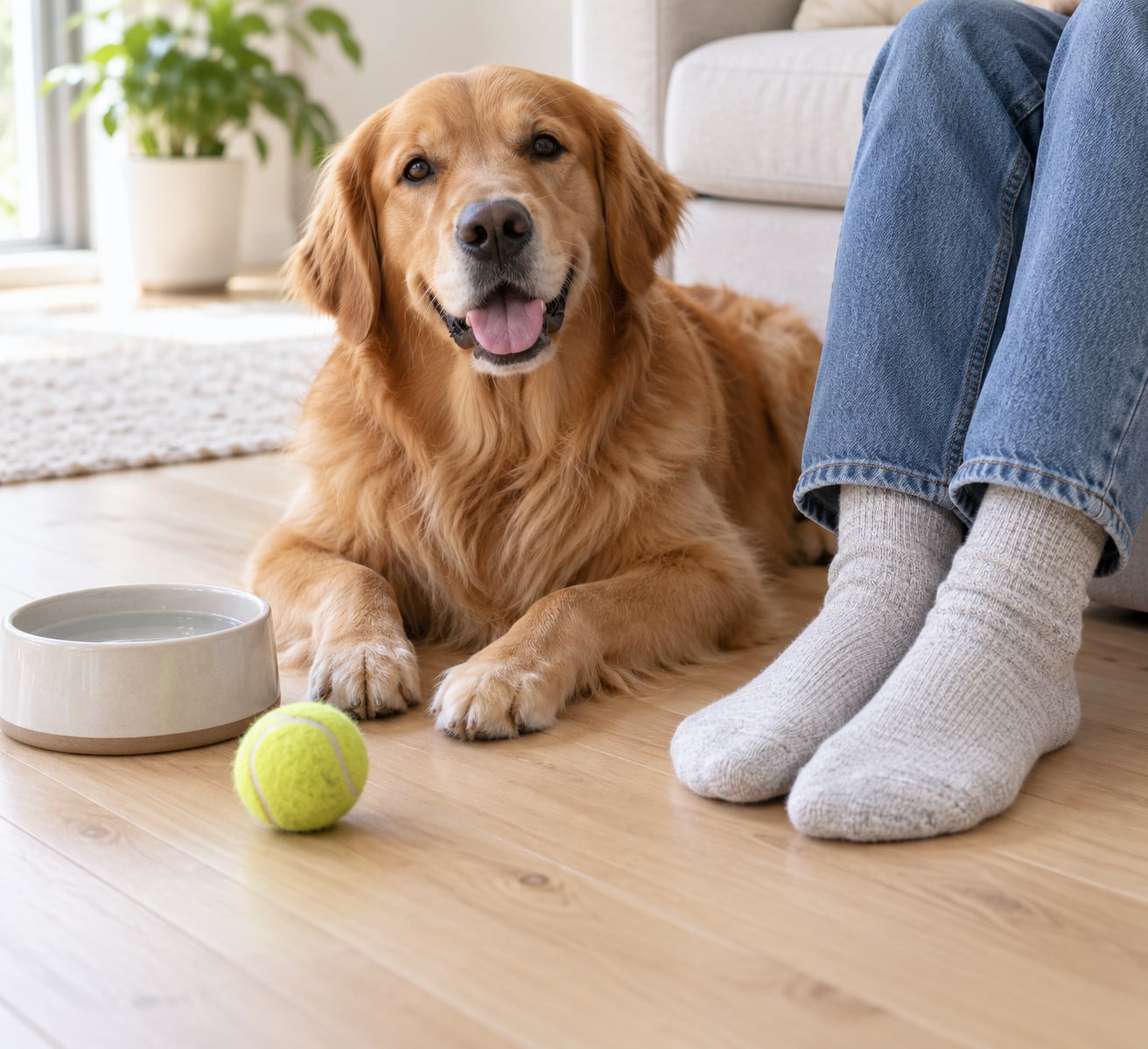
Dogs lick feet because your feet carry the strongest scent on your body, sweat, salt, skin oils and pheromone residue concentrated in your shoes all day. Most of the time it is scent, affection or a learned attention habit. Sudden, intense or one-foot-only licking is a different story, and that one deserves a veterinarian.
I have two dogs. One greets me at the door with a full-body wiggle and then licks my socks off the moment I sit down, and the other is only interested in feet that have been walking in wet grass. Neither one is sick. That said, the habit that seems perfectly charming at 6 p.m. can turn into a skin problem, for your dog or for you, and the line between the two is worth learning to see.
Table of Contents
- What Does It Mean When Your Dog Licks Your Feet?
- Common Reasons Dogs Lick People’s Feet</
- Why Does My Dog Lick My Feet So Much?
- Is Normal Dog Foot Licking or a Problem?
- What Medical Problems Can Cause Excessive Foot Licking?
- How to Respond Without Encouraging the Habit
- When Should You Call Your Veterinarian?
- Frequently Asked Questions
- Conclusion
What Does It Mean When Your Dog Licks Your Feet?
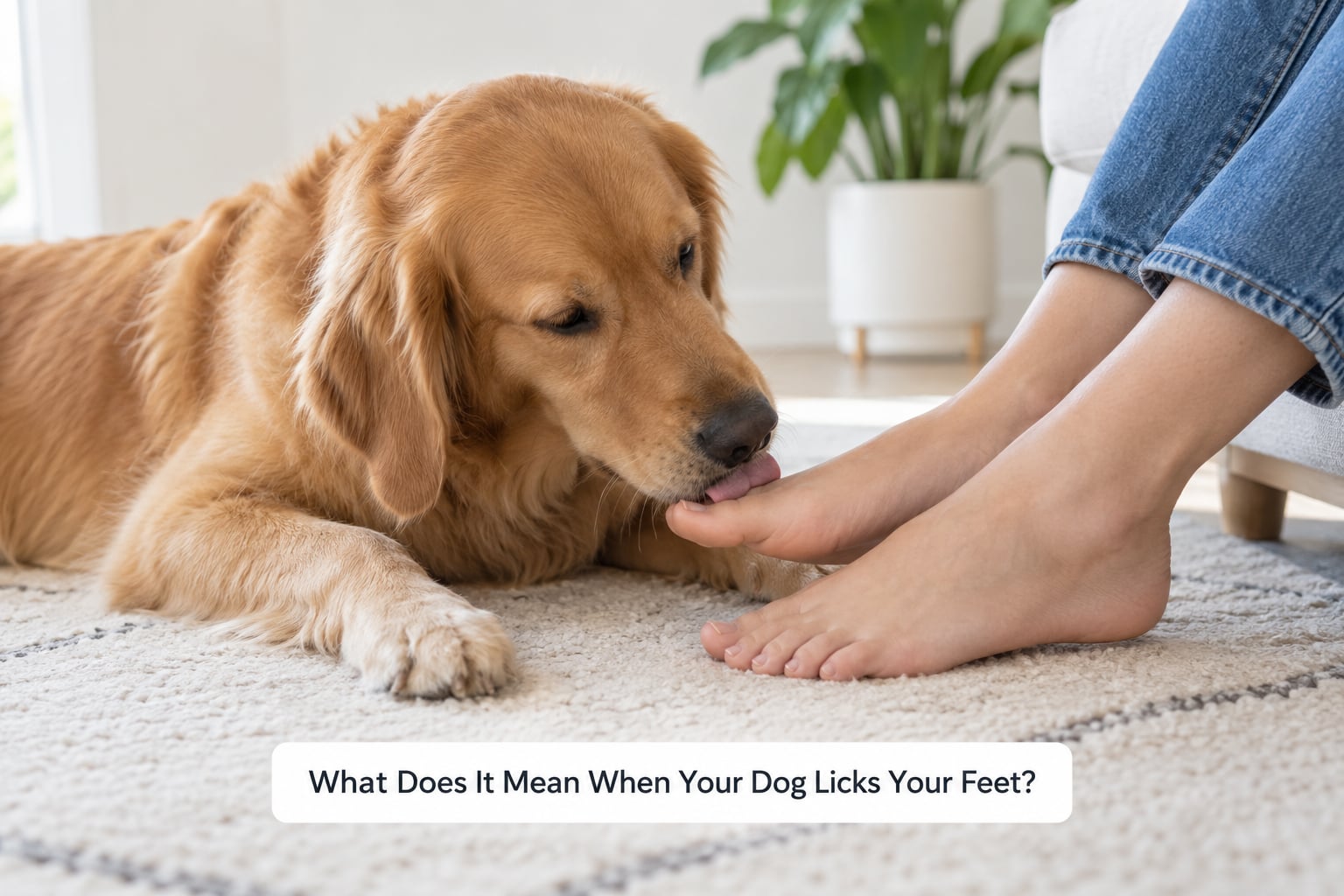
On its own, foot licking carries no single meaning. Dogs do it for scent, for bonding, to get your attention, out of boredom, as a way to settle stress, because it feels good, or because something itches and hurts. The same lick can carry two meanings at once, a bored dog asking for a walk is also a dog asking for a walk.
What tells you more than the act itself is the pattern: when it happens, how long it lasts, and what else changes around it. A dog that licks after you take your socks off is chasing scent. A dog that licks only at 2 a.m. and cannot settle is probably dealing with discomfort or anxiety. A dog that suddenly starts licking your ankles when it has never done it before is the one I would not guess about.
Frequency matters as much as intensity. A quick, relaxed lick when you come home is normal dog behavior. A dog that will not stop, licks until you bleed, or has taken a red, damp patch out of your skin needs attention, not patience.
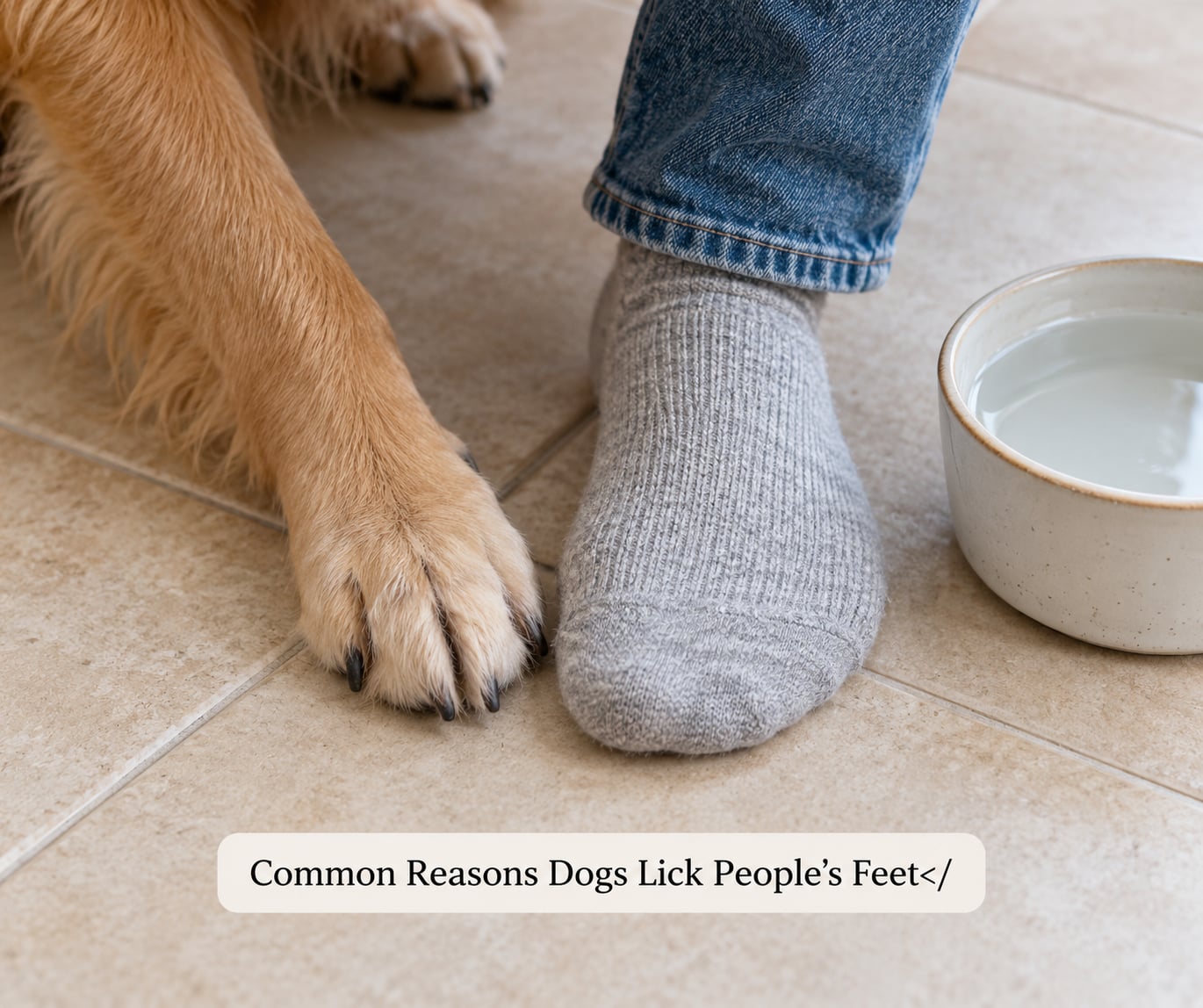
Common Reasons Dogs Lick People’s Feet</
Scent and salt
Your feet sweat more than most of your skin, and dogs have a sense of smell estimated at thousands of times ours. Salt from sweat, skin oils, lotion and whatever your socks collected all day make your feet the most interesting object in the room. This is also the pattern owners report most: the licking spikes right after socks come off.
Affection and bonding
Young dogs learn to lick their littermates and their mother during nursing, and the behavior carries into adulthood as a social gesture. Licking releases endorphins, so it genuinely feels good to do. Owners often notice it most when they are upset or crying, which is a different kind of comforting than a greeting.
Attention-seeking
This one is often built by accident. Your dog licks, you laugh, you pet them, you say a word, and they get a reward. Do that loop a few hundred times and the licking is no longer a dog decision, it is a trained response with a reliable payoff. Owners in dog communities describe this as the reason it got worse over months rather than being constant from day one.
Boredom or overstimulation
A dog with nothing to do will invent something. Foot licking is an easy, self-reinforcing activity that requires no equipment and no cooperation from you, so it fills gaps during long hours alone. It often appears in dogs whose owners work from home but are busy on screens all day.
Anxiety or stress
Self-soothing is the term behaviorists use. When a dog is uncertain, grooming itself or a familiar person releases calming hormones. Owners of anxious dogs report licking that escalates around thunderstorms, fireworks, or the hours they are at work. A dog that presses its body against you and licks while panting is asking for reassurance, not giving a lesson.
A learned habit
Some dogs settled into foot licking as puppies and never revisited it. It stays because it works, at least in the sense that the behavior persists. Habit is common in dogs with a long, repetitive, predictable day.
Irritation, allergy, pain or a medical concern
This is the reason that gets missed, because it usually shows up alongside the licking rather than instead of it. Itchy, irritated or painful skin, allergies, dermatitis, an injury between the toes, a nail problem, or pain somewhere else in the body can all send a dog to its feet or to yours. Constant moisture from saliva also breeds secondary bacterial and yeast infections, which makes a small problem worse over days.
What licking does not mean
It is not dominance. It is not submission, respect or an apology for wrongdoing. You will still find articles claiming dogs lick your feet to show you they know you are the boss, and that claim does not survive a look at how behavior is actually described today. Dogs lick for scent, emotion, learning and physical sensation, not to negotiate rank.
Why Does My Dog Lick My Feet So Much?
The reason your specific dog picks your feet comes down to three things: how interesting you smell right now, what your licking has always been rewarded with, and whether your feet happen to be near something good to eat. Salt residue, dinner smells drifting from the kitchen, and a warm, still, familiar surface after a long walk are more attractive to a dog than your hands ever are.
Owners often notice the timing more than the act. The most common triggers reported are coming home from work, taking off socks, finishing a walk, and settling down for the night. A dog that only shows up at those moments is telling you something specific, even if it is only that socks smell good.
Here is how to tell a normal habit from excessive licking:
- Quick and relaxed: a few licks, loose body, then moves on. Nothing changes on your skin.
- Rigorous and repetitive: the same spot for many minutes, teeth involved, saliva building up.
- One side only: licking a single paw, or you, far more often than before, often points to discomfort on that side.
- With physical change: damp matted fur, redness, small sores, thinning coat, a foul smell, or licking that continues at night when you cannot distract them.
- With behavior change: hiding, appetite changes, less interest in walks, restlessness, or a dog who suddenly avoids being touched.
Two more details worth noting. If your dog also has bad breath, halitosis and paw licking together are a known pattern that vets check for, often pointing toward dental or digestive issues. And if the licking appears in an adult dog that has never done it, treat it as new information about that dog’s health rather than as a new personality.
Is Normal Dog Foot Licking or a Problem?
Licking your feet is usually a normal canine behavior. It is uncomfortable and ticklish for you, but it is not harming your dog, and it does not need to be fixed on principle. The best answer is to let affectionate licking happen and to redirect when it becomes relentless.
Licking a dog’s own paws is a different question entirely. Occasional grooming of the paws between walks is normal. Persistent licking of the paws is one of the most common reasons dogs end up at the vet, and it usually points to itching, irritation or pain.
| What you see | What it usually means | What to do |
|---|---|---|
| Licking right after you take your socks off | Scent and salt build-up | Wipe or rinse your feet, wear socks on the sofa |
| Licking with a wiggle when you come home | Greeting and affection | Let it happen once, then give a toy |
| Licking when you are upset or crying | Comforting you, self-soothing | Stay calm, no correction needed |
| Licking that follows any movement or noise | Attention-seeking, learned habit | Ignore the licking, reward the calm |
| Licking when you are away or the weather is loud | Stress or separation anxiety | Enrichment, then a vet if it escalates |
| Licking that leaves your skin wet, red or sore | Over-grooming, possible allergy or dermatitis | Wash, protect the skin, call your vet |
| Licking one paw, with redness or a limp | Pain, injury, nail or skin problem | Book an appointment promptly |
If your dog is licking your feet but leaving you entirely alone, this table is the fastest way to narrow it down. If your dog is licking their own paws, skip to the next section.
What Medical Problems Can Cause Excessive Foot Licking?
Only a veterinarian can tell you what is actually going on inside your dog. What I can do is list the conditions they look for, so you know the vocabulary and you do not dismiss something early.
- Allergies and atopic dermatitis. Environmental allergens, food allergies, and dermatitis cause itching that has no obvious wound, which is why owners often miss it.
- Skin and secondary infection. Yeast and bacterial infections thrive in the constant moisture left by licking, so a mild itch turns into a red, sore paw.
- Parasites. Mites and fleas drive irritation that the dog can only relieve by licking.
- Pain. A torn nail, an injury between the toes, an ingrown nail, arthritis or back pain can all shift a dog’s attention to licking.
- Gastrointestinal or neurological issues. Nausea and certain neurologic conditions can present as repetitive licking behavior.
- Compulsive behavior. A licking disorder, Spanish term comportamiento compulsivo, is repetitive to the point where it interferes with eating, sleeping or walking. It needs a veterinary behaviorist, not more training.
Hygiene and safety: the part most articles skip
Yes, dogs can pick up the smell of athlete’s foot, and the concern is not only about your feet. Fungal infections live in warm skin folds and between toes, and a dog licking your feet and then grooming their own paws can move organisms both ways. If you have athlete’s foot, a fungal infection, or an open cut on your feet, keep socks on and wash both your feet and the dog’s paws after contact.
Second, be careful with what is on your skin and socks. Topical flea and heartworm treatments are designed to be absorbed through skin, and some are toxic to dogs when ingested. If you apply them and then walk in socks around the house, keep the dog out of reach. Human medication in general does not belong in a dog’s mouth; if any is absorbed, call a veterinarian or an animal poison line straight away.
Third, if your dog gets a small nick of your skin, saliva is not a wound treatment. Clean it properly, and keep an eye on redness or swelling that spreads.
How to Respond Without Encouraging the Habit
The rule is simple: do not punish, do not scold, and do not push the dog off your feet. Owners in dog forums say it plainly, the problem is usually with how we respond, not with the dog. Scolding adds anxiety, anxiety adds licking, and you have built a loop you did not want.
Try these steps in order.
- Figure out which reason it is. Use the table above. Attraction to scent needs a different response than anxiety.
- Stop rewarding the lick quietly. No laughing, no eye contact, no “who’s a good boy” mid-lick. Move on to something boring, like scrolling your phone.
- Redirect with a real alternative. Have a chew, a lick mat, a stuffed food toy or a ball within reach. You are not forbidding licking, you are moving it to something that is yours.
- Reward calm, not silence. Give attention or a treat for four quiet seconds of contact. You are teaching the behavior you want, which is stillness, not obedience.
- Give the dog a richer day. Ten minutes of sniffing, a food puzzle, or a short training session goes a long way toward a dog that is not looking for entertainment.
- Remove the easy triggers. Socks on the sofa, feet off the deck, or a wash of your feet after work often cuts the scent-driven licking in half.
- Use a taste deterrent only with advice. Bitter-tasting sprays and collars can help some dogs, but ask your vet first, especially if your dog has sores in the mouth.
Give this two to three weeks before deciding it failed. Behavior change that has been reinforced for months does not disappear in two evenings.
When Should You Call Your Veterinarian?
Book an appointment if you notice any of the following, and say the word licking in your first sentence so it is documented in your dog’s history.
- Broken skin, bleeding, swelling, sores or open wounds on your feet or on your dog’s paws.
- Redness, warmth, discharge, crusting, hair loss or a strong smell on the paws.
- A limp, a reluctance to walk, or a dog who pulls away when you touch a foot.
- Licking that lasts far longer than it used to, or that happens at night when you are asleep.
- Behavior that starts suddenly in an adult dog, especially an older dog.
- Excessive itching anywhere on the body, not just the feet.
- Other changes alongside it: appetite, weight, drinking, vomiting, diarrhea or breath odor.
- Restlessness, hiding, aggression or a dog who suddenly avoids contact.
- Licking that continues despite weeks of calm redirection.
Ask for a referral to a veterinary behaviorist, or a certified trainer, if the licking is emotional rather than medical and basic redirection is not moving it. For skin and pain cases, your regular vet is the right first door.
Frequently Asked Questions
Is it normal for a dog to lick my feet?
Yes, for most dogs it is normal behavior. Feet carry concentrated sweat, salt and skin oils, so they are genuinely interesting to a nose that is thousands of times sharper than ours. A quick, relaxed lick when you get home is affection and scent investigation. Licking that is obsessive, damages skin, or comes with physical symptoms is a different situation and deserves a vet check.
Why does my dog lick my feet at night?
Nighttime licking usually means the day has gone wrong for them. Dogs are often more restless when they are alone or when the house is quiet, and licking is a self-soothing behavior that releases calming hormones. Boredom and anxiety are the common reasons. If it goes on for a long time and you cannot redirect them, book a vet appointment, and mention any skin changes you have noticed.
Can itchy dog paws make a dog lick more?
Yes, and this is one of the most common reasons dogs lick their own paws. Allergies, atopic dermatitis, mites and yeast or bacterial infections all itch without an obvious wound, so the only relief available is licking. Look for redness, damp matted fur, a smell or a limp. Constant saliva moisture makes a mild irritation worse, so skin that needs attention needs it sooner rather than later.
How can I stop my dog from licking my feet?
Start by stopping what accidentally rewards it. No laughing, no petting mid-lick, and never scolding or pushing them away. Instead, move to something boring at the moment of the lick, keep a chew or lick mat near you, and reward four seconds of calm contact. Give it two to three weeks, and add daily sniffing or puzzle feeders so the dog is not looking for entertainment.
Does excessive foot licking mean my dog is anxious?
It can be one sign, but it is not proof. Anxiety shows up around thunderstorms, fireworks, being left alone or changes at home, and the licking usually comes with panting, pacing or an inability to settle. If it happens only when you are upset or crying, that is your dog comforting you, not anxiety. Licking alongside hiding, appetite changes or restlessness is worth a vet call.
When is foot licking an emergency?
Treat it as urgent if the licking comes with bleeding, swelling, an open wound, a discharge, a limp, or if your dog seems painful when you touch a foot. Any topical flea or heartworm medication absorbed from your skin or socks should prompt an immediate call to your veterinarian or an animal poison line. Sudden behavior change in an adult dog also deserves a prompt appointment, even without other symptoms.
Conclusion
Start by writing down when the licking happens. That one note usually separates scent, affection, attention-seeking and stress, and each one has a different fix. Then quietly stop rewarding it, offer a real alternative, and keep the day interesting.
If it is sudden, intense, one-sided, painful, or paired with skin changes or a shift in mood or appetite, skip the experiment and call your veterinarian. Affectionate licking is fine. Anything that damages skin or interrupts a normal dog is worth a professional look.