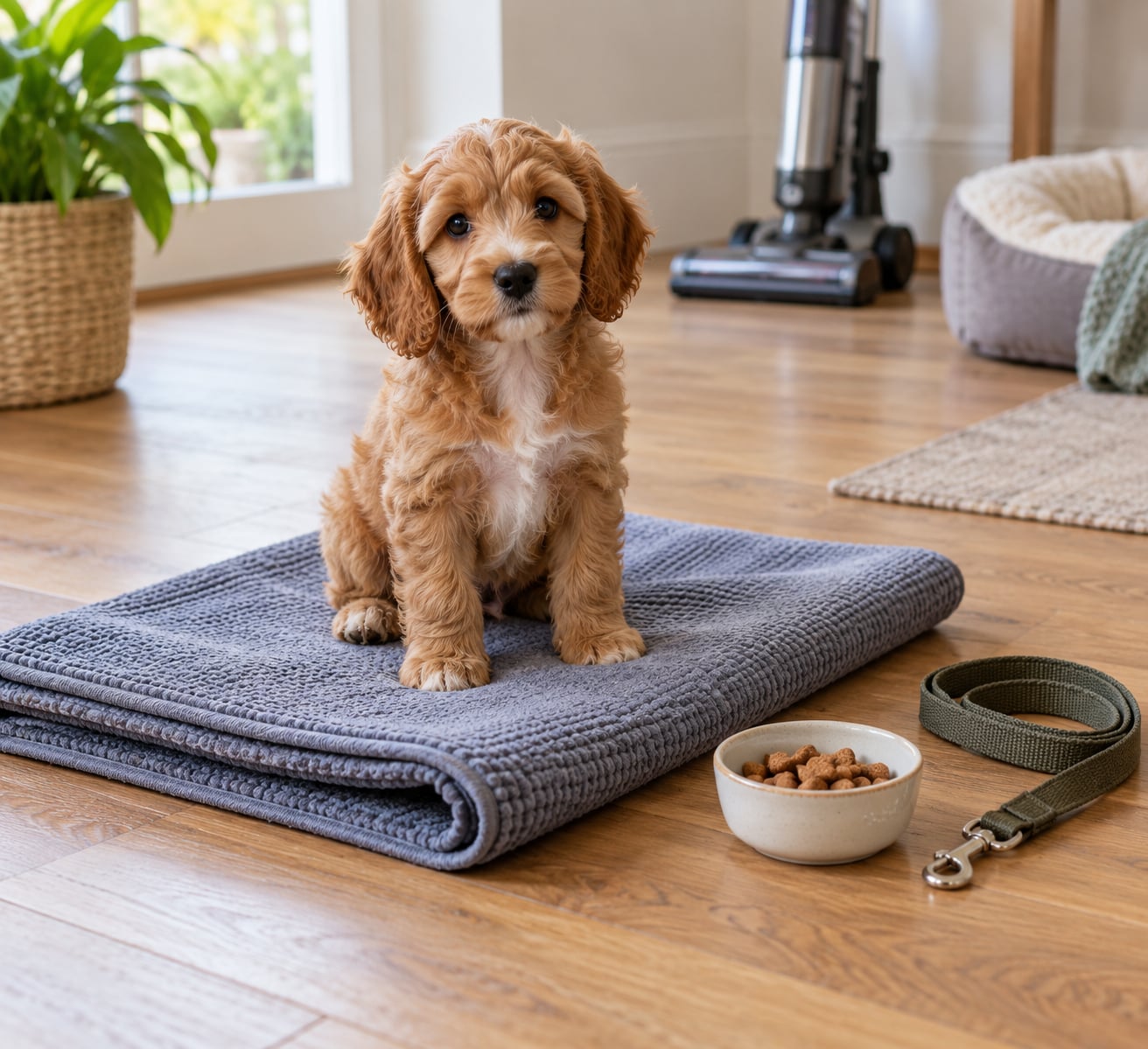
You can absolutely socialize a puppy before vaccinations are done, and you probably should. The trick is swapping dog parks, pet store floors and greetings with unknown dogs for controlled exposure at home, calm visitors, carried outings and distance-based observation. Learn how to socialize a puppy before vaccinations are done by building positive associations in low-risk settings on a timeline your veterinarian confirms. It takes a few short sessions a day, most of them under ten minutes.
The reason to move early is timing. A puppy’s critical socialization period runs roughly from three weeks to fourteen weeks, and most of that window overlaps the months when vaccinations are still incomplete. Wait for the final booster and you are not being careful, you are gambling with a developmental deadline. The AVSAB position on puppy socialization puts the benefit of early positive exposure above the small calculated risk of meeting a healthy, vaccinated dog in a controlled room.
What you are avoiding in the meantime is parvo, distemper and leptospirosis, which is a different kind of problem entirely. Disease risk comes from contaminated soil, shared water, unknown animals and high-traffic surfaces. Confidence comes from exposure. Those two goals only conflict when people pick dog parks as the venue, and dog parks are a poor choice for puppies at any stage.
Table of Contents
- What You Need
- How to Socialize a Puppy Before Vaccinations Are Done: Step-by-Step
- 1. Confirm the puppy’s vaccination schedule
- 2. Build confidence at home first
- 3. Invite healthy, vaccinated visitors
- 4. Practice calm handling and body handling
- 5. Take low-risk outings while carrying or avoiding contact
- 6. Expose the puppy to sounds, sights and movement at a manageable distance
- 7. Record progress and continue after vaccination is complete
- Common Mistakes
- Frequently Asked Questions
- Can a puppy be socialized before the full vaccine series is finished?
- Should I take my puppy to a dog class before vaccinations are complete?
- Is it safe to carry an unvaccinated puppy outside on a walk?
- How do I know when my puppy is ready for public dog parks?
- What should I do if my puppy is scared after a socialization experience?
- Conclusion
What You Need
None of this needs special equipment. What you need is information, a few household items and a written record so you stay consistent between sessions.
- A written vaccination schedule from your veterinarian. Ask for the actual dates, not a vague “around eight weeks”, and mark the date the final puppy dose is expected.
- A secure collar or harness and a lead. A martingale or well-fitted harness gives you control without the puppy learning that leash pressure means pressure on the neck. Keep sessions short enough that the lead stays slack.
- A washable mat or blanket. It gives you a defined spot in a busy place and a clean surface if you set the puppy down.
- A pocketful of small, soft, high-value treats. Something the puppy loves more than the floor. Cut them small so eating stays quick and the session keeps moving.
- A helper. One person handles the puppy and treats, the other moves the stimulus. Trying to do both makes a puppy’s first impression of a scooter a lot worse.
- A simple written log. A notebook or a note on your phone with the date, the stimulus and how the puppy reacted. That log is the single most useful thing you will build in this process.
Two things outside that list matter as much as anything in it: the exact stage of your puppy’s vaccine series, and your own ability to read stress early. Everything below depends on both. The timing is not a fixed calendar. It shifts with the puppy’s age, prior health, local disease pressure and what your clinic recommends, so treat the dates you were given as the source of truth rather than a rule of thumb.
How to Socialize a Puppy Before Vaccinations Are Done: Step-by-Step
The whole method rests on four ideas. Go slow, keep the puppy choosing, pay generously for calm, and stop while things are still going well. Sessions run five to fifteen minutes. A puppy that has a good time and then sleeps is the goal, not a puppy that has seen everything today.
1. Confirm the puppy’s vaccination schedule
Start by asking your veterinarian for the puppy’s exact vaccine timeline and the date the final puppy vaccination is expected. Ask which doses protect against which diseases in your area, and what the clinic considers safe contact in the meantime.
Dates move around more than people expect. A litter vaccinated at six weeks, dewormed and with an unknown background may be on a different schedule than a pet store puppy with a partial record. If the puppy is sick, is overdue on a dose or has been exposed to a suspected case of a preventable disease, that changes the plan and only a veterinarian should adjust it.
Write the schedule somewhere you will see it. Knowing that you have six weeks of controlled work ahead of you is genuinely useful information for planning.
It also explains why two puppies the same age can be on different timelines. Until a puppy is around eight weeks old, maternal-derived antibodies passed through the colostrum can blunt a vaccine response, so the series has to be given more than once to be sure it took. That is the same reason breeders and vets disagree about the right first dose, and it is why “fully vaccinated” is a date your clinic confirms rather than one you calculate yourself.
2. Build confidence at home first
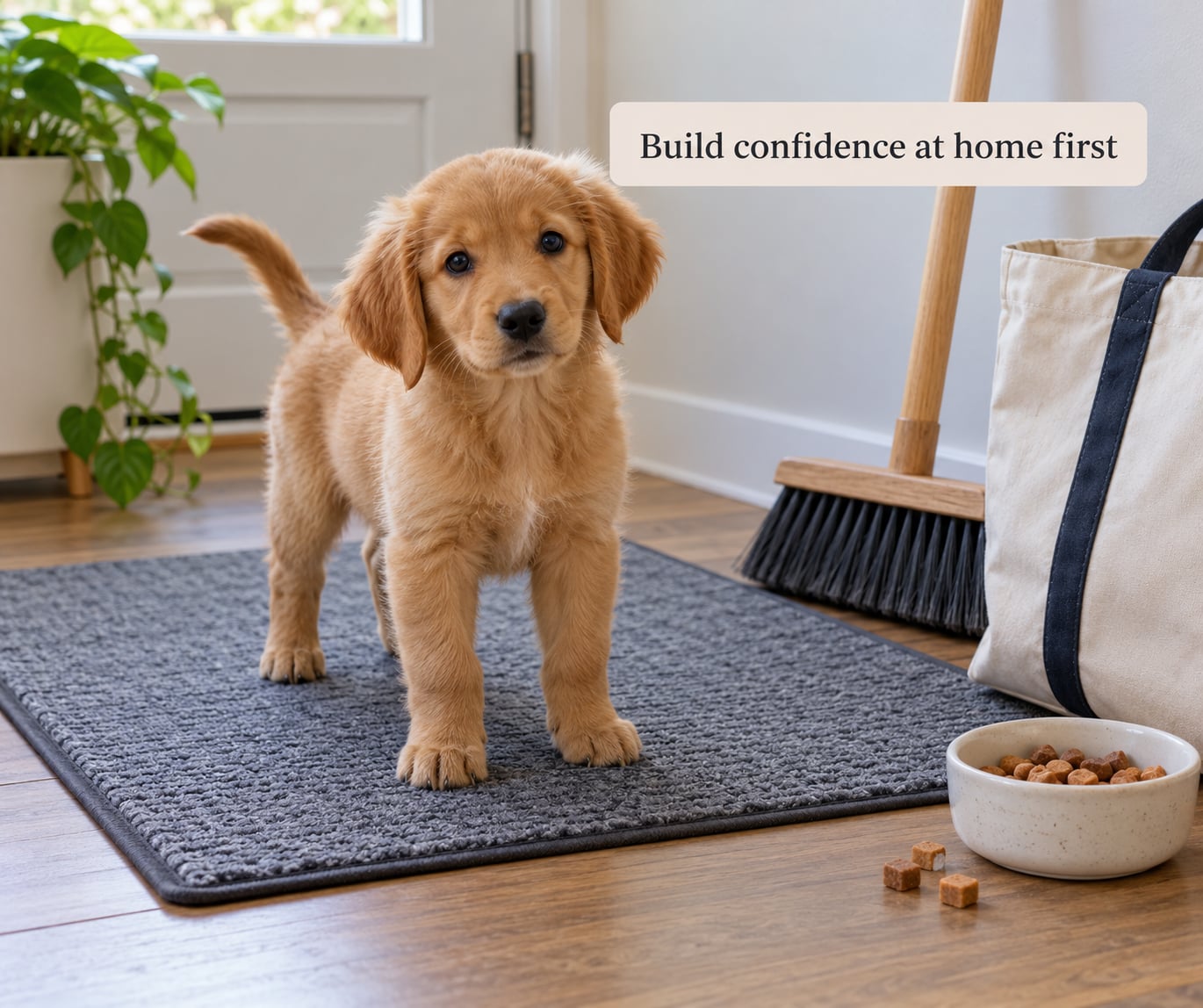
Home is the lowest-risk place to build your puppy’s first good experiences, and it is where you set the pattern of pairing novelty with reward. Start with household sounds on low: a vacuum on its quietest setting while you feed a meal nearby, a broom held still a few feet away, a doorbell recording at low volume, a plastic bag rustling.
Surfaces are easy to skip and easy to regret skipping. A puppy that has never met a metal grate, a rug with a fringe or a slightly uneven floor can hesitate on that same surface at eight months. Walk the puppy over each one, let it stand there for a second, reward the standing.
Objects work the same way. Introduce an umbrella opened slowly, a broom, a hat, a jacket on a hook. Then pair the object with a treat so the puppy starts to predict something good.
Handling belongs here too. Touch one paw for a second, deliver a treat. Repeat with the other paw, the ear, the side, the base of the tail. Keep each touch paired and brief. If the puppy moves away, that is information, not disobedience, so let it go and try again in a moment.
3. Invite healthy, vaccinated visitors
People exposure is the easiest part of early socialization to do well, because you control the room. Invite friends and family who are healthy and current on their own vaccinations, and give them five rules before they arrive: shoes off at the door, hands washed, no face contact, no reaching over the puppy’s head, and let the puppy come to them.
Keep sessions calm and short, five to fifteen minutes with one or two visitors at a time. A group of six adults is not a socialization session, it is a flash mob. Kids are fine when an adult is in charge of them and the puppy gets an exit route back to you.
You can make it more interesting without making it riskier. Ask visitors to arrive in a hat, sunglasses or a uniform, since a person in a knit hat reads as a completely different species to a young puppy. Feed the puppy at the visitor’s feet, not in their arms, so the puppy builds the association itself.
You will know it worked when the puppy chooses to move toward the visitor, settles near them, or goes back for more. If the puppy freezes, scans, yawns, licks its lips or puts its weight backward, end it early and try again next time with more distance.
4. Practice calm handling and body handling
Handling practice is what makes vet visits and grooming manageable later, and it is easiest to install before the puppy is big and heavy. Touch paws, ears, sides and tail in short sequences, one treat per touch, and end while the puppy is still comfortable.
Teach one simple cue in the same sessions, something like a name response or a hand target. It costs a few minutes and gives you something to redirect toward when the puppy is unsure. Reward the response and hand the treat away from whatever concerned it, so the puppy learns that moving away from the stimulus is safe.
Never force or wrestle with the puppy. A puppy held down through a scary moment learns that the scary thing happens anyway, and later that stage shows up as avoidance or defensive behaviour. If the puppy cannot eat while you touch him, pause the handling work.
5. Take low-risk outings while carrying or avoiding contact
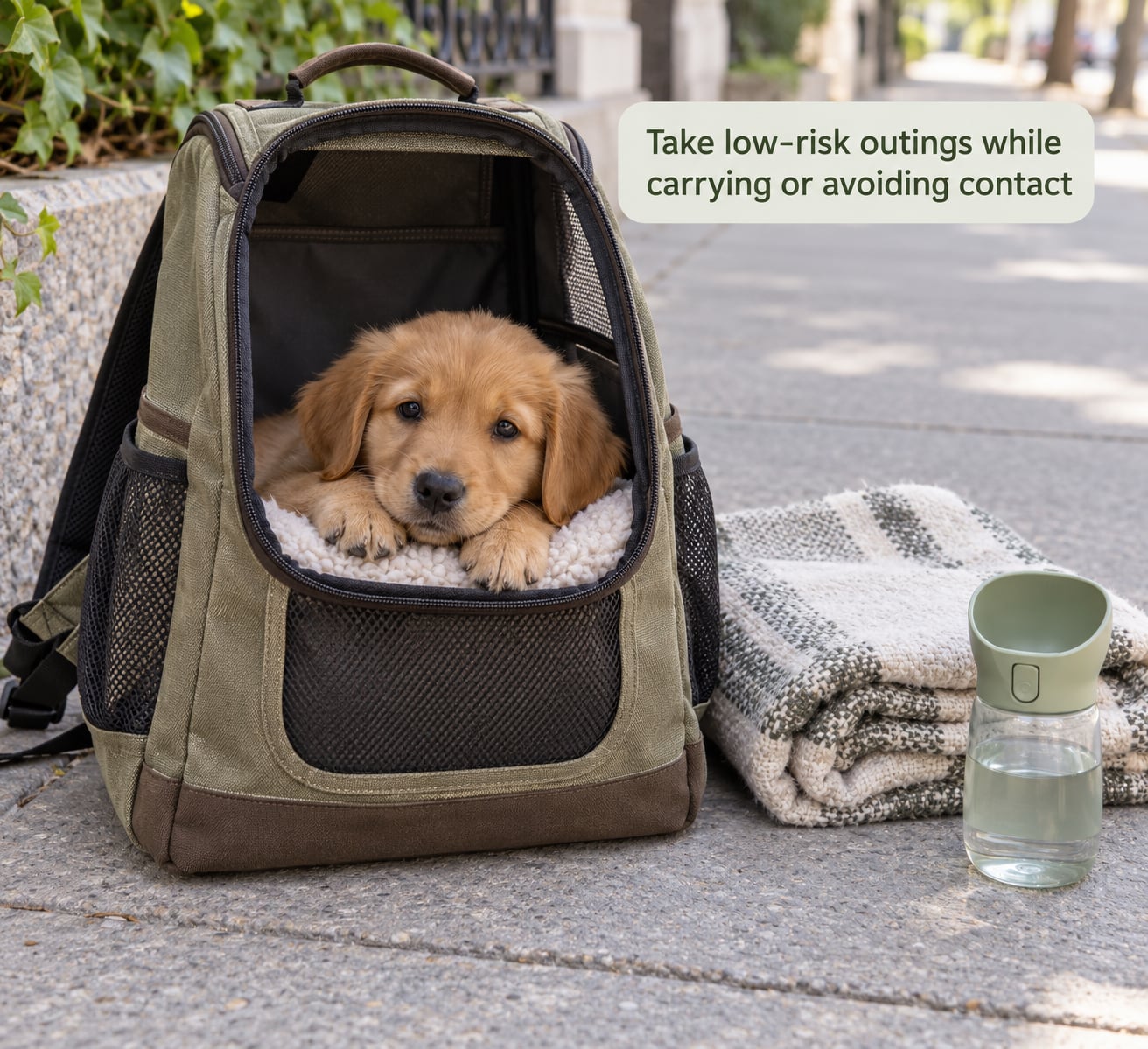
Outdoors is where the biggest mistake happens. People treat a public outing as proof of socialization and put a puppy with incomplete vaccinations straight onto contaminated ground. Carry the puppy instead, and you get the sights and smells without the surface exposure.
A backpack carrier, a front sling, a wagon or a stroller all work. Owners posting on r/puppy101 say the backpack method is the easiest way to get city exposure without touching the pavement, though the same threads flag the obvious problem: a carried puppy still needs a bathroom, and most of them do not think that part through.
So plan for it. Carry a few pee pads or a portable grass patch, schedule the outing around your puppy’s usual toilet times, and pick a spot that is not a shared dog-walking route. Puppy pee on a mat at home first, reward it heavily, and repeat that routine on outings until the association travels.
From the ground, a very short lead walk on a quiet street is reasonable. Skip communal dog runs, shared water bowls, wildlife areas, and anywhere you have seen sick dogs or unknown dogs. A clean blanket on a quiet bench outside a shop gives you ten minutes of new sounds with zero ground contact.
Hardware stores are popular with owners in those same r/puppy101 threads, and the logic holds: wide aisles, a predictable floor, no dense dog traffic, and a short car trip in and out. Set the puppy on a blanket rather than the floor, and leave before they get tired.
6. Expose the puppy to sounds, sights and movement at a manageable distance
Distance is the tool that makes this work. Find the point where the puppy can notice traffic, bicycles, doors, people or other animals without lunging, barking or freezing, and stay at that distance rather than closing the gap.
Sitting in a parked car and watching a busy street from the window is a real session with almost no disease risk, and it is the format several experienced trainers recommend for puppies not yet fully vaccinated. If the puppy reacts badly at that distance, add distance. If the puppy stays calm and still wants treats, you are in the right spot.
Keep a recall cue running through the whole thing. Mark and feed the moment the puppy looks at you rather than the scooter, so the puppy learns that checking in with you is what makes the scooter end. Sessions should stay short. Two minutes of good work beats twenty minutes of escalating barking.
Watch the early signals too. A puppy that goes quiet, turns away, licks its lips, yawns, shows the whites of its eyes or refuses treats is telling you to back off. Forcing a “brave” puppy past that point is the flooding approach, and it reliably trades a small fear today for a large fear later.
7. Record progress and continue after vaccination is complete
Your log is what turns this from guesswork into a plan. Note the date, the stimulus, whether the puppy ate, and a one-word read on the reaction: relaxed, curious, unsure or worried. After a few weeks you will see exactly which categories need more distance and which ones you can move up.
Keep the same safe practices until your veterinarian confirms the series is complete, then widen gradually. That usually means adding the ground you have avoided, then dog-dog contact with known vaccinated dogs, then a busier environment, one change at a time.
Socialization does not end at sixteen weeks either. Most dogs go through a later fear period around eight to eleven months, when the world suddenly seems strange and loud again, and the same method applies: distance, treats, short sessions, no flooding.
Common Mistakes
These are the errors that cost puppies the most, and each one has a straightforward fix.
Taking a puppy to a dog park before vaccines are done. Dog parks combine the highest disease pressure with the least supervision. Fix: observe from a distance, and use a class that verifies vaccination status if you want dog-dog contact.
Letting the puppy greet unknown dogs. A stranger’s dog carries an unknown vaccine history, and a loose dog meeting can turn into a chase or a fight. Fix: consent-based contact, where each dog chooses to approach and can walk away freely.
Allowing pet-store floors. Those floors take dogs with unknown histories. Fix: carry the puppy in a shopping cart with a blanket and keep the visit to a few minutes.
Forcing contact. Holding a puppy for handling or letting a stranger reach over its head teaches the opposite of confidence. Fix: pause, increase distance, and let the puppy move toward it again.
Making sessions too long. Twenty minutes of new stimuli overwhelms a puppy that would have learned more in three. Fix: five to fifteen minutes, ending on a good moment.
Ignoring early stress signals. The freeze or the quiet puppy gets read as “calm” and the session continues. Fix: treat a refusal of food as a stop signal.
Using human medication. Pain relief or sedatives meant for people are not safe for puppies and can mask the signs of a disease you are trying to catch. Never give a puppy anything that was not prescribed for it by a veterinarian.
Treating a completed vaccine series as instant public clearance. Immunity is not the same thing as confidence, and a puppy that has never seen traffic will still react to it. Keep working on distance-based exposure after the shots.
If you fix only three things, fix these: carry the puppy instead of putting it on shared ground, keep sessions short, and read the stress signals early. Everything else is a detail on top of those three.
Frequently Asked Questions
Can a puppy be socialized before the full vaccine series is finished?
Yes. The AVSAB position is that a puppy benefits more from positive early exposure than from being kept indoors until the final booster, provided the exposure is controlled. Keep sessions short, pair novelty with high-value treats, and avoid dog parks, pet store floors, shared water and unknown dogs. Disease risk comes from those specific sources, not from the act of socialization itself. Ask your veterinarian which contact is appropriate for your puppy’s stage of the series.
Should I take my puppy to a dog class before vaccinations are complete?
Ask the class what its vaccination policy is before you register. Good puppy classes require at least one or two age-appropriate doses plus a waiting period, verify records, keep groups small and require vaccination from all dogs attending, which makes them a controlled environment rather than a risk. Classes that accept any dog regardless of vaccine status are a different proposition, so read their policy and compare it with your veterinarian’s advice before enrolling.
Is it safe to carry an unvaccinated puppy outside on a walk?
Carrying is the safest way to get a puppy outside before vaccinations are complete, since you get traffic, wind, voices and movement without ground contact. Use a backpack, sling, wagon or stroller, and remember the puppy still needs a bathroom. Bring pee pads or a portable grass patch and time the outing around the usual toilet routine. Avoid busy dog-walking routes and anywhere with wildlife or unknown dogs.
How do I know when my puppy is ready for public dog parks?
Most veterinary and training guidance treats dog parks as inappropriate for puppies altogether, regardless of vaccine status. Park surfaces are shared and soil holds pathogens for long periods. When a puppy is older, fully vaccinated and reliably socialized, many owners still prefer a class with vaccinated dogs or walks with known, well-matched dogs, which give the social contact with supervision. If you want to try a park, talk to your veterinarian first and watch your puppy’s behaviour closely.
What should I do if my puppy is scared after a socialization experience?
Stop the exposure and give the puppy space, then return to the last distance or stimulus level where it was comfortable. Do several short, easy sessions there, rewarding calm behaviour heavily, before approaching again. Forcing a scared puppy through the experience is flooding, and it usually makes the fear worse. If fear around people, dogs or handling persists or appears suddenly in an older puppy, book a veterinary visit, since sudden behaviour change can have a medical cause.
Conclusion
Start by getting your puppy’s vaccine schedule from your veterinarian and marking the final dose date. Then run short, controlled sessions: sounds and surfaces at home, vaccinated visitors who follow five simple rules, and carried outings where you control the ground contact.
Keep sessions under fifteen minutes, reward generously, and stop while things are still going well. The count of experiences matters less than whether your puppy ends each one relaxed and still willing to engage. Comfort first, veterinary guidance second, and pace third, and the socialization window does what it is supposed to do.